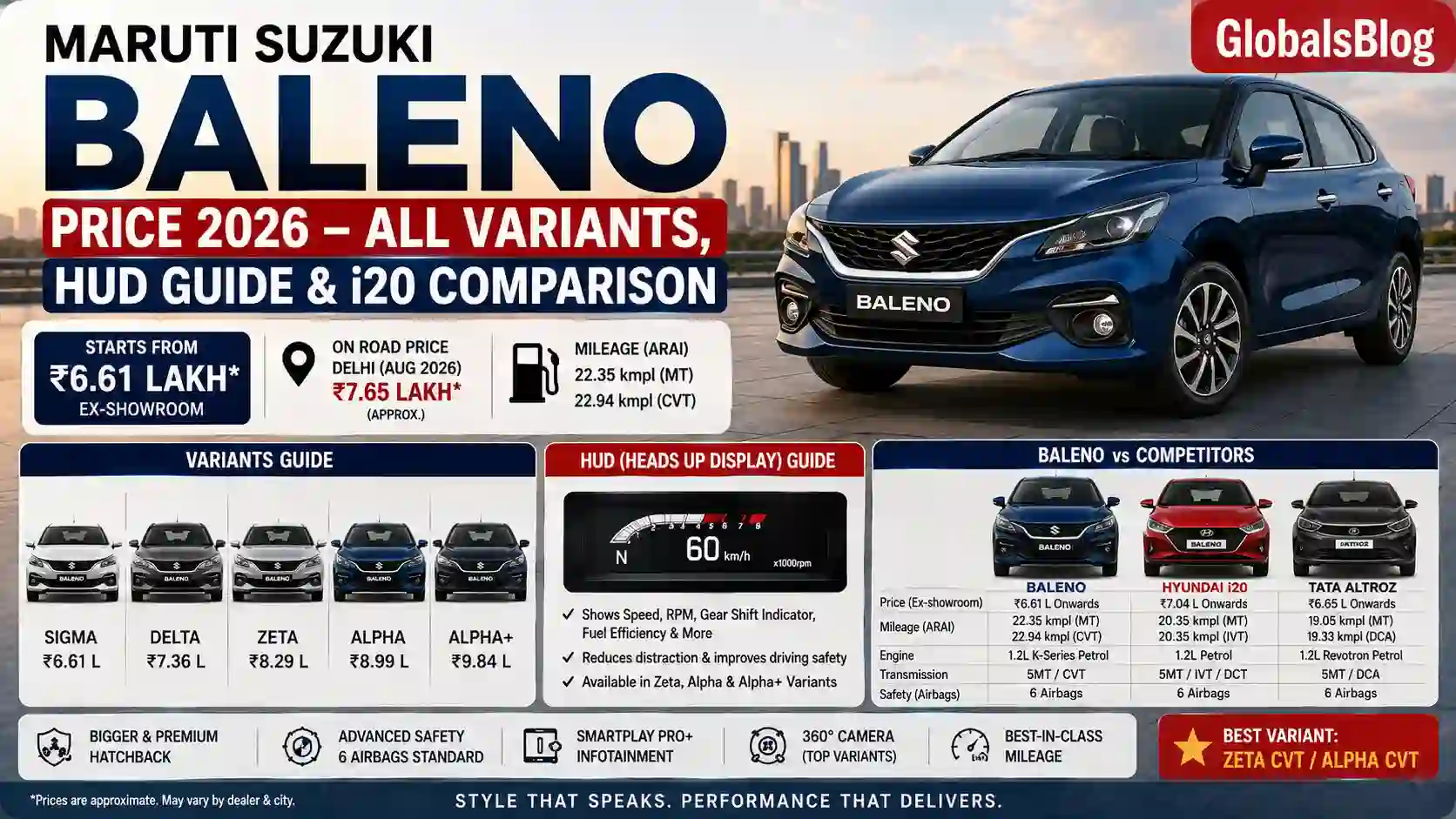
The Maruti Suzuki Baleno is India's bestselling premium hatchback — a car that has consistently outsold the Hyundai i20 and Tata Altroz every month since 2022. The 5th-generation Baleno (launched 2022) is the widest, most feature-loaded Maruti hatchback ever, with a heads-up display at ₹9.44 lakh ex-showroom and Maruti's legendary service network to back it up.
A reader from Jaipur had been comparing the Hyundai i20 and Maruti Baleno for two months before deciding. The i20 Sportz CVT was ₹11.60L ex-showroom. The Baleno Alpha CVT was ₹10.30L ex-showroom — with a sunroof, Heads-Up Display (HUD), 360° camera, and wireless CarPlay at ₹1.30L less. And the nearest Maruti Suzuki service centre from her house was 1.8 km away versus Hyundai's 12.4 km. She bought the Baleno Alpha CVT. The pattern is familiar in the premium hatchback segment — the Baleno consistently wins on feature-per-rupee and service network density, while the i20 wins on driving dynamics and European styling. The fifth-generation Baleno is Maruti's most comprehensive effort to close the feature gap that allowed the i20 and Altroz to compete — at a price that remains lower than both rivals. This guide covers all August 2026 prices, all variants, and the honest comparison that every Baleno buyer needs.
Maruti Baleno price (August 2026): Ex-showroom ₹6.61 lakh (Sigma base MT) to ₹10.30 lakh (Alpha CVT top). On road Delhi approximately ₹7.57L–₹11.82L. Engine: 1.2L DualJet K12N with SHVS mild hybrid (90 bhp, 113 Nm). Gearbox: 5-speed MT or CVT automatic. ARAI mileage: 22.35 kmpl (MT), 22.94 kmpl (CVT). Key features on top variants: HUD (heads-up display), 360° camera, sunroof, wireless CarPlay/Android Auto. Rivals: Hyundai i20 (₹7.04L ex), Tata Altroz (₹6.62L ex), Honda Jazz, Toyota Glanza (twin car). Best pick: Delta CVT (₹8.99L ex, value automatic) or Alpha CVT (₹10.30L ex, full-spec top).
Maruti Baleno Price — All Variants (August 2026)
| Variant | Transmission | Ex-showroom | On Road Delhi (approx) | Key Features |
|---|---|---|---|---|
| Sigma MT | 5-speed MT | ₹6.61L | ~₹7.57L | Base — dual airbags, ABS, 9-inch touchscreen, wireless CarPlay |
| Delta MT | 5-speed MT | ₹7.56L | ~₹8.67L | Auto headlamps, auto wipers, rear camera, 6 airbags, enhanced audio |
| Delta CVT | CVT automatic | ₹8.99L | ~₹10.31L | All Delta MT + CVT automatic — best value automatic Baleno |
| Zeta MT | 5-speed MT | ₹8.99L | ~₹10.31L | HUD (heads-up display), electric sunroof, 360° camera, auto AC |
| Zeta CVT | CVT automatic | ₹9.44L | ~₹10.84L | All Zeta MT + CVT — sunroof + HUD + automatic |
| Alpha MT | 5-speed MT | ₹9.49L | ~₹10.90L | LED projector headlamps, alloy wheels, head unit upgrade |
| Alpha CVT | CVT automatic | ₹10.30L | ~₹11.82L | Top spec — all Alpha features + CVT. Leather seats, premium audio, full features |
All prices ex-showroom India, August 2026. The Baleno's 5th-generation lineup spans ₹6.61L (base Sigma MT) to ₹10.30L (Alpha CVT top) — a range of ₹3.69L that covers the full spectrum from essential-only to fully equipped. The Baleno is also sold as the Toyota Glanza (badge-engineered twin at Toyota dealers — same car, Toyota badge, approximately ₹10,000–15,000 premium over Baleno at equivalent trim). On road Delhi adds approximately 14–15% above ex-showroom for registration, insurance, and handling charges.
Baleno Engine and Mileage
The 5th-generation Baleno uses Maruti's 1.2L DualJet engine (K12N) with dual fuel injectors per cylinder for better atomisation and SHVS (Smart Hybrid Vehicle by Suzuki) mild hybrid system that recovers braking energy and provides torque assist. The combination produces an unusually high ARAI mileage figure for a premium hatchback: 22.35 kmpl for the MT and 22.94 kmpl for the CVT — the CVT actually returns slightly better ARAI mileage than the MT, which is unusual and reflects the CVT's efficiency optimization. Real-world city mileage at 14–17 kmpl (MT) and 15–17 kmpl (CVT) is competitive — the mild hybrid's ISG (Integrated Starter-Generator) provides meaningful start-stop and acceleration-assist benefit in stop-start city traffic. The 90 bhp output is adequate for a 1,000kg hatchback in city use but noticeably lacks urgency on highway overtaking above 90 km/h — this is the Baleno's most consistently noted limitation, shared with all 1.2L naturally aspirated hatchbacks at this price. The engine is, however, exceptionally smooth and refined at city speeds where the DualJet technology and mild hybrid system work together to produce a quiet, responsive driving experience that competes favourably with the i20's 1.2L naturally aspirated unit.
Maruti Baleno vs Hyundai i20 vs Tata Altroz
| Model | Starting Price | Best Mileage | HUD | Service Network | Best For |
|---|---|---|---|---|---|
| Maruti Baleno | ₹6.61L ex | 22.94 kmpl CVT | ✅ Zeta+ variants | 4,000+ Maruti centres | Mileage, service network, value, HUD at low price |
| Hyundai i20 | ₹7.04L ex | 19.65 kmpl MT | ❌ | 1,400+ Hyundai centres | Driving dynamics, turbocharged 1.0L option, build quality feel |
| Tata Altroz | ₹6.62L ex | 19.06 kmpl MT | ❌ | 1,800+ Tata centres | 5-star NCAP safety, premium interior feel, turbo option |
| Toyota Glanza | ₹6.72L ex | 22.35 kmpl MT | ✅ (same as Baleno) | Toyota service + Maruti service | Toyota badge, Toyota dealer experience — same car as Baleno |
Baleno vs i20 — the core decision: These two cars represent two different philosophies for a premium hatchback. The Baleno is feature-forward, mileage-optimised, and service-network-backed — it gets a HUD and sunroof at prices where the i20 doesn't, its CVT returns 22.94 kmpl vs the i20 CVT's 19.65 kmpl, and Maruti's service network is nearly 3x denser than Hyundai's. The i20 is dynamics-forward — the 1.0L turbo GDI engine (120 PS, 172 Nm, DCT) is significantly more engaging to drive than the Baleno's 1.2L NA, the i20's ride quality is better calibrated for highway use, and the i20's interior build quality has a slightly more premium feel in tactile surfaces. For buyers in large cities who prioritise service network and fuel economy: Baleno. For buyers who value driving engagement and don't mind paying for the turbo: i20 1.0L DCT. For Tier-2/3 city buyers where Maruti's 4,000+ network matters most: Baleno emphatically.
Which Baleno Variant to Buy?
The Delta CVT at ₹8.99L ex is the Baleno's most price-efficient automatic variant — it brings the CVT gearbox with 22.94 kmpl ARAI mileage, 6 airbags, auto headlamps, auto wipers, rear parking camera, and wireless CarPlay/Android Auto, without paying for the sunroof and HUD that the Zeta adds. At ₹10.31L on road Delhi, the Delta CVT is ₹53,000 cheaper than the Zeta CVT (₹10.84L on road) — the ₹53,000 difference buys: sunroof (Zeta adds) and HUD (Zeta adds). For buyers who don't specifically want a sunroof: the Delta CVT at ₹10.31L on road is the most efficient spending in the Baleno automatic lineup. For buyers who consider sunroof non-negotiable: the Zeta CVT is the recommended variant, not the Alpha (which adds features the average buyer won't use daily).
The Zeta CVT at ₹9.44L ex is the Baleno's value sweet-spot — it adds the Heads-Up Display (HUD — projects speed, turn-by-turn navigation, and ADAS information onto the windscreen), electric sunroof, 360° surround view camera, automatic climate control, and rear AC vents to the Delta's features, all within the CVT automatic powertrain. At ₹10.84L on road Delhi, the Zeta CVT competes directly with the Hyundai i20 Sportz CVT (~₹11.40L on road) — and beats it on mileage (22.94 vs 19.65 kmpl), features (HUD, 360° camera, sunroof — all absent in i20 Sportz), and service network. The HUD at ₹10.84L on road is genuinely unusual — a driver information display projected onto the windscreen is a feature found on much more expensive cars. On the Baleno Zeta, it shows speed, navigation arrows from Google Maps/Apple Maps (when connected), and fuel economy data. For most Baleno buyers, the Zeta CVT is the recommended configuration — the HUD and sunroof significantly enhance the daily driving experience, and the Zeta hits below ₹11L on road Delhi.
The Alpha CVT at ₹10.30L ex is Baleno's range-topping variant — adding LED projector headlamps, 16-inch dual-tone alloy wheels, premium leatherette upholstery, and a head unit upgrade to the Zeta's full feature set. At ₹11.82L on road Delhi, the Alpha CVT is the most feature-complete premium hatchback under ₹12L on road in India. The Alpha's LED projector headlamps are a meaningful upgrade — projector beams produce a wider, better-cut light pattern than the reflector units on lower variants, making night driving noticeably better. The 16-inch alloys visually complete the car's appearance. For buyers who want the Baleno in its best form and plan to own it for 5+ years: the Alpha CVT at ₹11.82L on road Delhi is the definitive recommendation.
✓ Maruti Baleno Buying Tips
- The CVT actually returns better ARAI mileage than the MT — unique in the segment: The Baleno CVT (22.94 kmpl ARAI) outperforms the MT (22.35 kmpl ARAI) — an unusual reversal from most cars where the manual is more efficient. This is because the CVT is calibrated with Maruti's SHVS mild hybrid system for optimum efficiency across all rpm ranges, whereas the MT's efficiency depends on the driver's gear selection. In city stop-go traffic where the CVT stays at optimal rpm, the mileage advantage is most apparent. This removes the typical "buy MT for mileage" justification — choose between MT and CVT on convenience grounds rather than fuel efficiency grounds
- The HUD on Zeta is not a gimmick — it is the most useful daily driving feature at this price: The Baleno's Heads-Up Display projects vehicle speed and turn-by-turn navigation directions onto the windscreen — meaning the driver never has to take their eyes from the road to check speed or the phone navigation. At ₹9.44L ex (Zeta CVT), this feature is available at a price where no rival hatchback offers it. After a week of driving with the HUD, most Baleno owners report that it changes their driving experience more meaningfully than any other feature on the car
- Toyota Glanza is the same car — choose between them based on your city's dealer proximity: The Toyota Glanza and Maruti Baleno are identical vehicles built at the same Maruti factory with different badges and minor cosmetic differences. Toyota prices the Glanza approximately ₹10,000–15,000 higher than the equivalent Baleno at each trim level. The only reason to choose Glanza over Baleno: if Toyota's dealer in your city is significantly more convenient than Maruti's — which is almost never the case given Maruti's 4x denser network
- Maruti's 4,000+ service network is the strongest ownership argument: In any city or town in India, a Maruti service centre is within reasonable distance. This is the Baleno's most durable competitive advantage — beyond any feature or spec comparison, the density of Maruti's authorised service network means lower total cost of ownership (competitive service rates), shorter waiting times for service appointments, and accessible service even in smaller cities. For buyers in Tier-2 and Tier-3 cities who are comparing Baleno vs i20 vs Altroz: the service network consideration alone often settles the decision in favour of Baleno
- See our Maruti Swift price guide for the sportier Maruti hatchback alternative, and our Hyundai i20 price guide for the turbocharged performance rival
✗ Maruti Baleno Buying Mistakes to Avoid
- Buying the Sigma base expecting a complete car: The Sigma MT at ₹6.61L ex has only 2 airbags (vs 6 on Delta and above), no rear parking camera, no auto headlamps, and a basic audio system without wireless CarPlay. For an everyday car purchased in 2026, only 2 airbags is an inadequate safety specification. The Delta MT at ₹7.56L ex adds 6 airbags, rear camera, auto headlamps, and wireless CarPlay for ₹95,000 more — the minimum safety and feature level that makes the Baleno worthwhile as a 2026 purchase. Sigma only makes sense as a fleet purchase or if the ₹6.61L price point is a hard limit
- Choosing the i20 1.0T turbo DCT purely for the driving experience without comparing total cost: The Hyundai i20 1.0T turbo DCT (₹11.19L ex) is the most engaging premium hatchback to drive in this segment — 120 PS, 172 Nm, 7-speed DCT, 0–100 in approximately 10.3 seconds. It is significantly more fun to drive than the Baleno 1.2L NA CVT. The comparison that many buyers miss: the i20 1.0T DCT real-world mileage of approximately 14–16 kmpl (city, AC) vs Baleno CVT's 15–17 kmpl — essentially the same. But the i20 1.0T DCT at ₹11.19L ex is ₹89,000 more than Baleno Zeta CVT (₹9.44L ex) without offering a HUD, sunroof, or 360° camera. For buyers who value driving engagement and can accept the price premium without the Baleno's feature set: the i20 1.0T DCT is the correct choice. For buyers who want maximum features for budget: Baleno Zeta CVT is the answer
- Skipping the Zeta for Alpha without checking what you're actually getting: The Alpha adds ₹86,000 ex-showroom (₹10.30L vs ₹9.44L) over the Zeta CVT for LED projector headlamps, alloy wheels, and leatherette seats. These are real improvements but not transformative ones — the HUD and sunroof that define the Baleno's premium experience are already on the Zeta. For buyers who primarily drive in daylight and park in secure locations: the Zeta CVT at ₹10.84L on road delivers the Baleno's headline features at ₹98,000 less on road than the Alpha CVT. Alpha makes sense for buyers who drive significantly in the dark (LED headlamps are a meaningful safety upgrade), want the alloy wheel aesthetics, and plan 5+ years of ownership where leatherette upholstery's durability matters
- Comparing Baleno and Swift as interchangeable Maruti hatchbacks: The Baleno and Swift occupy different positions in Maruti's lineup despite similar prices. The Swift is a sporty, dynamic hatchback with a more direct steering feel, stiffer suspension, and a driving-engagement focus. The Baleno is wider, more spacious (longer wheelbase), feature-loaded (HUD, 360° camera, sunroof), and mileage-optimised. Buyers who want daily practicality, mileage, and features: Baleno. Buyers who want driving fun and don't need features: Swift. Testing both is the only way to understand which car's character matches your preferences
⚠️ Disclaimer: Maruti Suzuki Baleno prices, variant availability, and features are subject to change without notice. All prices listed are ex-showroom India as of August 2026. On road prices are indicative and vary by state — Karnataka (Bengaluru) buyers typically pay ₹80,000–1.10L more than Delhi for equivalent variants. Verify current pricing and availability at your nearest Maruti Suzuki Arena dealer or at marutisuzuki.com.
Sigma for Entry Only. Delta CVT for Value Auto. Zeta CVT for the HUD and Sunroof. Alpha CVT for LED Headlamps and Leather. Maruti's Service Network Closes Every Remaining Argument. The Baleno Outsells Because It Earns It.
The Jaipur reader's Baleno Alpha CVT purchase — ₹1.30L less than the i20 Sportz CVT with more features and a service centre 1.8 km away — captures why the Baleno has outsold every premium hatchback in India consistently since 2022. Hyundai makes a more engaging car to drive. Tata makes a safer-rated car on paper. Honda makes a smoother automatic. But none of them matches the Baleno on features-per-rupee at every price point, none matches its mileage on the CVT, and none has 4,000+ service centres across India. The HUD at ₹9.44L ex-showroom is not matched by any hatchback in the world at this price. The 22.94 kmpl CVT mileage is not matched in the premium hatchback segment. The Maruti service network is not matched by any competing brand. For most Indian premium hatchback buyers who are not performance enthusiasts, the Baleno Zeta CVT or Alpha CVT makes the most comprehensive case in its segment.
Maruti Suzuki Baleno price in India (August 2026): Ex-showroom ₹6.61 lakh (Sigma MT base) to ₹10.30 lakh (Alpha CVT top). Complete variant list — Sigma MT: ₹6.61L. Delta MT: ₹7.56L. Delta CVT: ₹8.99L. Zeta MT: ₹8.99L. Zeta CVT: ₹9.44L. Alpha MT: ₹9.49L. Alpha CVT: ₹10.30L. On road Delhi approximately ₹7.57L (base) to ₹11.82L (top). Engine: 1.2L DualJet K12N with SHVS mild hybrid, 90 bhp, 113 Nm. ARAI mileage: 22.35 kmpl (MT), 22.94 kmpl (CVT — best-in-class premium hatchback automatic mileage). HUD (Heads-Up Display) available from Zeta variants. Electric sunroof from Zeta. 360° camera from Zeta. LED projector headlamps on Alpha. 6 airbags from Delta. Rivals: Hyundai i20 (₹7.04L ex), Tata Altroz (₹6.62L ex), Toyota Glanza (same car, Toyota badge). Sold at Maruti Suzuki Arena dealers. Verify current pricing at marutisuzuki.com.
Best Maruti Baleno variant to buy (August 2026): Best value automatic: Delta CVT (₹8.99L ex, ~₹10.31L on road Delhi) — CVT automatic, 22.94 kmpl, 6 airbags, auto headlamps, wireless CarPlay. Best for automatic buyers without sunroof requirement. Best features: Zeta CVT (₹9.44L ex, ~₹10.84L on road Delhi) — adds HUD, electric sunroof, 360° surround camera, auto AC, rear AC vents to Delta CVT's features. The recommended configuration for most Baleno buyers — HUD at this price is available nowhere else in the hatchback segment. Best complete: Alpha CVT (₹10.30L ex, ~₹11.82L on road Delhi) — adds LED projector headlamps, 16-inch alloys, leatherette upholstery. Best for 5+ year ownership and night driving. Minimum recommended: Delta MT (₹7.56L ex) for 6 airbags + wireless CarPlay. Avoid: Sigma MT (only 2 airbags — inadequate safety specification for 2026). For most buyers: Zeta CVT is the sweet spot between features and price.
Maruti Baleno vs Hyundai i20 comparison (2026): Mileage: Baleno CVT 22.94 kmpl ARAI vs i20 CVT 19.65 kmpl — Baleno significantly better. HUD: Baleno Zeta+ has HUD; i20 has no HUD at any price. Sunroof: Baleno Zeta+ has sunroof; i20 has sunroof from Sportz. 360° camera: Baleno Zeta+; i20 Asta only. Features per rupee: Baleno wins significantly at every equivalent price point. Service network: Maruti 4,000+ vs Hyundai 1,400+ — Baleno massive advantage. Starting price: Baleno ₹6.61L vs i20 ₹7.04L — Baleno cheaper. Turbo engine: i20 1.0T GDI (120 PS, 172 Nm, DCT) available — Baleno has no turbo option. Driving dynamics: i20 wins — better suspension calibration, steering feel, turbo response. Build quality feel: i20 marginally more premium in tactile materials. Residual value: roughly comparable in most markets. Verdict: Baleno for features, mileage, service network, and value. i20 for driving engagement, turbo performance, and buyers who prioritise driving feel over feature lists. Baleno outsells i20 because most Indian hatchback buyers are daily commuters, not driving enthusiasts.
Maruti Baleno mileage: 5-speed MT: 22.35 kmpl ARAI. Real-world city with AC: 14–17 kmpl. Real-world highway at 80–100 km/h: 18–22 kmpl. CVT automatic: 22.94 kmpl ARAI — slightly better than MT due to SHVS mild hybrid optimization with CVT. Real-world city with AC: 15–17 kmpl (marginally better than MT in city stop-go). The 22.94 kmpl CVT ARAI is the best mileage figure for any premium hatchback automatic in India — the Hyundai i20 CVT delivers 19.65 kmpl ARAI, the Tata Altroz DCT delivers 18.29 kmpl. The SHVS mild hybrid system (Integrated Starter-Generator providing torque assist and regenerative braking) is responsible for the elevated mileage. Fuel tank: 37 litres. Estimated full-tank range at real-world 15 kmpl city: approximately 555 km. Running cost at ₹103/L petrol and 15 kmpl real-world: approximately ₹6.87/km.
Maruti Baleno on road price in Delhi (August 2026): Sigma MT approximately ₹7.57 lakh. Delta MT approximately ₹8.67 lakh. Delta CVT approximately ₹10.31 lakh. Zeta MT approximately ₹10.31 lakh. Zeta CVT approximately ₹10.84 lakh. Alpha MT approximately ₹10.90 lakh. Alpha CVT approximately ₹11.82 lakh. On road Delhi includes ex-showroom + RTO registration (approximately 4% for petrol vehicles + RTO processing fees) + first-year comprehensive insurance (₹30,000–55,000 depending on IDV) + handling charges. Karnataka (Bengaluru) buyers pay approximately ₹80,000–1.10L more than Delhi for equivalent variants due to Karnataka's higher road tax rate. Maharashtra on road is approximately ₹40,000–70,000 more than Delhi. Always get an itemised on road quote from the dealer before finalising. Prices indicative as of August 2026 — verify at marutisuzuki.com or nearest Arena outlet.
Yes — the Toyota Glanza and Maruti Suzuki Baleno are essentially the same vehicle. Both are manufactured at Maruti Suzuki's Manesar plant. Same engine (1.2L DualJet K12N with SHVS mild hybrid), same specifications (90 bhp, 113 Nm, 22.35/22.94 kmpl), same dimensions, same features at each trim level, same factory. Differences between Glanza and Baleno: Toyota badge (Glanza) vs Maruti badge (Baleno). Toyota dealer sales and service experience vs Maruti Arena experience. Price: Glanza is approximately ₹10,000–15,000 higher than equivalent Baleno trim (Toyota badges its products at a small premium). Minor cosmetic differences: grille, badge placement, some interior trim differences. Warranty: both come with standard 3-year/100,000 km manufacturer warranty. Service: Glanza can be serviced at both Toyota and Maruti Suzuki authorised centres (Toyota-Maruti partnership). Recommendation: Buy Baleno unless a Toyota dealer is specifically more convenient in your city — the products are mechanically identical and Baleno is cheaper by ₹10,000–15,000 per variant with Maruti's denser service network.
Leave a comment
Share a quick thought about this story.
Thanks for sharing your view. It is ready for review.
Please try again in a moment.