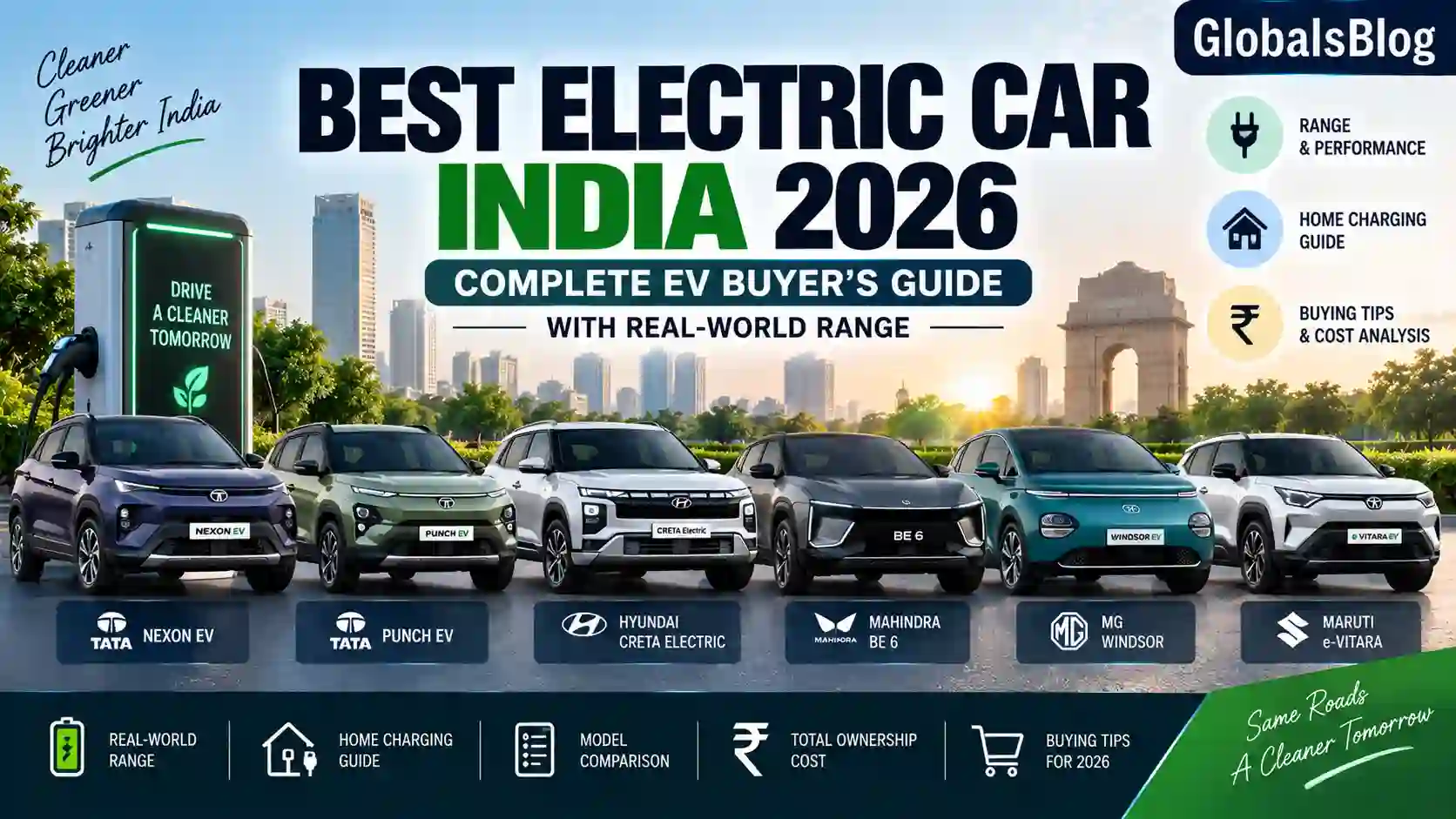
The Indian EV market crossed a threshold in 2026 — lifetime battery warranties are now standard from Tata, MG, and Mahindra; real-world range has crossed 400km on affordable EVs; and home charging running costs of ₹1–1.50 per km make the economics genuinely compelling versus ₹5.50–8.50 per km for petrol. This guide covers every segment from ₹7L to ₹50L with honest real-world range numbers, not ARAI claims.
An analytics lead from Bengaluru switched from a Hyundai Creta (petrol) to a Tata Nexon EV in early 2025. Eighteen months later, the calculation she ran: monthly fuel cost in the Creta — ₹6,500–7,000 at 1,200 km/month. Monthly home charging cost in the Nexon EV — ₹900–1,100. Annual saving: approximately ₹68,000. The Nexon EV's EMI was ₹4,200 more per month than the equivalent Creta. Net advantage of the EV: ₹68,000 saved in fuel minus ₹50,400 in extra EMI = approximately ₹17,600 net savings in year one — and the gap widens as fuel prices rise and the EMI doesn't. The calculation works for buyers who charge at home or at workplace chargers and drive a predictable urban distance. It does not work for buyers who drive unpredictably long distances without access to home charging. This guide tells you which EV is right for your specific use pattern — before the EMI conversation starts.
Best budget EV: Tata Punch EV (₹9.79L ex) — most popular sub-₹10L EV, 421km ARAI, lifetime battery warranty. Best city EV ₹12–15L: Tata Nexon EV (₹12.49L ex) — best all-rounder, widest service network, 489km. Best rear comfort: MG Windsor EV (₹12.04L BaaS / ₹14.99L+ owned). Best new 2026 launch: Maruti e-Vitara (₹16.19L, 543km, 6,000+ Maruti dealers). Best refinement: Hyundai Creta Electric (₹17.99L+, ADAS, V2L). Best long range: Mahindra BE 6 (₹19.45L, 683km ARAI, 175kW fast charge). No home charger available? Consider Honda City e:HEV strong hybrid instead.
The EV Buying Framework — Answer These First
| Your Situation | EV Decision | Best Pick |
|---|---|---|
| Home charger possible, drive under 60km/day | ✅ Go EV — economics strongly positive | Nexon EV or Punch EV |
| Workplace charger available, urban use | ✅ Go EV — excellent running cost advantage | Windsor EV or Nexon EV |
| Apartment, no home or workplace charger | ⚠️ Evaluate carefully — public charging adds cost | Consider Honda City e:HEV |
| Regular long highway trips 300km+ | ⚠️ Range anxiety real — fast charging still building | BE 6 (683km) or Creta Electric |
| Budget under ₹10L, city only | ✅ Best use case for small EVs | Punch EV or Tiago EV |
| Uncertain usage, resale concern | ⚠️ Petrol or strong hybrid safer in 2026 | Honda City e:HEV |
Best Electric Cars India 2026 — Ranked by Segment
The Tata Punch EV is India's most popular sub-₹10L electric car — a compact SUV body on a dedicated EV platform with 25kWh and 35kWh battery options and the full Tata EV ecosystem (Tata.ev app, home charger installation support, Tata Power charging, lifetime battery warranty on select variants). The 35kWh variant (approximately ₹12L, technically above ₹10L but the right recommendation) delivers real-world 270–310km — sufficient for city use with a home charger. The base 25kWh's real-world 170–210km is limiting in hilly or AC-heavy conditions. The Punch EV's 190mm ground clearance and SUV proportions make it more practical for Indian road conditions than the flat-profile Tiago EV. Lifetime battery warranty on Creative and Smart variants (2026 update) removes the main resale risk.
The Tata Nexon EV is India's best-selling electric car — refined across multiple generations since 2020, with the most thoroughly tested real-world ownership profile of any EV in India. The 40.5kWh battery delivers 489km ARAI and approximately 350–400km real-world under normal Indian conditions with AC. Tata's EV service network has the most EV-specific technician experience of any Indian brand. The Nexon EV is the default recommendation for first-time Indian EV buyers with home charging and a predictable urban commute — the Bengaluru analytics lead's car and calculation. See our Nexon complete price guide for all variant details.
The MG Windsor EV differentiates on two genuine axes: best rear seat experience in this segment (reclining rear, widest cabin) and the Battery-as-a-Service (BaaS) model (₹12.04L upfront, ₹3.50/km battery usage fee). BaaS works for under 15,000 km/year drivers; above 20,000 km/year, conventional ownership (₹14.99L+, lifetime battery warranty) is always cheaper. The 38kWh battery delivers real-world 320–360km. MG's ~450 dealer points is the service network risk — verify strong MG presence in your city before purchasing.
The Maruti e-Vitara is 2026's most significant mass-market EV launch — not for specifications but because it brings Maruti's 6,000+ dealer network to an EV for the first time. The 61kWh variant's 543km ARAI (real ~440–480km) genuinely addresses long-distance range anxiety. Also available as the Toyota e-Vitara (identical car, Toyota network — compare dealer quality in your city). For Maruti-loyal buyers and Tier 2/3 city buyers where Maruti's service density is unmatched, the e-Vitara removes the last major barrier to EV adoption.
The Hyundai Creta Electric minimises ownership anxiety most effectively — most refined driving experience in this band, most comprehensive ADAS (Level 2 on top variants), and Vehicle-to-Load (V2L) functionality that powers external devices up to 3.6kW from the car battery (generator-equivalent during power cuts — uniquely useful in India). The 51.4kWh battery delivers 473km ARAI (real 380–420km). Hyundai's 8-year/160,000km battery warranty has not yet moved to lifetime (the Creta Electric's one specification gap vs Tata and MG). For buyers wanting the smoothest, most confident first EV experience and willing to stretch to ₹17–22L on road, the Creta Electric is the premium safe choice.
The Mahindra BE 6 is India's most technologically advanced mass-market EV in 2026 — built on the INGLO platform (dedicated EV skateboard developed with Volkswagen Group), delivering 683km ARAI from the 79kWh battery (real ~520–560km) and 175kW DC fast charging (0–80% in under 30 minutes). The 175kW fast charge is the BE 6's decisive differentiator: a 20-minute charge stop adds ~200km real-world range, making long highway trips genuinely practical. Lifetime battery warranty (first owner). At ₹19.45L ex for the Pack One 59kWh, the BE 6 is the most compelling case for spending slightly more for a purpose-built EV platform vs ICE conversion — particularly for buyers who plan 5+ year ownership and want the most future-ready architecture available under ₹25L.
EV Comparison Table — September 2026
| Model | Ex-Price | Real Range | Fast Charge | Battery Warranty | Best For |
|---|---|---|---|---|---|
| Tata Punch EV | ₹9.79L | 270–310km (35kWh) | 50kW | Lifetime (select) | Budget, city, first EV |
| Tata Nexon EV | ₹12.49L | 350–400km | 50kW | 8yr/Lifetime | All-round, safest choice |
| MG Windsor EV | ₹12.04L (BaaS) | 320–360km | 50kW | Lifetime (owned) | Rear comfort, BaaS |
| Maruti e-Vitara | ₹16.19L | 440–480km (61kWh) | 50kW | TBD | Service network, Maruti loyalists |
| Hyundai Creta Electric | ₹17.99L | 380–420km | 50kW | 8yr/160k km | Refinement, ADAS, V2L |
| Mahindra BE 6 | ₹19.45L | 520–560km (79kWh) | 175kW | Lifetime | Long range, highway, future-ready |
Home Charging — The Most Important EV Decision
The Bengaluru analytics lead's ₹17,600 net annual saving in year one only works because she charges at home at approximately ₹8–9/kWh (domestic electricity tariff). The same Nexon EV charged exclusively at public DC fast chargers (₹18–25/kWh) would cost approximately ₹4.50–6/km — nearly eliminating the running cost advantage over petrol. The economics of EV ownership in India are almost entirely determined by your charging access:
| Charging Type | Cost per kWh | Nexon EV Cost/km | vs Petrol Creta | Annual Saving at 15,000km |
|---|---|---|---|---|
| Home charging (domestic tariff) | ₹7–10 | ₹1.0–1.4/km | ₹5.50–8.50/km petrol | ₹65,000–1,10,000 |
| Workplace charging (subsidised) | ₹4–8 | ₹0.6–1.1/km | ₹5.50–8.50/km petrol | ₹65,000–1,17,000 |
| Public AC charger | ₹12–18 | ₹1.7–2.6/km | ₹5.50–8.50/km petrol | ₹43,000–1,02,000 |
| Public DC fast charger | ₹18–25 | ₹2.6–3.6/km | ₹5.50–8.50/km petrol | ₹28,000–74,000 |
Home charging installs a 7.2kW AC wallbox charger (cost ₹15,000–25,000 including installation by Tata Power, Ather Grid, or third-party vendors). Society permission and a dedicated meter are the two typical barriers for apartment dwellers — both solvable but require advance planning before purchasing an EV.
✓ EV Buying Tips India — September 2026
- Confirm home charging feasibility before visiting the showroom, not after: The most common EV buyer regret in India is discovering — after the booking — that the apartment complex does not allow individual EV charger installation, or that the builder has not provided dedicated charging points. Check your society's policy and get written confirmation from the management committee (or request the EV charger provision in writing from the developer for new buildings). EESL and Tata Power provide society-level charging infrastructure assessment — ask the dealer to connect you with their charging partner before the booking amount is paid
- State subsidies are more significant than most buyers realise — check before purchasing: With no central FAME-III subsidy on passenger EVs in 2026, state-level incentives are the only direct subsidies available. Delhi: ₹30,000–1,50,000 subsidy depending on vehicle cost (EV policy 2.0). Maharashtra: road tax exemption (saves ₹70,000–1,50,000 on higher-priced EVs). Gujarat: 10% subsidy up to ₹1.5L on two-wheelers and cars. Tamil Nadu, Karnataka, Telangana: road tax reduction. The state subsidy in Delhi and Maharashtra alone can make a material difference on a ₹15–20L EV purchase — verify your state's current EV policy on the state transport department website before finalising
- Real-world range is 25–35% below ARAI in Indian summer conditions with AC: Every EV range figure in this guide distinguishes ARAI (official, highway at 25°C) from real-world (Indian summer, AC on, mixed city+highway). The Nexon EV's 489km ARAI becomes 350–400km in a Bengaluru October — which is the number that matters for your daily and weekly use planning. Before buying any EV, divide the ARAI range by 1.30 (30% reduction) to get a conservative real-world estimate. If that number comfortably covers your typical weekly distance on a full charge, the EV range is adequate. If it is marginal, either step up to a larger battery or stick with petrol
- The lifetime battery warranty changes the resale calculation — but verify the terms: Tata, MG, and Mahindra now offer lifetime battery warranties for the first registered owner (not transferable in most cases). This eliminates the main resale risk that made early EV ownership financially risky — the potential ₹3–5L battery replacement cost that could hit at year 6–8. However, the "lifetime" warranty terms vary: Tata's covers the battery against capacity loss below 70% of original capacity; MG's is similar. Read the specific warranty document for your model and variant — not all variants within a brand are covered, and what constitutes a warranty claim varies. The warranty is a genuine improvement; it is not unlimited coverage for any battery issue
- For EV charging infrastructure context (setting up a charging station rather than using one): see our EV charging station business guide
✗ EV Buying Mistakes to Avoid in India 2026
- Buying an EV without home charging and planning to use only public chargers: Public DC fast charging at ₹18–25/kWh produces an EV running cost of ₹2.60–3.60/km — still better than petrol at ₹5.50–8.50/km but not enough to offset the EV's higher purchase price over a typical 5-year ownership cycle in most cases. The EV economics in India are built on home charging. Without it, the case for an EV over a strong hybrid (Honda City e:HEV, Grand Vitara Strong Hybrid) weakens significantly — both hybrids have no charging requirement and deliver 27+ kmpl real-world
- Choosing the Windsor EV BaaS without calculating the total cost at your mileage: The Windsor EV's ₹12.04L BaaS price is India's most misleadingly priced EV offer for buyers who don't run the numbers. At ₹3.50/km battery usage fee, a buyer who drives 20,000 km/year pays ₹70,000/year in battery fees. Over 5 years: ₹3.50L in fees. The conventional ownership Windsor at ₹14.99L+ with a lifetime battery warranty costs ₹2.95L more upfront but ₹3.50L less in 5-year fees — making conventional ownership ₹55,000 cheaper over 5 years at 20,000 km/year. Run the specific calculation at your actual annual mileage before choosing BaaS
- Dismissing early-generation EV resale concerns as resolved just because of lifetime warranties: The lifetime battery warranty covers the first registered owner — it is typically not transferable to the second buyer. Early-generation EVs (pre-2023) with sub-25kWh batteries still depreciate 55–60% over 5 years. The new 50+kWh EVs with lifetime warranties are projected to depreciate closer to conventional ICE curves, but this has not been proven by actual resale transactions at scale. For buyers who plan to sell in 3–4 years: factor a conservative resale scenario into the total cost calculation. For buyers who plan to keep the car 7+ years: the lifetime warranty and the long-term running cost advantage make the EV economics very strong
- Comparing ARAI range between two EVs as if it represents real-world performance: The ARAI test cycle significantly overstates real-world EV range under Indian conditions — the Punch EV's 421km ARAI from the 35kWh battery is derived at 25°C without AC, on a controlled cycle. The same car in Hyderabad in May with AC running delivers 210–240km. Comparing the Punch EV's 421km ARAI against the Windsor EV's 460km ARAI without normalising both to real-world conditions (Punch real: 270–310km, Windsor real: 320–360km) leads to incorrect conclusions. Always compare real-world range figures — this guide provides them; the manufacturer ARAI figures are for regulatory comparison only
⚠️ Disclaimer: All ex-showroom prices are as of September 2026 and subject to change with manufacturer revisions. On-road prices vary significantly by state — road tax exemptions for EVs in Maharashtra and Gujarat materially reduce on-road cost vs non-EV-incentive states. Real-world range estimates are based on mixed city-highway driving with AC in moderate Indian conditions (25–35°C) — actual range varies with speed, AC intensity, battery age, and individual driving style. Battery warranty terms vary by variant and manufacturer — read the specific warranty document for your model before purchase. BaaS terms for the Windsor EV are subject to change — verify current per-km rate with your MG dealer.
Punch EV for Budget City. Nexon EV for the Safest First EV. Windsor EV for Rear Comfort. e-Vitara for Maruti Service Access. Creta Electric for ADAS and V2L. BE 6 for Long Range and Future-Ready Tech. Home Charging Is the Deciding Factor for All of Them.
The Bengaluru analytics lead's ₹17,600 net saving in year one — from ₹68,000 in fuel savings and ₹50,400 in extra EMI — is the EV ownership story in India when home charging is available. It is not the story when home charging is not available. The EV market in India in 2026 has genuinely solved the range problem (683km BE 6), the warranty problem (lifetime battery from Tata, MG, Mahindra), and the service network problem (Maruti e-Vitara with 6,000+ dealers). The remaining problem is infrastructure access at the individual level — the society that won't install chargers, the apartment without a parking bay, the erratic long-distance travel pattern. Answer the home charging question first. If it is yes, the economics work and the technology is ready. If it is no, a strong hybrid is a better choice in 2026 India.
Best electric cars in India (September 2026): Best budget (under ₹10L): Tata Punch EV (₹9.79L ex, 421km ARAI, 35kWh real ~300km, lifetime battery warranty on select variants). Best all-round ₹12–15L: Tata Nexon EV (₹12.49L ex, 489km ARAI, real 350–400km, widest EV service network). Best rear comfort ₹12–15L: MG Windsor EV (₹12.04L BaaS / ₹14.99L owned, reclining rear seats, lifetime warranty). Best new 2026 ₹16–18L: Maruti e-Vitara (₹16.19L ex, 543km, 6,000+ Maruti dealers). Best refinement ₹17–20L: Hyundai Creta Electric (₹17.99L+, ADAS, V2L, 473km ARAI). Best long range ₹19–21L: Mahindra BE 6 (₹19.45L, 683km ARAI, 175kW fast charge, INGLO platform). No home charger? Consider Honda City e:HEV strong hybrid. Home charging is the primary economic determinant of EV value in India — confirm availability before purchase.
Buying an EV is worth it in India in 2026 if: you have home or workplace charging access; you drive a predictable urban distance (40–80 km/day); your budget allows the EV premium over the equivalent petrol car; and you plan to keep the car 4+ years (the running cost saving compounds over time). Example calculation: Nexon EV (₹12.49L ex) vs Creta petrol (₹11.11L ex) — ₹1.38L price difference. Home charging cost: ₹1–1.40/km. Petrol Creta: ₹5.50–7/km. At 1,200 km/month: EV saves ₹5,500–7,300/month = ₹66,000–87,600/year. Extra EMI for EV (₹1.38L higher price at 9%/7yr): approximately ₹2,200/month. Net saving: ₹3,300–5,100/month from month one. An EV is NOT worth it if: no home charging access; irregular mileage pattern; budget requires selling in 2–3 years; or primary driving is long highways without charging infrastructure. In those cases: strong hybrid (Honda City e:HEV 27.26 kmpl, Grand Vitara Strong Hybrid 27.97 kmpl) delivers the best fuel economy without the charging dependency.
Tata Nexon EV real-world range in India (September 2026): ARAI certified range: 489km (40.5kWh battery). Real-world range in mixed city+highway driving with AC: 350–400km in moderate conditions (25–30°C). Real-world city driving (AC on, stop-and-go, Bengaluru/Mumbai conditions): 320–360km. Real-world highway at 100–110 km/h with AC: 380–420km. Real-world in peak summer (40°C+, AC at maximum): 280–320km. The 30% reduction from ARAI to real-world is the standard rule of thumb for Indian EV conditions — high ambient temperature, AC usage, and city speed profiles all reduce range below the controlled ARAI test conditions. Planning recommendation: treat the Nexon EV as a 300–380km real-world car depending on season and AC use, and plan charging around that figure. A full charge at home overnight (7.2kW wallbox, approximately 6 hours from 10–100%) starts every day at maximum range. Battery at 80%+: plan for 250–320km before the next charge. Most Bengaluru, Mumbai, and Delhi commuters find the Nexon EV's real-world range entirely adequate for 5–7 day use between home charges.
MG Windsor EV BaaS (Battery-as-a-Service): MG retains ownership of the battery; the buyer pays a lower upfront price (₹12.04L ex vs ₹14.99L+ for conventional ownership) and a per-km battery usage fee (approximately ₹3.50/km, subject to change). The BaaS model transfers battery degradation and replacement risk to MG and reduces the upfront EV purchase barrier. Is BaaS worth it? Calculate at your mileage: Under 10,000 km/year: BaaS likely economical — low annual battery fee (₹35,000/year), significant upfront saving. 15,000 km/year: roughly break-even — ₹52,500/year battery fee, upfront saving of ₹2.95L recovered in ~5.6 years. Over 20,000 km/year: conventional ownership is cheaper — ₹70,000/year battery fee over 5 years = ₹3.50L, vs ₹2.95L upfront premium for conventional. BaaS is optimal for low-mileage city drivers; conventional ownership is better for high-mileage users. The BaaS fee rate can change with MG policy — verify the current per-km rate and read the BaaS contract terms before signing.
Tata Nexon EV vs Hyundai Creta Electric (September 2026): Nexon EV wins on — price (₹12.49L vs Creta Electric's ₹17.99L entry — ₹5.50L less for base variants), available in more budget-accessible configurations, longer market track record (5+ years of EV development vs Creta Electric's 2024 launch), Tata's EV-specific service experience, lifetime battery warranty on select variants. Creta Electric wins on — interior refinement and material quality (significantly better), Level 2 ADAS (not available on most Nexon EV variants), V2L (Vehicle-to-Load) 3.6kW external power (not on Nexon EV), smoother driving experience, Hyundai's brand and resale perception, slightly larger battery (51.4kWh vs 40.5kWh — real-world ~380–420km vs ~350–400km). Decision: under ₹15L budget, first-time EV buyer, service-first priority → Nexon EV. Budget can stretch to ₹18–20L on road, refinement and ADAS matter, plan to keep 5+ years → Creta Electric. The ₹5.50L gap in ex-showroom prices makes these genuinely different budget tiers, not true head-to-head competitors — the Nexon EV's top variants (₹17.19L ex) and Creta Electric's base variants (₹17.99L ex) are the actual overlap zone.
Leave a comment
Share a quick thought about this story.
Thanks for sharing your view. It is ready for review.
Please try again in a moment.