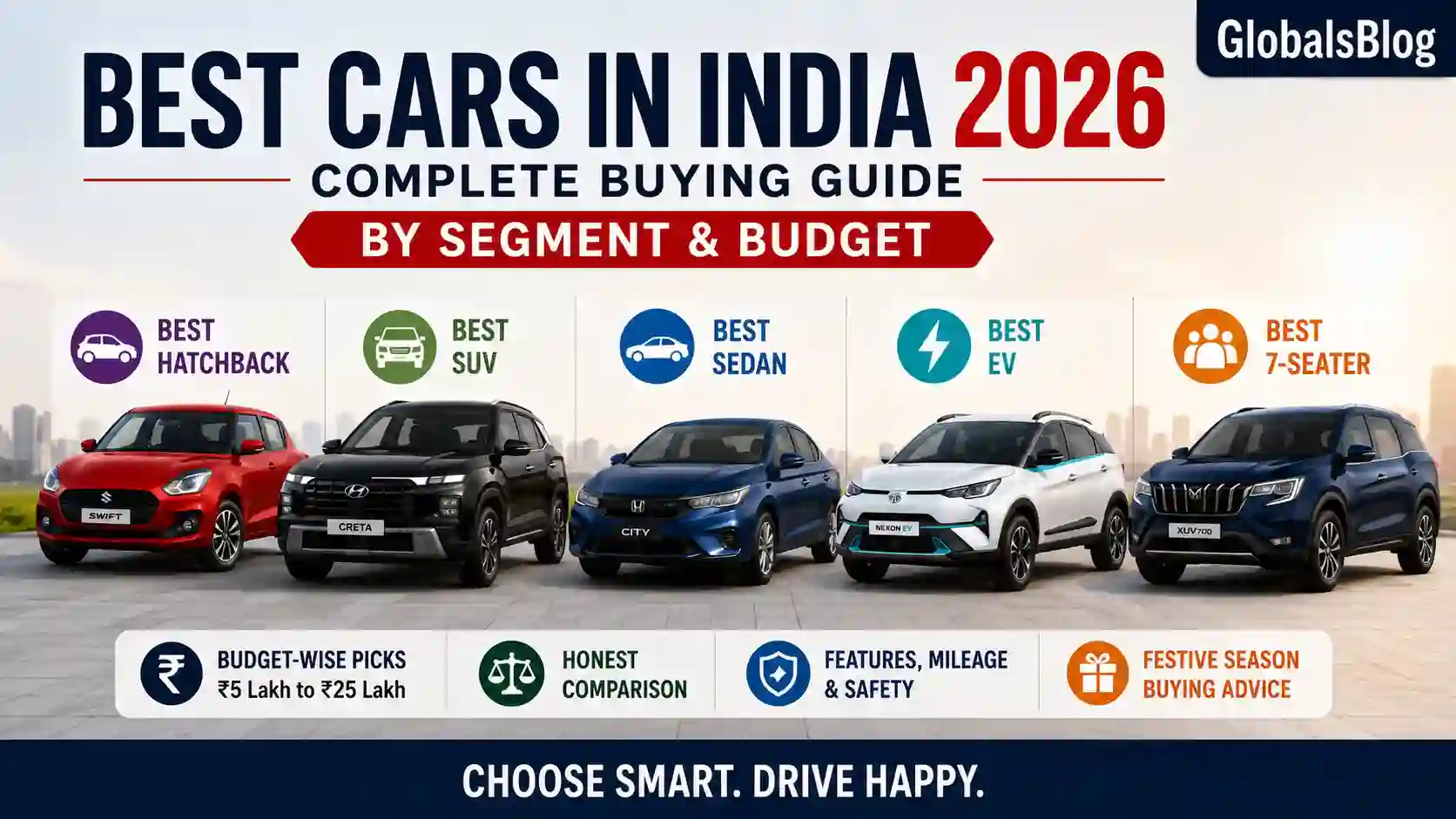
India's car market in 2026 is the third largest in the world and the most complex to navigate — 50+ models across hatchbacks, compact SUVs, sedans, full-size SUVs, EVs, and MPVs, all competing within overlapping price bands. This guide cuts through the noise: the best car in each segment, by budget, with honest reasoning for each pick.
A reader from Bengaluru spent four months researching her first car purchase. She had narrowed it down to six models across three segments, read every comparison article, watched every YouTube review, and was still paralysed. The problem was not lack of information — it was too much information without a clear framework. She eventually bought the Maruti Fronx CNG — not because it was the "best" car by any metric, but because it was the best car for her specific situation: a 35km daily commute, limited parking space, a ₹9 lakh budget, and a strong preference for low running costs. The right car is always context-specific. This guide gives you the framework to find yours, then points you to the detailed individual guides for whichever segment fits.
Best hatchback: Maruti Swift (₹6.49L ex) — best all-round, Hyundai i20 (₹5.99L ex) for premium features. Best compact SUV under ₹10L: Maruti Brezza or Tata Nexon. Best compact SUV ₹10–15L: Hyundai Creta or Kia Seltos. Best sedan: Honda City (₹11.90L ex) for reliability, Volkswagen Virtus (₹11.59L ex) for performance. Best EV: Tata Nexon EV (₹12.49L ex) for value, Hyundai Creta Electric (₹17.99L ex) for range. Best 7-seater: Toyota Innova Hycross (₹19.77L ex) or Maruti Ertiga (₹8.69L ex) for budget. Best CNG: Maruti Celerio CNG (₹5.37L ex) or Fronx CNG (₹8.55L ex).
How to Choose the Right Car — The Framework
Before looking at any specific model, answer these four questions. They will narrow 50+ options to 5–6 relevant ones:
| Question | Your Answer Determines |
|---|---|
| What is your total on-road budget? | The segment you shop in. On-road is always 15–20% more than ex-showroom. A ₹10L budget means ₹8–8.5L ex-showroom maximum |
| What is your primary use? | City-only → prioritise manoeuvrability + fuel efficiency. Highway + city mix → prioritise engine power + highway comfort. Long highway → comfort + boot space |
| How many people ride regularly? | 1–3 people → hatchback or compact SUV sufficient. 4–5 regularly → compact SUV minimum. 6–7 → MPV or 7-seater SUV |
| What is your annual running (km/year)? | Under 10,000 km → petrol AT or CNG. 10,000–20,000 km → petrol or CNG. Over 20,000 km → diesel or EV (lowest running cost per km) |
Best Cars in India by Segment — September 2026
The hatchback segment is under pressure from SUVs but remains India's most practical option for tight city parking and tight budgets. The segment's best offering in September 2026 depends on priority: for pure value and resale, Maruti Swift (₹6.49L ex) remains the benchmark — 24.6 kmpl ARAI, 5-star GNCAP, AMT automatic option, and Maruti's 6,000+ service network. For premium features and a more modern interior, Hyundai i20 (₹5.99L ex) offers sunroof, 10.25-inch screen, and a 1.2L NA engine that delivers 88 bhp — more refined than the Swift. Tata Altroz (₹6.30L ex) is the only hatchback with factory CNG, diesel, and a DCA automatic — the most versatile powertrain lineup in the segment. For those wanting the largest hatchback with a sunroof and connected tech, Maruti Baleno (₹6.61L ex) with its Head-Up Display is the premium hatchback choice.
The compact SUV segment is India's largest and most competitive — accounting for over 40% of all passenger vehicle sales. At the entry end (₹7–10L), Maruti Brezza and Tata Nexon dominate. Brezza for Maruti service network reliability and CNG option; Nexon for 5-star GNCAP safety and the most complete feature list at this price. In the ₹10–15L band, Hyundai Creta is India's best-selling compact SUV for a reason — the best interior quality, most variant choices (petrol/diesel/hybrid CNG), and the strongest resale value in the segment. Kia Seltos at similar pricing offers a sharper design, more power on the turbo variants, and Level 1 ADAS. Mahindra XUV 3XO (₹7.99L ex) punches above its price with Level 2 ADAS and a panoramic sunroof — a standout value-for-money offer in 2026.
Sedans are a shrinking but fiercely contested segment in India. Three cars dominate: Honda City (₹11.90L ex) for long-term reliability and Honda's 6,000+ service network — the safest choice for buyers who want a worry-free 5–7 year ownership experience. Hyundai Verna for the most features at this price — Level 2 ADAS, ventilated seats, panoramic sunroof, and a powerful 160 PS turbo top variant. Volkswagen Virtus (₹11.59L ex) for the best driving experience — 150 PS 1.5L TSI EVO with 7-speed DSG is the most engaging sedan available in India under ₹22L on road. The choice between these three is not about which is "best" — it is about which axis of value matters most to you: reliability (City), features (Verna), or driving engagement (Virtus).
India's EV market in 2026 has matured significantly — public charging infrastructure has expanded to 12,000+ fast chargers nationwide, and the top EV models offer genuine 400–500km real-world range. Tata Nexon EV (₹12.49L ex) remains the EV value leader — the 45 kWh LR variant delivers 489 km ARAI range, Level 2 ADAS, V2L support, and starts below ₹13.5L on road in Delhi. Hyundai Creta Electric (₹17.99L ex) offers the 51.4 kWh battery for 473 km ARAI range with V2L, the most premium EV interior in this price range, and the most complete Level 2 ADAS suite. The EV running cost advantage is significant: ₹1–1.5 per km (home charging) vs ₹6–8 per km for a petrol equivalent — at 15,000 km/year this translates to ₹70,000–90,000 annual savings in fuel.
The 7-seater segment spans from affordable MPVs to premium family SUVs. Maruti Ertiga (₹8.69L ex) is India's most popular 7-seater for good reason — CNG option (33 km/kg), automatic gearbox, and Maruti's service network make it the lowest-cost-of-ownership 7-seater in India. Kia Carens Clavis (₹10.60L ex) brings a turbo petrol DCT option alongside diesel and is significantly more premium than the Ertiga. Tata Safari (₹13.40L ex) offers 5-star GNCAP safety, ADAS, and the most SUV-like driving feel in the segment. Toyota Innova Hycross (₹19.77L ex) is the premium MPV benchmark — strong hybrid version delivers 23.24 kmpl, the highest fuel efficiency in any 7-seater currently sold in India.
CNG cars make financial sense for buyers who drive 15,000+ km per year in cities with CNG infrastructure (Delhi NCR, Mumbai, Ahmedabad, Pune, Hyderabad). Running cost: ₹2–3 per km on CNG vs ₹6–8 on petrol. Maruti Celerio CNG (₹5.37L ex, 35.6 km/kg) is the most fuel-efficient factory CNG car in India. Maruti Fronx CNG (₹8.55L ex) is the most premium CNG offering — a compact SUV body style with CNG drivetrain and 28.51 km/kg. Tata Altroz iCNG (factory-fitted dual-cylinder CNG with no boot space loss) and Tata Punch CNG (26.99 km/kg) are the safest CNG options — Tata's factory CNG comes with the full warranty intact. See our complete CNG cars guide for the full comparison.
Budget-Wise Car Recommendation Table — September 2026
| On-Road Budget | Best Pick | Why | Guide |
|---|---|---|---|
| Under ₹7L | Maruti Celerio / Alto K10 | Lowest entry, CNG option, Maruti service | — |
| ₹7L–₹10L | Maruti Swift / Tata Punch | Swift for mileage + resale; Punch for SUV feel | Best car under ₹10L → |
| ₹10L–₹13L | Maruti Brezza / Tata Nexon | Compact SUV entry — best two in this band | Best SUV under ₹10L → |
| ₹13L–₹18L | Hyundai Creta / Kia Seltos | Best-selling segment — most complete package | Best SUV under ₹15L → |
| ₹18L–₹23L | Hyundai Creta top / XUV700 base | Feature-loaded or premium SUV entry | Best SUV under ₹20L → |
| ₹23L+ | Mahindra XUV700 / Tata Safari top / Innova Hycross | Premium segment — safety, space, brand | Best 7-seater → |
Festive Season 2026 — Should You Buy Now?
September through November is India's peak car buying season — Navratri, Dussehra, and Diwali are considered auspicious times to purchase vehicles, and manufacturers respond with their best offers of the year. In September 2026, the following festive offers are typically available: exchange bonuses (₹20,000–₹50,000 for trading in your old vehicle), corporate discounts (3–8% for employees of listed companies), loyalty bonuses (for existing brand owners), and accessories packages. The best overall offers typically appear in the second and third weeks of October — Navratri discounts tend to peak here. If your budget and model choice are fixed and you are planning to buy before December, September–October is genuinely the right time. See our complete guide on the best time to buy a car in India for the full festive season buying strategy.
✓ Car Buying Tips — India 2026
- Always calculate on-road price, not ex-showroom: Ex-showroom is the factory price. On-road adds road tax (4–12% depending on state and vehicle price), registration fees, insurance (first year comprehensive), and TCS (1% above ₹10L ex-showroom). On-road is typically 15–18% above ex-showroom in Delhi/NCR and 18–22% in Karnataka. Never budget on ex-showroom — always get an on-road quote from the dealer before committing
- The resale value calculation changes the actual cost of ownership: A car with better resale value costs less to own over 4–5 years than its sticker price suggests, and vice versa. Maruti vehicles have the best resale values in India — consistently 60–65% residual value after 3 years. Tata has improved significantly. European brands (VW, Skoda) have lower resale values that partially offset their driving quality advantage. Calculate the 3-year total cost of ownership (purchase + fuel + insurance + maintenance − resale) rather than just the purchase price
- Buy the car that fits your service network, not just your showroom: The car that drives best at the showroom is not always the best ownership decision in your city. Before buying any car, verify the nearest authorised service centre to your home and workplace. Volkswagen India has ~250 dealer points. Honda has 6,000+. If the nearest VW dealer is 40km away and the Honda dealer is 2km away, that gap matters every time you need service
- Test drive on your actual roads, not the showroom route: Ask the salesperson to let you drive on the roads you actually use — your building basement (check turning radius), the highway stretch you commute on (check NVH at 100 km/h), and the speed breakers near your home (check suspension). Showroom test routes are designed to show the car's best. Your route will show you what ownership is actually like
- See our petrol vs diesel guide, EV vs petrol guide, and car insurance guide for the complete buying ecosystem
✗ Car Buying Mistakes to Avoid
- Choosing a segment based on what looks impressive, not what you need: The most common mistake Indian car buyers make in 2026 is buying a full-size SUV for city-only use. A Mahindra XUV700 or Tata Safari is brilliant on highways and in larger cities with parking space. In South Delhi, Indiranagar Bengaluru, or Bandra Mumbai — where parking is genuinely at a premium — the same car becomes a daily frustration. Match the car's size to your parking reality first, before the segment appeal
- Buying the top variant when the mid variant covers 95% of your needs: Car companies in India are exceptional at loading the top 2 variants with features that sound essential in a showroom and are used rarely in daily driving. Panoramic sunroof, ventilated rear seats, ADAS Level 2 — all genuinely useful, but not worth ₹2–3L premium over the mid variant if the base model already has the safety features (airbags, ABS, ESC) you actually need. Identify the 3 features you will use daily and buy the lowest variant that has all three
- Not accounting for insurance cost in the first-year budget: First-year comprehensive insurance on a ₹15L ex-showroom car runs ₹55,000–₹80,000 depending on the model and insurer. This is a mandatory on-road cost that many buyers overlook when setting their budget. A car at ₹15L ex-showroom easily crosses ₹19–20L on-road in many states once insurance, road tax, and registration are included
- Dismissing after-sales quality as a secondary consideration: The difference between a car that costs ₹8,000 per service and ₹18,000 per service, serviced every 10,000 km over 5 years, is ₹50,000 in maintenance costs alone. Add the opportunity cost of time spent at a service centre 40km away vs one 3km away. After-sales quality and accessibility should be equally weighted alongside the car's features when making a final decision
⚠️ Disclaimer: All car prices are ex-showroom India as of September 2026 and subject to change. On-road prices vary by state — Karnataka adds significantly more road tax than Delhi for equivalent vehicles. Festive offers and discounts change weekly — verify current offers at your nearest dealership before making a purchase decision. Fuel efficiency figures are ARAI-certified; real-world mileage varies by driving conditions, traffic, and driving style.
The Right Car Is Not the Best Car on Any List. It Is the Best Car for Your Commute, Your Parking, Your Budget, and Your Service Centre. Start There.
The Bengaluru reader who spent four months researching and eventually bought the Fronx CNG made the right decision — not because the Fronx is the "best" car in any absolute ranking, but because it was precisely right for her specific situation. The framework in this guide exists to short-circuit that four-month process: answer the four questions, land in the right segment, then use the individual guides linked above for the detailed comparison within that segment. India's car market in 2026 has genuinely excellent options at every price point. The hardest part is not finding a good car — it is finding the right car for you.
The best car in India in 2026 depends on your budget and use case. Best hatchback: Maruti Swift (₹6.49L ex) for reliability and resale, Hyundai i20 for features. Best compact SUV under ₹10L: Tata Nexon or Maruti Brezza. Best compact SUV ₹10–15L: Hyundai Creta (best-seller, best resale) or Kia Seltos (performance). Best sedan: Honda City (reliability), VW Virtus (driving experience), Hyundai Verna (features). Best EV: Tata Nexon EV (₹12.49L ex, 489km ARAI range) for value; Hyundai Creta Electric for premium. Best 7-seater: Maruti Ertiga (budget), Tata Safari (mid), Toyota Innova Hycross (premium, 23.24 kmpl hybrid). For festive season 2026: best offers on Creta, Nexon, Fronx, Swift expected October–November.
Best cars under ₹10 lakh ex-showroom in India (September 2026): Maruti Swift (₹6.49L ex) — best hatchback overall, 24.6 kmpl ARAI, 5-star GNCAP, AMT option, Maruti's 6,000+ service network. Hyundai i20 (₹5.99L ex) — best features under ₹10L, sunroof, 10.25-inch screen. Tata Nexon (₹7.99L ex) — best compact SUV entry under ₹10L, 5-star Global NCAP, ADAS. Maruti Brezza (starts ~₹8.34L ex) — best Maruti SUV, CNG option, strong resale. Mahindra XUV 3XO (₹7.99L ex) — best value SUV, Level 2 ADAS, panoramic sunroof at lowest price in India. For CNG buyers: Maruti Fronx CNG (₹8.55L ex, 28.51 km/kg) — best CNG SUV in the segment. On road prices in Delhi: add 15–16% to ex-showroom figures.
Fuel type guide for India 2026: Petrol — best for under 10,000 km/year drivers or those in cities without CNG infrastructure. Lowest maintenance complexity. Petrol automatic (AMT/CVT/AT) works well for city-only use. Diesel — best for 20,000+ km/year drivers with significant highway driving. Higher upfront cost, higher maintenance, but lowest per-km fuel cost after petrol and CNG. Diesel segment shrinking in India — fewer new diesel models launching. CNG (factory-fitted) — best for 15,000+ km/year city drivers in Delhi NCR, Mumbai, Ahmedabad, Pune, Hyderabad where CNG infrastructure is dense. Running cost ₹2–3/km vs ₹6–8/km petrol. Factory-fitted only (no aftermarket) for warranty and safety. EV — best for 10,000+ km/year drivers who home-charge overnight, live in cities (Bengaluru, Delhi, Mumbai, Hyderabad, Pune — good public charging), and can afford ₹12–20L purchase price. Running cost ₹1–1.5/km home-charged. 4–5 year payback vs petrol at 15,000 km/year.
Best resale value cars in India (2026): Maruti Suzuki vehicles consistently have the highest resale values — Swift, Brezza, Baleno, and Ertiga all retain 58–65% of purchase price after 3 years. Hyundai Creta and Venue also have strong resale values (55–60% at 3 years) due to brand trust and service network. Toyota Innova Hycross and Fortuner have exceptional resale due to Toyota's reliability reputation. Worst resale values: European brands (VW, Skoda) — 40–50% at 3 years due to perceived higher maintenance costs and limited service network. American brands (Jeep) — 40–48% at 3 years. Chinese-origin brands (MG) — 40–45% at 3 years due to resale market hesitation. For buyers who plan to sell within 3–5 years: Maruti and Hyundai are the safest choices for total ownership cost.
Yes — the festive season (Navratri to Diwali, typically October–November) is the single best time to buy a car in India. Manufacturers and dealers offer their highest annual discounts during this period: exchange bonuses (₹20,000–₹50,000 for trading in old vehicles), corporate discounts (3–8% for company employees), loyalty bonuses (for existing brand customers), free accessories packages (dashcam, seat covers, alloy upgrades), and extended warranty offers. The second and third weeks of October — around Navratri/Dussehra — typically see the best offers of the year. September is also a good time because dealers offer month-end clearance discounts to meet targets. January (post-festive clearance) is the second-best period. Avoid March (year-end price hikes for new model year) and June–August (pre-festive, fewer offers).
Best first car in India (2026) depends on budget: Under ₹8L on road: Maruti Swift (₹6.49L ex, on road Delhi ~₹7.5L) — easiest to drive, best resale, widest service network. The automatic AMT variant (₹7.77L ex) is worth the premium for city use. Under ₹12L on road: Tata Nexon (₹7.99L ex, on road Delhi ~₹9.3L) — compact SUV ground clearance, 5-star GNCAP safety, features that feel premium for the price. Hyundai i20 N Line (petrol manual) if driving engagement matters. Under ₹15L on road: Maruti Brezza (₹8.34L ex) or Hyundai Creta base — stepping into the compact SUV segment properly. For first-time buyers, three priorities always apply: choose automatic over manual for city use, prioritise Maruti or Hyundai for service network, and buy the third or fourth variant (not the top) — the premium features of the top variant are rarely used daily.
Leave a comment
Share a quick thought about this story.
Thanks for sharing your view. It is ready for review.
Please try again in a moment.