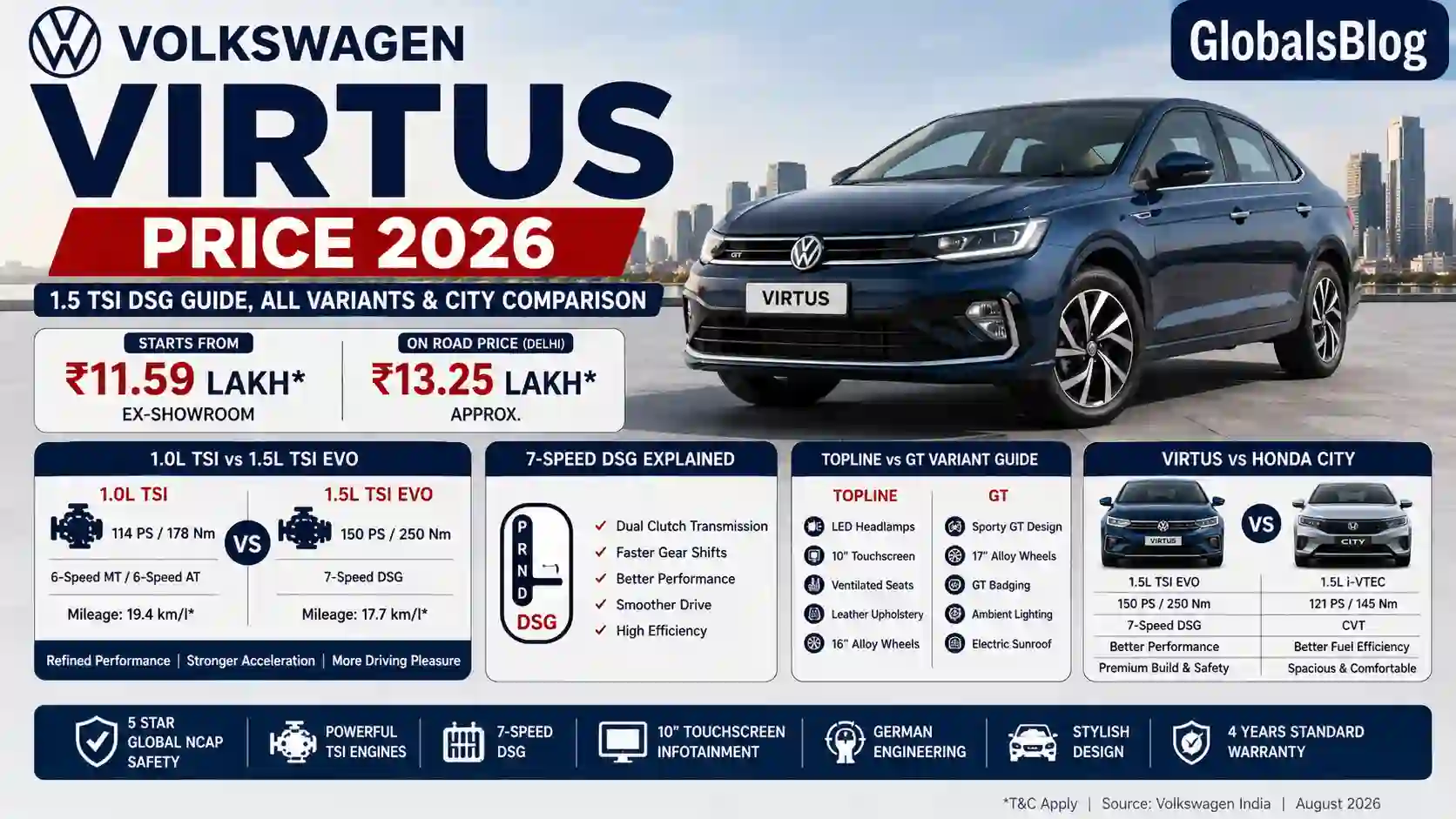
The Volkswagen Virtus is the best-engineered sedan in its segment — a 1.5L TSI EVO with 150 PS paired with a 7-speed DSG, IQ.DRIVE ADAS on the top variant, and the MQB-A0-IN platform shared with the Skoda Slavia. At ₹11.59 lakh ex-showroom base, it competes with the Honda City and Maruti Ciaz on price but is in a different engineering class.
A reader from Pune had spent six months choosing between the Honda City ZX CVT and the Volkswagen Virtus GT DSG. The City was the rational choice — Honda reliability, better service network, more fuel efficient, well-known quantity. The Virtus GT was the emotional choice — 150 PS and 250 Nm from a 1.5L turbo, a 7-speed DSG that she had experienced in a colleague's Skoda Octavia, and the genuine German-engineered feel that the Honda's competent-but-neutral driving experience could not match. She drove both cars back-to-back on the Pune–Solapur expressway. The Virtus GT at 120 km/h felt locked-down and effortless; the City CVT was comfortable but clearly a different category of experience at that speed. She bought the Virtus GT DSG. She has not questioned the decision in two years. This guide covers every Virtus variant, price, and the honest comparison with its main rivals.
Volkswagen Virtus price (August 2026): Ex-showroom ₹11.59 lakh (Comfortline 1.0 TSI MT base) to ₹19.39 lakh (GT Plus 1.5 TSI DSG top). Key variants: Comfortline 1.0 TSI MT ₹11.59L, Highline 1.0 TSI MT ₹13.09L, Topline 1.5 TSI DSG ₹16.39L, GT 1.5 TSI DSG ₹18.89L, GT Plus 1.5 TSI DSG ₹19.39L. Engines: 1.0L TSI (115 PS, 178 Nm) or 1.5L TSI EVO (150 PS, 250 Nm). Gearboxes: 6MT or 7-speed DSG. IQ.DRIVE ADAS on GT Plus. Rivals: Honda City (₹11.90L ex), Skoda Slavia (same platform, ₹11.49L ex), Hyundai Verna (₹11.00L ex). Best pick: GT 1.5 TSI DSG (₹18.89L ex) for performance buyers, Topline 1.5 TSI DSG (₹16.39L ex) for best value 1.5L variant.
Volkswagen Virtus Price — All Variants (August 2026)
| Variant | Engine / Gearbox | Ex-showroom | On Road Delhi (approx) | Key Features |
|---|---|---|---|---|
| Comfortline 1.0 TSI MT | 1.0L TSI 115 PS · 6MT | ₹11.59L | ~₹13.39L | Base — 8-inch infotainment, wireless CarPlay, 6 airbags, ESC |
| Comfortline 1.0 TSI AT | 1.0L TSI 115 PS · 6AT | ₹13.09L | ~₹15.12L | 6-speed torque converter automatic — smooth city AT |
| Highline 1.0 TSI MT | 1.0L TSI 115 PS · 6MT | ₹13.09L | ~₹15.12L | 10-inch infotainment, digital cluster, sunroof, connected car |
| Highline 1.0 TSI AT | 1.0L TSI 115 PS · 6AT | ₹14.59L | ~₹16.87L | Best comfort automatic — sunroof + smooth AT for city |
| Topline 1.5 TSI DSG | 1.5L TSI EVO 150 PS · 7DSG | ₹16.39L | ~₹18.95L | 1.5L TSI entry — DSG, sunroof, 10-inch screen, ventilated seats |
| GT 1.5 TSI DSG | 1.5L TSI EVO 150 PS · 7DSG | ₹18.89L | ~₹21.85L | GT package — sportier styling, paddle shifters, larger alloys |
| GT Plus 1.5 TSI DSG | 1.5L TSI EVO 150 PS · 7DSG | ₹19.39L | ~₹22.43L | IQ.DRIVE ADAS — Travel Assist, top specification |
All prices ex-showroom India, August 2026. The Virtus range spans from the Comfortline 1.0 TSI MT at ₹11.59L to the GT Plus 1.5 TSI DSG at ₹19.39L — a ₹7.80L range covering entry to fully specced. The key decision: 1.0L TSI (115 PS, 6MT or 6AT — city-optimised, more fuel efficient) or 1.5L TSI EVO (150 PS, 7-speed DSG — performance-oriented, highway brilliant).
Virtus Engines — 1.0L TSI vs 1.5L TSI EVO
The 1.0L TSI is a 3-cylinder turbocharged petrol producing 115 PS and 178 Nm — significantly more performance than naturally aspirated competitors (Honda City's 121 PS NA feels less urgent despite the higher headline figure because the TSI's 178 Nm arrives at 1,750 rpm vs the City's 145 Nm at 4,300 rpm). The 1.0L TSI is available with a 6-speed manual or a 6-speed torque converter automatic. ARAI mileage: 19.47 kmpl (MT), 17.35 kmpl (AT). Real-world city: 13–16 kmpl. The 1.0L is the right engine for buyers who primarily drive in the city and want the Volkswagen engineering quality without the 1.5L's premium. The 3-cylinder note at idle is the one compromise — slightly more vibration than a 4-cylinder at very low RPM, though it is not intrusive in motion.
The 1.5L TSI EVO is a 4-cylinder turbocharged petrol with 150 PS and 250 Nm — the most powerful engine in any mass-market sedan in India at this price. The EVO designation indicates the addition of ACT (Active Cylinder Technology) — the engine deactivates two of its four cylinders at light load (cruise, highway at steady speed) to improve fuel efficiency, then seamlessly reactivates them when more power is demanded. This makes the 1.5L TSI EVO both more powerful and more fuel efficient at highway speeds than the 1.0L TSI despite the larger displacement. ARAI: 18.68 kmpl (marginally lower than 1.0L MT's 19.47 kmpl, but in real-world highway use with ACT active, the 1.5L often matches or beats the 1.0L). The 7-speed DSG (Dual Clutch Transmission) is the most satisfying automatic gearbox in any sedan at this price — it shifts faster than a torque converter (80 milliseconds vs 300+ milliseconds) and delivers the 1.5L's full performance without the lag of a traditional automatic. 0–100 km/h: 8.1 seconds (GT variant). This is genuinely fast for a sedan at ₹19L on road.
Virtus vs Honda City vs Hyundai Verna vs Skoda Slavia
| Model | Starting Price | Max Power | Fastest Auto | ADAS | Best For |
|---|---|---|---|---|---|
| VW Virtus | ₹11.59L ex | 150 PS / 250 Nm | 7-speed DSG | ✅ IQ.DRIVE (GT Plus) | Performance, DSG, driving experience, highway |
| Honda City | ₹11.90L ex | 121 PS / 145 Nm | CVT | ❌ | Reliability, service network, fuel efficiency, practicality |
| Hyundai Verna | ₹11.00L ex | 160 PS / 253 Nm (turbo top) | 7-speed DCT | ✅ Level 2 (top) | Features, ADAS, ventilated seats, panoramic sunroof |
| Skoda Slavia | ₹11.49L ex | 150 PS / 250 Nm | 7-speed DSG | ❌ (most variants) | Same VW Group platform — slightly different styling, pricing |
| Maruti Suzuki Ciaz | ₹9.99L ex | 103 PS / 138 Nm (mild hybrid) | 4AT | ❌ | Lowest price, mild hybrid efficiency, Maruti service |
Virtus vs Honda City — the decisive rivalry: Honda City (₹11.90L ex base) is the Virtus's closest price rival and its most direct competition for sedan buyers. City advantages: Honda's legendary reliability record, more fuel efficient CVT (City gets 17.8 kmpl CVT ARAI vs Virtus 1.0L AT's 17.35 kmpl), Honda's 6,000+ service centres vs VW's 250+ dealer network (a significant difference for tier-2 and tier-3 cities), better resale value in most markets. Virtus advantages: 178 Nm at 1,750 rpm vs City's 145 Nm at 4,300 rpm (more responsive in city), 7-speed DSG available on 1.5L (City has only CVT automatic), 150 PS available vs City's 121 PS maximum, IQ.DRIVE ADAS available (City has none), better highway dynamics. For buyers who drive sedans primarily in the city and want Honda reliability: City. For buyers who value driving engagement, highway performance, and the DSG automatic: Virtus.
Virtus vs Skoda Slavia: The Slavia shares the Virtus's MQB-A0-IN platform and both engines. The pricing is nearly identical at equivalent variants. The Slavia has slightly different styling (more conservative exterior) and the Skoda brand's perception in India. Choose between them based on styling preference and which brand's dealer/service you prefer in your city — mechanically they are the same car.
Which Virtus Variant to Buy?
The Topline 1.5 TSI DSG at ₹16.39L ex is the best value 1.5L Virtus — it brings the full powertrain (150 PS, 250 Nm, 7-speed DSG), ventilated front seats, sunroof, 10-inch infotainment with wireless CarPlay, digital cluster, and connected car, without the GT's sportier styling premium or the GT Plus's ADAS addition. At ₹18.95L on road Delhi, the Topline 1.5 TSI DSG is ₹2.90L less than the GT Plus for essentially the same driving experience. The GT adds visual differentiation (sportier exterior, paddle shifters, larger alloys) for ₹2.5L over the Topline — if the GT styling is not important to you, the Topline DSG is the rational recommendation.
The GT 1.5 TSI DSG at ₹18.89L ex adds the GT visual package (sportier front bumper, larger 16-inch alloys, GT badging), paddle shifters (for manual DSG control), Discover Pro 25.4cm infotainment with premium features, and the driving character that comes with the paddle-shift DSG interaction. At ₹21.85L on road Delhi, it is a premium over the Topline DSG for primarily cosmetic and driver-engagement additions. If the GT's sportier appearance is important and paddle shifters are something you will use: the GT. If you want the 1.5L DSG experience at the lowest cost: Topline DSG.
The Highline 1.0 TSI AT at ₹14.59L ex is the recommended 1.0L automatic Virtus — sunroof, 10-inch infotainment with wireless CarPlay, digital cluster, connected car, and the 1.0L TSI's adequate city performance in a smooth 6-speed torque converter automatic. At ₹16.87L on road Delhi, it is ₹2.08L less than the Topline 1.5L DSG — a meaningful saving for buyers who don't need the 1.5L's performance. For city-primary users who want VW engineering, a sunroof, and an automatic: Highline 1.0L AT is the rational choice. The AT's torque converter is smoother at very low speeds than the DSG — better for parking and stop-start traffic at 5 km/h.
✓ Volkswagen Virtus Buying Tips
- The 1.5L TSI EVO's ACT cylinder deactivation is meaningfully efficient on highways: The Active Cylinder Technology in the 1.5L TSI shuts down cylinders 2 and 3 at light throttle loads above 60 km/h. At steady 80–100 km/h cruise, the engine is effectively running as a 0.75L 2-cylinder, consuming significantly less fuel. Real-world highway mileage for the 1.5L TSI Virtus at 80–90 km/h with ACT active: 19–22 kmpl — equal to or better than the 1.0L in the same conditions. This makes the 1.5L's fuel economy penalty vs the 1.0L much smaller than the ARAI numbers suggest for highway-heavy users
- VW's service network is significantly smaller than Honda or Hyundai — verify before buying: Volkswagen India operates approximately 250–300 dealer-and-service points nationwide — vs Honda's 6,000+, Hyundai's 1,500+, and even Skoda's comparable network. In Delhi, Mumbai, Bengaluru, and Pune, VW service access is adequate. In tier-2 and tier-3 cities, the nearest VW authorised service may be 50–100km away. Verify the nearest VW dealer to your home and office before purchasing — ownership experience with long service distances is significantly worse than with Honda or Maruti
- DSG requires periodic DSG fluid change — plan for it: The 7-speed DSG's dual-clutch fluid should be changed approximately every 60,000 km at VW authorised service (cost approximately ₹8,000–12,000). This is a maintenance item that NA petrol automatics (Honda City CVT) do not require at equivalent frequency. It is not a negative — the DSG's performance and efficiency justify this maintenance — but buyers should budget for it. Skipping DSG fluid changes can cause shudder and eventual transmission damage
- The Virtus GT's paddle shifters are genuinely useful with the DSG — not a gimmick: Unlike paddle shifters in some automatics where the gearbox reverts to auto mode after a few seconds, the Virtus GT's paddle shifters maintain manual mode until you deliberately return to automatic. Combined with the DSG's 80-millisecond shift speed, paddle-shifted DSG gives the driver genuine control over the transmission that makes highway overtaking and spirited driving significantly more engaging than any single-clutch automatic
- See our Honda City price guide for the most direct Virtus rival on reliability and service terms, and our Skoda Slavia guide for the platform-identical VW Group alternative
✗ Virtus Buying Mistakes to Avoid
- Buying in a city with limited VW service access: The Volkswagen Virtus is an excellent car — the VW dealer and service network in India is not. A Virtus owner in a city where the nearest VW service centre is 60km away faces a meaningfully worse ownership experience than a City or Verna owner in the same city. Driving long distances for routine service or minor issues is a real cost (time, fuel, inconvenience) that the ownership comparison calculations should include. If you are in Delhi, Gurgaon, Mumbai, Pune, Bengaluru, or Hyderabad: VW service access is adequate. If you are anywhere smaller: research specifically before buying
- Expecting Honda-level long-term reliability from the 1.5L TSI: The Volkswagen 1.5L TSI is a genuinely excellent engine with ACT cylinder deactivation and class-leading performance. However, turbocharged direct-injection engines in general require more maintenance attention than Honda's naturally aspirated i-VTEC — the turbo system, the high-pressure direct injection (carbon deposits on intake valves over time), and the DSG fluid are additional service considerations that the Honda City's CVT and NA engine do not have. This does not make the Virtus unreliable — it means the maintenance requirements are more specific and the consequences of deferred service are more significant. Service strictly on schedule at VW authorised facilities
- Choosing 1.0L AT over 1.5L DSG thinking they are similar: The 1.0L AT (torque converter, 6-speed) and the 1.5L DSG (dual clutch, 7-speed) are fundamentally different gearbox technologies. The 1.0L AT is smooth and comfortable in the city but slower to respond and does not match the DSG's outright performance. The 1.5L DSG at 0–100 km/h in 8.1 seconds vs the 1.0L AT at approximately 11–12 seconds is a meaningful real-world difference in overtaking and highway merging. If budget allows the 1.5L DSG and your primary use includes any highway driving: the DSG is worth the premium
- Dismissing the Virtus because it looks like a Honda City: The Virtus's three-box sedan silhouette in white or silver at a distance could be mistaken for several other sedans — it is not a visually dramatic car. The GT's sportier styling helps. The Virtus's distinctiveness is in the driving experience, the mechanical engineering, and the interior quality — not the exterior. Judge it on a test drive, not on a static photograph
⚠️ Disclaimer: Volkswagen Virtus prices, variants, and specifications are subject to change. All prices listed are ex-showroom India as of August 2026. On road prices vary by state — Karnataka buyers pay approximately ₹1.5–2L more than Delhi for equivalent variants. IQ.DRIVE ADAS features are driver-assist systems requiring driver attention at all times. DSG transmission requires periodic DSG fluid change at authorised service — do not skip this maintenance. Verify current pricing and variant availability at your nearest Volkswagen India dealer.
Comfortline for Entry VW. Highline AT for City Automatic. Topline DSG for Best Value 1.5L. GT for the Sportiest Virtus. GT Plus for ADAS. The Virtus Is the Sedan for Buyers Who Drive. Not for Buyers Who Commute.
The Pune reader who chose the Virtus GT DSG over the Honda City ZX CVT understood the correct distinction: the City is the better answer for buyers who use a sedan to commute reliably and economically. The Virtus GT is the better answer for buyers who actually enjoy the act of driving — who feel the 80-millisecond DSG shift as a response to their input rather than as a machine executing a programme, who want 250 Nm available at 1,500 rpm for an expressway overtake, and who are willing to accept a more limited service network in exchange for a more involving machine. Two years later, driving the Pune-Solapur expressway, she has not regretted the decision. This is the Virtus's promise: the most engaging sedan in India under ₹22L on road. It keeps that promise on every highway run.
Volkswagen Virtus price in India (August 2026): Ex-showroom from ₹11.59 lakh (Comfortline 1.0 TSI MT base) to ₹19.39 lakh (GT Plus 1.5 TSI DSG top). Key variants: Comfortline 1.0 TSI MT ₹11.59L; Comfortline 1.0 TSI AT ₹13.09L; Highline 1.0 TSI MT ₹13.09L; Highline 1.0 TSI AT ₹14.59L; Topline 1.5 TSI DSG ₹16.39L; GT 1.5 TSI DSG ₹18.89L; GT Plus 1.5 TSI DSG ₹19.39L. On road Delhi approximately: Comfortline MT ~₹13.39L to GT Plus ~₹22.43L. Engines: 1.0L TSI (115 PS, 178 Nm, 6MT or 6AT) and 1.5L TSI EVO (150 PS, 250 Nm, 7-speed DSG only). IQ.DRIVE ADAS available only on GT Plus. Rivals: Honda City (₹11.90L ex), Skoda Slavia (₹11.49L ex, same platform), Hyundai Verna (₹11.00L ex). Best value 1.5L: Topline DSG (₹16.39L ex). Best performance: GT DSG (₹18.89L ex).
Volkswagen Virtus vs Honda City comparison (2026): Virtus advantages — more powerful (150 PS 1.5L TSI vs City's 121 PS NA), more torque arriving earlier (178 Nm at 1,750 rpm vs 145 Nm at 4,300 rpm — more responsive in city), 7-speed DSG available (City only has CVT), IQ.DRIVE ADAS available on GT Plus (City has no ADAS), stronger highway dynamics and driving engagement. Honda City advantages — Honda's 6,000+ service centres vs VW's ~250–300 (dramatically better service access nationwide), better long-term reliability track record for NA vs turbo, better resale value in most Indian markets, CVT fuel efficiency, simpler maintenance. Choose Virtus if: highway driving is a significant use, DSG performance matters, VW service is accessible in your city, and driving engagement is a priority. Choose City if: service network density is important (tier-2/3 city buyers), resale value matters, long-term low-maintenance ownership is the priority, or you primarily drive in stop-start city traffic.
Volkswagen Virtus mileage (August 2026): 1.0L TSI MT — 19.47 kmpl ARAI, real-world city 13–16 kmpl. 1.0L TSI AT — 17.35 kmpl ARAI, real-world city 12–15 kmpl. 1.5L TSI EVO DSG — 18.68 kmpl ARAI, real-world city 12–15 kmpl, real-world highway 19–22 kmpl with ACT cylinder deactivation active. The 1.5L TSI EVO's Active Cylinder Technology (deactivates 2 of 4 cylinders at light load) makes it more efficient than expected at highway speeds — at 80–100 km/h cruise the 1.5L often matches or exceeds the 1.0L's real-world fuel consumption despite the larger displacement. In city stop-go, both 1.0L and 1.5L deliver 12–15 kmpl real-world. The 1.5L's fuel efficiency penalty vs 1.0L is most visible in city conditions (stop-start full cylinder operation) and least visible on highways (where ACT is most active).
Volkswagen Virtus 1.5 TSI DSG is worth buying if: you have a significant highway component in your driving (the 150 PS / 250 Nm at 1,500 rpm makes overtaking and highway merging genuinely effortless — no other sedan under ₹20L on road comes close); you want the fastest automatic gearbox in the segment (7-speed DSG at 80-millisecond shifts vs CVT or traditional AT); you are in a city with adequate VW service access (Delhi, Gurgaon, Mumbai, Pune, Bengaluru, Hyderabad, Chennai — VW has adequate dealer presence); and driving engagement is a meaningful priority. The Topline 1.5 TSI DSG at ₹16.39L ex (₹18.95L on road Delhi) is the best value 1.5L entry — ventilated seats, sunroof, digital cluster, 150 PS, 7DSG. The GT adds styling and paddle shifters for ₹2.5L more. Not worth buying if: you are in a city with limited VW service (the service experience will disappoint); you drive primarily in city stop-start (the 1.5L's advantage is on highways); or long-term simplicity and low maintenance are the priority (Honda City).
Volkswagen Virtus vs Skoda Slavia comparison: Both cars share the same MQB-A0-IN platform, the same engines (1.0L TSI 115 PS and 1.5L TSI EVO 150 PS), and the same gearboxes (6MT, 6AT, 7-speed DSG). The differences are primarily aesthetic, pricing structure, and brand positioning. Styling: Virtus has a more conventional three-box sedan look with a larger grille; Slavia has a more distinctively Skoda design. Pricing: nearly identical at equivalent trim levels — sometimes the Slavia is ₹5,000–₹15,000 cheaper or more expensive depending on variant. Brand: Volkswagen is perceived as slightly more premium in India; Skoda has a smaller but devoted following. ADAS: Slavia has recently added ADAS on its top variants (verify current availability); Virtus has IQ.DRIVE on GT Plus. Service: both use the same SAVWIPL (Skoda Auto Volkswagen India) dealer network — your city's VW and Skoda dealers may be the same building or nearby. Choose between them based on styling preference and which dealer in your city has better reviews — mechanically they are the same car.
Volkswagen Virtus on road price in Delhi (August 2026): Comfortline 1.0 TSI MT approximately ₹13.39L; Comfortline 1.0 TSI AT approximately ₹15.12L; Highline 1.0 TSI MT approximately ₹15.12L; Highline 1.0 TSI AT approximately ₹16.87L; Topline 1.5 TSI DSG approximately ₹18.95L; GT 1.5 TSI DSG approximately ₹21.85L; GT Plus 1.5 TSI DSG approximately ₹22.43L. On road Delhi adds approximately 15–16% above ex-showroom (road tax approximately 4–6% for personal petrol vehicles + first-year comprehensive insurance + registration fees + TCS for vehicles above ₹10L). Delhi is among the more affordable on road cities — Karnataka (Bengaluru) adds approximately ₹1.5–2L for the same variant due to higher state road tax rates. Always obtain an itemised on road quote from your Volkswagen dealer before finalising — prices are indicative as of August 2026.
Leave a comment
Share a quick thought about this story.
Thanks for sharing your view. It is ready for review.
Please try again in a moment.