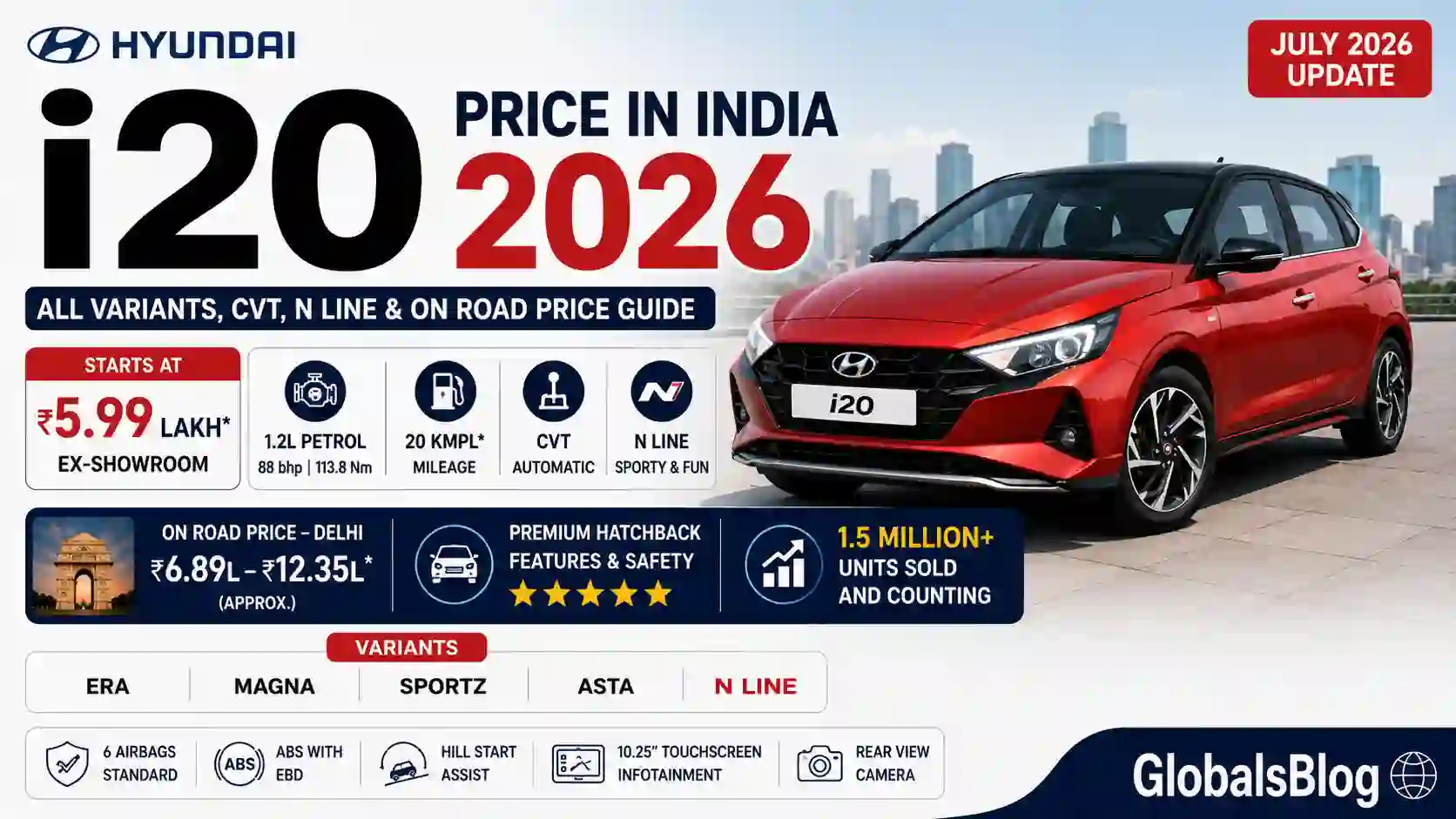
India's premium hatchback benchmark. 1.5 million units sold in India as of July 2026. 1.2L petrol with 88 bhp and 114 Nm — 20 kmpl mileage. CVT automatic from ₹8.70L ex. Sunroof from select variants. 6 airbags and ESP standard across all trims. 16 variants from Era to Asta (O) and N Line. Priced from ₹5.99L ex-showroom, on road Delhi from ₹6.89L. The i20 has defined the premium hatchback segment in India for over a decade — this guide has everything you need to pick the right variant in July 2026.
July 24, 2026: Hyundai Motor India celebrates 1.5 million sales of its i20 hatchback in India. The Era variant was re-introduced at ₹5.99 lakh ex-showroom in February 2026. Hyundai i20 prices in New Delhi start at ₹6.89 lakh and go up to ₹12.35 lakh on road, across 16 petrol variants. The Era is the base variant. The Hyundai i20 offers a 1.2L petrol engine up to 88 bhp (87 PS), manual and CVT automatic transmissions with ARAI mileage 16–20 kmpl. Key highlights include a 3-star Global NCAP safety rating and a fuel-efficient engine. It rivals the Maruti Suzuki Baleno, Toyota Glanza, and Tata Altroz. The i20's CVT is smooth and predictable — power delivery is linear and stress-free in traffic. The engine remains quiet at low speed and never feels jerky, especially in the CVT, ideal for city driving. The 2023-generation i20 brought meaningful upgrades — sunroof accessibility at lower trims, 6 airbags standard across all variants, and the N Line sportier range for enthusiast buyers. At 1.5 million cumulative units, the i20 is India's most proven premium hatchback. This guide covers every variant with July 2026 prices, on road costs, and which trim delivers the best value.
Hyundai i20 price (July 2026): On road Delhi: ₹6.89L (Era base MT) → ₹12.35L (Asta Opt iVT Knight top). Ex-showroom: ₹5.99L (Era) → ₹10.48L (Asta Opt iVT Knight). Engine: 1.2L petrol, 88 bhp, 114 Nm. CVT automatic from ₹8.70L ex. Mileage: 20 kmpl (MT), 19.7 kmpl (CVT). 1 offer available July 2026 Delhi. 16 variants — Era, Magna, Sportz, Asta, Asta (O), N Line. 6 airbags + ESP standard all variants. Sunroof from Sportz (O) variant. Key rivals: Maruti Baleno (₹5.99L ex), Toyota Glanza, Tata Altroz. Best picks: Sportz MT for value sunroof, Asta iVT for best automatic, N Line for enthusiasts.
Hyundai i20 Price — All Variants (July 2026)
| Variant | Trans. | Ex-showroom | On Road Delhi | Key Feature |
|---|---|---|---|---|
| Era | 5MT | ₹5.99L | ₹6.89L | Base — 6 airbags, ESP, ABS, 8-inch infotainment, rear camera |
| Magna | 5MT | ₹6.75L | ₹7.77L | Wireless CarPlay/Android Auto, cruise control, auto AC |
| Magna Executive | 5MT | ₹7.00L | ₹8.04L | Bose sound system, LED projector headlamps, alloy wheels |
| Sportz | 5MT | ~₹7.99L | ~₹9.19L | Sunroof entry variant, 10.25-inch infotainment, air purifier |
| Sportz iVT | CVT | ~₹8.70L | ~₹9.99L | Sunroof + CVT automatic — best value automatic entry |
| Asta | 5MT | ~₹9.04L | ~₹10.40L | Ventilated front seats, 360° camera, BlueLink connected car |
| Asta iVT | CVT | ~₹9.74L | ~₹11.21L | Best daily driver — ventilated seats + 360° camera + CVT |
| Asta (O) iVT | CVT | ~₹10.48L | ~₹12.00L | Top petrol — digital cluster, dual-zone AC, panoramic sunroof |
| Asta (O) iVT Knight | CVT | ₹10.48L | ₹12.35L | Top spec Knight edition — dark exterior theme, all Asta (O) features |
The Hyundai i20 engine: 1.2-litre petrol generating up to 88 PS (87 bhp) and 114 Nm. Paired with either a 5-speed MT or CVT (continuously variable transmission — called iVT by Hyundai). Dimensions: 3,995mm length × 1,775mm width × 1,505mm height, 2,580mm wheelbase. Fuel tank: 37 litres. 6 colours: Amazon Grey, Atlas White, Titan Gray, Typhoon Silver, Starry Night, Fiery Red. Dual-tone options: Atlas White + Black roof, Fiery Red + Black roof.
Hyundai i20 On Road Price — Key Cities (July 2026)
| City | Era MT (Base) | Sportz iVT | Asta iVT | Asta (O) iVT Knight (Top) |
|---|---|---|---|---|
| Delhi | ₹6.89L | ~₹9.99L | ~₹11.21L | ₹12.35L |
| Mumbai | ~₹6.67L | ~₹9.69L | ~₹10.87L | ~₹11.97L |
| Bengaluru | ~₹7.49L | ~₹10.86L | ~₹12.19L | ~₹13.08L |
| Hyderabad | ~₹7.19L | ~₹10.43L | ~₹11.70L | ~₹12.89L |
| Chennai | ~₹7.09L | ~₹10.28L | ~₹11.54L | ~₹12.71L |
| Pune | ~₹6.85L | ~₹9.94L | ~₹11.15L | ~₹12.28L |
The on-road price is about 10% above ex-showroom in Delhi, made up of RTO charges and first-year insurance. Bengaluru consistently has the highest on road premium due to Karnataka's road tax structure — the i20 Asta (O) iVT Knight at ₹13.08L on road Bengaluru vs ₹12.35L in Delhi is a ₹73,000 difference for the same car. Mumbai is the most competitive on road city for the i20 due to Maharashtra's road tax concessions for smaller engine vehicles.
Which i20 Variant to Buy?
The Sportz iVT at approximately ₹8.70L ex is the most significant sweet spot in the i20 lineup — it brings the sunroof, CVT automatic, and the larger 10.25-inch infotainment screen together at under ₹10L on road Delhi. The CVT automatic is smooth and predictable — power delivery is linear and stress-free in city traffic. The engine remains quiet at low speed and ideal for city driving. At ~₹9.99L on road Delhi, the Sportz iVT is ₹1.22L cheaper than the Asta iVT (₹11.21L on road Delhi) which adds ventilated seats, 360° camera, and BlueLink. For buyers who primarily want sunroof + CVT without the premium features, Sportz iVT is the correct variant. For buyers who want the full feature set, the Asta iVT at ₹11.21L is the step up. The Sportz iVT vs Asta iVT decision essentially comes down to whether ventilated front seats + 360° camera is worth ₹1.22L extra on road — for Bengaluru, Chennai, and Hyderabad where summer heat is extreme, ventilated seats are a meaningful comfort upgrade.
The Asta iVT is the most complete mid-spec i20 — ventilated front seats (unique feature in the hatchback segment at this price), 360° surround camera, BlueLink connected car (65+ features including remote AC, vehicle tracking, live diagnostics), CVT automatic, sunroof, auto-dimming rear-view mirror, and wireless CarPlay/Android Auto. The i20's design delivers a balance of comfort, efficiency, and refined performance for both routine commutes and longer drives. The Asta variants offer the most advanced i20 convenience features, superior interior finishes, and enhanced connectivity. Ventilated seats in an Indian hatchback is exceptional value — this feature typically appears in SUVs at ₹15L+. For Bengaluru, Hyderabad, and Chennai buyers where summer temperatures in parked cars reach 60°C+, the ventilated seat payback in comfort is significant. The 360° camera is the other key add — parking a hatchback in urban India's tight spots with a 360° view transforms the daily driving experience meaningfully.
The i20 N Line is a distinct variant with the 1.0L turbocharged GDi engine (100 bhp/172 Nm) rather than the standard 1.2L NA petrol — paired with a 7-speed DCT (dual-clutch automatic) or 6-speed iMT (intelligent manual, clutch-less manual). The N Line adds sportier suspension tuning, N Line-specific exterior styling (red accents, N badging, unique bumpers), sport bucket-style seats, and a more driver-focused cabin. The i20 N Line features a 1.0 Turbo GDi petrol engine — exclusive to the N Line variant, which is a different car from the standard i20 in terms of dynamics and character. At ~₹9.99–11.72L ex-showroom, the N Line is priced at a premium over the equivalent Asta iVT but delivers meaningfully different driving character — the turbo engine's 172 Nm torque vs the standard i20's 114 Nm makes highway overtaking and mid-range acceleration noticeably more capable. For buyers who drive long distances or enjoy an engaging driving experience, the N Line is the only correct i20 variant. Not recommended for: pure city commute buyers (the turbo advantage is wasted in stop-go traffic).
Hyundai i20 vs Competitors (July 2026)
| Model | Starting Price | Mileage | Auto Type | Sunroof | Best For |
|---|---|---|---|---|---|
| Hyundai i20 | ₹5.99L ex | 20 kmpl MT | CVT (smooth) | ✅ from Sportz | Premium feel, CVT smoothness, ventilated seats, BlueLink |
| Maruti Baleno | ₹5.99L ex | 22.35 kmpl MT | AMT (adequate) | ✅ from Alpha | Best mileage, lowest running cost, Maruti service/resale |
| Toyota Glanza | ₹6.59L ex | 22.35 kmpl MT | AMT | ✅ | Toyota reliability badge on Baleno platform, hybrid mild assist |
| Tata Altroz | ₹6.74L ex | 19.06 kmpl MT | DCT (sporty) | ✅ | 5-star GNCAP safety, DCA dual-clutch, funky design |
| Honda Jazz | Discontinued | — | — | — | — |
The i20's CVT is genuinely smoother than the Baleno's AMT in city stop-go — if automatic smoothness is the priority, i20 wins clearly. The Hyundai i20 set a high benchmark for premium hatchbacks when it launched — the combination of European-style build quality, feature-richness, and driving refinement remains its core identity. Baleno's advantage: 22.35 kmpl vs i20's 20 kmpl — a meaningful efficiency gap. At 1,500 km monthly, the Baleno saves approximately ₹1,000/month in petrol. Over 5 years: ₹60,000 saving — partially offsets the Baleno's price advantage. Tata Altroz's 5-star GNCAP vs i20's 3-star GNCAP is the safety argument against the i20 — buyers for whom GNCAP star count matters should note this difference.
Hyundai i20 Buying Tips — July 2026
- 1 offer July 2026 Delhi — claim before month end: For July 2026, 1 offer is available on the Hyundai i20 in New Delhi. Hyundai offers typically include exchange bonus (₹10,000–25,000), loyalty benefit, and finance subvention. Ask the dealer specifically for all applicable offers before negotiating — dealers sometimes withhold offer details to preserve margin
- Era variant reintroduced at ₹5.99L — the safety play: The Era variant was re-introduced at ₹5.99 lakh ex-showroom in February 2026. At ₹6.89L on road Delhi, Era gives 6 airbags + ESP + 8-inch screen + rear camera — the most safety per rupee in the premium hatchback segment. If budget is the binding constraint and safety is the priority, Era at ₹6.89L on road outperforms any competitor at the same price on airbag count
- CVT vs AMT — the transmission decision: The i20's CVT (iVT) is among the smoothest automatic transmissions in the Indian hatchback segment — no gear-hunt hesitation, rubber-band feel is minimal vs some CVTs. The Baleno's AMT comparison: AMT is cheaper but shows noticeable hesitation during upshifts in city traffic. If budget allows the i20 CVT variants, the extra ₹70,000–₹1L premium over a Baleno AMT is justified by the smoother driving experience alone
- 3-star GNCAP vs competitors: The i20 has a 3-star Global NCAP safety rating — lower than Tata Altroz (5-star) and Maruti Baleno (5-star BNCAP). Hyundai provides 6 airbags standard which partially compensates. Buyers for whom GNCAP star rating is the primary purchase criterion should consider the Baleno or Altroz instead
- Compare with the Maruti Baleno (₹5.99L ex, 22.35 kmpl, 5-star safety) for the full premium hatchback comparison. Also see Maruti Fronx (₹6.85L ex) if crossover body is preferred over hatchback
Era for Safety at ₹6.89L on Road. Sportz iVT for Sunroof + CVT Under ₹10L. Asta iVT for Ventilated Seats + 360° Camera. N Line for the Turbo. 1.5 Million Indians Have Already Chosen. The i20 Remains India's Premium Hatchback Standard.
Hyundai Motor India celebrated 1.5 million i20 sales in India on July 24, 2026 — the reintroduced Era variant at ₹5.99 lakh made the premium hatchback more accessible again. On road Delhi: ₹6.89L (base) to ₹12.35L (top). 16 variants, 1 offer available July 2026. The i20's CVT delivers smooth, predictable city driving — linear power delivery, quiet engine, ideal for urban commuting. The Asta variants offer the most comprehensive feature set including ventilated seats unique to the segment. Six airbags standard across all variants — from the ₹5.99L Era to the ₹10.48L Asta (O). For premium hatchback buyers in 2026, the i20 remains the benchmark — with the N Line as India's most exciting hot hatch at an accessible price.
Hyundai i20 price in India (July 2026): Ex-showroom ₹5.99 lakh (Era MT base, reintroduced Feb 2026) to ₹10.48 lakh (Asta Opt iVT Knight top). On road Delhi: ₹6.89 lakh (Era MT) to ₹12.35 lakh (Asta Opt iVT Knight). 16 variants across Era, Magna, Magna Executive, Sportz, Asta, Asta (O) trims in petrol MT and CVT (iVT) automatic. Engine: 1.2L petrol, 88 bhp (87 PS), 114 Nm. CVT automatic from ~₹8.70L ex (~₹9.99L on road Delhi). Mileage: 20 kmpl MT, 19.7 kmpl CVT ARAI. 6 airbags + ESP standard on all variants. Sunroof from Sportz variant. Ventilated front seats from Asta. BlueLink connected car from Asta. N Line (1.0L Turbo, 100 bhp, 7-speed DCT): ₹9.99–11.72L ex separately. 1 offer Delhi July 2026. 1.5 million units sold in India (milestone July 2026). Rivals: Maruti Baleno (₹5.99L), Tata Altroz (₹6.74L), Toyota Glanza (₹6.59L).
Hyundai i20 on road price in Delhi (July 2026): Era MT (base) ₹6.89 lakh (ex ₹5.99L + RTO ₹54,088 + insurance ₹34,826). Magna MT approximately ₹7.77 lakh. Magna Executive MT approximately ₹8.04 lakh. Sportz MT approximately ₹9.19 lakh. Sportz iVT (CVT) approximately ₹9.99 lakh. Asta MT approximately ₹10.40 lakh. Asta iVT (CVT) approximately ₹11.21 lakh. Asta (O) iVT approximately ₹12.00 lakh. Asta (O) iVT Knight (top) ₹12.35 lakh. On road premium: approximately 10% above ex-showroom in Delhi — RTO charges + first-year insurance. 1 offer available July 2026 that may reduce effective on road price. Delhi is more affordable than Bengaluru (approximately ₹73,000 more expensive for same top variant) due to Karnataka's higher road tax. Mumbai is the cheapest on road for the i20 in India.
Best Hyundai i20 variant to buy (July 2026): Best budget safety: Era MT (₹5.99L ex, ₹6.89L on road Delhi) — 6 airbags + ESP standard, 8-inch screen, best safety-per-rupee in segment. Best value automatic: Sportz iVT (~₹8.70L ex, ~₹9.99L on road Delhi) — sunroof + CVT + 10.25-inch screen under ₹10L on road. Best complete package: Asta iVT (~₹9.74L ex, ~₹11.21L on road Delhi) — adds ventilated front seats (unique in segment), 360° camera, BlueLink connected car. Best top spec: Asta (O) iVT Knight (₹10.48L ex, ₹12.35L on road Delhi) — digital cluster, dual-zone AC, panoramic sunroof, Knight dark theme. Best enthusiast: N Line (~₹9.99–11.72L ex) — 1.0L Turbo 100 bhp, 7-speed DCT, sportier suspension and design. For most buyers: Sportz iVT (city auto on budget) or Asta iVT (full feature set including ventilated seats). Buyers in hot cities (Bengaluru, Chennai, Hyderabad): the ventilated seats in Asta iVT justify the ₹1.22L premium over Sportz iVT.
Hyundai i20 vs Maruti Baleno comparison (2026): Starting price: Same — both ₹5.99L ex-showroom. Mileage: Baleno wins — 22.35 kmpl MT vs i20's 20 kmpl MT. Monthly saving at 1,500 km: approximately ₹900. Automatic: i20 CVT is smoother than Baleno AMT — i20 wins for city auto. Safety: Baleno 5-star BNCAP vs i20 3-star GNCAP — Baleno wins on NCAP stars. Both have 6 airbags standard. Ventilated seats: i20 Asta has this; Baleno does not — i20 wins for premium comfort. Features: i20 is more feature-rich at equivalent trims — BlueLink, 360° camera, air purifier, connected car. Baleno does not have these. Resale value: Maruti Baleno holds resale value better than i20 in most Indian markets. Service network: Maruti's 4,000+ service centres vs Hyundai's 1,400+ — Baleno wins significantly for Tier-2/3 city buyers. Verdict: Baleno for mileage, safety stars, resale, service network, running cost. i20 for smoother automatic, richer features, better interior quality, ventilated seats. The choice depends on priorities — economy/practicality → Baleno; premium experience → i20.
Hyundai i20 mileage (2026): ARAI certified mileage: petrol 5MT — 20.35 kmpl (Era/Magna/Sportz variants). Petrol CVT (iVT) — 19.65 kmpl. Real-world mileage: city stop-go with AC — approximately 14–16 kmpl (MT) and 13–15 kmpl (CVT). Highway at 80–100 km/h — approximately 18–20 kmpl (MT). The i20's 1.2L naturally aspirated petrol is tuned for refinement over efficiency — compare with Maruti Baleno 1.2L DualJet at 22.35 kmpl ARAI. In real-world city conditions, the gap narrows: Baleno ~15–17 kmpl vs i20 ~14–16 kmpl. Factors affecting real-world mileage: AC use (8–12% reduction), traffic conditions, tyre pressure, driving style. N Line 1.0T turbo: approximately 18.4 kmpl ARAI MT — turbo engine trades some efficiency for performance. Running cost at ₹100/L petrol, 1,500 km/month: approximately ₹7,500/month (MT, real-world 20 kmpl average between city and highway).
Hyundai i20 N Line price in India (July 2026): The i20 N Line is a distinct sporty variant with a different engine from the standard i20. Engine: 1.0L Turbo GDi petrol, 100 bhp (vs standard i20's 88 bhp), 172 Nm torque (vs 114 Nm). N Line variants: N6 (~₹9.99L ex) with 6-speed iMT (intelligent clutchless manual); N8 (~₹11.72L ex) with 7-speed DCT automatic. On road Delhi (N8 DCT top): approximately ₹13.40–13.80L. N Line adds: sportier suspension tuning, N Line exclusive exterior styling (red accents, N badging, unique front bumper, black mirror caps), sport seats, N Line-specific steering, Bose sound, red seat belt highlights. Who should buy N Line: buyers who drive highway regularly, want the most engaging driving experience in the hatchback segment, and value sporty design over pure features. Who should not buy N Line: pure city commuters (turbo advantage wasted in stop-go), buyers for whom mileage is the priority (1.0T real-world mileage is lower than 1.2 NA in city). The N Line is not a performance car — it is a well-tuned, stylish, turbocharged daily driver that is considerably more engaging than the standard i20.
Reader Experiences