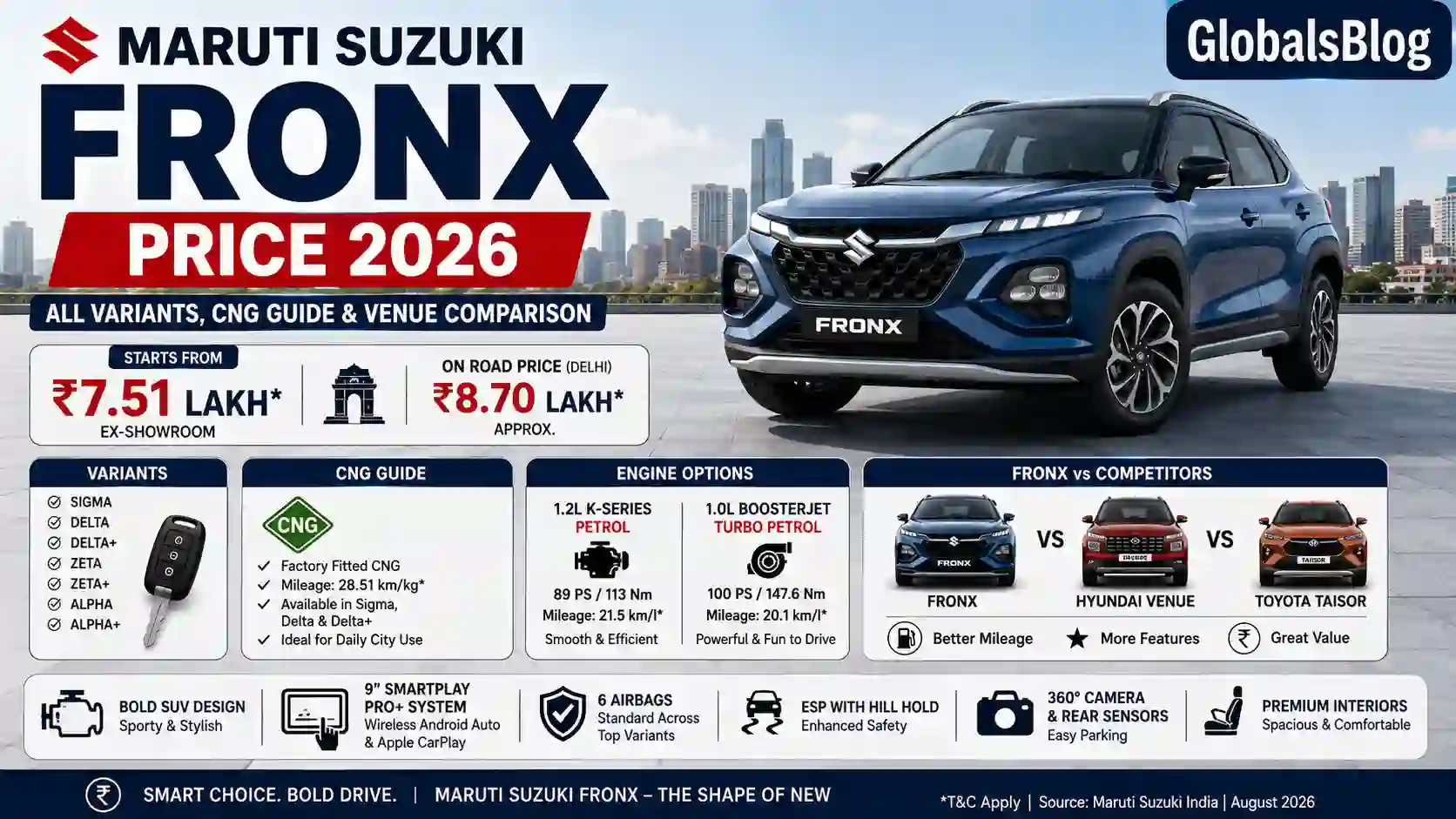
The Maruti Suzuki Fronx is a coupe-SUV built on the Baleno platform — bringing the Baleno's proven reliability, Maruti's 4,000+ service network, and a turbo petrol engine with CNG option into an SUV-styled package from ₹7.51 lakh ex-showroom. The strong hybrid mild-hybrid and CNG variants make it the most fuel-efficient coupe-SUV in India.
A reader from Pune had been comparing the Hyundai Venue, Kia Sonet, and Maruti Fronx for three months. The Venue had BlueLink. The Sonet had the best infotainment. The Fronx had one thing neither competitor offered at its price: factory CNG with a 25.51 km/kg efficiency and Maruti's 4,000+ service centre network. He drove 2,200 km per month commuting Pune to Lonavala — the running cost calculation was unambiguous. At ₹2.7/km CNG vs ₹7.5/km petrol, the annual saving was over ₹1 lakh. He bought the Fronx Zeta CNG. Six months later he said the only decision he questioned was not buying the Zeta+ CNG with the sunroof. This guide covers every Fronx variant, price, CNG guide, and the honest comparison with its compact SUV rivals.
Maruti Suzuki Fronx price (August 2026): Sigma ₹7.51L ex (base) to Alpha Turbo AT ₹13.03L ex (top). Key engines: 1.2L naturally aspirated petrol (90 PS, Sigma/Delta — entry variants), 1.0L Boosterjet turbo petrol (100 PS, Zeta+/Alpha), 1.2L CNG (88.5 PS, Sigma/Delta/Zeta variants, 25.51 km/kg ARAI). Best variant: Zeta+ Turbo MT (₹11.18L ex) for performance buyers, Zeta CNG (₹9.56L ex) for high-mileage city buyers. Rivals: Hyundai Venue (₹7.94L), Kia Sonet (₹7.99L), Toyota Taisor (rebadge of Fronx), Tata Nexon (₹8.10L). On road Delhi: ₹8.60L (base) to ₹14.95L (top).
Maruti Fronx Price — All Variants (August 2026)
| Variant | Engine | Ex-showroom | On Road Delhi (approx) | Key Feature |
|---|---|---|---|---|
| Sigma 1.2 MT | 1.2L Petrol 90 PS | ₹7.51L | ~₹8.60L | Base — entry SUV styling, Maruti reliability |
| Delta 1.2 MT | 1.2L Petrol 90 PS | ₹8.35L | ~₹9.58L | SmartPlay infotainment, rear parking sensors |
| Delta 1.2 CNG MT | 1.2L CNG 88.5 PS | ₹9.31L | ~₹10.68L | Factory CNG — 25.51 km/kg, city running cost |
| Zeta 1.2 MT | 1.2L Petrol 90 PS | ₹9.28L | ~₹10.64L | Sunroof, connected car, 6 airbags |
| Zeta 1.2 CNG MT | 1.2L CNG 88.5 PS | ₹9.56L | ~₹10.97L | CNG + sunroof — best city running cost with sunroof |
| Zeta+ 1.0 Turbo MT | 1.0L Boosterjet 100 PS | ₹11.18L | ~₹12.84L | Turbo engine, HUD, 360° camera, full features |
| Zeta+ 1.0 Turbo AT | 1.0L Boosterjet 100 PS | ₹12.18L | ~₹13.99L | Turbo + automatic — best city performance |
| Alpha 1.0 Turbo MT | 1.0L Boosterjet 100 PS | ₹12.01L | ~₹13.80L | Leather seats, premium finish, top manual |
| Alpha 1.0 Turbo AT | 1.0L Boosterjet 100 PS | ₹13.03L | ~₹14.95L | Top variant — all features + turbo auto |
All prices ex-showroom India, August 2026. The Fronx range spans from the Sigma base (₹7.51L) to the Alpha Turbo AT (₹13.03L). The critical choice is engine — the 1.2L naturally aspirated (Sigma/Delta/Zeta) versus the 1.0L Boosterjet turbo (Zeta+/Alpha). The CNG option is available only on the 1.2L non-turbo engine (Sigma, Delta, Zeta variants). There is no turbo CNG Fronx.
Fronx Engines — 1.2L vs 1.0L Turbo vs CNG
The 1.2L K-Series naturally aspirated petrol engine (90 PS, 113 Nm) is Maruti's most proven engine unit — used across Swift, Baleno, Dzire, and Grand i10 Nios, with decades of reliability and ownership data. In the Fronx, the 1.2L delivers adequate performance for city driving and 21.79 kmpl ARAI (real-world 17–20 kmpl highway, 14–17 kmpl city with AC). The engine is not turbocharged — it lacks the punch of the Boosterjet but is significantly more refined at low city speeds, easier on clutch-heavy traffic, and more fuel-efficient. The 1.2L also accepts the CNG fitment (factory CNG, not aftermarket) — making it the only engine in the Fronx lineup available with CNG. For buyers who primarily want a practical, reliable, fuel-efficient city SUV with Maruti's service coverage: the 1.2L is the correct engine. For buyers who want performance and enjoy driving: the Boosterjet is the right choice.
The 1.0L Boosterjet is the engine that makes the Fronx genuinely enjoyable to drive — a turbocharged 3-cylinder producing 100 PS and 148 Nm that delivers significantly more pull from low RPM than the 1.2L naturally aspirated. The 148 Nm peak torque arrives at 2,000 rpm (vs 4,400 rpm for the 1.2L), making the turbo Fronx considerably more responsive in city traffic and meaningful on overtakes above 80 km/h. The engine pairs with either a 5-speed MT or a 6-speed torque converter AT — the AT provides a smooth, comfortable automatic experience comparable to the XUV 3XO diesel AT's class in this segment. ARAI: 20.01 kmpl (MT), 17.01 kmpl (AT). Real-world: 15–17 kmpl city (MT), 14–16 kmpl city (AT). The Boosterjet is not available with CNG — buyers who want CNG must choose the 1.2L. The turbo adds approximately ₹2.7L over the equivalent 1.2L variant — justified for buyers who value driving character and performance over maximum fuel economy.
The Fronx CNG (factory-fitted, not aftermarket) is the most fuel-efficient compact SUV in India at 25.51 km/kg ARAI — more efficient than the Venue CNG (25.15 km/kg) and significantly more efficient than the Sonet (no factory CNG). The factory CNG fitment (as opposed to aftermarket conversions) comes with Maruti warranty coverage, no impact on engine warranty, and superior integration compared to kit CNG. The CNG engine produces 88.5 PS and 121.5 Nm in CNG mode (vs 90 PS / 113 Nm in petrol mode) — a marginal power reduction typical of bi-fuel CNG setups. At CNG prices of ₹75–95/kg in major Indian cities and 22–23 km/kg real-world efficiency, the per-km cost is approximately ₹3.26–4.32/km. Compared to the 1.2L petrol at ₹103/litre and 15 kmpl city: approximately ₹6.87/km. Annual saving for 2,000 km/month: ₹84,000–₹86,000. The Fronx CNG boot space: the CNG cylinder reduces boot capacity — plan accordingly for long-distance luggage. Available as: Delta CNG (₹9.31L) and Zeta CNG (₹9.56L — adds sunroof, connected car, and 6 airbags over Delta CNG).
Fronx vs Hyundai Venue vs Kia Sonet vs Tata Nexon
| Model | Starting Price | Turbo Petrol | CNG | ADAS | Service Network | Best For |
|---|---|---|---|---|---|---|
| Maruti Fronx | ₹7.51L ex | ✅ 100 PS Boosterjet | ✅ Factory 25.51 km/kg | ❌ | 4,000+ (widest in India) | CNG running cost, Maruti service, turbo performance |
| Hyundai Venue | ₹7.94L ex | ✅ 120 PS turbo | ✅ 25.15 km/kg | ❌ | 1,500+ | BlueLink, N Line variant, Hyundai reliability |
| Kia Sonet | ₹7.99L ex | ✅ 120 PS turbo | ❌ | ❌ | 900+ | Best infotainment, diesel MT/DCT, iMT gearbox |
| Tata Nexon | ₹8.10L ex | ✅ 120 PS turbo | ❌ | ✅ Top variants | 1,800+ | 5-star GNCAP, ADAS, EV option |
| Toyota Taisor | ₹7.74L ex | ✅ 100 PS (same Boosterjet) | ✅ 25.51 km/kg (same) | ❌ | 1,100+ | Toyota badge, Toyota Warranty+, same Fronx platform |
Fronx vs Venue — the key comparison: The Venue (₹7.94L ex base) is the Fronx's most direct rival at almost identical starting price. Venue advantages: 120 PS turbo (vs Fronx Boosterjet's 100 PS — 20% more power), BlueLink connected car is more mature and feature-rich than Maruti's connected car, Hyundai's 6-speed iMT gearbox option. Fronx advantages: Maruti's 4,000+ service centres (vs Hyundai's 1,500+ — a meaningful difference in tier-2 and tier-3 cities), CNG efficiency 25.51 vs 25.15 km/kg (marginal), factory CNG integration quality, and the Baleno platform's well-known long-term reliability track record. For buyers in cities with Maruti's dense service presence and a CNG infrastructure: Fronx. For buyers who want more turbo power and BlueLink connectivity: Venue.
Fronx vs Toyota Taisor: The Toyota Taisor is the rebadged Fronx — identical platform, identical engines, identical features, different styling and Toyota's warranty and service coverage (Toyota Warranty+ is noted for quality). The Taisor costs slightly less at equivalent variants (₹7.74L base vs ₹7.51L base Fronx, but mid-variants Taisor is typically ₹3,000–15,000 cheaper depending on variant). For buyers who value Toyota's brand reputation for long-term reliability and Toyota's service quality, the Taisor is the practical equivalent. Both are equally reliable platforms.
Which Fronx Variant to Buy?
The Zeta CNG MT at ₹9.56L ex is the recommended Fronx for high-mileage city buyers — the variant where the CNG efficiency advantage (25.51 km/kg, India's best in compact SUV CNG) is paired with the sunroof, connected car features, 360° camera, and 6 airbags of the Zeta trim. This is the configuration the Pune reader should have chosen over the Delta Zeta — the sunroof adds significant daily satisfaction at only ₹25,000 more than the Delta CNG (₹9.31L). For buyers covering 2,000+ km/month in cities with CNG infrastructure: the Zeta CNG running cost advantage over petrol equivalents pays back the premium in approximately 8–12 months.
The Zeta+ Turbo MT at ₹11.18L ex is the recommended Fronx for performance buyers — the first variant with the 1.0L Boosterjet turbo (100 PS, 148 Nm), combined with a Head-Up Display (HUD — rare in this segment at this price), 360° camera system, and the full Zeta feature set. The Boosterjet engine at 2,000 rpm peak torque delivers the kind of low-RPM shove that makes city overtaking and highway merging genuinely effortless — the 1.2L's 4,400 rpm torque peak requires more revving for the same result. The HUD projects speed and navigation information onto the windscreen — a premium feature not available in most competitors at this price point. At ₹12.84L on road Delhi, the Zeta+ Turbo MT competes with the XUV 3XO AX5 petrol DCT and the Nexon top turbo petrol — both of which offer more SUV presence but less driving character than the Boosterjet.
The Zeta+ Turbo AT at ₹12.18L ex is the recommended Fronx for city automatic buyers who want turbo performance without a clutch. The 6-speed torque converter AT paired with the Boosterjet is smooth at low city speeds (no DCT judder at 2–10 km/h) and responsive above 40 km/h where the turbo's torque peak at 2,000 rpm delivers effortless acceleration. At ₹13.99L on road Delhi, it overlaps with the XUV 3XO AX5 DCT and the Venue top petrol DCT — both are genuine comparisons worth test-driving. The Fronx AT's advantage: Maruti's service network; the competition's advantage: more SUV presence and, in the Nexon's case, better crash safety ratings.
✓ Maruti Fronx Buying Tips
- Maruti's 4,000+ service centre advantage is the real differentiator over Venue and Sonet: The Fronx vs Venue comparison is often decided on paper features (Venue has BlueLink, Fronx has better CNG efficiency). The practical differentiator in tier-2 and tier-3 cities — and in emergencies anywhere — is Maruti's 4,000+ service centres versus Hyundai's 1,500+ and Kia's 900+. For buyers who live in cities where Hyundai or Kia service centres are 30km away while a Maruti centre is 5km away, this is not a trivial consideration. Maruti's service cost per visit is also consistently lower than Korean brands
- The Toyota Taisor is worth comparing before buying the Fronx: The Taisor is the same car with Toyota's badge and warranty coverage. In some markets it is priced ₹10,000–₹30,000 below the equivalent Fronx variant. Toyota's reputation for long-term reliability and resale value is strong. If a Toyota service centre is as accessible to you as a Maruti one, the Taisor is worth a test drive alongside the Fronx before deciding
- CNG boot space trade-off is real — test before buying: The Fronx CNG has a cylinder in the boot that reduces boot capacity. If you regularly need to carry 3+ large bags, airport-level luggage, or equipment, test-drive the CNG variant's boot with your actual luggage before committing. For solo commuters or couples: the reduced boot is rarely a problem. For families taking road trips: measure carefully
- The Boosterjet's 3-cylinder note is an acquired taste: The 1.0L Boosterjet is a 3-cylinder engine — it produces more vibration at idle and a slightly different engine note than a 4-cylinder. Most buyers adapt quickly but if engine refinement is a priority, start the turbo Fronx at idle in the showroom before deciding. The 1.2L 4-cylinder is smoother at idle but less characterful above 3,000 rpm
- See our Maruti Baleno price guide — the Fronx's platform sibling as a hatchback option at lower price — and our Hyundai Venue price guide for the most direct competitor comparison
✗ Fronx Buying Mistakes to Avoid
- Buying CNG without verifying CNG station access on your route: The Fronx CNG's running cost advantage is only realised if you can fill CNG conveniently. Before buying any CNG vehicle, verify: the number of CNG stations within 5km of your home, office, and regular routes; whether queues at those stations are manageable for your schedule; and whether the city has consistent CNG supply (CNG availability varies by city and season). In Delhi, Mumbai, Pune, Ahmedabad, and most Tier-1 cities: CNG is widely available. In many Tier-2 cities: verify specifically
- Choosing the 1.2L petrol for highway-heavy use: The 1.2L naturally aspirated engine (90 PS, 113 Nm, peak torque at 4,400 rpm) is excellent for city use but requires significantly more effort on sustained highway overtaking above 90 km/h — the engine needs to be revved to its upper range for overtaking acceleration that the Boosterjet delivers lazily at 2,000 rpm. For buyers who regularly drive 100km+ highway stretches at speed: the Boosterjet is the right engine. The 1.2L's mileage advantage (21.79 vs 20.01 kmpl ARAI) is not significant enough to justify the performance gap on highway use
- Expecting Nexon-level SUV presence from the Fronx: The Fronx is a coupe-SUV built on the Baleno hatchback platform — the ground clearance (190mm) and exterior dimensions (3,995mm length) are closer to a hatchback than to the Nexon (4,032mm) or Venue (4,040mm). The coupe-SUV roofline is visually distinctive but reduces rear headroom compared to standard SUVs. Test-drive with your family before buying if rear passenger headroom is a priority
- Skipping the Zeta CNG sunroof for the cheaper Delta CNG: The Pune reader's regret is instructive — the ₹25,000 difference between Delta CNG (₹9.31L) and Zeta CNG (₹9.56L) adds the sunroof, 360° camera, connected car, and 6 airbags (vs 4 in Delta). At that price differential, the Zeta CNG is a materially better car. The sunroof in particular adds daily quality-of-life value that ₹25,000 buys very efficiently in no other category
⚠️ Disclaimer: Maruti Suzuki Fronx prices, variants, and specifications are subject to change. All prices listed are ex-showroom India as of August 2026. On road prices vary by state — Karnataka and Maharashtra buyers pay higher road tax than Delhi. CNG efficiency varies with gas quality and filling pressure. Verify current pricing and variant availability at your nearest authorised Maruti Suzuki dealer or on Maruti's official website.
Zeta CNG for City Running Cost. Zeta+ Turbo MT for Performance. Zeta+ Turbo AT for Smooth Automatic. Alpha for the Full Package. Maruti's 4,000+ Network Is the Real USP. The Fronx Is the Most Practical Compact SUV for CNG Cities.
The Pune reader's Zeta CNG decision — driven by running cost arithmetic, Maruti's service density, and the factory CNG warranty coverage — was the right call for his usage pattern. At 2,200 km/month city CNG, the annual saving over an equivalent petrol Venue is over ₹1 lakh. The Fronx is not the most powerful (Venue's 120 PS turbo) or the safest-rated (Nexon's 5-star GNCAP) or the most feature-rich (Sonet's infotainment) compact SUV. It is the most practical for a specific and important Indian buyer profile: high-mileage city commuters in CNG-infrastructure cities who want Maruti's unmatched service network and the industry's best factory CNG efficiency in a coupe-SUV package. At ₹9.56L ex for the Zeta CNG with sunroof, 360° camera, and 6 airbags, the Fronx makes that case better than any other compact SUV in India.
Maruti Suzuki Fronx price in India (August 2026): Ex-showroom from ₹7.51 lakh (Sigma 1.2L MT base) to ₹13.03 lakh (Alpha 1.0 Turbo AT top). Key variant prices: Sigma ₹7.51L, Delta 1.2L MT ₹8.35L, Delta CNG MT ₹9.31L, Zeta 1.2L MT ₹9.28L, Zeta CNG MT ₹9.56L, Zeta+ Turbo MT ₹11.18L, Zeta+ Turbo AT ₹12.18L, Alpha Turbo MT ₹12.01L, Alpha Turbo AT ₹13.03L. On road Delhi approximately ₹8.60L (base) to ₹14.95L (top). Engines: 1.2L naturally aspirated petrol (90 PS), 1.0L Boosterjet turbo (100 PS), 1.2L CNG (88.5 PS, 25.51 km/kg ARAI). CNG available on Sigma, Delta, and Zeta variants only — not on Boosterjet turbo variants. Toyota Taisor is the rebadged equivalent — compare prices before buying.
Maruti Fronx vs Hyundai Venue comparison (2026): Fronx advantages — Maruti's 4,000+ service centres (vs Venue's 1,500+, a critical differentiator in tier-2/3 cities), factory CNG at 25.51 km/kg ARAI (vs Venue CNG 25.15 km/kg, marginal difference), Baleno platform reliability track record, lower maintenance costs, Toyota Taisor equivalent for Toyota buyers. Venue advantages — 120 PS turbo petrol (vs Fronx Boosterjet's 100 PS, 20% more power), more mature BlueLink connected car (60+ features, stronger app), 6-speed iMT gearbox option (clutchless manual), Hyundai's N Line sporty variant option, and slightly more SUV dimensions (4,040mm vs Fronx 3,995mm). Both are reliable, well-priced compact SUVs. Verdict: Fronx for CNG cities + Maruti service density. Venue for more turbo power + BlueLink connectivity. Neither is objectively better — usage pattern and service centre accessibility drive the decision.
Maruti Fronx CNG is worth buying for buyers who cover 1,500+ km/month in cities with good CNG infrastructure. Key facts: 25.51 km/kg ARAI efficiency (highest in compact SUV CNG segment); factory-fitted (not aftermarket) — full Maruti warranty, better integration, safer installation; 88.5 PS in CNG mode (vs 90 PS petrol — marginal difference in daily use); real-world 22–23 km/kg city. Cost comparison at 2,000 km/month: CNG at ₹85/kg and 22 km/kg = ₹7,727/month. Petrol at ₹103/L and 15 kmpl city = ₹13,733/month. Annual saving: ₹72,072. CNG premium over equivalent petrol variant: approximately ₹40,000–₹50,000. Payback in 6–8 months for 2,000 km/month city driving. Considerations: boot space reduces with CNG cylinder; verify CNG station density on your specific routes; CNG mode only for city (for highway, switch to petrol for better pull). The Zeta CNG (₹9.56L) with sunroof is recommended over Delta CNG for ₹25,000 more — the feature additions are worth it.
Maruti Fronx mileage (August 2026): 1.2L petrol MT — 21.79 kmpl ARAI, real-world 17–20 kmpl highway, 14–17 kmpl city with AC. 1.0L Boosterjet turbo MT — 20.01 kmpl ARAI, real-world 16–18 kmpl highway, 14–16 kmpl city. 1.0L Boosterjet turbo AT — 17.01 kmpl ARAI, real-world 14–16 kmpl city. 1.2L CNG — 25.51 km/kg ARAI, real-world 22–23 km/kg city. The 1.2L petrol is the most fuel-efficient petrol variant; CNG is significantly more efficient with lower per-km cost. For maximum fuel economy on petrol: 1.2L MT, Eco drive mode, 70–80 km/h steady highway speed. For CNG buyers: real-world efficiency of 22 km/kg is reliable in normal city conditions; efficiency reduces in heavy AC use and stop-start traffic.
Maruti Fronx vs Toyota Taisor: The Taisor is a rebadged Fronx — identical platform, identical engines (1.2L petrol, 1.0L Boosterjet turbo, 1.2L CNG), identical features. The differences are badge, minor styling, and aftersales. Taisor advantages: Toyota brand reputation for long-term reliability and strong resale value, Toyota Warranty+ programme, Toyota service centre quality (typically higher customer satisfaction ratings than Maruti ARENA, though far fewer in number). Fronx advantages: Maruti's 4,000+ service centres nationwide (vs Toyota's 1,100+), significantly wider service accessibility in tier-2/3 cities, typically lower service costs. Pricing: comparable, Taisor sometimes ₹5,000–₹25,000 cheaper at equivalent variants (varies by city). Who should choose which: If a Toyota service centre is within 5km of your home or office and the service experience matters more than service centre count: Taisor. If Maruti's 4,000+ network density matters for your city or travel pattern: Fronx. Performance, fuel efficiency, and features are identical in both — the choice is entirely about brand and service preference.
Maruti Suzuki Fronx on road price in Delhi (August 2026): Sigma 1.2L MT approximately ₹8.60L; Delta 1.2L MT approximately ₹9.58L; Delta CNG MT approximately ₹10.68L; Zeta 1.2L MT approximately ₹10.64L; Zeta CNG MT approximately ₹10.97L; Zeta+ Turbo MT approximately ₹12.84L; Zeta+ Turbo AT approximately ₹13.99L; Alpha Turbo MT approximately ₹13.80L; Alpha Turbo AT approximately ₹14.95L. On road Delhi adds approximately 14–15% above ex-showroom (road tax approximately 4–6% for personal vehicles + first-year insurance + registration + handling). Karnataka and Maharashtra buyers pay approximately ₹60,000–₹1.2L more than Delhi for equivalent variants due to higher state road tax rates. Always obtain an itemised on road price quote from your Maruti dealer before finalising — prices are indicative as of August 2026.
Leave a comment
Share a quick thought about this story.
Thanks for sharing your view. It is ready for review.
Please try again in a moment.