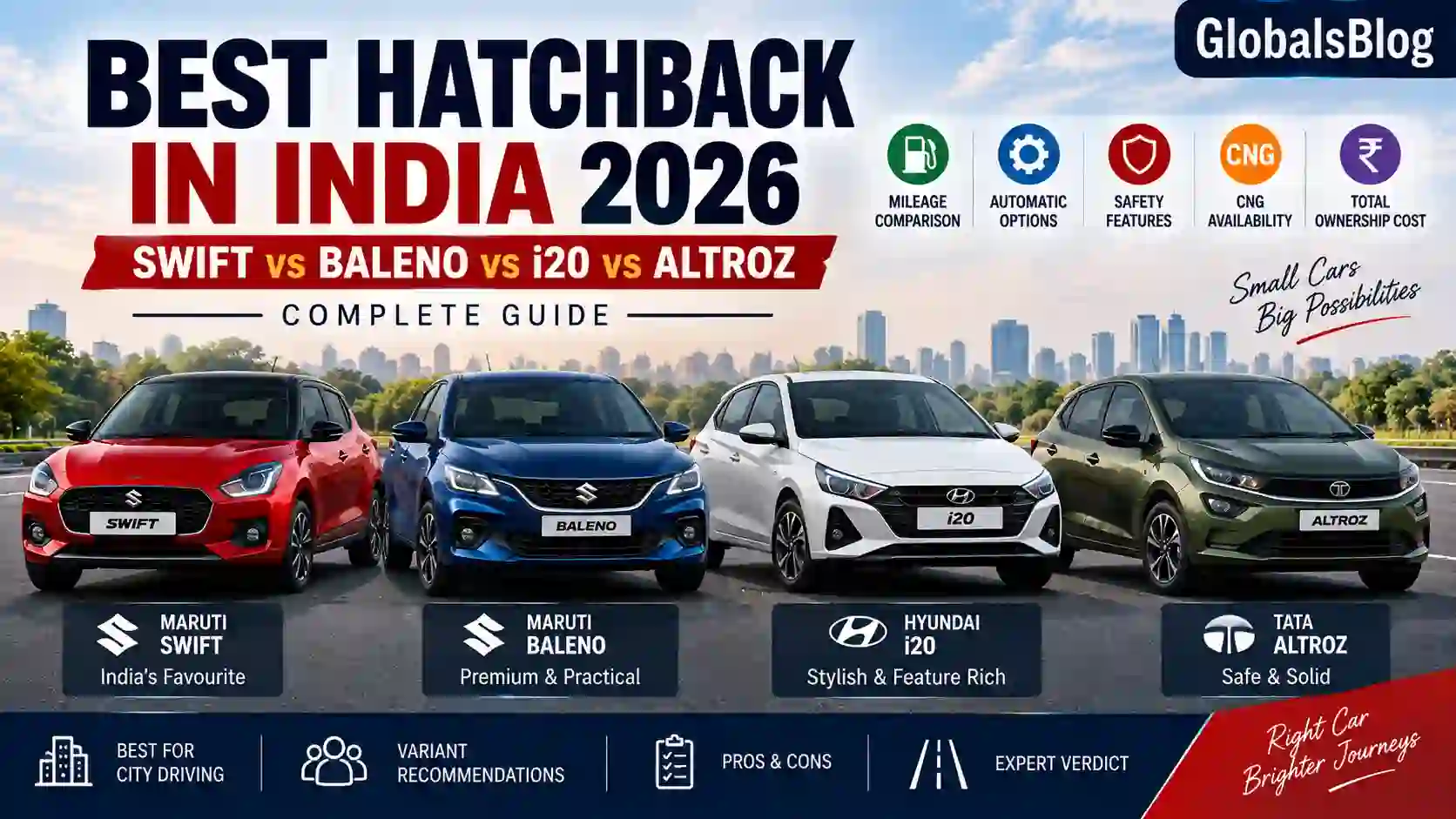
SUVs now account for over 60% of Indian car sales — but the hatchback segment remains the most rational choice for most Indian city drivers. Tight parking, bumper-to-bumper traffic, a ₹6–10 lakh budget, and a requirement for the most reliable service network in the country: the hatchback solves all four simultaneously better than any other segment.
A government teacher from Lucknow bought a Hyundai Creta because her colleagues all drove SUVs and it seemed like the aspirational choice. Eighteen months later she sold it and bought a Maruti Swift. The Creta's turning radius made the school's parking lot a daily ordeal. The road tax on a ₹13L car in UP was ₹1.2L. The EMI on a ₹15L on-road vehicle consumed 40% of her monthly take-home. The Swift at ₹7.5L on-road fit in every parking space, cost ₹65,000 road tax, had an EMI that left her financial life intact, and was serviced at a Maruti dealer 1.2km from her house. "The SUV was the wrong car for my actual life," she told a colleague who was about to make the same mistake. This guide is for buyers who want to make the right choice — not the aspirational one.
Best overall: Maruti Swift (₹6.49L ex) — 24.6 kmpl ARAI, 5-star GNCAP, 6-speed AMT automatic, best resale. Best premium: Maruti Baleno (₹6.61L ex) — Head-Up Display, larger cabin, CVT automatic, most features. Best features: Hyundai i20 (₹6.99L ex) — sunroof, 10.25-inch screen, 6 airbags, most premium feel. Best safety: Tata Altroz (₹6.65L ex) — 5-star GNCAP, iCNG dual-cylinder, DCA automatic. Best CNG: Tata Altroz iCNG (₹7.85L ex) or Maruti Swift CNG (₹8.19L ex). Best value automatic: Swift AMT (₹7.49L ex) — cheapest automatic hatchback with 5-star safety. Festive season (Oct–Nov): best exchange bonuses on Swift and Baleno.
Best Hatchbacks India 2026 — Complete Ranking
The 2024-generation Maruti Swift (4th-gen global model, launched India February 2024) is the benchmark Indian hatchback — not because it is the most feature-loaded or the most technologically advanced, but because it optimises every dimension that matters for Indian city ownership simultaneously. The 1.2L Z-series dual-jet petrol engine delivers 24.6 kmpl ARAI — the highest mileage of any petrol hatchback in India, full stop. The 5-star Global NCAP rating means safety is not compromised for the lower price. The 6-speed AMT automatic (₹7.49L ex) is the cheapest automatic transmission in any 5-star safety hatchback in India. Maruti's 6,000+ service centres mean that wherever you live in India — Tier 1, 2, or 3 city — you are within practical distance of an authorised workshop. The resale value at 3 years (60–65% retention) is the highest in the hatchback segment. The Swift's one acknowledged weakness: the cabin is the smallest among its direct competitors, and the 268L boot is modest. If boot space and cabin width matter more than mileage and running cost, the Baleno is the better Maruti.
The Maruti Baleno sits one segment above the Swift in Maruti's lineup — same service network advantage but with a distinctly larger and more premium cabin. The Baleno's 318L boot (vs Swift's 268L) and wider rear seat are the two practical differences most owners notice daily. The signature feature of the Baleno's higher variants is the Head-Up Display (HUD) — a small transparent screen that projects speed and navigation data onto the windshield, a feature previously found only in cars costing ₹20L+, which Maruti brought to ₹8–9L. The CVT automatic (smoother than the Swift's AMT in city traffic) is available from ₹8.46L ex. The Baleno's 1.2L DualJet engine (90hp) delivers 22.35 kmpl ARAI — slightly less than the Swift but still among the best in class. The cabin uses slightly better materials than the Swift and the overall feel is marginally more refined. Toyota sells the identical car as the Toyota Glanza — same specifications, same factory, Toyota dealership network (worth considering if Toyota's service density is better in your city than Maruti's).
The Hyundai i20 is the most feature-rich hatchback in India — the car that brings segment-first features to the ₹7–11L price band with each generation. The current i20 offers a 10.25-inch touchscreen (the largest in any hatchback), a sunroof (rare in the segment), BlueLink connected car technology, and an N Line sporty variant for driving enthusiasts. Six airbags are standard on mid and top variants. The 1.2L NA petrol (88hp) and 1.0L Turbo GDi (120hp) engines cover both regular commuter and driving-enthusiast needs — the turbo manual i20 N Line (₹10.49L ex) is the only performance-oriented hatchback available in India under ₹11L. The i20's weaknesses relative to Maruti: lower fuel efficiency (19.65 kmpl MT vs Swift's 24.6 kmpl), Hyundai's smaller service network (1,300+ vs Maruti's 6,000+), and 10–15% lower resale value at 3 years. In a city with strong Hyundai dealer access, the i20's feature richness may outweigh these trade-offs. In a Tier 2 or 3 city where Maruti has 5 dealers and Hyundai has 1: the mileage and service calculus strongly favours the Swift or Baleno.
The Tata Altroz has the most diverse powertrain lineup of any Indian hatchback — petrol (1.2L NA), diesel (1.5L, the only diesel hatchback in India), factory-fitted dual-cylinder iCNG (the only CNG system that does not eat into the boot space), and a DCA (Dual Clutch Automated) automatic gearbox. The 5-star Global NCAP rating matches the Swift's — and Tata's reputation for structural safety has been reinforced by multiple NCAP tests across their range. The iCNG variant (₹7.85L ex) is particularly noteworthy: Tata's proprietary twin-cylinder CNG system fits the tanks under the boot floor rather than in the boot itself, preserving the full 345L boot space that competitors sacrifice when fitting aftermarket CNG. The Altroz's weaknesses: slightly firmer ride quality than the Swift or i20, the interior quality does not match Hyundai's i20 at equivalent prices, and Tata's service network — while expanding — is still smaller than Maruti's in most cities outside Maharashtra and Gujarat.
Volkswagen discontinued the Polo in India in 2022 — a significant loss for buyers who wanted European driving dynamics in a hatchback. As of September 2026, no direct replacement has been launched. Skoda similarly has no hatchback in the Indian market (the Fabia is not sold here). The VW-Skoda India hatchback gap is real and unfilled — buyers who want the Polo's driving character in 2026 are left choosing between the i20 N Line turbo (closest in spirit, better feature content, but CVT/iMT rather than DSG) or waiting for an announced but unlaunched European VW hatchback for India. For buyers specifically seeking the enthusiast hatchback experience: the Hyundai i20 N Line 1.0 Turbo MT (₹10.49L ex) is currently the closest available alternative.
Head-to-Head Comparison — September 2026
| Model | Base Price | Best AT | ARAI Mileage | Boot | Airbags | Service | Best For |
|---|---|---|---|---|---|---|---|
| Maruti Swift | ₹6.49L | AMT ₹7.49L | 24.6 kmpl | 268L | 2–6 | 6,000+ | Mileage, resale, running cost |
| Maruti Baleno | ₹6.61L | CVT ₹8.46L | 22.35 kmpl | 318L | 2–6 | 6,000+ | Boot space, HUD, cabin size |
| Hyundai i20 | ₹6.99L | CVT ₹8.99L | 19.65 kmpl | 311L | 2–6 | 1,300+ | Features, sunroof, turbo option |
| Tata Altroz | ₹6.65L | DCA ₹8.99L | 19.06 kmpl | 345L | 2–6 | ~1,500 | Safety, diesel, iCNG, DCA |
Which Hatchback to Buy — Decision Guide
| Your Priority | Best Pick | Why |
|---|---|---|
| Best mileage + lowest running cost | Maruti Swift | 24.6 kmpl ARAI — highest of any petrol hatchback in India |
| Automatic at lowest price | Swift AMT VXi (₹7.49L ex) | Cheapest 5-star safety hatchback with automatic in India |
| Largest cabin + boot | Baleno / Altroz | Altroz 345L boot (iCNG no loss), Baleno 318L, Swift 268L |
| Most features and premium feel | Hyundai i20 | Sunroof, 10.25" screen, BlueLink, ADAS — segment-first features |
| CNG without boot sacrifice | Tata Altroz iCNG | Only hatchback with twin-cylinder CNG — full boot preserved |
| Diesel hatchback | Tata Altroz Diesel | Only diesel hatchback sold in India in 2026 |
| Best resale value | Maruti Swift or Baleno | 60–65% at 3 years — Maruti leads hatchback resale consistently |
| Driving enthusiast | i20 N Line 1.0 Turbo | 120hp turbo, closest to Polo-character performance available |
✓ Hatchback Buying Tips — India September 2026
- The hatchback saves more money than you think — the road tax difference alone justifies it: A car at ₹6.5L ex-showroom pays approximately 7–8% road tax in most states (₹45,000–52,000 in Delhi). A compact SUV at ₹13L ex-showroom pays the same percentage on a much larger base (₹91,000–1,04,000 in Delhi). The hatchback saves approximately ₹50,000 in road tax alone — money you keep. Add the lower EMI, lower insurance premium (first-year comprehensive on a ₹6.5L car vs ₹13L car is roughly ₹18,000 vs ₹40,000), and lower fuel cost (Swift 24.6 kmpl vs Creta 17.4 kmpl at ₹105/L petrol = ₹28,000 annual fuel saving at 15,000 km/year). The total ownership cost difference over 3 years between a top Swift and a base Creta is approximately ₹2.5–3.5 lakh in the hatchback's favour — before resale
- AMT is better than its reputation for city driving: The Swift AMT's automated manual gearbox has a worse reputation than it deserves — early AMT systems in India (pre-2020) had jerky behaviour at low speeds. The Swift's 6-speed AMT (2024 generation) is significantly smoother, particularly in creep mode for traffic. For pure city driving (under 60 km/h, stop-and-go, parking), the AMT is functionally adequate. Its weakness is on highways above 80 km/h where the occasional gear-hunt is noticeable. The Baleno CVT and i20 CVT are smoother automatics — worth the ₹500–800 premium if smooth transmission feel is important to you
- Festive season (October–November) exchange offers are the hatchback segment's best deal: The high-volume hatchback segment sees the most aggressive dealer-level exchange bonuses during the festive season — typically ₹25,000–50,000 over the standard trade-in value for your old car. On a ₹7–9L purchase, this represents a 3–6% effective discount that makes October the genuinely best month to buy a Swift or Baleno. Add corporate discount (if applicable) and loyalty bonus (if existing Maruti owner) and the total discount can reach ₹60,000–80,000 on a ₹9L car
- In Tier 2 and Tier 3 cities, the Maruti service network advantage is not abstract — it is a daily quality of life factor: The Lucknow teacher's decision to return to the Swift was partly about parking but also partly about service. A Maruti service centre in most Tier 2 cities has 5–8 year trained technicians, genuine spare parts at fixed transparent prices (Maruti publishes service rate cards), and typically 2–5 alternatives within the city. In non-metro cities, competing brands may have 1 or 2 authorised service points. The difference in convenience — same-day service vs booking 2 weeks ahead, knowing the price before you go vs negotiating every time — compounds over 5 years of ownership
- For the complete budget breakdown and on-road price, see our complete India car buying guide — hatchback to SUV to EV
✗ Hatchback Buying Mistakes to Avoid
- Buying an SUV because it seems more aspirational for your income level: The Lucknow teacher's mistake is India's most common car buying mistake — choosing a car for its social signal rather than for its fit with the actual life it will be used in. An SUV in a city with narrow lanes and limited parking is a daily friction point. A hatchback in that same city is a daily convenience. The car that makes your actual life easier is always the better car, regardless of what your colleagues drive
- Dismissing the Swift AMT for not being a "proper automatic": The Swift AMT's lack of a traditional CVT or torque converter is a real specification — but the practical difference for city-primary drivers (the target audience for the Swift AMT) is smaller than online auto forums suggest. Test drive the Swift AMT in actual city traffic — slow-speed creep mode, parking in a tight space, stop-and-go — and make the judgement in real conditions, not from specs. Many buyers who drive it are surprised by how smooth it is at the speeds they actually use
- Choosing the i20 over the Baleno purely because of the sunroof without verifying service access: The Hyundai i20's sunroof is a genuinely popular feature — but in a city where Hyundai has one service centre vs Maruti's four, the sunroof does not make up for the service access difference over 5 years. If you are in Mumbai, Delhi, Bengaluru, Hyderabad, Chennai, or Pune — Hyundai service access is fine. In most other cities, do the specific check: which brand has more authorised service points within 15km of your home, and what are the current service rate cards?
- Buying a base hatchback without 6 airbags when it costs only ₹50,000–70,000 more to get them: The base variants of the Swift (LXi, VXi) and Baleno (Sigma, Delta) have 2 airbags. The mid variants (Swift ZXi, Baleno Zeta) have 6 airbags for approximately ₹50,000–70,000 more. The difference between 2 and 6 airbags in a side-impact collision is the difference between head curtain airbag deployment and no curtain coverage. Given the high rate of side-impact accidents on Indian roads, spending ₹50,000 more for 4 additional airbags — on a 5-year ownership — is ₹10,000 per year for meaningful additional safety coverage
⚠️ Disclaimer: All prices are ex-showroom India as of September 2026 and subject to change with manufacturer revisions. On-road prices vary by state — road tax in Karnataka is higher than Delhi for equivalent vehicles. Fuel efficiency figures are ARAI-certified; real-world mileage varies 15–20% below ARAI in city conditions. Festive season offers are dealer-specific — verify current exchange and corporate bonuses at your nearest dealership before purchase. Service centre counts are approximate and change as dealer networks expand.
Swift for Mileage and Resale. Baleno for Boot and HUD. i20 for Features and Sunroof. Altroz for Safety and Diesel. All Four Under ₹11L. The Hatchback Is Not the Compromise — The Wrong Car Is.
The Lucknow teacher sold the Creta and bought the Swift — and describes the switch as one of the best financial and practical decisions she made that year. The hatchback she dismissed as a compromise turned out to be the correct car for her parking space, her budget, her commute, and her city. The aspirational car she chose instead cost her ₹1.2L in road tax, a daily parking ordeal, an EMI that consumed 40% of her take-home, and eventually the decision to go back to the right car. India's car market offers four genuinely excellent hatchbacks in 2026 — each with a clearly defined strongest suit. The right one for you is the one that fits your actual life, not the one that looks most impressive on the weekend.
Best hatchbacks in India (September 2026): Best overall: Maruti Swift (₹6.49L ex) — 24.6 kmpl ARAI (highest petrol hatchback), 5-star GNCAP, 6-speed AMT available, 6,000+ service centres, best resale value. Best premium: Maruti Baleno (₹6.61L ex) — Head-Up Display, 318L boot (largest hatchback), CVT smooth automatic, same Maruti service advantage. Best features: Hyundai i20 (₹6.99L ex) — sunroof, 10.25" screen, BlueLink connected tech, 6 airbags, 1.0L Turbo option. Best safety + versatility: Tata Altroz (₹6.65L ex) — 5-star GNCAP, iCNG with no boot loss (₹7.85L), only diesel hatchback in India, DCA automatic. Best budget automatic: Swift AMT VXi (₹7.49L ex) — cheapest 5-star automatic hatchback. Best enthusiast: i20 N Line 1.0 Turbo MT (₹10.49L ex) — only performance hatchback under ₹11L in India.
Maruti Swift vs Hyundai i20 (2026): Swift wins on — fuel efficiency (24.6 kmpl vs i20's 19.65 kmpl — a ₹20,000+ annual saving at 15,000 km/year), service network (6,000+ vs 1,300+ dealers), resale value (60–65% at 3 years vs i20's 50–55%), lower on-road price at equivalent variants, AMT automatic at lower price point. i20 wins on — feature content (sunroof, 10.25" screen, BlueLink connected car), interior premium feel, turbo engine option (120hp vs Swift's 82hp), 6 airbags more widely across variants. Decision: if your primary concerns are running cost, service access in a non-metro city, and resale value — Swift. If you are in a major metro with good Hyundai access and want the best features and a sunroof — i20. The Swift's 24.6 vs i20's 19.65 kmpl mileage gap translates to approximately ₹4,400/month in fuel savings at 1,500 km/month at ₹105/L petrol.
Hatchback vs SUV — when a hatchback is the better choice: In Indian city conditions, a hatchback is superior to a compact SUV if: your parking space is narrow (column parking, multi-level car parks, office basement) — hatchbacks are typically 15–30cm narrower and shorter than compact SUVs; your budget is ₹10L or below on-road — the best compact SUVs start at ₹11–12L on road while the best hatchbacks are ₹7–9L; your annual driving is mostly city under 12,000 km — the SUV's higher road clearance advantage is unused in city conditions; you prioritise fuel efficiency — the Swift's 24.6 kmpl vs a compact SUV's 17–18 kmpl at the same speed saves ₹20,000–30,000 annually at 15,000 km/year. An SUV is better than a hatchback if: you regularly drive on unpaved roads, speed breakers, or waterlogged stretches where ground clearance (160–200mm) matters; your family regularly has 4–5 adults and needs the space; or you drive significant highway distances where the SUV's stability advantage is real. For pure city commuting with a tight budget: the hatchback is the more rational choice in the majority of Indian use cases.
Best mileage hatchbacks in India (September 2026): Maruti Swift petrol MT — 24.6 kmpl ARAI (highest petrol hatchback). Maruti Swift AMT — 25.75 kmpl ARAI (highest of any petrol hatchback automatic). Maruti Baleno CVT — 22.94 kmpl ARAI. Maruti Baleno MT — 22.35 kmpl. Hyundai i20 CVT — 24.1 kmpl. Tata Altroz iCNG — 25.11 km/kg (CNG, not petrol comparison). Hyundai i20 MT — 19.65 kmpl. Tata Altroz petrol MT — 19.06 kmpl. Real-world mileage in city conditions: subtract 18–22% from ARAI figures. Swift real-world city: approximately 18–20 kmpl. Baleno real-world city: 17–19 kmpl. i20 real-world city: 14–16 kmpl. For CNG: Altroz iCNG at 25.11 km/kg × CNG price ₹95/kg (Delhi September 2026) = running cost ₹3.78/km vs Swift petrol at ₹105/L ÷ 20 kmpl = ₹5.25/km — CNG advantage ₹1.47/km or ₹22,000/year at 15,000 km.
Best automatic hatchbacks under ₹10 lakh in India (September 2026): Maruti Swift AMT VXi (₹7.49L ex, ₹8.69L on road Delhi) — best value 5-star safety automatic. 6-speed AMT, 25.75 kmpl ARAI. Adequate for city driving, minor gear-hunt on highway. Maruti Baleno Delta+ CVT (₹8.46L ex, ~₹9.79L on road Delhi) — smoothest automatic under ₹10L on road, CVT ideal for city stop-and-go, HUD included. 22.94 kmpl ARAI. Best premium automatic under ₹10L. Hyundai i20 Sportz CVT (₹8.99L ex) — 10.25" screen, CVT smooth auto, features richest automatic under ₹10L. 24.1 kmpl ARAI. Tata Altroz XZ DCA (₹8.99L ex) — Dual Clutch Automated, faster gear changes than AMT or CVT, sportier character. 5-star GNCAP. Summary: For smoothest city automatic — Baleno CVT. For most features — i20 CVT. For best mileage + lowest price — Swift AMT. All three comfortably under ₹10L on road in Delhi (add 5–8% in Karnataka).
Safest hatchbacks in India (September 2026): Tata Altroz — 5-star Global NCAP, 6 airbags on mid and top variants, highest structural safety score in Indian hatchback segment testing. The Altroz's body structure showed best-in-class protection in the GNCAP's adult occupant protection test for Indian hatchbacks. Maruti Swift (2024 generation) — 5-star Global NCAP, 6 airbags on top variants (ZXi and ZXi+), significant safety improvement over the previous generation. 2 airbags on base variants — check the specific variant you are buying. Hyundai i20 — 5-star Euro NCAP in global spec. In India spec: 6 airbags on Sportz and above. Level 1 ADAS (forward collision warning, lane keep assist) on Asta top variant. Standard safety (ABS, EBD, ESC) across all variants. The safest buying decision: choose a variant with 6 airbags across all three cars — the ₹50,000–70,000 premium over 2-airbag base variants for 4 additional airbags (including critical side curtain airbags) is meaningfully worthwhile over a 5-year ownership period on Indian roads.
Leave a comment
Share a quick thought about this story.
Thanks for sharing your view. It is ready for review.
Please try again in a moment.