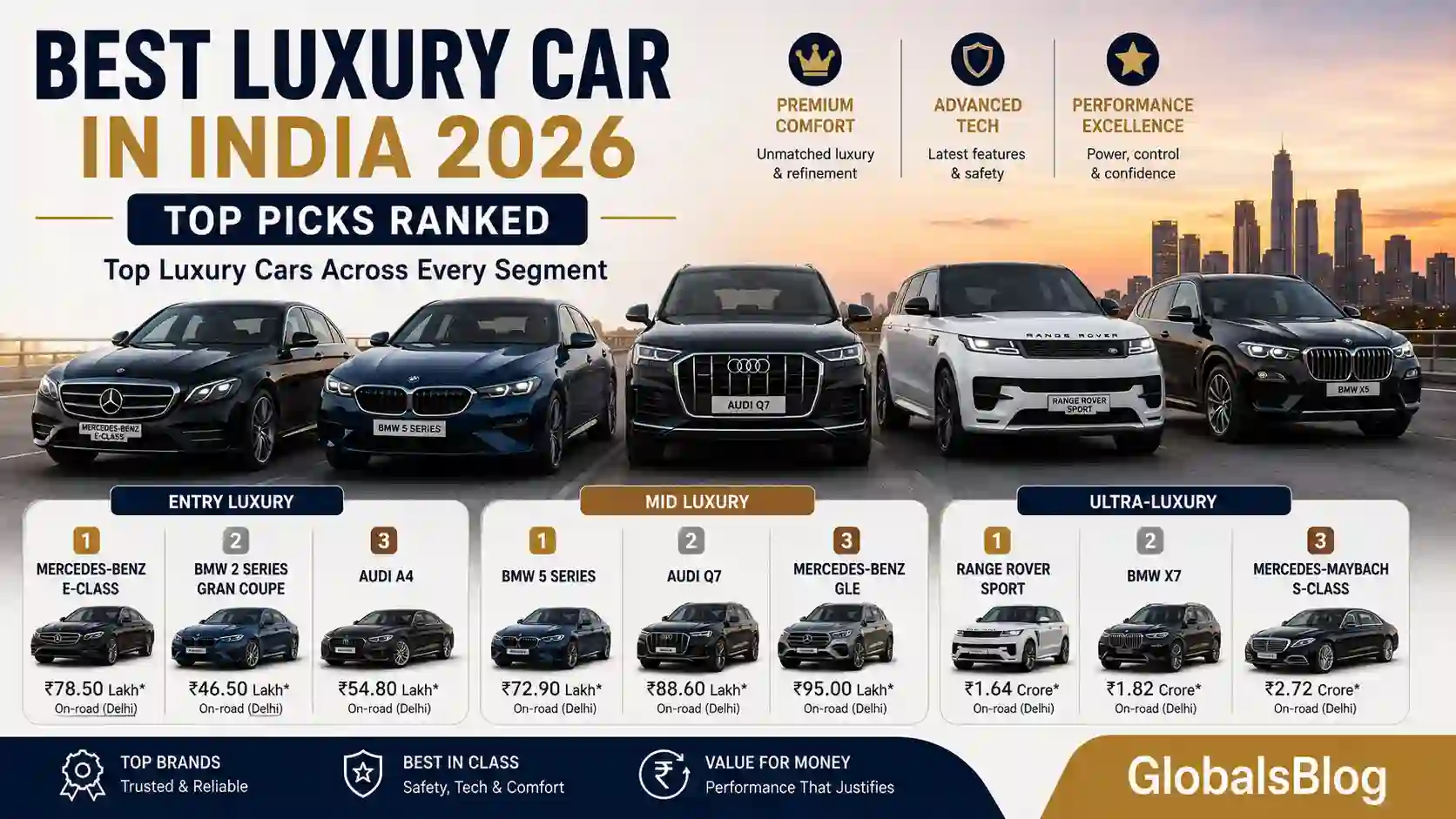
Luxury cars in India span ₹40 lakh to ₹5 crore. Knowing which segment matches your actual needs saves more than just money.
A reader from Mumbai described his situation precisely — ₹60 lakh budget, wanted to "feel like a luxury car" but was not sure if that meant Mercedes, BMW, a top-spec Jeep, or a loaded Tata Safari. He had been test-driving all four without a clear framework for what he was actually buying. The answer depended entirely on how he planned to use the car — owner-driven versus chauffeur-driven, highway versus city, and whether the badge mattered to him professionally or purely personally. This guide gives that framework before the recommendations.
The best luxury cars in India in 2026 are the Mercedes-Benz C-Class (best entry luxury sedan), BMW X1 (best entry luxury SUV), Mercedes GLC (best mid-luxury SUV), BMW 5 Series (best executive sedan), and Mercedes E-Class (best chauffeur-driven sedan). For Indian buyers considering near-luxury options at lower cost, the Jeep Meridian and Tata Harrier in top spec deliver significant luxury feel at ₹30-40 lakh — before the true luxury segment begins around ₹45-50 lakh.
How to Think About Luxury Cars in India — Three Segments
India's luxury car market has three genuinely distinct segments with different value propositions, different buyer profiles, and different ownership experiences.
Near-luxury (₹25-45 lakh): Top-spec Indian and Korean SUVs — Tata Harrier/Safari top variants, Hyundai Tucson, Jeep Meridian. These offer significant luxury features (panoramic roof, ventilated seats, ADAS, premium audio) without the service cost, depreciation, or badge of genuine German luxury. The honest choice for buyers who want luxury features over luxury branding.
Entry luxury (₹45-70 lakh): Mercedes C-Class, BMW 2 Series Gran Coupe, Audi A4, Volvo S60. These are genuine German luxury badges at the lowest rung of the segment. Service costs are meaningfully higher than mass-market cars, depreciation is significant, but the badge, interior quality, and driving experience are genuinely in a different category from near-luxury Indian SUVs.
Mid-to-premium luxury (₹70 lakh-₹2 crore): Mercedes E-Class, GLC, BMW 5 Series, X3, X5, Audi A6, Q5, Q7. The heart of Germany's India luxury market — where most business buyers, executives, and serious enthusiasts operate. Chauffeur-driven sedans like the E-Class and owner-driven SUVs like the X5 serve fundamentally different needs within this segment.
Best Luxury Cars in India 2026 — By Segment
The C-Class remains India's benchmark entry luxury sedan — combining the Mercedes three-pointed star's aspirational value with a genuinely premium interior that the current W206 generation significantly upgraded from its predecessor. The vertical touchscreen, 64-colour ambient lighting, and MBUX infotainment system deliver an interior that punches well above the entry luxury price point. The 2.0L petrol engine delivers adequate performance for Indian conditions without the diesel complexity some buyers prefer to avoid. Where the C-Class particularly excels for India is rear seat comfort — unusually spacious for its class and often specified by buyers who are primarily rear passengers rather than drivers.
The third-generation BMW X1 is a genuinely strong entry luxury SUV for India — the curved display combining instrument cluster and infotainment is genuinely impressive for the price point, the 2.0L petrol delivers spirited performance, and the relatively compact footprint makes it practical for Indian city traffic where the larger X3 and X5 can become unwieldy. The locally assembled X1 also benefits from significantly lower on-road pricing versus fully imported alternatives. For owner-driven entry luxury SUV buyers who prioritise driving dynamics over rear seat space — the X1's rear legroom is merely adequate — this is consistently our recommendation over the C-Class crossover and Audi Q3.
The new GLC is the heart of Mercedes India's volume sales — combining the brand's most aspirational visual design with genuinely excellent interior quality and the rear seat space that Indian buyers in this segment consistently prioritise. The MBUX Hyperscreen option in higher variants delivers one of the most visually striking interiors available in India under ₹1 crore. The 2.0L mild-hybrid petrol provides real-world efficiency improvement alongside adequate performance. For buyers stepping from the C-Class to a larger premium SUV with genuine rear seat luxury, the GLC is the natural Mercedes upgrade path and consistently outsells its BMW X3 rival in India.
The G60 fifth Series represents BMW's most significant executive sedan upgrade in years — a curved display system, available rear screen entertainment, and a level of rear seat comfort that makes it genuinely competitive with the Mercedes E-Class for chauffeur-driven use. The M Sport specification gives it visual aggression that the more conservative E-Class deliberately avoids. For owner-drivers who want genuine driver engagement alongside executive sedan refinement, the 5 Series delivers what the E-Class cannot — a car that rewards spirited driving rather than simply isolating the driver from it. At ₹72-88 lakh it sits at a meaningful premium over the C-Class but justifies it with a significantly larger, more feature-rich product.
The E-Class LWB (Long Wheelbase) version sold in India is specifically designed for chauffeur-driven rear seat occupancy — the stretched rear legroom, reclining rear seats, business-class level rear amenities, and exceptionally smooth ride tuning make it India's definitive executive chauffeuring sedan. Mahindra's ownership of the locally assembled facility has brought pricing to competitive levels for this class. For corporate buyers and business executives who spend significant time in the rear seat, the E-Class LWB is the most directly applicable luxury car recommendation in India regardless of the competition — nothing at a similar price point matches its specific rear-seat focus for Indian usage patterns.
Luxury Car Comparison — India 2026
| Model | Segment | Price Range | Drive Style | Verdict |
|---|---|---|---|---|
| BMW X1 | Entry Luxury SUV | ₹49–56L | Owner-driven | Best Entry Luxury SUV |
| Mercedes C-Class | Entry Luxury Sedan | ₹57–62L | Owner/Rear | Best Entry Luxury Sedan |
| BMW 5 Series | Executive Sedan | ₹72–88L | Owner-driven | Best Driver's Sedan |
| Mercedes GLC | Mid-Luxury SUV | ₹77–85L | Owner/Family | Best Mid-Luxury SUV |
| Mercedes E-Class LWB | Executive Sedan | ₹78–92L | Chauffeur-driven | Best Chauffeur Sedan |
Mercedes dominates this list — reflecting its consistent position as India's best-selling luxury car brand. BMW competes most effectively in the entry luxury SUV (X1) and driver-focused segments (5 Series, X3, X5). Audi's Q5 and A6 are strong alternatives to equivalent BMW and Mercedes models but are covered more fully in our dedicated electric and best car guides.
The Near-Luxury Case — Before Spending ₹50 Lakh
This section exists because the honest answer to many "I want a luxury car" conversations is that near-luxury Indian and Korean SUVs at ₹30-40 lakh deliver a significant proportion of the luxury experience at a meaningfully lower total cost.
The top-spec Tata Harrier or Safari (₹26-28 lakh), loaded Hyundai Tucson (₹36-40 lakh), and Jeep Meridian (₹37-43 lakh) all offer panoramic sunroofs, ventilated front seats, premium audio systems, ADAS features, and genuinely premium interiors that compete favourably with entry luxury German cars on features — while costing 30-40% less to buy, significantly less to service, and depreciating far less aggressively.
The genuine luxury car value proposition over near-luxury is threefold: the brand badge and its social/professional signalling, the specific interior material quality and design language that German brands consistently deliver at a different level, and for driving enthusiasts, the chassis and powertrain refinement. If any of these three genuinely matter for your situation, the luxury price is justified. If primarily features and comfort drive the decision, the near-luxury segment deserves serious consideration first.
Tips for Buying a Luxury Car in India
- Budget for service costs realistically — German luxury car services typically cost ₹25,000-₹60,000 per service versus ₹5,000-₹12,000 for mass-market cars
- Factor in depreciation — luxury cars in India depreciate significantly faster than mass-market cars, losing 15-20% in year one and 40-50% by year three
- Compare locally assembled versus imported models — locally assembled Mercedes and BMW models have meaningfully lower on-road pricing than equivalent imported variants
- Test drive specifically in Indian road conditions — speed breakers, potholes, and city traffic reveal ride quality differences that showroom experiences cannot
- Check extended warranty availability before purchase — luxury car ownership after warranty expiry significantly increases cost exposure
- Our best car insurance guide covers which insurers handle luxury car claims most effectively — important given higher repair costs
Luxury Car Buying Mistakes in India
- Not factoring total cost of ownership versus purchase price — The Mumbai reader at the start of this article was comparing ₹60 lakh options without accounting for the fact that a Mercedes E-Class at ₹85 lakh with lower depreciation can sometimes cost less to own over 5 years than a C-Class at ₹60 lakh with faster depreciation and similar service costs.
- Buying German luxury purely for features when a near-luxury Indian SUV delivers comparable features at 30-40% lower cost and service expense
- Choosing AMG or M performance variants without regular high-performance driving use — the premium is substantial and the benefit is purely available in environments that allow the performance to be used
- Ignoring resale planning — luxury car resale in India benefits significantly from low odometer readings, original service history, and popular colours (white, black, silver)
- Not verifying parts availability in your city — some luxury models have limited authorised service presence in tier-2 cities that creates genuine ownership inconvenience
⚠️ Disclaimer: Prices listed are indicative ex-showroom figures as of June 2026 and are subject to change. Luxury car pricing in India varies significantly by variant, import content, and dealer-level charges. Always verify current pricing with an authorised dealer before making a purchase decision.
Know Your Segment Before You Know Your Car
BMW X1 for entry luxury SUV. Mercedes C-Class for entry luxury sedan. BMW 5 Series for driver-focused executive. Mercedes GLC for mid-luxury family SUV. Mercedes E-Class LWB for chauffeur-driven executive. And if features matter more than badge — the Tata Harrier or Jeep Meridian top spec deserves serious consideration at 30-40% lower total cost. The best luxury car is the one that matches your actual usage, not the most impressive name on the shortlist.
The best luxury car in India depends on your segment and usage. For entry luxury, the BMW X1 is the best SUV and Mercedes C-Class the best sedan. For mid-luxury, the Mercedes GLC leads for family SUV use and BMW 5 Series for owner-driven executive sedan. For chauffeur-driven executive use, the Mercedes E-Class LWB is India's definitive recommendation. Mercedes-Benz is consistently India's best-selling luxury car brand across all segments.
The BMW X1 at ₹49 lakh is among the most accessible genuine luxury cars in India from a German premium brand. The Mercedes-Benz A-Class Limousine and Audi A3 also occupy the entry luxury segment around ₹45-55 lakh. Below this price range, top-spec Indian and Korean SUVs like the Tata Harrier and Jeep Meridian offer significant luxury features without the German luxury badge, typically at ₹30-42 lakh.
Neither is objectively better — they suit different preferences. Mercedes generally leads on interior luxury, rear seat comfort, and brand aspiration in India, making it the dominant choice for chauffeur-driven executive use and aspirational luxury buyers. BMW leads on driving dynamics, owner-driver engagement, and sporty aesthetics. Mercedes outsells BMW in India consistently. For owner-drivers who enjoy spirited driving, BMW is often preferred. For primarily rear-seat-focused executive use, Mercedes is the standard recommendation.
The main hidden costs are service expenses (₹25,000-₹60,000 per scheduled service versus ₹5,000-₹12,000 for mass-market cars), significantly faster depreciation (40-50% value loss by year three for most German luxury cars), higher insurance premiums reflecting the higher declared value and parts cost, and expensive out-of-warranty repair costs for parts that fail after the standard warranty period. Total cost of ownership over 5 years often exceeds the purchase price difference between luxury and near-luxury alternatives.
Mercedes-Benz models generally hold resale value better than equivalent BMW and Audi models in India, reflecting the brand's stronger aspirational demand in the used luxury market. Among specific models, the GLC and E-Class tend to hold value better than sedans like the C-Class. Low mileage, complete service history from authorised centres, neutral colours (white, black, silver), and popular variants significantly improve resale value across all German luxury brands.
Reader Experiences