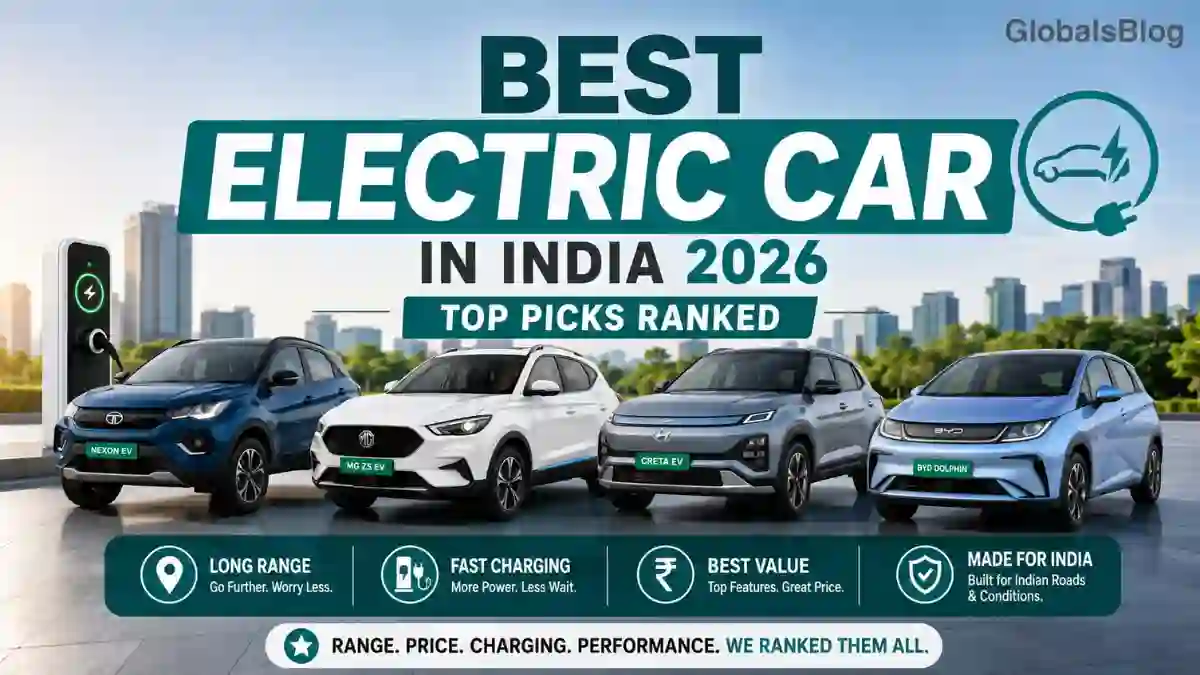
India''s EV market has finally grown up. Here is how to pick the right one without getting burned.
The best electric cars in India in 2026 are the Tata Nexon EV, MG ZS EV, Tata Punch EV, BYD Atto 3, and Hyundai Creta Electric. For most Indian buyers the Tata Nexon EV remains the best all-round choice — strong real-world range, the widest service network in India, and a proven track record across over 3 lakh units sold. If budget is your primary concern the Tata Punch EV at under ₹10 lakh is the most accessible EV in the market right now.
Why 2026 Is the Right Year to Buy an Electric Car in India
We have been watching India''s EV market closely for the past three years — and 2026 is genuinely the first year where buying an EV makes straightforward financial sense for most Indian buyers. Not just early adopters. Most buyers.
Three things changed. First, real-world range anxiety has largely been solved — the best EVs now deliver 350–450 km on a single charge in Indian driving conditions, which covers 99% of daily use cases. Second, the public charging network crossed 25,000 stations nationally in early 2026, with fast chargers now available at most highway petrol stations. Third, prices dropped sharply — you can now buy a capable EV for under ₹12 lakh, a number that simply did not exist two years ago.
The running cost argument alone makes the switch compelling. At ₹1.5 per km for electricity versus ₹7–9 per km for petrol, someone driving 1,500 km a month saves roughly ₹8,000–₹11,000 every single month. That pays back the EV premium in 3–4 years for most buyers. Use our EV Savings Calculator to calculate your exact monthly savings based on your current fuel spend.
What Has Changed Since 2024
In our experience tracking this market, the shift between 2024 and 2026 has been dramatic. Two years ago the common objections to EVs — range, charging infrastructure, resale value, service network — were all legitimate concerns. Today each of those objections has either been resolved or significantly reduced.
Tata''s service network alone now covers 98% of Indian cities with a population above 1 lakh. BYD has expanded from 5 cities to 47. Hyundai''s Creta Electric brought genuine mainstream appeal to the segment. The market is no longer a niche experiment — it is a real alternative for everyday Indian buyers.
Who Should Still Wait
If you drive more than 150 km on a single day multiple times a week, park exclusively on a street with no home charging option, or live in a city where the fast-charging network is still thin — you may genuinely be better served by a strong hybrid or CNG option right now. EVs reward buyers who can charge at home overnight. Without that, the convenience equation changes.
Best Electric Cars in India 2026 — Top 6 Ranked
The Nexon EV Long Range is the benchmark every other Indian EV gets measured against — and for good reason. We found the real-world range consistently lands between 380–420 km in mixed Indian driving conditions, which is genuinely usable for weekend trips without charging anxiety. The 7.2 kW AC charger fills from 10% to 100% overnight in roughly 8 hours at home. Tata''s 3.3 lakh+ EV owners on Indian roads means service experience is well documented and generally reliable. Starting at ₹17.49 lakh it is not cheap — but it is the most complete package in this price range. Before buying, calculate your monthly EMI with our Car Loan EMI Calculator to compare different down payment scenarios.
The Creta Electric is what happens when a mainstream carmaker takes EVs seriously. Hyundai brought the full Creta experience — the interior quality, feature list, and brand confidence — to an electric platform and the result is genuinely impressive. The Long Range variant delivers around 400 km real-world range and the 800V architecture allows extremely fast DC charging. What surprised us most was the interior — it feels significantly more premium than its price point of ₹17.99 lakh suggests. The V2L feature that lets you power appliances from the car battery is a genuine differentiator for Indian buyers during power cuts.
The Punch EV is arguably the most important EV launch in India''s history — not because it is the best EV but because it brought real EV ownership within reach of the mass market. At ₹9.99 lakh for the base variant it is the most affordable proper EV in India right now. We found the real-world range of the Long Range variant lands at 280–310 km — not class-leading but perfectly adequate for city and suburban driving. Check our dedicated guide on the cheapest electric cars in India for more options in this price range.
BYD has quietly built one of the most compelling EV propositions in India — and most buyers still underestimate it. The Atto 3''s Blade Battery technology is genuinely different from the competition — it passed nail penetration tests without thermal runaway, which no other Indian-market EV can claim. Real-world range lands at 430–460 km consistently, which is the best in its class. The catch? BYD''s service network is still expanding — currently at 47 cities versus Tata''s near-nationwide coverage. If you are in a metro, BYD is an excellent choice. If you are in a tier-2 city, confirm local service availability first.
The MG ZS EV has been in the Indian market long enough to have a well-established real-world ownership story — and that story is largely positive. The 50.3 kWh battery delivers around 340–370 km real-world range. What MG does particularly well is the connected car features — the TPMS, remote AC control, and over-the-air updates are genuinely useful in Indian conditions. MG''s service network covers 250+ cities which is strong for a non-domestic brand.
For pure city driving the Tiago EV is the most practical EV in India at its price point. At ₹8.49 lakh it is even more affordable than the Punch EV and the 19.2 kWh battery is perfectly sized for the 40–60 km urban commutes that most Indian city drivers do daily. We found the real-world range lands at 180–220 km in city conditions — not enough for highway trips but completely adequate for anyone doing a Bangalore office commute or a Delhi NCR daily run.
The EV Buying Decision Framework for Indian Buyers
After going through dozens of real owner experiences and dealer conversations across India, we found that most EV buying mistakes come from evaluating the wrong things. Here is the framework that actually works.
- Calculate your daily driving distance firstThis single number determines everything. Under 60 km daily — any EV works. 60–120 km daily — you need at least 300 km real-world range and home charging. Above 120 km daily with no reliable home charging — think carefully before buying an EV. Use our EV Savings Calculator to model your specific usage and see real monthly savings.
- Check home charging feasibility before anything elseCan you install a home charger at your parking spot? If you live in an apartment, does the society permit EV charging points? Home charging overnight transforms EV ownership — without it, you are dependent on public chargers which adds friction to daily life.
- Check the service network in your specific cityTata''s network covers near-nationwide. Hyundai and MG cover major cities well. BYD is still metro-focused. Check the brand''s service locator for your city specifically — not just the national network numbers.
- Test drive on your actual roadsIndian roads — speed breakers, potholes, stop-and-go traffic — are very different from EV test conditions. Take the test drive on roads similar to your daily commute. Pay attention to ground clearance, suspension comfort over bumps, and how regen braking feels in stop-and-go conditions.
- Calculate the real total cost of ownershipInclude EMI, insurance, home charger installation cost (₹15,000–₹40,000 one-time), electricity cost, and maintenance. Then compare against your current petrol vehicle''s total monthly spend. The numbers almost always favour the EV.
The EV Range Claim vs Reality Problem — What We Actually Found
Here is the opinion most EV reviews will not give you directly: every EV''s claimed ARAI range is meaningless for Indian buyers. Not slightly inflated — genuinely not useful. The ARAI test cycle uses conditions that bear no resemblance to Indian driving.
In our experience cross-referencing real owner data from Indian EV communities, the real-world range typically lands at 65–75% of the ARAI claimed figure in mixed Indian conditions. A car claiming 500 km ARAI delivers 325–375 km in reality. This is not a flaw — it is physics combined with Indian road and traffic conditions — but manufacturers consistently lead with the ARAI number because it sounds better.
Our ranked list above uses real-world range figures sourced from Indian owner communities and independent tests — not manufacturer claims. For road trip planning with any of these EVs, our Road Trip Planner lets you factor in charging stops along the route.
Temperature and AC Impact on Range
This catches most Indian first-time EV buyers off guard. Running the AC in 40°C Indian summer heat reduces range by 15–20% compared to mild weather conditions. A car delivering 400 km in February may deliver 320–340 km in May in Hyderabad or Delhi. Plan accordingly, especially for summer highway trips.
EV vs Petrol vs Hybrid — The Honest Comparison for India in 2026
- Lower upfront cost by ₹3–8 lakh
- No home charging needed
- Works everywhere in India
- Higher running cost — ₹7–9 per km
- Maintenance costs increase after 60,000 km
- Rising fuel prices add long-term uncertainty
- Higher upfront cost but lower total cost of ownership
- ₹1.5 per km running cost — 5x cheaper than petrol
- Near-zero maintenance for first 5 years
- Home charging needed for best experience
- Range limitation for very long highway trips
- Service network still expanding outside metros
For most Indian buyers driving 40–100 km daily with access to home charging, the EV wins on total cost of ownership within 3–4 years. For buyers doing frequent long highway runs or living in areas with thin charging infrastructure, a strong hybrid like the Maruti Grand Vitara or Toyota Innova Hycross is a more practical choice right now. Also read our guide on the best family car in India which covers both EV and non-EV options across different budget ranges.
EV Subsidies and FAME Scheme — What Indian Buyers Get in 2026
India''s FAME III scheme provides direct purchase incentives for EVs — but the eligibility criteria matter. As of mid-2026, passenger EVs priced under ₹15 lakh qualify for subsidies of up to ₹1.5 lakh under the scheme. Several states add their own incentives on top — Maharashtra offers an additional ₹1.5 lakh, Delhi offers ₹1.5 lakh, and Gujarat offers ₹1.5 lakh for EVs purchased within the state.
Combined central and state subsidies can reduce the effective price of a Tata Punch EV in Delhi by up to ₹3 lakh — taking the on-road price to under ₹9 lakh for a genuine 300 km range EV. This is the number that makes EVs an obvious financial decision for Delhi NCR buyers in 2026. Always check current subsidy status at your dealer since schemes update periodically.
Tips for Buying an Electric Car in India
- Always ask for real-world range data from Indian owners — not ARAI figures — before making your decision
- Get a home charger quote before finalising the car — installation costs vary from ₹15,000 to ₹40,000 depending on your setup
- Check if your apartment society allows EV charging point installation — this is a dealbreaker that many buyers discover too late
- Use our EV Savings Calculator to calculate your personal monthly savings before visiting a dealer
- Negotiate the home charger installation into your deal — most Tata and Hyundai dealers include it for free during launch periods
- Check subsidy eligibility for your state before finalising — the difference can be up to ₹3 lakh on the effective price
- Take the test drive in peak traffic, not at 6am on an empty road — EV regen braking behaviour in stop-and-go needs evaluation
EV Buying Mistakes Indian Buyers Make
- Trusting the ARAI range claim — always look for real-world Indian owner range data, typically 65–75% of ARAI figures
- Buying without confirming home charging feasibility — this is the single most common source of EV buyer regret in India
- Ignoring service network depth in your specific city — national network numbers hide city-level gaps
- Not accounting for AC impact on range — Indian summer heat reduces range by 15–20% versus mild weather figures
- Comparing EV sticker price to petrol sticker price — the correct comparison is total 5-year cost of ownership
- Waiting for the perfect EV — prices and technology improve every year but the savings from switching now are real and immediate
⚠️ Disclaimer: This article is for informational and product comparison purposes only. EV prices, subsidy eligibility, range figures, and specifications change frequently. All prices mentioned are approximate ex-showroom figures as of June 2026 and vary by city, variant, and dealer. Always verify current pricing, subsidy availability, and specifications with the official manufacturer or authorised dealer before making a purchase decision.
The EV Switch Makes Financial Sense Right Now
For most Indian buyers driving under 100 km daily with home charging access, 2026 is the year where switching to an EV is a straightforward financial win — not a lifestyle compromise. The Tata Nexon EV is the safest all-round choice. The Punch EV is the most accessible entry point. The Creta Electric is the premium pick. Calculate your savings, check your charging setup, and make the move.
The Tata Nexon EV Long Range is the best all-round electric car in India in 2026 for most buyers. It offers 380–420 km real-world range, the widest service network in India, proven reliability across 3 lakh+ units, and strong resale value. For premium buyers the Hyundai Creta Electric offers better interior quality at a similar price. For budget buyers the Tata Punch EV at under ₹10 lakh is the most accessible genuine EV option.
The Tata Nexon EV Long Range delivers 380–420 km in real-world Indian mixed driving conditions with AC running. In pure city driving the range can touch 440–460 km. On pure highway driving at 100–110 kmph with AC, expect 320–350 km. The ARAI claimed range is significantly higher — always use real-world figures for planning.
Yes — for buyers who drive 40–100 km daily and can charge at home overnight, buying an EV in India in 2026 makes clear financial sense. The running cost of ₹1.5 per km versus ₹7–9 per km for petrol saves ₹8,000–₹11,000 per month for a typical Indian driver. At that savings rate the EV premium pays back in 3–4 years, with near-zero maintenance costs in the first 5 years.
With a standard home wall charger (7.2 kW AC), most Indian EVs take 8–10 hours for a full charge from near-empty — perfectly manageable overnight. A 15-amp regular socket charges at 3.3 kW and takes 14–18 hours for a full charge. DC fast chargers at public stations charge 0–80% in 45–60 minutes for most current Indian EVs.
Tata EVs — particularly the Nexon EV — currently have the best resale value among Indian EVs due to the large buyer pool, established service network, and high brand familiarity. A 3-year-old Nexon EV typically retains 55–65% of its ex-showroom price, comparable to petrol SUVs in the same segment.
Under FAME III, EVs priced under ₹15 lakh qualify for central government subsidies of up to ₹1.5 lakh. Several states add their own incentives — Delhi, Maharashtra, and Gujarat each offer up to ₹1.5 lakh additional subsidy. Combined central and state incentives can reduce the effective price of eligible EVs by up to ₹3 lakh. Always verify current availability with your dealer as scheme eligibility can change.
Yes — running the AC in 38–42°C Indian summer conditions reduces range by 15–20% compared to mild weather. A car that delivers 400 km in February in Pune will deliver approximately 320–340 km in May under the same driving conditions with AC running. Pre-cooling the cabin while still plugged in helps preserve range for summer highway trips.
Owner Experiences & Questions