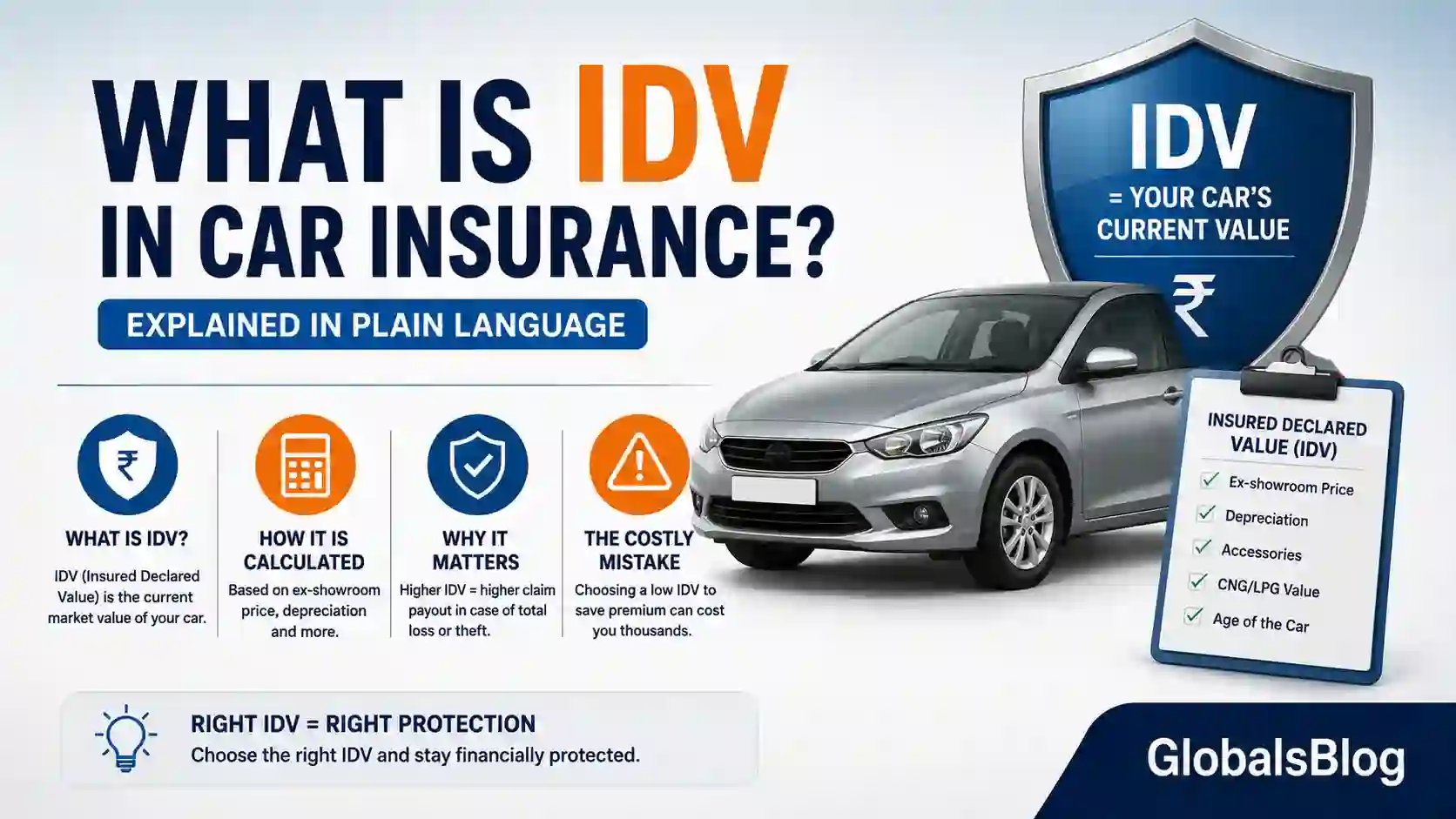
IDV is the single most important number in your car insurance policy. Most buyers set it wrong and never know until it is too late.
A reader from Pune had his car declared a total loss after a flood. He had bought comprehensive insurance and assumed he would receive the car's current market value as compensation. He received ₹3.2 lakh instead of the ₹5.8 lakh he expected. The reason was simple — he had set his IDV at the lowest available option three years earlier to save ₹1,400 on premium. That single decision cost him ₹2.6 lakh when the claim arrived.
IDV — Insured Declared Value — is the maximum amount your car insurance company will pay you in case of total loss or theft of your vehicle. It is based on the manufacturer's listed selling price minus depreciation based on your car's age. Setting a lower IDV reduces your annual premium but directly reduces your claim payout if your car is stolen or written off. For most Indian buyers, setting IDV close to the actual current market value of your car — not the minimum allowed — is the financially correct decision.
What IDV Means — The Simple Explanation
Think of IDV as the answer to this question: if your car is stolen today or completely destroyed in an accident, how much will your insurance company pay you?
That maximum payout amount is your IDV — Insured Declared Value. It is not the price you paid for the car when new. It is not the current second-hand market price. It is a calculated value based on the manufacturer's listed selling price for your car model, minus a depreciation percentage that increases each year as the car ages.
The critical thing to understand is that IDV is a number you partially control at the time of buying or renewing insurance. IRDAI regulations allow insurers to offer IDV within a permitted range — typically 10-15% above or below the calculated depreciated value. Most online insurance platforms let you adjust the IDV slider and show how premium changes as you move it. Moving it down saves premium. Moving it down also directly reduces what you receive if you ever file a total loss claim.
IDV vs Market Value — Are They the Same?
Not exactly, and this difference matters. IDV is calculated using a standardised IRDAI depreciation schedule applied to the manufacturer's ex-showroom price. The actual second-hand market value of your specific car — based on its condition, mileage, location, and demand — may be higher or lower than the calculated IDV. In general, IDV and market value move in the same direction (both reduce as the car ages) but the exact figures often differ by ₹50,000-₹2,00,000 depending on the car model and age.
How IDV is Calculated — The Formula
The basic IDV formula is straightforward:
IDV = (Manufacturer's Listed Selling Price − Depreciation) + Value of Fitted Accessories
The depreciation percentage is set by IRDAI and increases with the car's age:
| Car Age | Depreciation % | IDV as % of Ex-Showroom | Example (₹10L car) |
|---|---|---|---|
| Under 6 months | 5% | 95% | ₹9,50,000 |
| 6 months – 1 year | 15% | 85% | ₹8,50,000 |
| 1–2 years | 20% | 80% | ₹8,00,000 |
| 2–3 years | 30% | 70% | ₹7,00,000 |
| 3–4 years | 40% | 60% | ₹6,00,000 |
| 4–5 years | 50% | 50% | ₹5,00,000 |
The Pune reader's situation becomes clear through this table. His car was 3-4 years old when he renewed with a reduced IDV. Instead of the standard 60% of ex-showroom, he set it lower to save premium. When the flood hit, his payout reflected his chosen IDV, not the car's actual market worth.
Why Reducing IDV to Save Premium Is Usually a Mistake
This is the most important section of this guide and the one most insurance buyers get wrong.
Here is the math that makes reducing IDV look attractive at first: for a car with a calculated IDV of ₹8 lakh, moving the IDV slider down by ₹1 lakh saves approximately ₹800-1,200 in annual premium, depending on the insurer. That is a real, immediate, visible saving.
What most buyers do not calculate is the other side of that trade. If your car is stolen or totalled at any point during the policy year, you receive ₹1 lakh less in compensation. You saved ₹1,200 in premium and accepted a ₹1,00,000 reduction in protection. The trade-off only makes sense if the probability of a total loss claim is below roughly 0.12% — which for most cars is not a reliable assumption, especially considering theft risk, flood risk in Indian cities, and accident severity.
The financially correct approach for most Indian buyers is to keep IDV at or close to the maximum permitted value, accept the marginally higher premium, and treat the difference as the actual cost of full insurance protection.
When Does IDV Specifically Matter
-
Total loss claim — repair cost exceeds 75% of IDV When an insurer assesses repair costs as exceeding 75% of the vehicle's IDV, the car is declared a total loss and the insurer pays the IDV amount rather than the repair cost. A higher IDV means a higher payout in this scenario — directly proportional.
-
Theft claim If your car is stolen and not recovered, your insurer pays the IDV. A ₹2 lakh difference in IDV between minimum and maximum allowed value translates directly into ₹2 lakh less compensation for the same theft event.
-
Constructive total loss When a car is so severely damaged that repair would cost more than its insured value, even if technically repairable. IDV determines whether a claim reaches this threshold and what payout follows.
-
Return to Invoice cover add-on For new cars specifically, Return to Invoice is an add-on that pays the original invoice price rather than depreciated IDV in case of total loss or theft. This covers the gap between IDV and what you actually paid — worth considering for cars in their first 1-2 years. Our best car insurance guide covers which insurers offer the strongest Return to Invoice coverage.
IDV for Bikes — Same Rules, Different Stakes
The IDV calculation and logic applies equally to two-wheeler insurance — the same IRDAI depreciation schedule, the same permitted adjustment range, and the same trade-off between premium saving and claim payout. Given that two-wheelers are significantly more vulnerable to theft in Indian conditions, setting IDV correctly on bike insurance is arguably even more important than for cars — the probability of a theft claim is meaningfully higher for two-wheelers parked on Indian streets.
The keyword "what is IDV in bike insurance" gets 2,200 monthly searches specifically — a strong signal that Indian two-wheeler owners face the same confusion around this concept as car owners.
IDV Tips for Indian Car and Bike Owners
- Never reduce IDV purely to save on premium — the premium saving is small, the claim payout reduction is large
- At renewal, compare your IDV against current second-hand market prices for your car model online — if the market value is higher than your calculated IDV, consider negotiating the IDV upward within the permitted range
- For cars under 2 years old, consider the Return to Invoice add-on — it covers the gap between IDV and original purchase price for total loss or theft
- Always check the IDV shown in your policy document, not just the premium — some aggregator platforms default to minimum IDV without clearly highlighting this
- When switching insurers at renewal, verify the new insurer's IDV calculation matches the previous one rather than accepting a significantly lower figure that reduces your coverage
- Our best car insurance company guide covers which insurers offer the most straightforward IDV handling in claims
IDV Mistakes Indian Buyers Make
- Reducing IDV to minimum to save annual premium — The Pune reader's ₹1,400 annual premium saving cost him ₹2.6 lakh in claim compensation. This is not a theoretical risk — floods, theft, and serious accidents happen, and IDV directly determines the financial outcome when they do.
- Not checking IDV when switching insurers — some aggregator platforms default to a lower IDV that reduces premium attractively but materially reduces coverage without clearly flagging the change
- Assuming IDV equals current market value — they move in the same direction but are calculated differently, and for popular models IDV often undervalues the actual resale market price
- Forgetting to update IDV for accessories added after purchase — significant accessories like CNG kits or infotainment systems increase the car's value but need to be declared separately to be covered
- Not considering Return to Invoice for new cars — in the first 1-2 years, the gap between IDV and purchase price can be significant enough to justify the add-on cost
💡 Key Rule: IDV is not where you save money on car insurance. The place to save is by comparing premiums across insurers for the same IDV level — not by reducing the IDV itself. A lower IDV is not a discount, it is a reduction in what you are insured for.
Set IDV Correctly Once — It Protects You Every Day After
IDV is the maximum you can receive from your insurer if the worst happens. Reducing it to save ₹1,000-2,000 annually means accepting a ₹1-2 lakh reduction in that protection. Keep IDV at or near maximum, compare premiums across insurers for that same IDV, and save on insurance the right way — not by reducing what you are covered for.
IDV stands for Insured Declared Value — the maximum amount your car insurance company will pay you if your vehicle is stolen or declared a total loss after an accident. It is calculated as the manufacturer's listed selling price minus depreciation based on your car's age, following an IRDAI-prescribed depreciation schedule. IDV is not the same as the current market value or the original purchase price, though all three move in the same direction as the car ages.
Keep IDV as high as possible within the permitted range. A lower IDV reduces your annual premium by a small amount but directly reduces your claim payout by a proportionally much larger amount in case of theft or total loss. The premium saving from reducing IDV is rarely worth the coverage reduction — the financially correct approach is maintaining IDV near maximum and saving on insurance by comparing premiums across insurers for the same coverage level.
IDV is calculated as the manufacturer's listed selling price minus a depreciation percentage set by IRDAI based on the car's age. A car under 6 months old has 5% depreciation (IDV = 95% of ex-showroom price), 6 months to 1 year has 15% depreciation, 1-2 years has 20%, 2-3 years has 30%, 3-4 years has 40%, and 4-5 years has 50% depreciation. Beyond 5 years, IDV is agreed mutually between the insurer and the policyholder.
If your IDV is set lower than your car's actual market value, you are underinsured — meaning in a total loss or theft claim, you receive less than the car is actually worth in the market. This gap is the financial risk of reducing IDV to save on premium. For cars where market resale value is higher than the calculated IDV, consider negotiating the IDV upward within the permitted range or adding Return to Invoice cover for newer vehicles.
Yes — IDV applies to both car and bike insurance using the same IRDAI depreciation schedule and the same calculation method. The principle is identical: IDV represents the maximum payout in case of total loss or theft, and reducing it to save premium directly reduces the claim payout by the same amount. For two-wheelers, maintaining correct IDV is arguably more important given higher theft risk in Indian conditions.
Return to Invoice is an add-on cover that pays the original invoice price of your car rather than the depreciated IDV in case of total loss or theft. It covers the gap between what you originally paid and the depreciated IDV — most relevant for cars in their first 1-2 years when this gap is largest. For example, a car bought at ₹12 lakh with an IDV of ₹10.2 lakh after 6 months would receive ₹12 lakh under Return to Invoice versus ₹10.2 lakh without it.
Reader Experiences
Best electric car India 2026 — Nexon EV, Punch EV, Creta Electric, Mahindra BE 6, MG Windsor, Maruti e-Vitara compared. Home charging guide, real-world range and buying framework.
Leave a comment
Share a quick thought about this story.
Thanks for sharing your view. It is ready for review.
Please try again in a moment.
Newsletter
Get weekly travel, auto & beauty tips
Join 1,000+ readers. No spam. Unsubscribe anytime.
GlobalsBlog uses cookies for analytics (Google Analytics) and personalised advertising (Google AdSense). By clicking Accept All you consent to these cookies. You can decline non-essential cookies without losing access to any content. Read our Privacy Policy