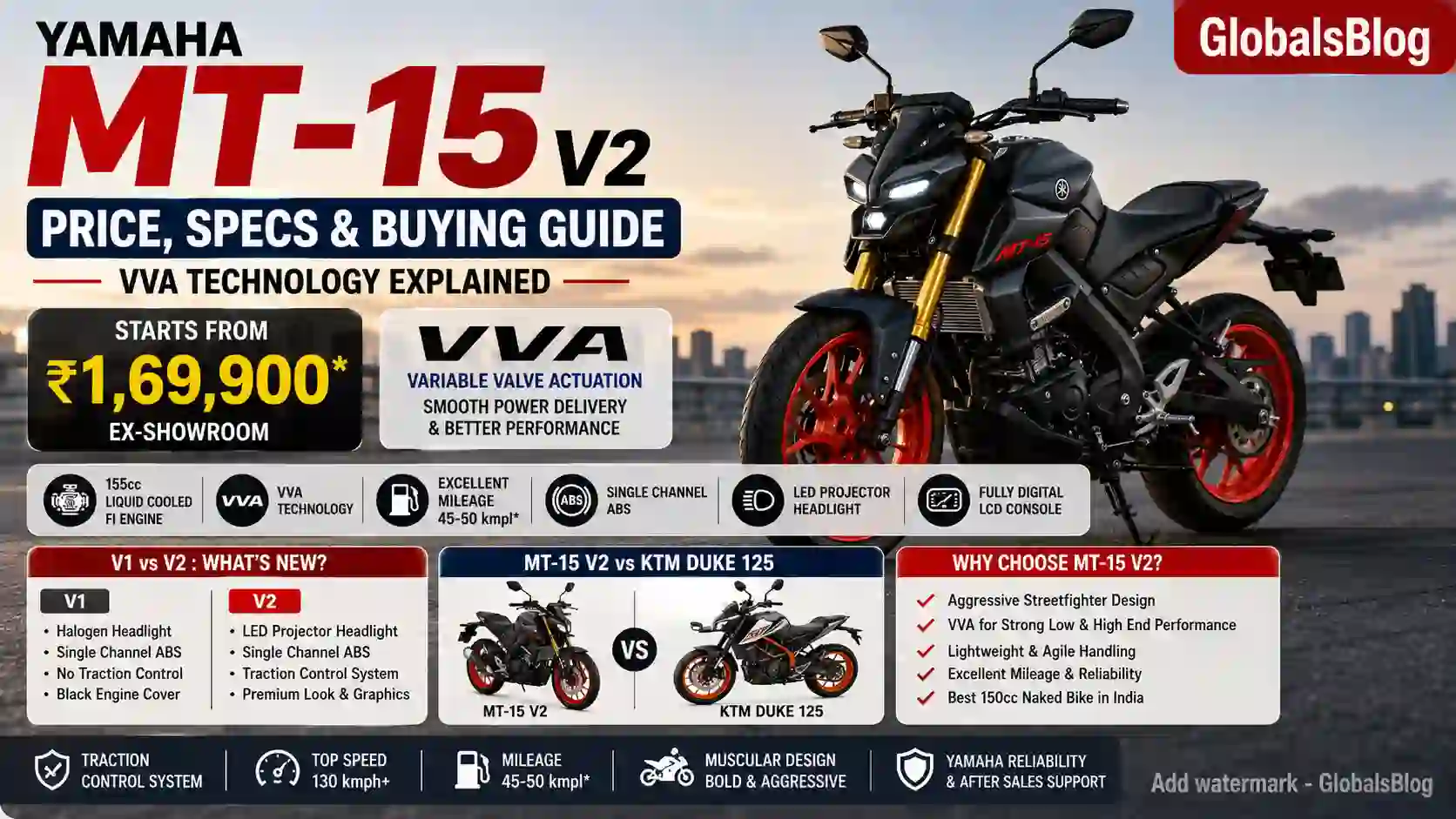
The Yamaha MT-15 is the naked streetfighter version of the R15 — same 155cc VVA engine, same Delta Box frame, same 6-speed gearbox, but with naked aggressive styling, upright riding position, and street-focused ergonomics. It is the most capable naked 150cc motorcycle in India and the only one in its class with Variable Valve Actuation.
A reader from Hyderabad had owned a Bajaj Pulsar 150 for three years before buying the Yamaha MT-15. The switch was motivated by two test rides — one on the MT-15, one on the KTM Duke 125 (a direct comparison in the naked streetfighter segment). He described the MT-15's VVA kick above 7,000 rpm — where the second intake cam profile activates and the engine suddenly pulls harder — as "nothing like anything else in this segment, it felt like a different motorcycle." The MT-15's Variable Valve Actuation technology produces a dual-character engine: smooth and tractable below 7,000 rpm for city use, then a sharp power surge above 7,000 rpm that makes it genuinely engaging on open roads. Combined with the Delta Box aluminium frame (the same used in the R15, one of the stiffest frames in the 150cc class), the MT-15 handles with a precision and chassis feedback that its competitors — including the KTM Duke 125 and the Honda CB150R — cannot match. This guide covers every MT-15 variant, the comparison with its main rivals, and the honest assessment of who this motorcycle is for.
Yamaha MT-15 price in India (August 2026): ₹1,69,900 (MT-15 V2, base colour ex-showroom) to ₹1,74,900 (MT-15 V2 special edition colour). On road Delhi: approximately ₹1,93,000–₹1,99,000. Engine: 155cc, VVA (Variable Valve Actuation), 19.3 PS at 10,000 rpm, 14.7 Nm at 8,000 rpm. Gearbox: 6-speed with slipper and assist clutch. Fuel injection: fuel-injected (no carburettor). Mileage: 45 kmpl ARAI (real-world city: 35–42 kmpl). Best for: city riding with weekend sport riding, buyers who want R15 DNA in an upright ergonomic, VVA tech experience. Not for: highway touring (wind protection = zero), pillion comfort, or buyers who want maximum practicality over fun.
Yamaha MT-15 Price — All Variants (August 2026)
| Variant | Ex-showroom | On Road Delhi (approx) | Colour |
|---|---|---|---|
| MT-15 V2 — Metallic Black | ₹1,69,900 | ~₹1,93,000 | Metallic Black (standard) |
| MT-15 V2 — Cyan Storm | ₹1,69,900 | ~₹1,93,000 | Cyan Storm |
| MT-15 V2 — Special Edition | ₹1,74,900 | ~₹1,99,000 | Special Edition colour — Phantom Blue / Warrior White variants |
All prices ex-showroom India, August 2026. The MT-15 V2 is mechanically identical across all colour options — the ₹5,000 premium for the Special Edition buys the premium colour, not additional mechanical specification. The base Metallic Black is the recommended choice unless the special colour is specifically desired. On road prices vary by state — Delhi is among the lower on road states; Karnataka and Telangana charge higher road tax.
Yamaha MT-15 V2 — Engine and Technical Specifications
The MT-15 V2 uses Yamaha's 155cc single-cylinder liquid-cooled engine with Variable Valve Actuation (VVA) — the same engine that powers the R15 V4, which means it is the most advanced 150cc engine available in India in a street motorcycle. VVA is a simplified version of Honda's VTEC system: two different intake cam profiles are active at different rpm ranges. Below approximately 7,000 rpm, a more conservative valve profile optimises low-rpm torque for city riding — smooth, tractable, economical. Above 7,000 rpm, a second, more aggressive cam profile activates, increasing valve lift and duration for maximum peak power. The result is an engine that feels like two different characters: easy-going below 7,000 rpm where you spend most of your city time, then a noticeable surge of urgency above 7,000 rpm that makes the MT-15 genuinely exciting. The 19.3 PS peak power is the highest in the 150cc naked segment — above the KTM Duke 125 (14.5 PS), Honda CB150R (17.1 PS), and Bajaj Pulsar NS160 (15.9 PS). The slipper and assist clutch (standard on V2) reduces lever effort by approximately 30% over older non-assist designs and provides back-torque limiting during aggressive downshifts — a feature typically found on performance motorcycles ₹3–5L more expensive.
MT-15 V2 — What Changed from V1
| Feature | MT-15 V1 | MT-15 V2 (Current) |
|---|---|---|
| Slipper assist clutch | ❌ Standard clutch | ✅ Slipper + assist — lighter, safer |
| Dual-channel ABS | Single-channel (front only) | ✅ Dual-channel — front and rear |
| Instrument cluster | Analogue-digital | ✅ Fully digital LCD |
| LED turn signals | Incandescent | ✅ Full LED |
| Colour options | 3 colours | ✅ Expanded with special editions |
| Engine | 155cc VVA, 18.5 PS | 155cc VVA, 19.3 PS (tuned slightly higher) |
| Price premium over V1 | — | ~₹10,000–15,000 more |
The V2 upgrades are genuinely meaningful — the dual-channel ABS is a significant safety upgrade (V1's single-channel ABS provided no rear wheel braking control), the slipper clutch reduces the risk of rear wheel lockup during aggressive downshifts, and the fully digital instrument cluster provides better readability. The V2 is the correct version to buy if choosing between V1 used and V2 new.
Yamaha MT-15 vs Competitors
| Model | Price (ex) | Engine | Power | Frame | Best For |
|---|---|---|---|---|---|
| Yamaha MT-15 V2 | ₹1,69,900 | 155cc VVA liquid-cooled | 19.3 PS | Delta Box aluminium | Best chassis, VVA tech, R15 DNA in naked form |
| KTM Duke 125 | ₹1,72,500 | 124.7cc liquid-cooled | 14.5 PS | Steel trellis | KTM brand, aggressive styling, lighter |
| Honda CB150R StreetFire | ₹1,37,000 | 147.3cc air-cooled | 17.1 PS | Diamond steel | Budget option, Honda reliability, lower price |
| Bajaj Pulsar NS160 | ₹1,30,200 | 160cc air-cooled | 15.9 PS | Perimeter steel | More affordable, pillion comfort, everyday use |
| TVS Apache RTR 160 4V | ₹1,16,000 | 159.7cc oil-cooled | 17.63 PS | Double cradle | Race-tuned suspension, triple spark, value |
| Yamaha R15 V4 | ₹1,82,900 | 155cc VVA liquid-cooled | 18.4 PS | Delta Box aluminium | Same engine, full fairing, track-oriented |
MT-15 vs KTM Duke 125: The MT-15 produces 19.3 PS vs Duke 125's 14.5 PS — a 33% power advantage from the 155cc vs 124.7cc displacement. The MT-15 is the faster motorcycle. The Duke 125 has the KTM brand appeal and a slightly more aggressive trellis-frame aesthetic. MT-15 wins on performance; Duke 125 wins on brand prestige perception among a specific buyer demographic.
MT-15 vs R15 V4: Same engine, same frame — the R15 V4 has a full fairing (wind protection, aerodynamic downforce) and a more aggressive track-oriented riding position. The MT-15 has naked styling, upright ergonomics, and is approximately ₹13,000 cheaper. Choose MT-15 for city comfort and weekend fun; choose R15 for track days and sustained highway speeds. See our R15 V4 price guide for the full R15 comparison.
MT-15 Real-World Mileage and Performance
| Riding Condition | Real-World Mileage | Notes |
|---|---|---|
| City stop-go (conservative) | 38–42 kmpl | Below 7,000 rpm most of the time — VVA low-cam profile |
| City with spirited riding (7,000+ rpm regularly) | 32–38 kmpl | VVA engaging frequently, more fuel in use |
| Highway at 80–90 km/h | 40–46 kmpl | Cruising in 6th gear, sustained rpm in power band |
| 0-60 km/h time | ~4.5 seconds | Class-competitive acceleration |
| Top speed | ~135–140 km/h | Claimed 155+ km/h but real-world varies by rider weight |
The MT-15's ARAI mileage of 45 kmpl is achievable in steady-state riding below 7,000 rpm. Riders who explore the VVA surge regularly (the most enjoyable part of the bike) will see 35–42 kmpl in city use. This is still significantly better than most 150cc motorcycles that produce similar performance from larger, less efficient engines. The MT-15's liquid cooling maintains consistent performance across temperature ranges — no power loss in summer heat that air-cooled engines experience.
✓ Yamaha MT-15 Buying Tips
- Buy the V2 over V1 used — dual-channel ABS is the critical safety upgrade: The MT-15 V1's single-channel ABS covered only the front wheel — rear wheel lock during braking was still possible. The V2's dual-channel ABS provides independent front and rear braking control, making panic stops significantly safer. The V2 price premium (approximately ₹10,000–15,000 over equivalent-condition V1 used) is worth every rupee for the braking safety upgrade alone. Do not compromise on this
- The VVA is the reason to choose MT-15 over competitors — explore it: The most common feedback from first-time MT-15 owners is that they spend the first two weeks riding it like a regular commuter (below 7,000 rpm) without experiencing what the motorcycle actually is. The VVA switch at 7,000 rpm, combined with the Delta Box frame's stability through corners, is the unique character that justifies the MT-15's price premium over the Apache RTR 160 and NS160. Find an open road, build to 7,000 rpm in 4th or 5th gear, and feel the VVA engage. That is the motorcycle
- Seat height consideration for shorter riders: At 810mm seat height, the MT-15 is one of the taller 150cc motorcycles in India. Riders below 5'6" may have difficulty flat-footing both feet simultaneously. Test-sit before purchase — the seat height is manageable (the narrow seat means one foot can flat-foot comfortably at stops) but it is a real consideration, particularly in heavy city traffic where frequent stops require confident footing
- Yamaha's service quality and parts cost are among the best in the segment: Yamaha's service network in India covers all tier-1 and most tier-2 cities with authorised Blue Square and branded service centres. The MT-15's service interval is 4,000 km (shorter than the Pulsar's 5,000 km) and service costs approximately ₹2,000–3,500 per service — mid-range for the segment. Spare parts availability is excellent nationally
- Add a windscreen accessory if planning regular highway use: The MT-15's naked design provides zero wind protection — at 100+ km/h, wind blast on the chest and head becomes fatiguing for journeys over 30–40 minutes. Yamaha and aftermarket suppliers offer small flyscreen and adjustable windscreen accessories (₹1,500–3,500) that reduce wind blast significantly without changing the naked aesthetic
✗ Yamaha MT-15 Buying Mistakes to Avoid
- Buying the MT-15 expecting pillion comfort: The MT-15's pillion seat is minimal — a small raised perch with no grab handles (handle is integrated into the frame, not prominent). The pillion footpegs are set high and relatively forward. For occasional short-distance pillion use, it is adequate. For daily pillion commuting over distances above 20 km, the MT-15 produces complaints. The Bajaj Pulsar NS160, Honda CB150R, and TVS Apache RTR 160 all have more conventional pillion seats with better back support. If pillion use is a frequent requirement, the MT-15 is the wrong motorcycle
- Assuming the MT-15 is a touring motorcycle: The MT-15 is a city and canyon motorcycle. Its naked styling means no aerodynamic protection above 80 km/h, the riding position (slightly forward lean) becomes tiring on straight highway above 120 km/h over sustained distances, and the fuel tank (10 litres) gives approximately 350–400 km range — adequate for city use, requires fuel stops every 4–5 hours on highways. For touring above 500 km regularly, the R15 V4 (full fairing) or the Royal Enfield Meteor/Hunter 350 (purpose-built for relaxed highway cruising) are more appropriate
- Not comparing the MT-15 with the TVS Apache RTR 160 4V on value: The Apache RTR 160 4V at ₹1,16,000 ex-showroom (versus MT-15's ₹1,69,900) produces 17.63 PS — only 1.67 PS less than the MT-15 — with race-tuned suspension, a slipper clutch option, and TVS's motorsport heritage. The ₹53,900 difference between the Apache and MT-15 is significant. Before buying the MT-15 on brand association alone, test-ride the Apache. For buyers who find the Apache's performance adequate and the ₹53,900 saving compelling: the Apache is a genuinely strong alternative. For buyers who specifically want the VVA technology, the Delta Box frame's precision, or Yamaha brand association: the MT-15 premium is justified
- Skipping the test ride on the specific VVA sweep: Many MT-15 test rides are conducted in dealership parking areas or slow city traffic — conditions where the VVA never activates and the motorcycle feels indistinguishable from any other 150cc commuter. Ask the dealer for a 15-minute test ride on a road that allows 70+ km/h. Build to 7,000 rpm in 4th gear. The VVA engagement at that point is the test ride's entire purpose. If the dealership cannot accommodate this, find one that can — buying a motorcycle without experiencing its defining feature is choosing blind
⚠️ Disclaimer: Yamaha MT-15 prices are subject to change. All prices listed are ex-showroom India as of August 2026. On road prices vary by state. Always wear a BIS-certified helmet and appropriate protective gear when riding. Verify current pricing and variant availability at your nearest Yamaha dealer or yamaha-motor-india.com.
Metallic Black for Value. V2 Always Over V1. Dual-Channel ABS Non-Negotiable. VVA Above 7,000 RPM Is the Entire Point. Delta Box Frame Is Why It Handles. Test Ride the VVA Before Buying.
The Hyderabad reader's switch from a Pulsar 150 to the MT-15 was made in the 7,000 rpm moment — the point where the VVA cam profile switches and the motorcycle becomes noticeably more urgent. That moment, on a Delta Box frame that communicates grip and cornering loads through the handlebar and footpegs better than any steel-frame 150cc in India, is what the MT-15 costs approximately ₹40,000–55,000 more than its closest value competitors. It is a genuinely worthwhile premium for the buyer who rides for the experience rather than purely for transport. The MT-15 V2 at ₹1,69,900 is the most technologically sophisticated 150cc naked motorcycle in India — dual-channel ABS, slipper clutch, liquid cooling, fuel injection, VVA, and the Delta Box aluminium frame, in a motorcycle that weighs 138 kg and fits through city traffic. Buy the V2, explore the VVA, and wear a proper helmet.
Yamaha MT-15 V2 price in India (August 2026): Ex-showroom ₹1,69,900 (base Metallic Black or Cyan Storm) and ₹1,74,900 (Special Edition Phantom Blue / Warrior White). On road Delhi approximately ₹1,93,000–₹1,99,000 depending on colour. On road prices vary by state — Karnataka and Telangana on road prices are ₹15,000–25,000 higher than Delhi due to higher road tax. The MT-15 V2 is available in 3 standard colour options plus special edition variants. All variants are mechanically identical — the price difference is purely for the colour. Verify current pricing at nearest Yamaha dealer. The MT-15 V2 (current version) includes dual-channel ABS, slipper and assist clutch, and fully digital instrument cluster as standard.
Yamaha MT-15 V2 mileage: ARAI certified 45 kmpl. Real-world city mileage: 35–42 kmpl (higher end when ridden conservatively below 7,000 rpm; lower end when VVA is explored regularly above 7,000 rpm). Real-world highway at 80–90 km/h: 40–46 kmpl. The liquid-cooled engine and fuel injection maintain consistent efficiency across temperature ranges — no significant mileage drop in summer heat unlike air-cooled engines. At ₹103/litre petrol and 38 kmpl average, monthly fuel cost for 1,000 km commute is approximately ₹2,710. Compared to the Bajaj Pulsar 150 (approximately 45–50 kmpl city): the MT-15 uses slightly more fuel for significantly more performance. The VVA engine's dual cam character means mileage is highly dependent on how often you explore above 7,000 rpm — conservative riders get closer to 42 kmpl, spirited riders closer to 35 kmpl.
Yamaha MT-15 vs KTM Duke 125 comparison: MT-15 advantages — significantly more power (19.3 PS vs 14.5 PS — 33% more), Variable Valve Actuation technology (dual cam profile unique in the segment), aluminium Delta Box frame (lighter, stiffer than Duke 125's steel trellis), dual-channel ABS standard on V2, liquid cooling, slipper assist clutch standard. KTM Duke 125 advantages — KTM brand image and motorsport heritage (strongest naked streetfighter brand globally), slightly lighter (148 kg vs MT-15's 138 kg — similar), KTM orange colour exclusivity, taller handlebar (more upright riding position). Price: MT-15 ₹1,69,900 vs Duke 125 ₹1,72,500 — nearly identical. On absolute performance criteria, the MT-15 is the stronger motorcycle. On brand image specifically: KTM has a more premium street perception. Verdict: MT-15 for performance, technology, and value. Duke 125 for brand association. If power matters: MT-15 by a significant margin.
Yamaha MT-15 V1 vs V2 differences: V2 adds: dual-channel ABS (V1 had single-channel front-only — the most significant safety upgrade), slipper and assist clutch (V1 had standard clutch — V2 is 30% lighter lever, back-torque limited), fully digital LCD instrument cluster (V1 had analogue-digital), full LED turn signals (V1 had incandescent), slightly higher power (19.3 PS V2 vs 18.5 PS V1), expanded colour options including Special Edition. Price premium: V2 is approximately ₹10,000–15,000 more expensive than equivalent-age V1 in the used market. Verdict: always buy V2 over V1. The dual-channel ABS alone — which controls rear wheel lock during panic stops — is worth the premium. Single-channel ABS on a performance-oriented naked motorcycle is a meaningful safety limitation that V2 resolves.
Yes — the Yamaha MT-15 is well-suited to daily commuting with caveats. Advantages for commuting: the VVA engine's low-rpm character below 7,000 rpm is smooth and tractable in city stop-go traffic; 138 kg kerb weight is nimble through traffic; 6-speed gearbox and fuel injection provide consistent city performance; slipper assist clutch reduces lever fatigue; real-world city mileage of 38–42 kmpl is reasonable for the performance class. Limitations for commuting: 810mm seat height is tall for riders below 5'6" in heavy traffic; pillion comfort is minimal (not for daily pillion commuting above 20 km); zero wind protection means 100+ km/h extended highway riding becomes tiring; service intervals are 4,000 km (more frequent than commuter motorcycles at 5,000–6,000 km). For a primarily city commute of 20–40 km daily with occasional weekend sport riding: the MT-15 is an excellent choice. For pure commuting with pillion and zero weekend sport riding: the Bajaj Pulsar NS160 or Honda CB150R are more practical at significantly lower prices.
VVA (Variable Valve Actuation) in the Yamaha MT-15 is a system that uses two different intake cam profiles at different engine rpm ranges. Below approximately 7,000 rpm, the low-lift, short-duration cam profile optimises torque for city riding — the engine is smooth, tractable, and fuel-efficient. Above approximately 7,000 rpm, the VVA system switches to a high-lift, longer-duration cam profile that increases valve opening and duration for maximum peak power — producing a noticeable power surge that changes the character of the engine. The result: a motorcycle that is easy and economical in city use (below 7,000 rpm where most commuting happens) and genuinely exciting and powerful when the rpm rises above 7,000 on open roads or during acceleration. It is a simplified version of Honda's VTEC system applied to a 155cc single-cylinder motorcycle engine. VVA is unique to Yamaha's 155cc engine in the Indian market — no competitor in the 150–160cc segment offers equivalent technology. It is the primary technical reason the MT-15 costs approximately ₹40,000 more than competing naked motorcycles at lower performance levels.
Leave a comment
Share a quick thought about this story.
Thanks for sharing your view. It is ready for review.
Please try again in a moment.