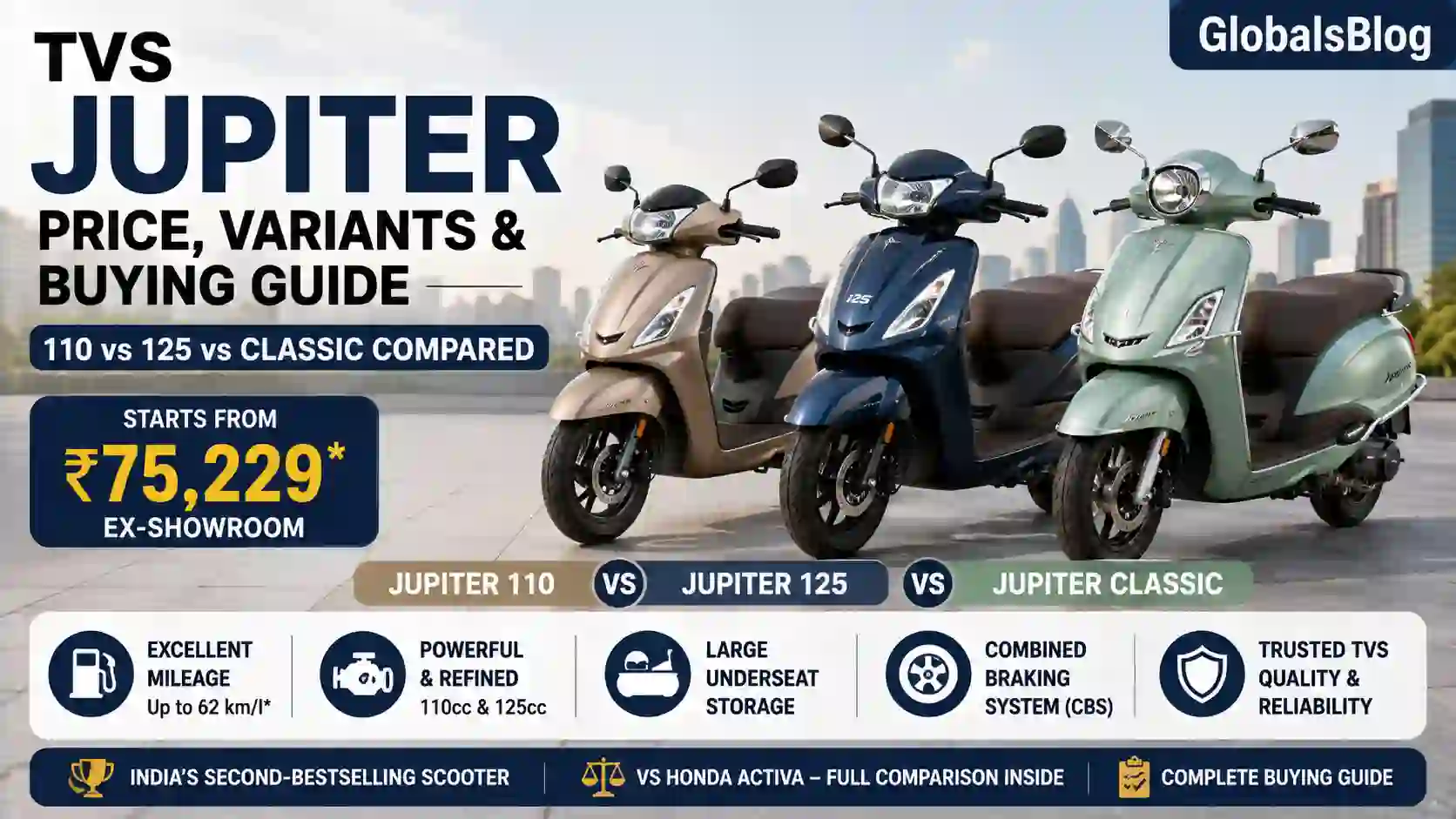
The TVS Jupiter is India's second-bestselling scooter — a 110cc automatic that consistently challenges the Honda Activa for market share and wins on features, ride quality, and practical design choices that the Activa does not offer. The Jupiter's external fuel filler cap, under-seat storage with USB charging, and suspension calibration for Indian roads have made it the scooter of choice for buyers who looked at the Activa and wanted more.
A reader from Coimbatore had replaced three successive Honda Activas over 14 years before switching to the TVS Jupiter 125 on the fourth purchase. The switch was made after her mechanic — who serviced both brands — pointed out that the Jupiter's external fuel filler cap (no need to open the seat for refuelling) was a feature she had wanted for years without knowing it existed, and that the Jupiter's front storage box (4-litre compartment with 12V charging socket) solved the problem of nowhere to put her handbag while riding. These are not revolutionary engineering achievements — they are practical design decisions that make daily scooter use meaningfully easier. The Jupiter's consistent second-place sales position in India is built on exactly this kind of accumulated practical intelligence. This guide covers every Jupiter variant, the 110cc versus 125cc decision, and the comparison with the Activa that most buyers are navigating.
TVS Jupiter price in India (August 2026): Jupiter 110 starts at ₹75,229 (ZX drum, ex-showroom); Jupiter 125 starts at ₹79,729 (drum, ex-showroom). Top variants: Jupiter 125 Classic (₹1,00,153 ex), Jupiter 110 ZX Disc (₹85,879 ex). On road Delhi: approximately ₹84,000–₹1,14,000 depending on variant. Engine: Jupiter 110 — 109.7cc, 7.6 PS; Jupiter 125 — 124.8cc, 8.15 PS. ARAI mileage: 56.7 kmpl (Jupiter 110) / 51.8 kmpl (Jupiter 125). Key differentiators: external fuel filler, front storage box with 12V socket, best-in-class under-seat storage (30L), ET-FI fuel injection on 125. Recommended: Jupiter 125 drum (₹79,729 ex) for most buyers — better engine, OBD2 compliant, future-ready at ₹4,500 more than 110.
TVS Jupiter Price — All Variants (August 2026)
| Variant | Engine | Ex-showroom | On Road Delhi (approx) | Key Features |
|---|---|---|---|---|
| Jupiter 110 ZX Drum | 110cc | ₹75,229 | ~₹84,000 | Base — drum brake, external fuel filler, front storage |
| Jupiter 110 ZX Disc | 110cc | ₹85,879 | ~₹96,500 | Front disc brake — better braking, CBS |
| Jupiter 125 Drum | 125cc | ₹79,729 | ~₹89,500 | Recommended — 125cc, ET-FI fuel injection, drum brake |
| Jupiter 125 Disc | 125cc | ₹90,604 | ~₹1,02,000 | 125cc + front disc brake + CBS |
| Jupiter 125 Classic | 125cc | ₹1,00,153 | ~₹1,13,000 | Top variant — chrome accents, SmartConnect Bluetooth, LED headlight |
All prices ex-showroom India, August 2026. The recommended variant for most buyers is the Jupiter 125 drum at ₹79,729 — the ₹4,500 premium over the Jupiter 110 ZX drum buys a more powerful engine (8.15 PS vs 7.6 PS), fuel injection (ET-FI), and OBD2 compliance for future regulations. The disc brake upgrade (₹10,875 more than drum on the 125) adds front disc braking and CBS — recommended for riders who do significant speeds above 60 km/h or in heavy traffic. The Classic at ₹1,00,153 adds SmartConnect Bluetooth (call alerts, navigation, ride statistics on the instrument cluster) — worth the premium for smartphone-integrated daily riding.
Jupiter 110 vs Jupiter 125 — Which to Choose?
| Factor | Jupiter 110 | Jupiter 125 |
|---|---|---|
| Engine displacement | 109.7cc | 124.8cc |
| Peak power | 7.6 PS at 7,500 rpm | 8.15 PS at 6,750 rpm |
| Peak torque | 8.4 Nm at 5,500 rpm | 10.5 Nm at 4,500 rpm |
| Fuel system | Carburettor | ET-FI fuel injection |
| OBD2 compliance | Limited | Full OBD2 — future-ready |
| ARAI mileage | 56.7 kmpl | 51.8 kmpl |
| Real-world mileage | 44–50 kmpl | 40–46 kmpl |
| Starting price | ₹75,229 | ₹79,729 |
| Premium over 110 | — | ₹4,500 |
| Best for | Mileage-first buyers, budget constrained | Most buyers — better performance, cleaner engine |
The Jupiter 125's 10.5 Nm torque at 4,500 rpm (vs 110's 8.4 Nm at 5,500 rpm) makes the 125 meaningfully more relaxed in city traffic — the peak torque arrives earlier and at lower rpm, making the 125 pull away from stops more effortlessly and feel more confident with a pillion. The fuel injection (ET-FI on the 125) also means smoother cold starts, better throttle response, and more consistent fuel efficiency versus the carburettor's sensitivity to ambient temperature. For the ₹4,500 difference, the Jupiter 125 drum is the superior purchase for most buyers. The Jupiter 110 makes sense only for buyers who specifically prioritise the slightly higher ARAI mileage or have a strict budget ceiling at ₹85,000 on road.
TVS Jupiter — Standout Features
The TVS Jupiter's external fuel filler cap — located on the front apron rather than under the seat — is the single most practically significant feature difference between the Jupiter and most competing scooters including the Honda Activa. On the Activa and most Indian scooters, the fuel filler cap is located under the seat: refuelling requires stopping the scooter, opening the seat (with either a key or handle), and then inserting the fuel nozzle. On the Jupiter, the fuel filler cap is externally accessible on the front without opening the seat — a 10-second process versus 45–60 seconds. For daily commuters who refuel weekly, this saves approximately 4–5 minutes per week — approximately 3.5 hours annually — and eliminates the fumbling with seat locks at petrol stations. It is a feature so obvious that competitors have struggled to explain why they have not adopted it.
The Jupiter's under-seat storage capacity is the largest in the 110–125cc Indian scooter segment at 30 litres — comfortably accommodating a full-face helmet (which many 110cc scooters cannot), a set of groceries, and a medium-sized bag simultaneously. The Activa 6G's under-seat storage is approximately 18–20 litres; the Jupiter's 30 litres is 50–65% more usable space. For Indian daily riders who use their scooter as a carry-all for school bags, lunch boxes, helmets, and shopping — this difference is substantial in real use. The storage box is internally lit on the Classic variant (convenient for finding items in dark parking areas) and fitted with a 12V charging socket and USB port in higher trims.
The Jupiter's front storage box — a 4-litre compartment on the front apron with a 12V charging socket — solves the problem of where to put a phone, wallet, or small bag while riding. The front compartment provides a readily accessible location for items that need to be reached without stopping (mobile phone at a red light, toll card at a highway booth) while the 12V socket allows phone charging during the ride. The Activa's front has a hook but no enclosed storage compartment — an enclosed front storage space with a charging option is a Jupiter-specific advantage that matters disproportionately on long daily commutes.
The Jupiter 125 Classic's SmartConnect Bluetooth system connects to the TVS iQube app on a smartphone and displays call alerts (caller name on the instrument), navigation turn-by-turn prompts, and ride statistics (daily distance, average speed, fuel efficiency, service reminders) on the analogue-digital instrument cluster. For commuters who use Google Maps navigation and want to receive calls without handling a phone while riding, the SmartConnect system provides these functions without a separate phone mount. The Classic variant at ₹1,00,153 is the only variant with SmartConnect — the drum and disc variants do not include Bluetooth connectivity.
TVS Jupiter vs Honda Activa — Which is Better?
| Factor | TVS Jupiter 125 | Honda Activa 6G | Better |
|---|---|---|---|
| Starting price | ₹79,729 (drum) | ₹77,434 (drum) | Activa (₹2,295 cheaper) |
| Engine | 124.8cc FI, 8.15 PS, 10.5 Nm | 109.51cc FI, 7.68 PS, 9.26 Nm | Jupiter (more power and torque) |
| Fuel filler | External cap — no seat opening | Under seat | Jupiter (significantly more convenient) |
| Under-seat storage | 30 litres | ~18–20 litres | Jupiter (50% more space) |
| Front storage | 4L compartment + 12V socket | Hook only, no compartment | Jupiter |
| ARAI mileage | 51.8 kmpl | 60 kmpl | Activa (more fuel efficient) |
| Ride quality | Softer, more comfort-focused | Adequate, slightly firmer | Jupiter (better on bad roads) |
| Brand trust / resale | Very strong in South India | Strongest nationwide | Activa (marginally, in North India) |
| Service network | TVS — 3,500+ centres India | Honda — 4,500+ centres India | Activa (larger network) |
| SmartConnect Bluetooth | ✅ (Classic variant) | ❌ | Jupiter (Classic) |
Buy TVS Jupiter 125 if: Practical features matter (external fuel filler, large storage, front compartment), you carry a full-face helmet daily, you prefer the larger engine and more torque, you ride on roads with significant potholes or speed bumps (Jupiter's softer suspension), or you are in South India where TVS service network density is highest. The Jupiter 125 delivers more daily practicality than the Activa 6G at a small price premium.
Buy Honda Activa 6G if: Nationwide service network depth is a priority (Honda has 25% more service centres), maximum fuel efficiency is the primary concern (60 kmpl vs 51.8 kmpl ARAI), you are in a city with excellent Honda service access, or you value Honda brand reputation specifically for resale or family preference. The Activa's resale value and service network breadth are its primary advantages — the Jupiter wins on almost every practical daily-use feature.
TVS Jupiter Real-World Mileage
| Variant | ARAI | City Real-World | Monthly Fuel Cost (1,000 km) |
|---|---|---|---|
| Jupiter 110 ZX | 56.7 kmpl | 44–50 kmpl | ₹2,060–₹2,341 |
| Jupiter 125 Drum/Disc | 51.8 kmpl | 40–46 kmpl | ₹2,239–₹2,575 |
| Jupiter 125 Classic | 51.8 kmpl | 39–45 kmpl | ₹2,289–₹2,641 |
The Jupiter's real-world city mileage (40–50 kmpl) is lower than the ARAI figures due to Indian city stop-and-go traffic, AC weather (no AC on scooters but ambient heat affects fuel efficiency), and pillion riding. The Jupiter 110's slightly higher ARAI mileage versus the 125 translates to approximately ₹200–300/month less fuel cost at 1,000 km monthly — a difference that most buyers would not notice in their monthly budget. The Jupiter 125's ₹4,500 purchase premium over the 110 is recovered in approximately 15–22 months of mileage savings for the 110 buyer — after which the 125 buyer has the better engine at no effective additional cost.
✓ TVS Jupiter Buying Tips
- Buy Jupiter 125 over Jupiter 110 for ₹4,500 more: The Jupiter 125 drum at ₹79,729 over the Jupiter 110 ZX drum at ₹75,229 is the most straightforward upgrade decision in the Indian scooter market. The 125's additional 14.4cc (13% more displacement), fuel injection versus carburettor, 1.75 PS more power, and 2.1 Nm more torque all contribute to a meaningfully better riding experience. The ₹4,500 difference is approximately 1 month of petrol at typical usage. Unless you are at a very strict budget ceiling, the 125 is the correct choice
- Choose disc brake if you ride above 60 km/h regularly: The disc brake upgrade (₹10,875 on the 125) provides front disc braking with CBS (Combined Braking System) — applying front brakes automatically distributes some force to the rear. For riders whose commute includes regular highway sections or who ride above 60 km/h, the disc brake's superior stopping power and feel are meaningful safety additions. For purely urban riding below 50 km/h, drum brakes are adequate. The disc is recommended
- The Classic variant's SmartConnect is genuinely useful on daily commutes: The Jupiter 125 Classic at ₹1,00,153 is the only Jupiter variant with Bluetooth connectivity. The SmartConnect's navigation prompts on the instrument cluster — showing turn directions without needing to look at a phone — are particularly useful in unfamiliar areas. The ₹9,549 premium over the disc variant (₹90,604) for SmartConnect plus the chrome Classic styling is justified for daily riders who use navigation frequently
- TVS service quality is excellent in South India — more variable in the north: TVS's strongest service network concentration is in Tamil Nadu, Karnataka, Telangana, and Andhra Pradesh. In North India (Delhi, UP, Punjab, Rajasthan), Honda's service network is denser and more consistent. If you are in South India and choosing between Jupiter and Activa, the TVS service consideration is not a disadvantage. If you are in North India, verify your nearest TVS authorised service centre before purchase
- TVS offers manufacturer warranty extensions at purchase: TVS Jupiter comes with a standard 3-year/30,000 km warranty — extendable to 5 years at purchase for approximately ₹1,500–2,500. For a scooter used as a daily commuter, the extended warranty is worth adding at purchase when the incremental cost is lowest
✗ TVS Jupiter Buying Mistakes to Avoid
- Buying the Jupiter 110 over the 125 to save ₹4,500: The Jupiter 110's carburettor fuel system will face increasing scrutiny under tightening OBD2 emission norms — the Jupiter 125's fuel injection is future-proofed for regulatory changes. The 110's real-world mileage advantage over the 125 (approximately 4–6 kmpl more) saves approximately ₹200–300 per month at 1,000 km usage — the ₹4,500 purchase saving takes 15–22 months to recoup. After that point, the 125 buyer has the better product at no net additional cost. The 110 makes economic sense only for buyers at a strict ₹84,000 on road budget ceiling
- Assuming Jupiter service costs are equivalent to Honda: The Honda Activa's enormous sales volume has built a massive third-party and authorised parts ecosystem — spare parts are available everywhere in India, at every price point, and many general mechanics (not just TVS authorised centres) can service a Jupiter effectively. However, some genuine TVS parts (specific electrical components, plastic trim panels) are more consistently available at authorised TVS centres than at independent workshops. In rural or remote areas, Honda parts availability can be meaningfully better than TVS. If you regularly travel to rural areas or small towns, factor this in
- Not test-riding the Classic variant's instrument cluster before buying: The SmartConnect Bluetooth system's integration with the analogue-digital instrument cluster is a specific interface that works differently from smartphone navigation. The navigation arrows appear on a small display section — adequate and clear at a glance, but different from a large phone screen. Test-ride the Classic specifically with the SmartConnect connected to verify that the display format works for your navigation style before committing the ₹1,00,153 premium
- Ignoring TVS's Easy Ride Assist on the 125: The Jupiter 125 includes TVS's Easy Ride Assist — a system that prevents the scooter from rolling back on slopes (hill hold assist equivalent for scooters). This feature is particularly useful for riders who are less experienced or who deal with steep approaches to parking spots, school drop-offs with gradient approaches, or hilly city terrain (Bengaluru, Hyderabad, Pune). It is not a widely marketed feature but it is present and genuinely useful in the right terrain — confirm with the dealer that it is active on the variant you are purchasing
⚠️ Disclaimer: TVS Jupiter prices are subject to change. All prices listed are ex-showroom India as of August 2026. On road prices vary by state road tax. Verify current pricing and variant availability at your nearest TVS authorised dealer before purchase.
Jupiter 125 Drum for Best Value. Disc for Safety. Classic for SmartConnect. External Fuel Filler and 30L Storage Are Why Riders Switch from Activa. Buy the 125, Not the 110.
The Coimbatore reader who switched from three successive Activas to the Jupiter 125 on the fourth purchase did so for the external fuel filler cap and the front storage box — features she had wanted for 14 years without knowing a scooter offered them. The Jupiter's consistent second-place position in India's scooter market is built on this accumulation of practical design decisions: the external fuel filler that saves 45 seconds per refuelling, the 30-litre storage that accommodates a full-face helmet, the front compartment that holds a phone with a charging cable. The Jupiter 125 drum at ₹79,729 is the recommended starting point — ₹4,500 more than the 110 for fuel injection, more torque, and OBD2 compliance. Add the disc brake for ₹10,875 more if you ride above 60 km/h. Add the Classic for SmartConnect if you navigate by phone daily. The Activa is more fuel-efficient and has a larger service network — but the Jupiter makes every refuel, every parking stop, and every grocery run easier. For daily commuters who use their scooter as a tool, that is the more valuable product.
TVS Jupiter price in India (August 2026, ex-showroom): Jupiter 110 ZX Drum ₹75,229; Jupiter 110 ZX Disc ₹85,879; Jupiter 125 Drum ₹79,729; Jupiter 125 Disc ₹90,604; Jupiter 125 Classic ₹1,00,153. On road Delhi: approximately ₹84,000 (110 drum base) to ₹1,14,000 (125 Classic). On road prices vary by state — Maharashtra and Karnataka road tax is higher; Delhi is lower. Recommended variant: Jupiter 125 Drum at ₹79,729 ex-showroom for most buyers — fuel injection, better engine, OBD2 compliant, only ₹4,500 more than the 110 base. Verify current pricing at nearest TVS authorised dealer as prices are subject to change.
TVS Jupiter 125 is better than Jupiter 110 for most buyers. The 125's advantages: 124.8cc vs 109.7cc (13% more displacement), 8.15 PS vs 7.6 PS power, 10.5 Nm vs 8.4 Nm torque (arrives at lower rpm — more relaxed in city traffic), ET-FI fuel injection vs carburettor (smoother cold starts, better throttle response, OBD2 compliant), and future-proofed for tightening emission norms. The 110's advantages: slightly better ARAI mileage (56.7 vs 51.8 kmpl) and lower starting price (₹75,229 vs ₹79,729). The ₹4,500 price difference is approximately 1 month of petrol at typical usage — the 125's better engine and fuel injection make it the superior long-term purchase. Recommended: Jupiter 125 drum at ₹79,729 for most buyers. Jupiter 110 only for buyers at a strict ₹84,000 on road budget ceiling.
TVS Jupiter 125 vs Honda Activa 6G: Buy Jupiter if — practical features matter (external fuel filler, 30L under-seat storage vs Activa's 18–20L, front storage with charging socket), you carry a full-face helmet daily, you ride on rough roads (Jupiter's softer suspension is better on potholes), or you are in South India where TVS service is excellent. Buy Activa if — maximum fuel efficiency is the priority (60 kmpl ARAI vs 51.8 kmpl), Honda's nationwide service network density matters (4,500+ Honda centres vs 3,500+ TVS), or you are in North India where Honda service access is denser. Starting price: Jupiter 125 drum ₹79,729 vs Activa 6G drum ₹77,434 (₹2,295 difference). The Jupiter wins on daily practical features; the Activa wins on fuel efficiency and service network breadth.
TVS Jupiter 125 mileage: ARAI certified 51.8 kmpl. Real-world city mileage: 40–46 kmpl in typical Indian city stop-and-go traffic. Real-world highway mileage: 46–52 kmpl at 60–70 km/h. At ₹103/litre petrol and 43 kmpl city average, monthly fuel cost for 1,000 km is approximately ₹2,395. Real-world mileage is approximately 10–15% lower than ARAI due to traffic conditions, pillion riding, and ambient temperature. The Jupiter 110's ARAI mileage is 56.7 kmpl (real-world 44–50 kmpl) — approximately 4–6 kmpl more than the 125. The mileage difference saves approximately ₹200–300 per month at 1,000 km usage, meaning the Jupiter 110's ₹4,500 lower purchase price takes 15–22 months to recover through fuel savings.
TVS Jupiter's advantages over competing scooters: External fuel filler cap (no seat opening for refuelling — saves 45 seconds per fuel stop vs competitors), 30-litre under-seat storage (best-in-class — 50–65% more than Honda Activa's 18–20L, fits full-face helmet), front storage box with 12V charging socket (4-litre front compartment for phone and small items, not available on Activa), softer suspension calibration for Indian road conditions, SmartConnect Bluetooth navigation on Classic variant, Easy Ride Assist (hill hold on the 125), and fuel injection (ET-FI on the 125 for smoother cold starts and OBD2 compliance). The Jupiter 125's 10.5 Nm torque at low rpm makes it more relaxed in city stop-and-go traffic than the Activa 6G. These practical daily-use advantages are why the Jupiter is India's second-bestselling scooter despite the Activa's larger service network and better ARAI mileage.
TVS Jupiter disc vs drum variant: Buy disc if — you regularly ride above 60 km/h, your commute includes highway sections, or you are in heavy traffic where emergency stops are frequent. The disc brake (with CBS — Combined Braking System) provides significantly better stopping power and feel than drum brakes, particularly at speeds above 60 km/h. Price difference: Jupiter 125 disc (₹90,604) vs drum (₹79,729) = ₹10,875 more. Buy drum if — your riding is entirely urban below 50 km/h, budget is the priority, and your commute is predominantly stop-and-go city traffic where stopping distances are short. For most Indian daily commuters, the disc brake upgrade at ₹10,875 is a worthwhile safety investment. Drum brakes are adequate but the disc brake is the better choice if the budget allows.
Leave a comment
Share a quick thought about this story.
Thanks for sharing your view. It is ready for review.
Please try again in a moment.