Every car and bike in India since April 2020 must be BS6. Most buyers have no idea what that actually means for them.
A reader from Lucknow buying his first car in 2024 asked his dealer whether he should specifically look for a BS6 vehicle. The dealer said "all new vehicles are BS6 now, sir." That answer was accurate but unhelpful — it did not explain what BS6 actually means, why it matters, whether an older BS4 vehicle from the used car market would be a problem, or what BS6 Phase 2 means now that it has begun rolling out. This guide explains all of it in plain language.
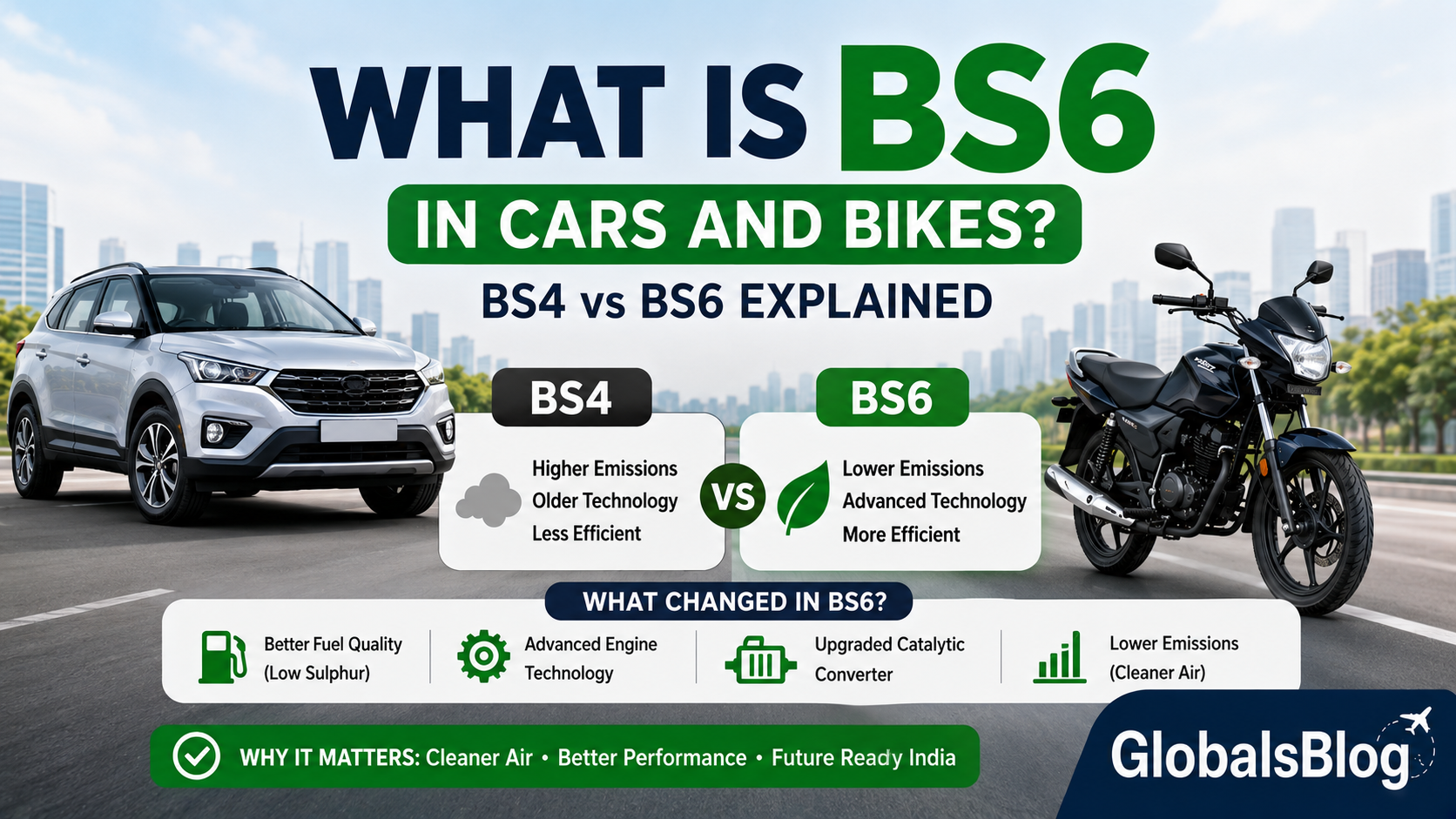
BS6 stands for Bharat Stage 6 — India's current vehicle emission standard that replaced BS4 on April 1, 2020. BS6 vehicles produce significantly less harmful pollutants than BS4, particularly 25 times less particulate matter from diesel engines and 68% less nitrogen oxide. All new vehicles sold in India since April 2020 must meet BS6 standards. If you are buying a new car or bike in India today, it is automatically BS6. For used vehicles, always check the Registration Certificate — BS4 vehicles are legal to own and drive but cannot be newly registered.
What BS6 Means — The Simple Version
BS stands for Bharat Stage — India's domestic vehicle emission standard framework, modelled on European Euro emission norms. The number indicates which generation of the standard applies. Higher numbers mean stricter emission limits and cleaner engines.
India jumped directly from BS4 to BS6 in April 2020, skipping BS5 entirely — a deliberate policy decision to align India's standards more quickly with global norms. This was a significant leap: BS6 is roughly equivalent to Euro 6, the current European standard, while BS4 was equivalent to Euro 4 — a standard Europe moved past more than a decade earlier.
In practical terms, BS6 means every new vehicle sold in India since April 2020 uses significantly cleaner engine technology, burns cleaner fuel, and emits far less harmful pollution than BS4 vehicles did. For car and bike buyers, it means all current new vehicles automatically meet BS6 — there is nothing to check or ask for at a new vehicle showroom. The relevance primarily arises when considering used vehicles or understanding why older BS4 vehicles may have different maintenance considerations.
BS4 vs BS6 — What Actually Changed
| Standard | In Force Since | NOx Limit (Diesel) | Particulate Matter (Diesel) | Fuel Required | Status |
|---|---|---|---|---|---|
| BS4 | April 2017 | 250 mg/km | 25 mg/km | 50 ppm sulphur fuel | New sales banned since Apr 2020 |
| BS6 Phase 1 | April 2020 | 80 mg/km | 4.5 mg/km | 10 ppm sulphur fuel | Current standard — all new vehicles |
| BS6 Phase 2 | April 2023 (OBD-II) | 80 mg/km | 4.5 mg/km | 10 ppm sulphur fuel | Current — adds OBD-II diagnostics |
The numbers make the improvement concrete: nitrogen oxide (NOx) emissions dropped from 250 mg/km to 80 mg/km — a 68% reduction. Particulate matter from diesel engines dropped from 25 mg/km to 4.5 mg/km — an 82% reduction. These are the two pollutants most directly linked to respiratory disease and urban air quality deterioration. The fuel improvement — from 50 ppm sulphur content to 10 ppm — was a necessary enabler of BS6 engines, which cannot function correctly on higher-sulphur fuel.
What BS6 Phase 2 Means — OBD-II Explained
BS6 Phase 2, which took effect from April 2023 for new vehicles, added a requirement for OBD-II (On-Board Diagnostics II) — a standardised electronic system that continuously monitors the vehicle's emission control components and alerts the driver to any malfunction via a dashboard warning light.
OBD-II does not change the emission limits themselves. What it adds is real-world compliance monitoring — ensuring that vehicles actually continue meeting BS6 standards throughout their working life, not just at the time of manufacture. Before OBD-II, a vehicle could pass factory emission tests and then see emission control components degrade without any driver alert. OBD-II makes the emission system's ongoing health visible and diagnosable.
For buyers: If you bought a new vehicle from April 2023 onward, it includes OBD-II as standard. If your dashboard shows an emission system warning light, it is likely an OBD-II triggered alert — get it checked at an authorised service centre rather than ignoring it, as the emission control system requires attention.
BS6 and Diesel Vehicles — The Specific Impact
BS6 had a more dramatic impact on diesel vehicles than petrol ones, for one specific reason: diesel BS6 engines require a technology called Selective Catalytic Reduction (SCR) and Diesel Particulate Filters (DPF) to meet the much stricter particulate and NOx limits. These systems require a consumable additive called Diesel Exhaust Fluid (DEF) or AdBlue — a urea-water solution injected into the exhaust system to neutralise NOx emissions.
This added both cost and maintenance complexity to diesel vehicles. BS6 diesel cars require periodic AdBlue refills (typically every 10,000-15,000 km depending on the vehicle), and the DEF tank needs topping up before it runs empty — running out of AdBlue can trigger performance limitations or engine start prevention on some vehicles.
This additional maintenance requirement, combined with lower fuel cost savings than before and higher BS6 diesel vehicle pricing, is one of the primary reasons diesel's share of new car sales in India has declined significantly since BS6 implementation. Our best car in India guide explains how fuel type choice has evolved in the BS6 era across different buyer segments.
Can I Still Buy and Use a BS4 Vehicle in India?
Yes — owning and using a BS4 vehicle is completely legal in India. The BS4 ban applies only to new registrations, not to existing registered vehicles. Millions of BS4 cars and bikes continue to operate legally on Indian roads and will do so until their natural end of life or scrappage.
The practical considerations for BS4 vehicle owners are: fuel compatibility (BS6 petrol and diesel is backward-compatible with BS4 engines — you can fill BS6 fuel in a BS4 vehicle without issues), resale value impact (BS4 vehicles depreciate faster as buyers prefer BS6 vehicles for newer purchases), and the Delhi-NCR odd-even restrictions that specifically target older BS4 diesel vehicles.
For used car buyers considering a BS4 vehicle: check the Registration Certificate for the emission standard, factor the faster depreciation into your pricing, and note that some city-specific restrictions may limit BS4 diesel vehicle usage in pollution alert periods.
BS6 Practical Tips for Indian Buyers
- All new vehicles sold in India today are automatically BS6 — nothing to check at a new vehicle showroom
- For used vehicles, check the RC (Registration Certificate) for the emission standard — it will state BS4 or BS6
- BS6 fuel (both petrol and diesel) is the only fuel available at Indian pumps since April 2020 — it is backward-compatible with BS4 vehicles
- If you own a BS6 diesel car, check your AdBlue/DEF level regularly — running it completely empty can trigger start prevention on some models
- The OBD-II emission warning light on BS6 Phase 2 vehicles should not be ignored — get it checked at an authorised service centre promptly
- Our car insurance guide covers how BS6 vehicles are handled for IDV and claims — BS6 vehicles have different repair cost structures than BS4
BS6 Misconceptions to Clear Up
- Thinking you need to specifically ask for or seek out a BS6 vehicle when buying new — The Lucknow reader's question is understandable but unnecessary. Every new vehicle sold at any authorised dealership in India since April 2020 is BS6 by legal requirement. There is no option to purchase a new BS4 vehicle.
- Assuming BS6 fuel cannot be used in older BS4 vehicles — it can. BS6 fuel is backward-compatible and is in fact the only fuel available at Indian pumps.
- Confusing BS6 Phase 1 and BS6 Phase 2 as different emission standards — the pollution limits are identical. Phase 2 adds OBD-II real-world compliance monitoring, not stricter emission limits.
- Thinking BS4 vehicles are illegal to drive — they are not. Existing registered BS4 vehicles are fully legal to own and operate. Only new registrations of BS4 vehicles are banned.
- Ignoring AdBlue maintenance on BS6 diesel vehicles — running low or empty on DEF can cause vehicle performance issues or start prevention on some models.
💡 The Short Version: BS6 = cleaner engine, cleaner fuel, less pollution. If buying new, it is automatic. If buying used, check the RC. If you have a BS6 diesel, maintain the AdBlue. If your OBD-II warning light comes on, get it checked.
New Vehicle = BS6 Automatically. Used Vehicle = Check the RC.
BS6 made Indian vehicles dramatically cleaner — 68% less NOx, 82% less particulate matter from diesel. All new vehicles since April 2020 meet this standard automatically. For used cars and bikes, the RC tells you the standard. For diesel owners, maintain AdBlue. For Phase 2 vehicles, respect the OBD-II warning light. That is everything a practical Indian buyer needs to know about BS6.
BS6 stands for Bharat Stage 6 — India's current vehicle emission standard that came into effect on April 1, 2020. It replaced BS4 and sets strict limits on harmful pollutants from vehicle exhausts, particularly nitrogen oxide (NOx) and particulate matter. BS6 vehicles produce 68% less NOx and 82% less particulate matter from diesel engines compared to BS4 vehicles. All new cars and bikes sold in India since April 2020 must meet BS6 standards.
The key differences between BS4 and BS6 are: emission limits are significantly stricter in BS6 (NOx reduced from 250 mg/km to 80 mg/km for diesel, particulate matter from 25 mg/km to 4.5 mg/km), BS6 requires much cleaner fuel (10 ppm sulphur versus 50 ppm for BS4), and BS6 diesel vehicles require additional emission control technology including Diesel Particulate Filters and AdBlue/DEF systems. India skipped BS5 entirely to jump directly from BS4 to BS6 in April 2020.
Yes — BS6 fuel is fully backward-compatible with BS4 engines. Since BS6 fuel has lower sulphur content (10 ppm versus 50 ppm), using it in a BS4 vehicle is actually beneficial for engine cleanliness. BS6 fuel is also the only fuel available at petrol pumps across India since April 2020, so all vehicles — both BS4 and BS6 — have been running on BS6 fuel since that date.
Yes — existing BS4 vehicles that were registered before April 2020 are completely legal to own and drive across India. The April 2020 mandate only banned new registrations of BS4 vehicles, not the use of already-registered ones. Millions of BS4 cars and bikes continue to operate legally on Indian roads. Note that some city-specific restrictions during high pollution periods, particularly in Delhi-NCR, may apply specifically to older diesel vehicles.
BS6 Phase 2, effective from April 2023, added mandatory OBD-II (On-Board Diagnostics II) requirements to BS6 Phase 1. The emission limits themselves are identical between Phase 1 and Phase 2 — both require the same NOx and particulate matter standards. What Phase 2 adds is a standardised electronic monitoring system that continuously checks the vehicle's emission control components and alerts the driver via a dashboard warning light if any malfunction occurs, ensuring real-world compliance throughout the vehicle's operating life.
Reader Questions