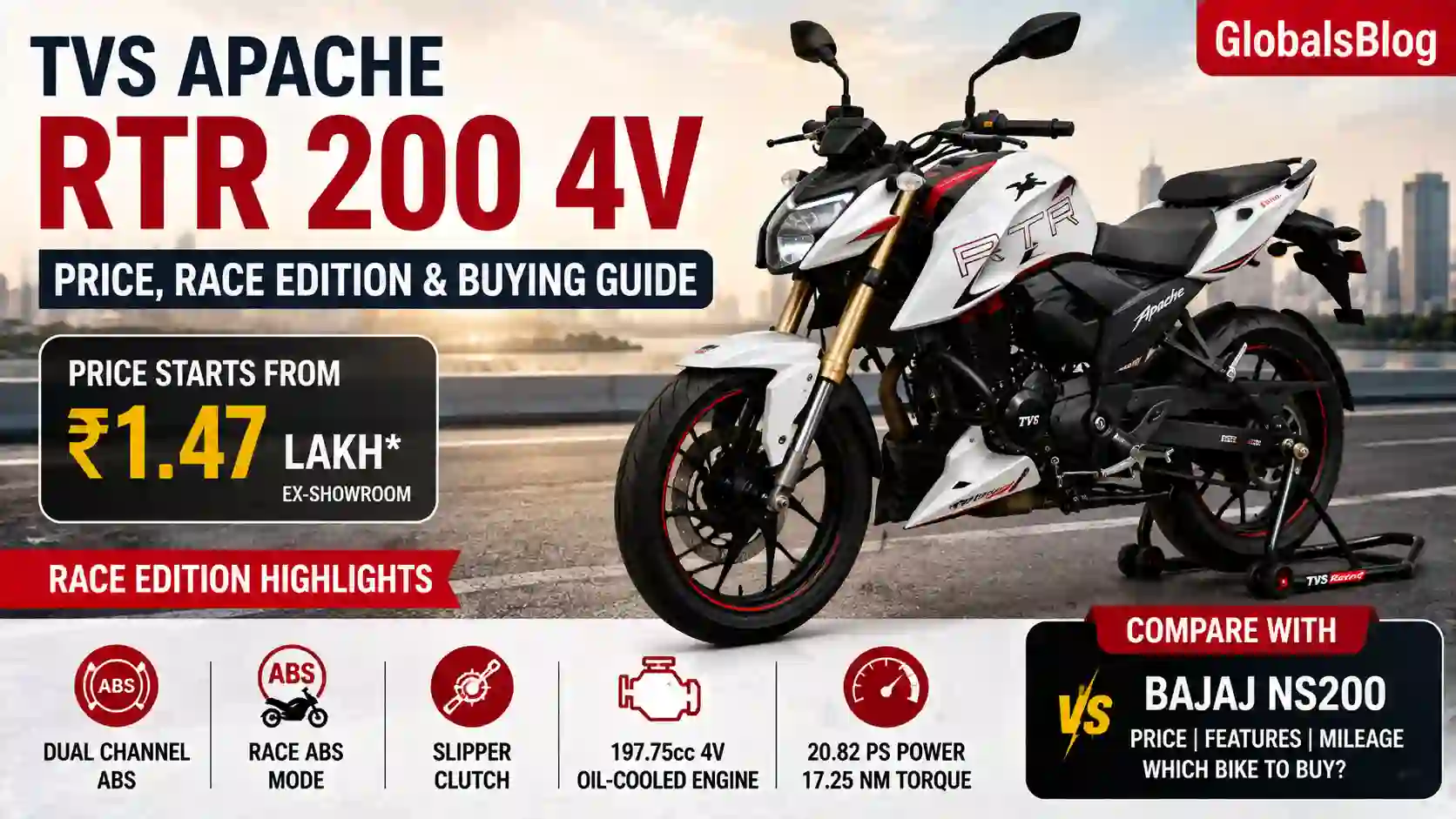
The TVS Apache RTR 200 4V is the Bajaj NS200's closest rival — and by most chassis and handling measurements, its superior. It costs ₹16,000 less. It is also less well-known, which is the only reason it does not outsell the NS200.
A reader from Chennai had shortlisted the Bajaj Pulsar NS200 for six months before a colleague suggested a test ride on the TVS Apache RTR 200 4V. He had dismissed it as "the other 200cc bike" — not the NS200 with its established reputation and the larger Bajaj dealer network. The test ride changed his decision. He described the Apache as "sharper in corners, more planted at 100 km/h, and somehow both more precise and more stable than the NS200 I had ridden the week before." He bought the Apache RTR 200 4V Race Edition and has covered 23,000 km in 14 months. His one complaint: the service centre is 8 km further from his home than the Bajaj dealer. The Apache's story is consistently the same — superior chassis, comparable power, lower price, thinner service network. This guide covers everything to make the decision correctly.
TVS Apache RTR 200 4V price in India (August 2026): RTR 200 4V (Single Channel ABS) ₹1.47 lakh ex; RTR 200 4V Race Edition (Dual Channel ABS) ₹1.57 lakh ex. Best variant: Race Edition at ₹1.57 lakh — dual-channel ABS is mandatory for any 200cc performance motorcycle. Key strengths over Bajaj NS200: better chassis dynamics, sharper handling, lower price (₹16,000 less than NS200), lighter kerb weight. Key limitation vs NS200: TVS service network thinner in Tier 2/3 cities, less community/owner group support. RTR 200 4V real-world mileage: 28–32 kmpl city, 32–36 kmpl highway.
TVS Apache RTR 200 4V Price — All Variants (August 2026)
| Variant | ABS | Ex-showroom | Key Difference |
|---|---|---|---|
| Apache RTR 200 4V | Single Channel ABS | ₹1.47 lakh | Base — single-channel ABS, standard colour options |
| Apache RTR 200 4V Race Edition | Dual Channel ABS | ₹1.57 lakh | Recommended — dual ABS, Race ABS mode, slipper clutch, additional colour options |
All prices ex-showroom India. On-road price adds approximately 15–18% for RTO, insurance, and handling charges. The ₹10,000 premium for the Race Edition (dual-channel ABS vs single-channel) is the most important upgrade in the range — the rear-wheel ABS prevents the rear wheel lockup that can cause loss of control during emergency braking, particularly on wet surfaces. Always buy the Race Edition.
TVS Apache RTR 200 4V — Engine and Technical Specifications
The TVS Apache RTR 200 4V uses a 199.5cc four-valve single-cylinder oil-cooled engine producing 21.4 PS and 18.1 Nm. The "4V" in the name refers to the four-valve cylinder head — two intake and two exhaust valves that improve combustion efficiency and allow higher revving compared to the two-valve designs used in most budget 200cc engines. The engine's power figures (21.4 PS) appear lower than the Bajaj NS200 (24.5 PS) on paper, but the real-world performance difference is less significant than the numbers suggest — the Apache's lighter kerb weight (166 kg vs NS200's 158 kg difference matters less than the RTR's superior suspension geometry in mixed riding conditions).
The Race Edition adds a slipper clutch — a mechanical device that prevents rear-wheel lock-up when the rider downshifts aggressively or releases the clutch too quickly while braking. This is a feature found on sportbikes costing significantly more and its presence at ₹1.57 lakh makes the Race Edition the most technically well-equipped 200cc motorcycle in India at its price point.
TVS Apache RTR 200 4V Mileage — Real-World
| Variant | ARAI Mileage | Real-World City | Real-World Highway |
|---|---|---|---|
| RTR 200 4V (both variants) | ~36 kmpl | 28–32 kmpl | 32–36 kmpl |
The Apache RTR 200 4V's real-world fuel efficiency (28–32 kmpl city) is comparable to the Bajaj NS200 (28–32 kmpl city) — both use 200cc oil-cooled naturally aspirated engines with similar performance tuning. The highway mileage (32–36 kmpl) is slightly better than the NS200's 32–36 kmpl in similar conditions. At ₹103/litre petrol and 30 kmpl real-world, a 1,000 km/month rider spends approximately ₹3,433 on fuel — the same calculation as the NS200.
TVS Apache RTR 200 4V vs Bajaj Pulsar NS200 — The Definitive Comparison
| Spec | TVS Apache RTR 200 4V Race Edition | Bajaj Pulsar NS200 |
|---|---|---|
| Price (ex-showroom) | ₹1.57 lakh | ₹1.63 lakh |
| Engine | 199.5cc, oil-cooled, 4V | 199.5cc, liquid-cooled |
| Power | 21.4 PS | 24.5 PS |
| Torque | 18.1 Nm | 18.3 Nm |
| Kerb weight | 166 kg | 156 kg |
| Chassis | Perimeter frame | Perimeter frame (delta box) |
| Suspension (front) | Telescopic (race-tuned) | Telescopic |
| Slipper clutch | ✅ Yes (Race Edition) | ❌ No |
| Dual-channel ABS | ✅ Yes (Race Edition) | ✅ Yes |
| Race ABS mode | ✅ Yes — rear wheel lift protection | ❌ No |
| Cooling | Oil-cooled | Liquid-cooled |
| Service network | Good — slightly thinner than Bajaj | Excellent — widest in 200cc segment |
| Chassis dynamics | Best in class — sharper, more precise | Very good — more street-balanced |
The NS200's liquid-cooled engine gives it a 3.1 PS power advantage over the Apache's oil-cooled engine. The Apache Race Edition's slipper clutch, Race ABS mode, and chassis precision are features the NS200 does not have. The ₹6,000 price difference (Race Edition vs NS200) does not adequately summarise the comparison — the technical specification difference between oil-cooled (Apache) and liquid-cooled (NS200) matters more for sustained high-speed riding where the NS200's cooling advantage becomes relevant. For city and normal highway riding, the Apache's chassis dynamics advantage is more consistently felt.
TVS Apache RTR 200 4V On-Road Price — Key Cities
| City | RTR 200 4V (Single ABS) | Race Edition (Dual ABS) |
|---|---|---|
| Delhi | ~₹1.70L | ~₹1.81L |
| Mumbai | ~₹1.73L | ~₹1.85L |
| Bengaluru | ~₹1.74L | ~₹1.86L |
| Chennai | ~₹1.72L | ~₹1.83L |
| Hyderabad | ~₹1.75L | ~₹1.87L |
| Pune | ~₹1.72L | ~₹1.83L |
| Jaipur | ~₹1.67L | ~₹1.78L |
TVS Apache RTR 200 4V — Features
| Feature | RTR 200 4V Base | RTR 200 4V Race Edition |
|---|---|---|
| ABS | Single channel | Dual channel Race ABS |
| Slipper clutch | ❌ | ✅ |
| Race ABS mode | ❌ | ✅ (rear wheel lift protection) |
| Instrument cluster | Semi-digital | Semi-digital with lap timer |
| Glide-through technology | ✅ | ✅ |
| LED headlight | ✅ | ✅ |
| Riding modes | Urban / Sport | Urban / Sport / Rain |
| Colour options | 3 colours | 5 colours including Race variants |
The Race Edition's three riding modes (Urban, Sport, Rain) add meaningful real-world functionality — the Rain mode reduces ABS sensitivity threshold and power delivery, making the bike significantly safer on wet roads, a relevant feature for Indian monsoon conditions. The lap timer is primarily relevant for track use but the ABS and riding mode improvements are daily-ride benefits.
TVS Apache RTR 200 4V — Buying Tips
- Always buy the Race Edition: The ₹10,000 premium over the base buys dual-channel ABS, slipper clutch, Race ABS mode, and three riding modes including Rain mode. Dual-channel ABS is the most important safety upgrade on any 200cc motorcycle — the rear wheel ABS prevents loss of control during emergency braking. The base single-channel ABS variant should only be considered if the budget is absolutely non-negotiable
- The Apache beats the NS200 on chassis — choose based on your use case: If you ride aggressively in twisty roads, canyons, mountain ghats, or track days, the Apache's chassis is meaningfully better than the NS200's. If you ride primarily in straight-line city traffic with occasional highway use, the NS200's 3 PS power advantage and liquid cooling are more relevant advantages. Know your actual riding style before choosing
- Check TVS service centre proximity in your city: TVS has a good service network in metro cities (Chennai, Bengaluru, Mumbai, Delhi, Hyderabad are all well-covered). In Tier 2 cities, the TVS network is thinner than Bajaj's — verify the nearest authorised TVS service centre before committing, particularly if you are in a city where Bajaj has 3–4 centres and TVS has 1
- The slipper clutch makes a real daily difference: Chennai reader's feedback from 23,000 km — the slipper clutch on the Race Edition prevents rear-wheel lock when downshifting quickly in city traffic. Most sport motorcycle accidents happen not at high speed but during normal deceleration when the rider downshifts too aggressively. The slipper clutch is not a track-only feature
- Compare directly with our Bajaj Pulsar NS200 guide — the two are the closest direct rivals in Indian 200cc performance motorcycling. A test ride of both before deciding is the single most valuable investment of time in the purchase process
TVS Apache RTR 200 4V — Common Buying Mistakes
- Buying the base single-channel ABS variant to save ₹10,000: At any performance motorcycle price point, dual-channel ABS is not an optional upgrade — it is the minimum safety standard. The Race Edition's ₹10,000 premium is the single most value-for-money safety investment available in this category. Do not buy the base
- Dismissing the Apache because of lower power figures vs NS200: 21.4 PS vs 24.5 PS is a 14% power difference that is meaningful at redline on a straight road. In the mixed conditions of Indian daily riding — corners, traffic gaps, ghats, highway overtaking — the power difference is rarely the limiting factor. The chassis, geometry, and slipper clutch advantages of the Apache are felt far more frequently than the NS200's 3 PS power advantage
- Not comparing on-road prices in your specific state: The ₹16,000 ex-showroom advantage over the NS200 narrows or widens depending on state road tax. In Karnataka (which has higher road tax), the Race Edition vs NS200 on-road difference is approximately ₹12,000. In Rajasthan (lower road tax), it can be ₹20,000. Always compare on-road prices, not ex-showroom
- Skipping the extended test ride: The Apache's chassis advantage is only apparent above 60 km/h in corners and on varied road surfaces. A 10-minute showroom parking lot test ride does not reveal it. Request a 20–30 minute route test ride that includes a variety of road surfaces and some corners — or arrange to borrow a friend's Apache for an evening ride before deciding
⚠️ Disclaimer: TVS Apache RTR 200 4V prices and specifications are subject to change. TVS Motor Company periodically revises pricing and introduces updates. All prices listed are ex-showroom India as of August 2026 — verify current on-road pricing at your nearest TVS dealership before purchase.
Race Edition Only. Best Chassis in 200cc Class. ₹16,000 Less Than NS200. Slipper Clutch Standard. Check TVS Network in Your City First.
The TVS Apache RTR 200 4V Race Edition is the most technically complete 200cc performance motorcycle available in India under ₹2 lakh on-road — dual-channel Race ABS with rear wheel lift protection, slipper clutch, three riding modes including Rain, and a chassis that most experienced riders rate above the Bajaj NS200 in outright dynamics. The ₹1.57L ex-showroom price is ₹16,000 less than the NS200 for a motorcycle that, in most riding scenarios, is more capable. The honest limitation: TVS's service network is thinner than Bajaj's outside major metros. For riders in well-covered cities who have verified TVS service centre proximity, the Apache RTR 200 4V Race Edition is the most compelling 200cc buy in India. The Chennai reader covering 23,000 km in 14 months has the simplest summary: "The only thing I would change is the distance to the TVS service centre."
TVS Apache RTR 200 4V price in India (August 2026, ex-showroom): Base variant with single-channel ABS — ₹1.47 lakh; Race Edition with dual-channel ABS, slipper clutch, and Race ABS mode — ₹1.57 lakh. On-road price adds approximately 15–18% for RTO, insurance, and handling charges depending on state. The Race Edition on-road price is approximately ₹1.78–1.87 lakh depending on state. Always verify current on-road pricing with your nearest TVS dealership. The Race Edition is the strongly recommended variant — dual-channel ABS and slipper clutch are essential at this performance level.
TVS Apache RTR 200 4V Race Edition vs Bajaj Pulsar NS200 comparison: Apache advantages — better chassis dynamics and handling (sharper, more precise, better cornering), slipper clutch standard (NS200 does not have one), Race ABS mode with rear wheel lift protection, ₹6,000 lower price (Race Edition vs NS200), Rain riding mode. NS200 advantages — 3.1 PS more power (24.5 PS vs 21.4 PS), liquid-cooled engine (better for sustained high-speed use), wider service network (particularly in Tier 2/3 cities), larger owner community and more experienced mechanics. Choose Apache if: you ride in twisty roads, ghats, or mountain highways where chassis dynamics matter, or if a TVS service centre is conveniently located in your city. Choose NS200 if: you ride primarily in straight-line city traffic and highways, service network convenience is a priority, or you live in a Tier 2/3 city where Bajaj has significantly better dealer coverage than TVS. Both are excellent — the right choice depends on your specific riding style and location.
TVS Apache RTR 200 4V mileage: ARAI certified approximately 36 kmpl. Real-world mileage in city traffic: 28–32 kmpl in stop-go conditions. Real-world highway mileage at 80–100 km/h: 32–36 kmpl. The Apache RTR 200 4V's fuel efficiency is comparable to the Bajaj NS200 in real-world conditions — both use similarly displaced 200cc engines with similar performance tuning. Mileage varies significantly with riding style: Sport mode and aggressive riding reduces city mileage to 25–28 kmpl; Urban mode with smooth throttle application achieves 30–32 kmpl in city conditions. At ₹103/litre petrol and 30 kmpl average, a 1,000 km/month rider spends approximately ₹3,433/month on fuel.
TVS Race ABS is TVS's proprietary ABS system on the Apache RTR 200 4V Race Edition that adds rear wheel lift protection to the standard dual-channel ABS function. In a standard dual-channel ABS motorcycle, both wheels are monitored to prevent lockup during braking. TVS Race ABS additionally detects when the rear wheel begins to lift off the ground during hard front braking (a common cause of front-over-rear accidents called a "stoppie") and modulates the front brake force to keep the rear wheel on the ground. This is a feature found on premium sportbikes costing ₹5–15 lakh more. The practical benefit: in an emergency braking scenario, the Apache RTR 200 4V Race Edition stops more safely than a standard dual-channel ABS motorcycle, particularly from higher speeds. For a ₹10,000 premium over the single-channel base, the Race ABS system on the Race Edition is one of the most valuable safety upgrades available in this price range.
Yes — the TVS Apache RTR 200 4V is capable for highway riding up to 120–130 km/h. At those speeds, the oil-cooled engine runs adequately hot but without issues in normal Indian highway conditions (80–110 km/h cruise). The Apache is significantly more stable at highway speeds than smaller 150–160cc motorcycles due to its weight and perimeter frame geometry. For very long highway runs (400+ km in a day, sustained 100+ km/h) or aggressive mountain highway riding in sustained high-RPM conditions, the Bajaj NS200's liquid-cooled engine has a thermal advantage — the liquid cooling maintains lower operating temperatures during extended performance use. For normal highway touring at 80–100 km/h, the Apache RTR 200 4V handles it without concern. The Race Edition's Sport and Urban riding modes and three-position ABS setting also make it more versatile across different highway conditions than the base variant.
TVS Apache RTR 200 4V Race Edition vs KTM Duke 200 comparison: Price — Apache Race Edition ₹1.57 lakh ex vs KTM Duke 200 ₹2.07 lakh ex — Apache is ₹50,000 cheaper. Power — KTM Duke 200 produces 25 PS vs Apache's 21.4 PS — Duke has a 3.6 PS advantage. Chassis — KTM Duke 200 uses KTM's steel trellis frame with WP suspension, widely considered the sharpest-handling 200cc motorcycle available in India. The Apache's chassis is excellent but the Duke's is class-leading. Features — Apache Race Edition has slipper clutch, Race ABS, riding modes; Duke 200 has simpler specification without Race ABS. Verdict: Duke 200 is the more capable performance machine; Apache Race Edition is the better value. For buyers with a firm ₹2L on-road budget, the Apache Race Edition is the right choice. For buyers who can stretch to the Duke 200's ₹2.40L+ on-road price, the KTM's riding dynamics and brand prestige justify the premium for performance-focused buyers.
Reader Experiences
Apache RTR 200 4V Race Edition for 23,000 km — the guide's framing of "best chassis, comparable power, thinner service network" is accurate and complete. The chassis on the Chennai–Pondicherry ECR coastal highway feels planted and precise at speeds where other 200cc bikes I have ridden start to feel vague. The slipper clutch during a near-miss in city traffic (emergency braking + panic downshift) prevented what could have been a rear-wheel skid. That single incident justified the Race Edition's ₹10,000 premium many times over. The TVS service centre 8 km further is the only complaint — everything else is exactly what the guide describes.
Rode both NS200 and Apache RTR 200 back to back on the same route before deciding. The NS200 feels like a more complete daily city bike — smooth, predictable, familiar. The Apache feels like a more focused machine — tighter, more communicative through the handlebars, demands more attention from the rider but rewards it with better corner speed. I chose the NS200 because I ride 95% in Delhi city traffic where the Apache's chassis advantage is irrelevant. If I were in a city where there are actual roads to exploit the chassis, I would have chosen the Apache.
Rain mode on the Race Edition during Kerala monsoon — the first wet-road ride after enabling Rain mode was genuinely reassuring. The throttle response is smoother and the ABS threshold is more conservative. On a wet road in Kochi's monsoon traffic where the road surface is unpredictable, the Rain mode removed anxiety about sudden braking or acceleration that I used to manage by riding more cautiously. This is a feature that makes the Apache meaningfully safer in Indian monsoon conditions and it is only on the Race Edition.
Bought KTM Duke 200 over the Apache after reading this guide and the Pulsar guide — the comparison is accurate. The Duke costs ₹50,000 more and the riding experience difference is real and significant. For someone who specifically enjoys riding for the riding, the Duke's WP suspension and trellis frame make it worth the premium. For someone who commutes with occasional spirited riding, the Apache Race Edition at ₹1.57L delivers 85% of the Duke's experience at 76% of the price. I made the choice with full information and do not regret it, but the Apache guide correctly identifies that the Duke is the better performance machine if the budget allows.
Service network warning is accurate — bought the Apache in Nagpur where the TVS service centre is on the far side of the city. Scheduled service every 5,000 km means four visits per year, each a 40-minute ride one way. Manageable but it is a real factor that I did not research properly before buying. The guide's advice to check TVS service centre proximity specifically before purchasing is the most practically useful recommendation. The bike itself is excellent. The service logistics are the only genuine inconvenience.