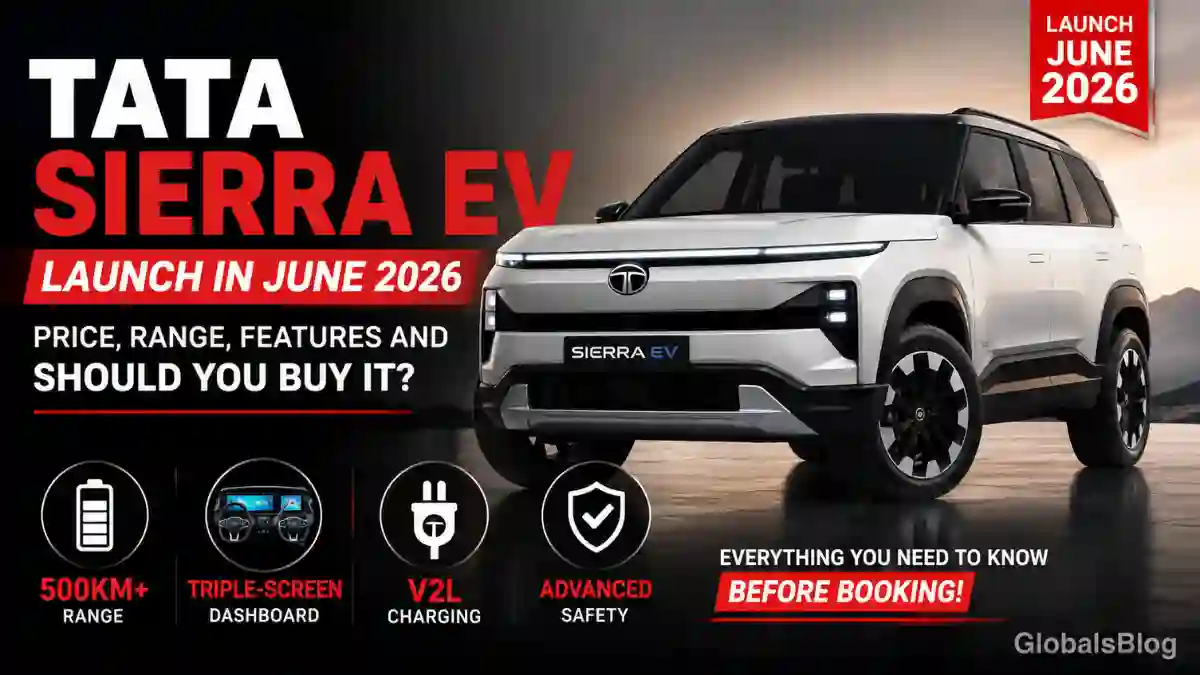
The Sierra nameplate is back — and this time it is electric, and it might actually be Tata''s most important launch of the year.
A reader messaged us last week: "I have been waiting for the Sierra EV since the concept dropped at Auto Expo. Should I cancel my Nexon EV booking and wait?" Fair question. We looked at everything confirmed so far — and here is the honest answer for every buyer sitting on that exact fence right now.
The Tata Sierra EV is expected to launch in June 2026 with prices starting around ₹18 lakh. It comes with 65 kWh and 75 kWh battery options, 500+ km real-world range on the larger pack, a triple-screen dashboard, V2L and V2V charging, Level 2 ADAS, and both single-motor RWD and dual-motor AWD variants. It sits above the Nexon EV and directly targets the Hyundai Creta Electric.
What We Actually Know — Confirmed vs Rumoured
There is a lot of noise around the Sierra EV right now. Let us separate what is confirmed from what is still speculation — because the difference matters when you are deciding whether to book.
Confirmed by Tata Motors: The Sierra EV will use the same 65 kWh and 75 kWh battery packs from the Harrier EV. Single-motor rear-wheel-drive and dual-motor all-wheel-drive variants will both be offered. V2L (Vehicle-to-Load) and V2V (Vehicle-to-Vehicle) charging are confirmed features. Level 2 ADAS — lane keeping assist, adaptive cruise control, automatic emergency braking — is confirmed. The triple-screen dashboard layout is confirmed. Launch is expected this month.
Not yet confirmed: Exact pricing beyond the ₹18 lakh starting estimate. Specific range figures per variant — the 500 km figure is based on the Harrier EV's 65 kWh pack performance extrapolated to the Sierra's platform. On-road availability dates outside major metros. Whether a Standard Range variant below ₹18 lakh will be offered at launch.
The Platform Story — Why This Matters
The Sierra EV shares its platform and battery architecture with the Harrier EV — which means Tata has already worked out the engineering challenges. The 65 kWh and 75 kWh battery pack options are borrowed from the Harrier EV, and real-world range data from Harrier EV owners gives us a reliable baseline for what to expect from the Sierra. That de-risks the Sierra EV significantly compared to a brand-new platform launch.
The Design — What Makes It Different From Every Other Tata EV
The Sierra EV has a retro-modern design that references the original Tata Sierra from the 1990s — boxy, upright, with a distinctive D-pillar glass section that was the original Sierra's signature. The production-spec model features a triple-screen dashboard layout, panoramic sunroof, V2L and V2V charging functions, Level 2 ADAS and connected technologies. In a segment dominated by smooth, anonymous crossover shapes, the Sierra's distinctive silhouette is a genuine differentiator.
Tata Sierra EV vs Hyundai Creta Electric — The Real Comparison
This is the comparison that matters most for most buyers. Both target the ₹18–₹25 lakh segment, both offer 400–500 km range, both have strong brand backing. Here is where they differ.
- Distinctive retro-modern design — stands out
- V2V charging — can charge another EV from the car
- AWD option available
- Tata's nationwide service network — best in India
- 75 kWh option for 500+ km range
- New model — no real-world ownership data yet
- Proven platform with 6+ months of owner data
- V2L charging confirmed and working well
- 800V architecture for faster charging
- Premium interior quality edge
- Available now — no waiting list uncertainty
- Hyundai service network strong in metros
Our honest take: if you can wait 2–3 months for the Sierra EV to hit showrooms and gather real owner data, wait. The V2V feature alone is genuinely unique in this segment — no other Indian-market EV lets you charge another EV from your car's battery. For Indian buyers with multiple EVs in the family or who travel in EV-heavy friend groups, that is a real practical differentiator. If you need a car right now, the Creta Electric is the safer established choice. Check our full breakdown in the best electric car in India guide to see how both sit in the full EV landscape.
Should You Cancel Your Nexon EV Booking for the Sierra EV?
This is the actual question sitting in thousands of Indian buyers' heads right now. Direct answer: probably not — but it depends on your budget.
The Nexon EV Long Range starts at ₹17.49 lakh. The Sierra EV starts at approximately ₹18 lakh — a ₹50,000 gap at base. But the Sierra EV is a larger, more feature-rich car with a bigger battery option. If your budget stretches to ₹20–₹22 lakh comfortably, the Sierra EV is likely the better long-term buy — more space, more range, more features.
If you are stretching to reach ₹17–₹18 lakh and the EMI is already tight, stick with the Nexon EV. A proven car that fits your budget beats a more exciting car that strains it. Use our Car Loan EMI Calculator to model what the Sierra EV at different price points looks like on your monthly budget before making any booking decision.
And yes — we know the Sierra looks cooler. But looking cool in a car you are financially uncomfortable with gets old faster than you think.
BYD''s First PHEV for India — The Other Big June Launch
The Sierra EV is not the only significant June launch. BYD has already confirmed that its first plug-in hybrid model for India will debut soon with the Atto 2 DM-i and Sealion 6 emerging as the strongest contenders following the release of a teaser. The Atto 2 DM-i uses a 1.5-litre naturally aspirated petrol engine paired with either a 7.8 kWh or 18 kWh battery pack and offers a combined driving range of up to 998 km.
A 998 km combined range PHEV is a genuinely significant product for Indian buyers who want EV efficiency on daily commutes but zero range anxiety on highway trips. If BYD prices this competitively — under ₹25 lakh for the Atto 2 DM-i — it will put serious pressure on the Maruti Grand Vitara and Toyota Hyryder in the strong hybrid segment. We will cover the BYD PHEV launch in detail once pricing is confirmed.
What to Do Right Now If You Are Considering the Sierra EV
- Do not cancel existing bookings until Sierra EV pricing is officially announced — estimates can shift by ₹1–2 lakh at launch
- Register your interest at a Tata dealer now — early registrations typically get priority delivery slots
- Use our EV Savings Calculator to model the Sierra EV at ₹18–₹22 lakh and see your monthly savings versus your current car
- Wait for the first 2–4 weeks of real owner range data before booking — the 500 km claim needs Indian road verification
- Ask your dealer specifically about V2V charging compatibility — confirm whether it works with other Tata EVs you may already own
⚠️ Disclaimer: This article is for informational purposes only. Tata Sierra EV pricing, specifications, and launch timeline are based on confirmed details and credible industry reports as of June 2026. Final specifications and prices may vary at official launch. Always verify with an authorised Tata Motors dealer before making any booking or purchase decision.
The Tata Sierra EV is expected to start at approximately ₹18 lakh ex-showroom for the base single-motor RWD variant with the 65 kWh battery. The top-spec dual-motor AWD variant with the 75 kWh battery is expected to be priced between ₹22–₹25 lakh. Official pricing will be confirmed at launch. Always verify with an authorised Tata Motors dealer for final on-road pricing in your city.
The Tata Sierra EV with the 75 kWh battery is expected to deliver 500+ km real-world range based on performance data from the same battery pack in the Harrier EV. The 65 kWh variant is expected to deliver 420–450 km real-world range in mixed Indian driving conditions. These are estimates based on the shared battery architecture — official ARAI range figures will be confirmed at launch.
V2V (Vehicle-to-Vehicle) charging means the Tata Sierra EV can transfer power from its battery directly to another electric vehicle. If your travel companion's EV runs low on charge, you can use the Sierra EV to top it up — essentially turning your car into a mobile charger. This is different from V2L (Vehicle-to-Load) which powers household appliances. The Sierra EV supports both V2L and V2V, making it one of the most versatile EVs in its segment for Indian buyers.
If your budget comfortably covers ₹20–₹22 lakh and you want a larger car with more range and unique features like V2V charging, waiting 2–3 months for the Sierra EV is worth it. If your budget is tight at ₹17–₹18 lakh or you need a car urgently, the Nexon EV Long Range is a proven, reliable choice available now. Do not stretch your budget for a new launch model — wait for real owner data before committing to a higher price point.
Tata Sierra EV is expected to launch in June 2026 with deliveries beginning in major metros first — Delhi, Mumbai, Bangalore, Chennai, Hyderabad, and Pune. Broader nationwide delivery rollout typically follows 4–8 weeks after the initial metro launch for Tata EV models. Registering interest at your local dealer now helps secure an early delivery slot once booking opens officially.
Reader Questions