You do not need to spend ₹17 lakh to own an electric car in India anymore. Not even close.
Someone in our comments last month said his neighbour laughed at him for considering an EV — "too expensive, too risky." He bought a Tata Tiago EV for ₹8.49 lakh. His monthly fuel saving is ₹4,200. His neighbour is still paying ₹106 per litre. The cheap EV conversation in India has completely changed — and most people have not caught up yet.
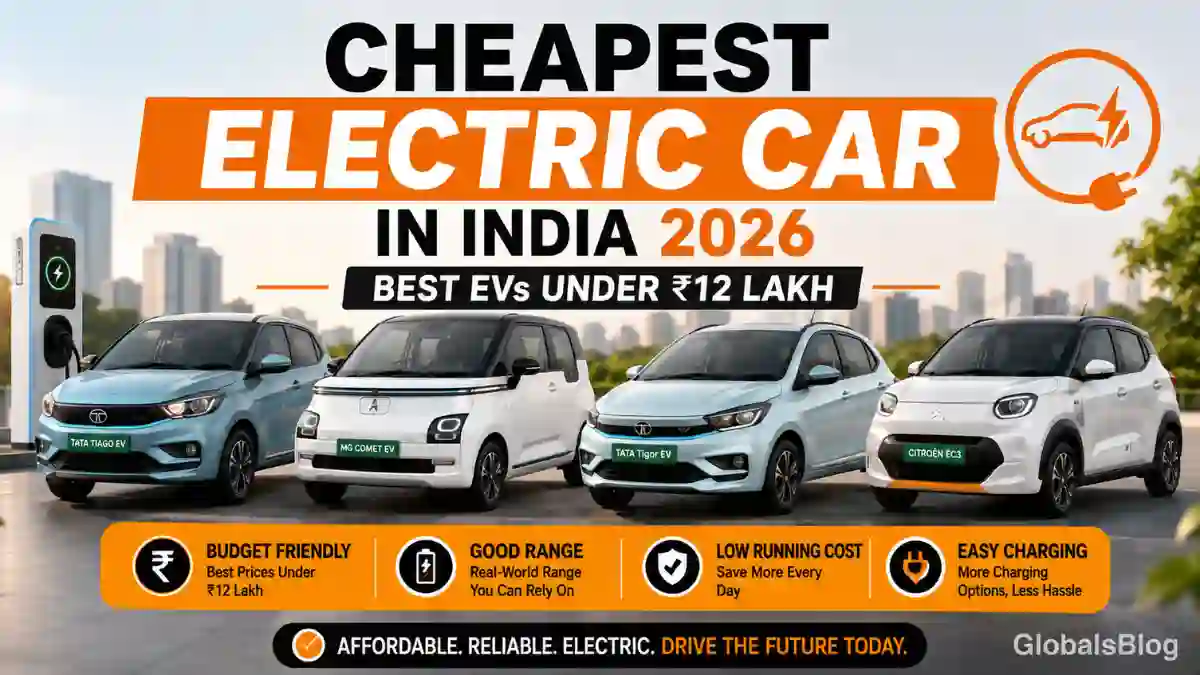
The cheapest electric cars in India in 2026 are the Tata Tiago EV (from ₹8.49 lakh), Tata Punch EV (from ₹9.99 lakh), MG Comet EV (from ₹7.98 lakh), and Citroen ë-C3 (from ₹11.50 lakh). For most city buyers the Tata Punch EV offers the best balance of price, real-world range, and Tata''s nationwide service network. Use our EV Savings Calculator to see your exact monthly savings before deciding.
The Cheap EV Myth Indians Need to Stop Believing
For three years the conversation around EVs in India was dominated by one number — ₹14 lakh, ₹15 lakh, ₹17 lakh. The assumption baked into every dinner table EV discussion was that electric cars are premium products for premium budgets.
That assumption is now wrong. Completely wrong.
You can buy a real, capable, warranty-backed electric car in India in 2026 for under ₹10 lakh. Not a golf cart. Not a low-speed neighbourhood vehicle. A proper car with a 5-star NCAP-equivalent safety rating, a 180–310 km real-world range, and access to India''s fastest-growing service network. The price barrier that kept EVs as aspirational purchases has fallen — and most Indian buyers have not registered that yet.
What Changed Between 2024 and 2026
Battery costs dropped roughly 18% over two years. FAME III subsidies specifically targeted sub-₹15 lakh EVs. Tata and MG both made deliberate strategic decisions to attack the mass market. The result is a completely different affordable EV landscape from what existed even 18 months ago.
If you looked at budget EVs in early 2024 and walked away unimpressed — look again. The products have changed faster than the perception has.
The Real Cost Comparison Nobody Does
Most people compare the sticker price of a budget EV against the sticker price of an equivalent petrol car. That is the wrong comparison. The right comparison is total 5-year cost of ownership — and on that metric, a ₹9.99 lakh Punch EV beats a ₹7.50 lakh petrol hatchback for anyone driving more than 1,000 km per month. Run your exact numbers with our EV Savings Calculator — it takes 90 seconds and uses your actual fuel spend.
Cheapest Electric Cars in India 2026 — Ranked by Value
At ₹7.98 lakh the MG Comet is technically the cheapest electric car you can buy in India right now. It is a micro-urban car — 2,974mm long, two proper seats in front and two extremely tight seats at the rear, and a 230 km ARAI range that delivers roughly 150–170 km in real urban conditions. Honestly? It is not for everyone. It is for one specific buyer — someone with a 30–40 km daily city commute, guaranteed parking, and no highway use case whatsoever. For that buyer it is genuinely excellent. For everyone else, keep reading.
The Tiago EV is what happens when Tata takes a proven, trusted platform and goes electric without cutting corners. Starting at ₹8.49 lakh it offers a proper 5-seat hatchback with 200–220 km real-world city range and access to Tata''s service network that covers 98% of Indian cities above 1 lakh population. The Medium Range variant is the sweet spot — ₹9.09 lakh, 250 km real-world city range, and enough for 99% of Indian urban commuters. If you drive under 60 km a day and can charge at home, the Tiago EV is the most sensible budget EV decision in India right now. Calculate your EMI first using our Car Loan EMI Calculator — at current interest rates the monthly outgo is often lower than a petrol car EMI plus fuel combined.
This is our pick for most Indian buyers in the budget EV segment. The Punch EV at ₹9.99 lakh is a proper compact SUV — higher ground clearance for Indian roads, better boot space than the Tiago, and significantly more highway capability with 280–310 km real-world range on the Long Range variant. It also qualifies for the maximum FAME III subsidy which in Delhi brings the effective price under ₹8 lakh. The waiting list has stretched to 6–8 weeks at most dealerships — which tells you everything about how Indian buyers are voting with their wallets. See our full analysis in the best electric car in India guide for how the Punch EV compares against the Nexon EV and Creta Electric.
At ₹11.50 lakh the ë-C3 sits just above the sub-₹10 lakh bracket but delivers something neither Tata option does — a distinctly European design and a surprisingly premium interior feel at this price point. The real-world range of 200–230 km is comparable to the Tiago EV but the ride quality on broken Indian roads is notably better. Citroen''s service network is the concern — 170+ touchpoints is fine in metros but thinner in tier-2 cities. If you are in Delhi, Mumbai, Bangalore, Chennai, or Hyderabad, the ë-C3 is a genuinely interesting choice. If you are in Jaipur or Bhopal, stick with Tata.
What "Cheap" Actually Costs You — The Honest Trade-offs
Nobody talks about this clearly enough. Every budget EV involves a real trade-off — and pretending otherwise would be doing you a disservice.
Range is the biggest one. The sub-₹10 lakh EVs deliver 150–310 km in city conditions. On the highway at 100 kmph with AC that drops to 120–220 km. That means a Pune-Mumbai highway run — 148 km — is doable in the Punch EV Long Range with comfortable margin. In the Tiago EV Standard Range it is tight. In the MG Comet it is not advisable.
"The right budget EV is the one that covers your actual daily distance — not the one with the longest claimed range on the brochure."
— Rule we apply to every EV recommendation at GlobalsBlog
Charging infrastructure is the second trade-off. Budget EV buyers are more likely to be first-time EV buyers — and first-time EV buyers are more likely to live in apartments where home charging is uncertain. This matters more for budget buyers than premium ones. If you cannot reliably charge at home or at your workplace, a budget EV creates friction that a petrol car does not. Solve the charging question before solving the car question.
And the service network question — say it plainly. Tata''s network is the best in India for EVs right now. Full stop. MG is good in top 30 cities. Citroen is thin outside metros. For a budget buyer making their first EV purchase, Tata''s network depth is genuinely worth paying a small premium for.
How to Actually Buy a Budget EV in India — Step by Step
- Calculate your daily distance firstSounds obvious. Most people skip it. Write down your actual daily commute distance for a typical week — not your estimate, the real number from Google Maps. If it is under 50 km daily, any EV on this list works. If it is 50–80 km daily, you need the Punch EV Long Range minimum. Above 80 km daily with no home charging — reconsider.
- Confirm home charging before the test driveVisit your parking spot and answer three questions: Is there an electrical point within 10 metres? Does your apartment society allow EV charger installation? Who manages the electrical board for your parking area? Sort them before you visit a showroom.
- Check subsidy eligibility before negotiating priceThe Tiago EV and Punch EV both qualify for FAME III central subsidies. Add your state subsidy on top — Delhi gets ₹1.5 lakh extra, Maharashtra ₹1.5 lakh, Gujarat ₹1.5 lakh. Always ask the dealer to show you the post-subsidy on-road price — not the ex-showroom headline.
- Negotiate what you get, not what you payIn a high-demand EV market, outright price discounts are rare. Focus your negotiation on free home charger installation (worth ₹15,000–₹25,000), extended warranty, free first three services, and accessories package. These are more achievable than a price cut and add real value.
- Book now, take delivery in 6–8 weeksThe Punch EV specifically has a real waiting list. Booking locks your price — if Tata announces a price revision your booking price is protected. The booking amount is refundable if you change your mind. There is no downside to booking early.
Budget EV Buying Tips That Actually Help
- Always ask for the post-subsidy on-road price — the difference between sticker and effective price can be ₹2–3 lakh in eligible states
- Get the home charger installation quote before finalising — factor it into your total cost comparison
- The Long Range variant of every budget EV is almost always worth the ₹50,000–₹80,000 premium — the range difference is significant in real use
- Use our EV Savings Calculator to calculate your personal monthly saving — then use that number in your family''s budget discussion
- Check insurance cost before buying — EV insurance is slightly higher than petrol equivalent due to battery cover
- Register for the EV in your name to get the full subsidy — corporate registration gets different treatment in some state schemes
Budget EV Mistakes Indian Buyers Make
- Buying on range claim, not real-world range — A reader from Nagpur almost bought the MG Comet based on its 230 km ARAI claim. Real-world city range is 150–170 km. His commute is 45 km each way. He caught it in time and went with the Tiago EV instead. Always check owner forums for real range data before deciding.
- Ignoring the apartment charging problem — The single most common source of budget EV regret in India. Solve this before the showroom visit, not after delivery.
- Choosing the cheapest variant to save ₹50,000 — The Standard Range variants of budget EVs look attractive on paper. In practice the range difference makes them impractical for most real-world use. The Long Range variant is almost always the right call.
- Not factoring in insurance — EV comprehensive insurance runs 10–15% higher than an equivalent petrol car due to battery replacement cover. Budget for it.
- Waiting for the "perfect" budget EV — And yes — we know people who have been "waiting for a better option" since 2023. The savings they missed in those two years would have paid for the home charger installation twice over. The best budget EV is the one you actually buy.
⚠️ Disclaimer: This article is for informational and product comparison purposes only. All prices are approximate ex-showroom figures as of June 2026 and vary by city, variant, and dealer. Subsidy eligibility changes — always verify with the official dealer and your state transport department before purchase.
The Cheap EV Moment Is Here — Stop Waiting
The Tata Punch EV at ₹9.99 lakh with ₹3 lakh in Delhi subsidies is a ₹7 lakh effective EV with 300 km real range and India''s best service network. That product did not exist two years ago. It exists now. Run your numbers, confirm your charging setup, and make the decision — because every month you wait is a month of fuel savings you are not collecting.
The cheapest electric car in India in 2026 by ex-showroom price is the MG Comet EV at ₹7.98 lakh — a micro urban car with 150–170 km real-world city range. For a more practical everyday car, the Tata Tiago EV starts at ₹8.49 lakh and offers 200–250 km city range with Tata''s nationwide service network. The Tata Punch EV at ₹9.99 lakh is the best all-round budget EV for Indian buyers who need a mix of city and occasional highway use.
Yes — the Tata Punch EV is worth buying in 2026 for most Indian buyers in the budget segment. It offers 280–310 km real-world range on the Long Range variant, Tata''s best-in-class service network, FAME III subsidy eligibility that can bring the effective price to under ₹8 lakh in states like Delhi, and the proven safety record of the Punch platform. The 6–8 week waiting list at most dealerships is the only practical inconvenience — book early to protect your pricing.
Under FAME III, electric cars priced under ₹15 lakh qualify for central government subsidies of up to ₹1.5 lakh. State governments add additional incentives — Delhi, Maharashtra, and Gujarat each offer up to ₹1.5 lakh extra. Combined, buyers in these states can get up to ₹3 lakh off the price of eligible EVs like the Tata Tiago EV and Punch EV. Always verify current subsidy availability with your dealer as allocations can run out during the financial year.
The Tata Punch EV Long Range and Tiago EV Long Range can handle Indian highways with planning. At 100 kmph with AC, highway range drops to roughly 200–240 km for the Punch EV and 160–190 km for the Tiago EV. For trips under 150 km one way the Punch EV Long Range is comfortable. For longer highway trips, plan charging stops using apps like PlugShare or Tata Power EV. The MG Comet is not recommended for highway use.
Charging a Tata Tiago EV from near-empty to full at home costs approximately ₹60–₹90 depending on your state''s electricity tariff. A full charge gives 200–250 km city range, making the cost per kilometre approximately ₹0.30–₹0.45. Compare this to a petrol hatchback''s ₹6–₹8 per kilometre and the savings become very clear very quickly for anyone driving regularly.
The MG Comet is a good buy for one specific profile — a city buyer with a short daily commute under 40 km, guaranteed overnight charging, zero highway requirement, and the need for a compact second car. For everyone outside that profile it is too limited in range, rear space, and highway capability. Its ₹7.98 lakh price is genuinely impressive but do not let the price tag distort your assessment of whether it actually fits your life.
Owner Experiences & Questions