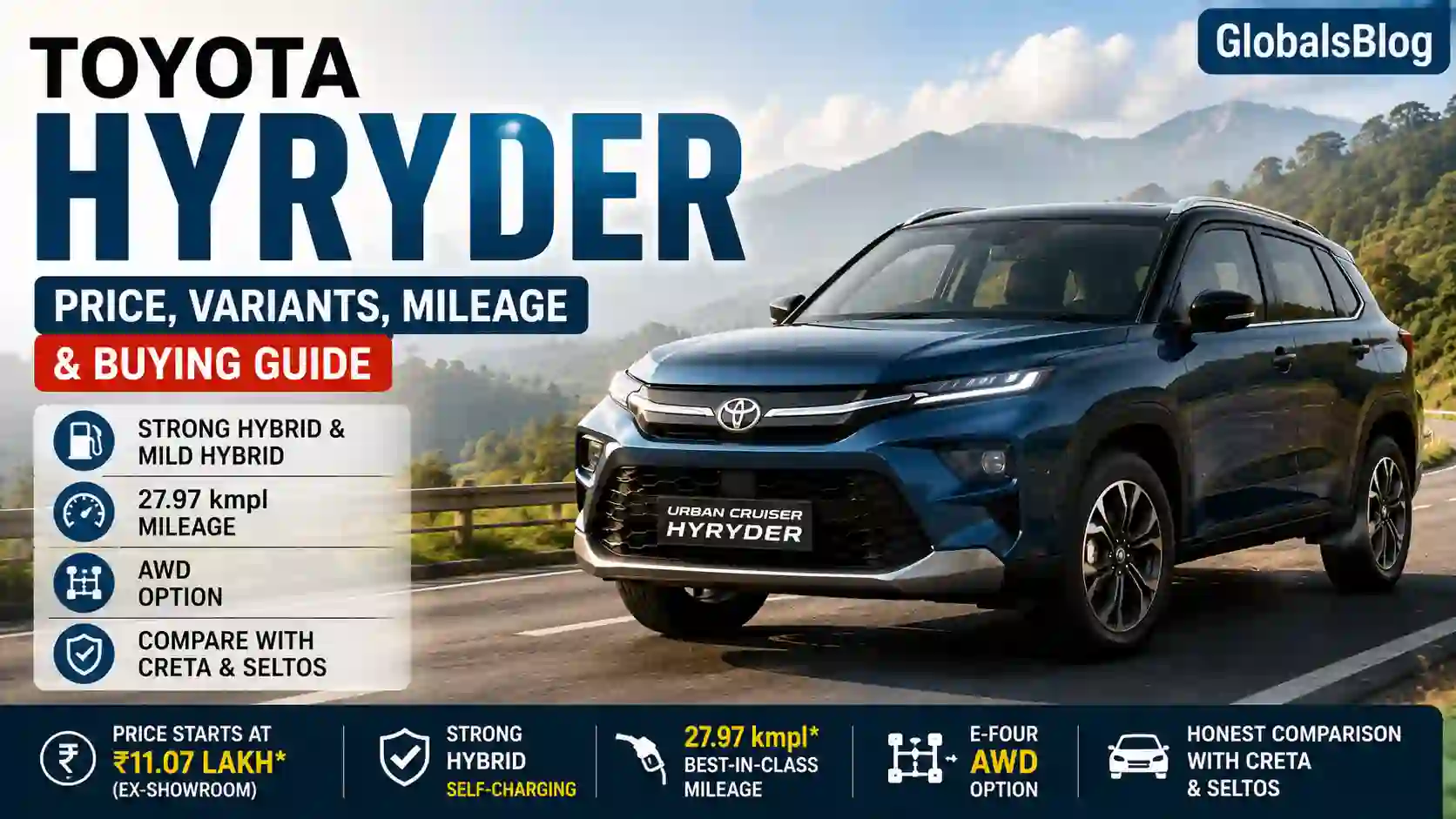
The Toyota Urban Cruiser Hyryder is the first Toyota SUV built specifically for India — and the only car in its segment that offers a strong hybrid system delivering real-world mileage above 23 kmpl without charging infrastructure.
A reader from Hyderabad had shortlisted the Hyundai Creta and the Maruti Grand Vitara before a colleague mentioned the Toyota Hyryder. His initial reaction was that Toyota SUVs were for older buyers and that the Hyryder "looked like a Grand Vitara." He drove it anyway — specifically the Strong Hybrid variant — and bought it two weeks later. His reasoning: "I cover 2,500 km a month. The fuel savings alone justify the price premium over the Creta in 18 months. And Toyota's service reliability over five years is worth something real." The Hyryder is exactly this — a car that makes more sense the more seriously you do the numbers, and one that most buyers dismiss before doing them. This guide covers everything: price, variants, the strong hybrid vs mild hybrid difference, real-world mileage, and honest comparisons with the Maruti Grand Vitara, Hyundai Creta, and Kia Seltos.
Toyota Urban Cruiser Hyryder price in India (August 2026): E MT ₹11.07 lakh, S MT ₹13.57 lakh, S+ MT ₹15.12 lakh, G MT ₹16.72 lakh, G AT ₹18.07 lakh, V MT ₹17.90 lakh, V AT ₹19.17 lakh, V Strong Hybrid ₹19.71 lakh, S Strong Hybrid ₹16.72 lakh (all ex-showroom). Best value: G MT at ₹16.72 lakh — gets all essential features. Best overall: V Strong Hybrid at ₹19.71 lakh — 23+ kmpl real-world mileage, self-charging hybrid, Toyota's most efficient SUV. The strong hybrid adds ₹2–3 lakh over the mild hybrid V AT but pays back in fuel savings within 18–24 months for buyers covering 1,500+ km monthly.
Toyota Hyryder Price — All Variants
| Variant | Powertrain | Gearbox | Price (Ex-showroom) | Verdict |
|---|---|---|---|---|
| E | 1.5L Mild Hybrid | 5MT | ₹11.07 lakh | Entry — skip |
| S | 1.5L Mild Hybrid | 5MT | ₹13.57 lakh | Misses sunroof |
| S+ | 1.5L Mild Hybrid | 5MT | ₹15.12 lakh | Gets sunroof |
| G MT | 1.5L Mild Hybrid | 5MT / AWD option | ₹16.72 lakh | Best Value |
| G AT | 1.5L Mild Hybrid | 6AT | ₹18.07 lakh | Automatic comfort |
| V MT | 1.5L Mild Hybrid | 5MT | ₹17.90 lakh | Fully loaded, manual |
| V AT | 1.5L Mild Hybrid | 6AT | ₹19.17 lakh | Fully loaded, auto |
| S Strong Hybrid | 1.5L Strong Hybrid | e-CVT | ₹16.72 lakh | Hybrid efficiency, fewer features |
| V Strong Hybrid | 1.5L Strong Hybrid | e-CVT | ₹19.71 lakh | Best Overall |
All prices ex-showroom India, August 2026. On-road price adds 12–16% depending on state (RTO registration, insurance, handling charges). The most significant pricing decision is between the mild hybrid and strong hybrid — a difference of approximately ₹2–3 lakh at equivalent trim levels that delivers dramatically different real-world fuel efficiency.
Strong Hybrid vs Mild Hybrid — The Decision That Matters Most
The mild hybrid system on the Hyryder uses a 12V integrated starter generator (ISG) that assists the petrol engine during acceleration and enables start-stop functionality — it is not a full hybrid system. The electric motor cannot propel the car independently; it only reduces the load on the petrol engine at specific points in the drive cycle. This is the same mild hybrid approach used by Maruti (SHVS) across multiple vehicles. The real-world fuel efficiency improvement over a non-hybrid equivalent is approximately 10–15%. The significant advantage of the mild hybrid variants: they are available with a 5-speed manual gearbox and, crucially, with an All-Wheel Drive (AWD) option — making the Hyryder the only AWD-capable SUV under ₹20 lakh in its segment.
The strong hybrid system is a genuine full parallel hybrid — the same Toyota Hybrid System II (THS-II) used in the Innova Hycross, Camry, and globally in the RAV4 Hybrid. The electric motor can propel the car independently at low speeds (city driving below approximately 40 km/h often runs on electric power alone), the battery recharges through regenerative braking and the petrol engine, and the system seamlessly switches between electric, petrol, and combined modes without driver input. No external charging is required — the battery charges itself during normal driving. This is the critical distinction from a plug-in hybrid: the strong hybrid works exactly like a conventional car in terms of refuelling (petrol only, at any petrol station) while delivering hybrid efficiency automatically.
The real-world difference is significant. In city driving — the majority of Indian buyers' usage — the strong hybrid regularly achieves 23–26 kmpl because it runs on electric power for a substantial portion of stop-go traffic. On the highway, where electric power use is minimal, it returns 18–20 kmpl — similar to the mild hybrid. The strong hybrid variant does not offer a manual gearbox (the e-CVT is integral to how THS-II functions) and AWD is not available. It is front-wheel drive only.
Toyota Hyryder Mileage — Real-World vs ARAI
| Variant | ARAI Mileage | Real-World City | Real-World Highway | Monthly Savings vs Creta* |
|---|---|---|---|---|
| Mild Hybrid MT | 21.11 kmpl | 14–16 kmpl | 18–21 kmpl | ₹800–₹1,200/month |
| Mild Hybrid AT | 19.88 kmpl | 13–15 kmpl | 17–20 kmpl | ₹600–₹1,000/month |
| Strong Hybrid e-CVT | 27.97 kmpl | 22–26 kmpl | 18–21 kmpl | ₹2,500–₹3,500/month |
*Savings estimated vs Hyundai Creta 1.5 T-GDi DCT at 2,000 km/month, petrol at ₹103/litre. The strong hybrid's city mileage advantage is where it most outperforms — stop-go traffic is where electric power use is highest and where the efficiency gap over conventional engines is most pronounced. On highway driving the strong hybrid advantage narrows significantly because high-speed continuous driving leaves less opportunity for regenerative braking and electric-only operation.
Toyota Hyryder Variants — What You Get at Each Level
The E and S variants miss the sunroof (available from S+), the larger 9-inch touchscreen (E gets no screen, S gets a basic unit), connected car features, rear AC vents, and automatic climate control. The base E variant at ₹11.07 lakh is priced against budget hatchbacks and misses features that make an SUV liveable. The S at ₹13.57 lakh gets the touchscreen and some added features but still lacks the sunroof that the majority of Indian buyers in this segment consider near-essential. Skip both unless the entry price point is the absolute priority.
The S+ gets the panoramic sunroof and auto climate control — the two additions that make the most practical daily difference. The G MT at ₹16.72 lakh adds ventilated front seats, connected car (Toyota Connect), 360-degree surround view camera, and the AWD option (G AWD MT at approximately ₹18.72 lakh). For buyers who want the full Hyryder feature set without the V variant's premium and do not specifically need the strong hybrid's fuel efficiency, the G MT is the rational choice. The AWD version of the G MT is unique in the segment — no other SUV at this price point offers all-wheel drive.
The V variants add a head-up display (HUD), 10-inch digital instrument cluster, Arkamys premium audio, and connected safety features over the G. The V Strong Hybrid at ₹19.71 lakh combines all of these with Toyota's THS-II strong hybrid system — making it the most complete and most efficient version of the Hyryder. The HUD and digital cluster are genuine differentiators versus competitors at similar prices; the strong hybrid's fuel efficiency is the most compelling reason to pay the V Strong Hybrid premium. For the Hyderabad reader covering 2,500 km monthly, the payback period on the strong hybrid premium (approximately ₹2–3 lakh over equivalent mild hybrid) is 14–18 months of fuel savings — after which the efficiency advantage is pure benefit.
Toyota Hyryder vs Maruti Grand Vitara vs Hyundai Creta vs Kia Seltos
| Spec | Hyryder V Strong Hybrid | Grand Vitara Intelligent Hybrid | Hyundai Creta SX(O) | Kia Seltos HTX+ |
|---|---|---|---|---|
| Price | ₹19.71 lakh | ₹19.75 lakh | ₹19.70 lakh | ₹18.65 lakh |
| Engine | 1.5L Strong Hybrid | 1.5L Strong Hybrid | 1.5 T-GDi (160 PS) | 1.5 T-GDi (160 PS) |
| ARAI Mileage | 27.97 kmpl | 27.97 kmpl | 18.4 kmpl | 18.0 kmpl |
| Real City Mileage | 22–26 kmpl | 22–26 kmpl | 11–13 kmpl | 11–13 kmpl |
| Gearbox | e-CVT | e-CVT | 7-speed DCT | 7-speed DCT |
| Boot Space | 373 litres | 373 litres | 433 litres | 433 litres |
| NCAP Safety | 5-star (Global NCAP) | 5-star (Global NCAP) | 5-star (Global NCAP) | 3-star (Global NCAP) |
| AWD | No (FWD only) | No (FWD only) | No | No |
| Service Reliability | Excellent (Toyota) | Excellent (Maruti) | Good (Hyundai) | Good (Kia) |
The Hyryder and Grand Vitara share identical powertrains (Toyota supplies the strong hybrid system to Maruti under the platform-sharing agreement) — the choice between them is primarily exterior design, brand preference, and minor feature differences. The Creta and Seltos offer more boot space, more powerful engines, and a wider service network at similar prices — but their city fuel efficiency is roughly half the Hyryder strong hybrid's. The calculation is straightforward: if you drive primarily in the city and cover significant monthly kilometres, the Hyryder strong hybrid's fuel efficiency advantage compounds into significant savings. If you drive primarily on highways or have shorter monthly distances, the Creta or Seltos's conventional powertrain's advantages (more power, more space) become more relevant.
Toyota Hyryder Dimensions
| Dimension | Measurement | Class Context |
|---|---|---|
| Length | 4,365 mm | Similar to Creta (4,300 mm) — slightly longer |
| Width | 1,795 mm | Comparable to Creta (1,790 mm) |
| Height | 1,635 mm | Comparable to Creta (1,635 mm) |
| Wheelbase | 2,600 mm | Slightly less than Creta (2,610 mm) |
| Ground Clearance | 210 mm | Best in class — higher than Creta (190 mm) |
| Boot Space | 373 litres | Less than Creta (433 litres) — hybrid battery occupies space |
The 210mm ground clearance is the Hyryder's dimensional highlight — highest in its segment and genuinely useful for Indian road conditions including unpaved lanes, speed breakers, and monsoon flooding. The boot space penalty (373L vs 433L in the Creta) is the hybrid battery's cost — the battery pack sits under the boot floor in the strong hybrid. For most buyers this difference is not felt in daily use, but for families who regularly carry large luggage or sports equipment, it is worth a comparison.
Toyota Hyryder — Buying Tips
- Calculate your break-even before choosing mild vs strong hybrid: At 1,000 km/month city driving, the strong hybrid saves approximately ₹1,500–₹2,000/month over the mild hybrid V AT. At ₹2–3 lakh premium, payback is 12–20 months. At 2,000+ km/month, payback is under 12 months. Do this calculation with your actual monthly distance before choosing the variant
- The G MT AWD is the only AWD option in the segment under ₹19 lakh: If you drive on unpaved roads, in hilly terrain, or in states with heavy monsoon conditions, the AWD G MT deserves serious consideration — no other SUV offers AWD capability at this price point
- Toyota's service reliability is the strongest in this segment: Maruti has a wider network, but Toyota's service quality consistency and long-term reliability track record (particularly for hybrid systems) is the best available in India. Factor this into total cost of ownership over 5–7 years
- The strong hybrid's resale value is higher: Toyota hybrids hold value exceptionally well in India because of proven reliability and fuel efficiency appeal in the second-hand market. A 3-year-old Hyryder Strong Hybrid retains approximately 65–70% of value versus 55–60% for comparable conventional SUVs
- Compare with the Maruti Grand Vitara — identical hybrid powertrain, different exterior design and feature set. The choice between them often comes down to which design you prefer and Maruti's wider service network advantage
Toyota Hyryder — Common Buying Mistakes
- Dismissing the strong hybrid because the price looks high: The Hyryder V Strong Hybrid at ₹19.71 lakh is ₹0.54 lakh more than the Creta SX(O) turbo at ₹19.17 lakh. At 2,000 km/month city driving, the Hyryder saves approximately ₹3,000/month in fuel. In 6 months the fuel savings exceed the price premium — and continue for the car's life. Evaluate on total cost of ownership, not sticker price alone
- Choosing the strong hybrid expecting highway mileage gains: The strong hybrid's efficiency advantage is predominantly in city and stop-go driving. On continuous highway driving above 80 km/h, the electric motor contributes less and real-world mileage drops to 18–21 kmpl — comparable to the mild hybrid. If your driving is 80% highway, the mild hybrid AT is a better value proposition
- Overlooking the boot space reduction in the strong hybrid: The 373-litre boot (vs 433L in the Creta) is meaningfully smaller when carrying full family luggage for a highway trip. Test the boot with your actual luggage before committing if this is a regular use case
- Ignoring the e-CVT's character on spirited driving: The strong hybrid's e-CVT gearbox is optimised for efficiency, not driving engagement — it feels elastic under hard acceleration and does not reward aggressive driving the way the Kushaq's DSG or Creta's DCT does. Buyers who enjoy spirited driving will find the strong hybrid less satisfying in this regard, and the mild hybrid G MT is a better choice for them
⚠️ Disclaimer: Toyota Urban Cruiser Hyryder prices, variant specifications, and feature lists are subject to change. Toyota India periodically revises pricing and introduces new variants. All prices are ex-showroom India as of August 2026 — verify current pricing and availability with your nearest Toyota dealership before purchase.
G MT for Best Value. V Strong Hybrid for Best Total Cost. AWD G MT for Capability. The Only SUV Under ₹20 Lakh That Makes Fuel Efficiency a Genuine Buying Argument.
The Toyota Urban Cruiser Hyryder does not win on maximum features per rupee at any trim level — the Hyundai Creta and Kia Seltos are better on that measure. What it does win on is the combination of fuel efficiency, long-term reliability, and total cost of ownership for buyers who drive significant monthly distances. The strong hybrid variant's 22–26 kmpl city mileage is not a claim — it is the consistent real-world result that Hyryder owners report across India's traffic conditions. The G MT AWD is the segment's only all-wheel drive option under ₹19 lakh. And Toyota's service reliability over five-plus years has a value that shows up in resale price and unscheduled repair costs. This is a car for buyers who do the arithmetic rather than the spec comparison — and the arithmetic, for the right buyer, is compelling.
Toyota Urban Cruiser Hyryder price in India (August 2026, ex-showroom): E MT ₹11.07 lakh, S MT ₹13.57 lakh, S+ MT ₹15.12 lakh, G MT ₹16.72 lakh, G AT ₹18.07 lakh, V MT ₹17.90 lakh, V AT ₹19.17 lakh, S Strong Hybrid ₹16.72 lakh, V Strong Hybrid ₹19.71 lakh. On-road price adds 12–16% for RTO, insurance, and handling charges depending on state. The best value variant is G MT at ₹16.72 lakh; the most efficient and fully featured variant is V Strong Hybrid at ₹19.71 lakh. Prices subject to change — verify with Toyota dealership.
Toyota Hyryder mileage (ARAI certified): Mild Hybrid MT — 21.11 kmpl; Mild Hybrid AT — 19.88 kmpl; Strong Hybrid e-CVT — 27.97 kmpl. Real-world mileage: Mild Hybrid city 14–16 kmpl, highway 18–21 kmpl. Strong Hybrid city 22–26 kmpl, highway 18–21 kmpl. The strong hybrid's significant advantage is in city and stop-go driving, where the electric motor takes over at low speeds and the petrol engine switches off frequently. On continuous highway driving the strong hybrid's advantage narrows to 1–2 kmpl over the mild hybrid.
Toyota Hyryder vs Hyundai Creta — the right choice depends on your priorities. Choose Hyryder if: city fuel efficiency is important (strong hybrid delivers 22–26 kmpl vs Creta's 11–13 kmpl in city), you drive 1,500+ km monthly (strong hybrid payback period is 12–18 months), long-term reliability is a priority (Toyota's hybrid system reliability track record is exceptional), or you need AWD capability (Hyryder G MT AWD is the only AWD SUV under ₹19 lakh in class). Choose Creta if: more boot space matters (433L vs 373L), you want a more powerful engine (160 PS vs 116 PS system output), you prefer a 7-speed DCT's driving character over the e-CVT, a wider service network is important, or your driving is primarily highway (where hybrid advantage is minimal).
No — the Toyota Hyryder Strong Hybrid is a self-charging hybrid that does not require any external charging. The hybrid battery charges automatically through two mechanisms: regenerative braking (energy recovered when the car decelerates or brakes is stored in the battery) and the petrol engine (which charges the battery when the charge level drops below a threshold). You refuel with petrol at any petrol station exactly as with a conventional car — no charging points, no home charger, no range anxiety. This is a fundamental difference from a plug-in hybrid (PHEV) or an electric vehicle (EV). The Hyryder Strong Hybrid is often confused with these, but it is a fully conventional refuelling experience that simply delivers significantly better fuel efficiency automatically.
Best Toyota Hyryder variant depends on use case: For best value overall: G MT at ₹16.72 lakh — gets ventilated seats, 360 camera, Toyota Connect, panoramic sunroof, and AWD option. For best fuel efficiency and long-term savings: V Strong Hybrid at ₹19.71 lakh — 27.97 kmpl ARAI, 22–26 kmpl real city, all features including HUD, digital cluster, and Arkamys audio. For AWD capability: G MT AWD — unique in the segment, ideal for hilly terrain or unpaved roads. For city-only automatic convenience on a budget: G AT at ₹18.07 lakh. Avoid the E and S variants — they miss too many essential features. The V Strong Hybrid is the definitive Hyryder for high-mileage city drivers; the G MT is the rational choice for buyers wanting full features at a lower price point.
Whether the Toyota Hyryder Strong Hybrid is worth the ₹2–3 lakh premium over the mild hybrid depends entirely on your monthly driving distance and city/highway split. At 1,500 km/month with 70% city driving: the strong hybrid saves approximately ₹2,000–₹2,500/month in fuel, recovering the ₹2–3 lakh premium in 12–15 months. After that, pure savings for the car's life. At 800 km/month with mostly highway driving: savings are approximately ₹800–₹1,000/month, payback is 25–35 months — still positive but slower. For buyers with low monthly distances or predominantly highway usage, the mild hybrid G or V AT offers better value. For city commuters with 1,500+ km/month, the strong hybrid is the mathematically correct choice over a 5-year ownership period.
Reader Experiences
V Strong Hybrid owner since January 2026 — 14,000 km, predominantly Bengaluru city driving. My average over the last three months is 24.3 kmpl per the onboard computer. My previous car (Hyundai Verna turbo) was averaging 11 kmpl in the same city. The fuel bill reduction is approximately ₹3,200/month at my mileage. The car paid back the price premium over the Creta I was also considering in less than 10 months. The math is not subtle — this is the correct car for anyone with significant city mileage in Indian traffic conditions.
Chose the G MT AWD for Himachal driving — the only reason to choose this variant over the strong hybrid. The AWD made a real difference on the Manali-Leh highway in October slush and on the wet mountain roads around Kasol. The mild hybrid mileage on those drives was 17–18 kmpl which is acceptable. No other SUV at this price point offers AWD. If you drive in the hills regularly this is the variant — the strong hybrid is the right choice for flat-city people.
The e-CVT criticism in the buying mistakes section is accurate — if you enjoy driving, the strong hybrid is not the car for you in terms of feel. It is extremely smooth and refined but it is optimised for efficiency, not engagement. I came from a Honda City manual and the e-CVT took real adjustment. After six months I have fully adapted and the fuel efficiency has made the adjustment worth it. But buyers who specifically enjoy the driving experience should try the e-CVT on a meaningful test drive before deciding.
The 373L boot size is a real constraint for our family — we do regular 600 km highway trips with two children and full luggage. Had to use a rooftop carrier after the first trip. The Creta's 433L would have been meaningfully more practical for this use case. The fuel savings in the city are excellent but the boot is genuinely limiting on highway family trips. Wish I had tested this before buying. Check the boot with your actual luggage before deciding.
Toyota service experience after 10,000 km service — arrived at scheduled time, car returned same day, service cost ₹6,800 which was exactly what the app estimated. No upselling, no unnecessary recommendations. Coming from Hyundai where the service experience varied dramatically between visits, the Toyota consistency is noticeable. The guide is right that service reliability over five years has real monetary value — and it shows up in the first service interaction.