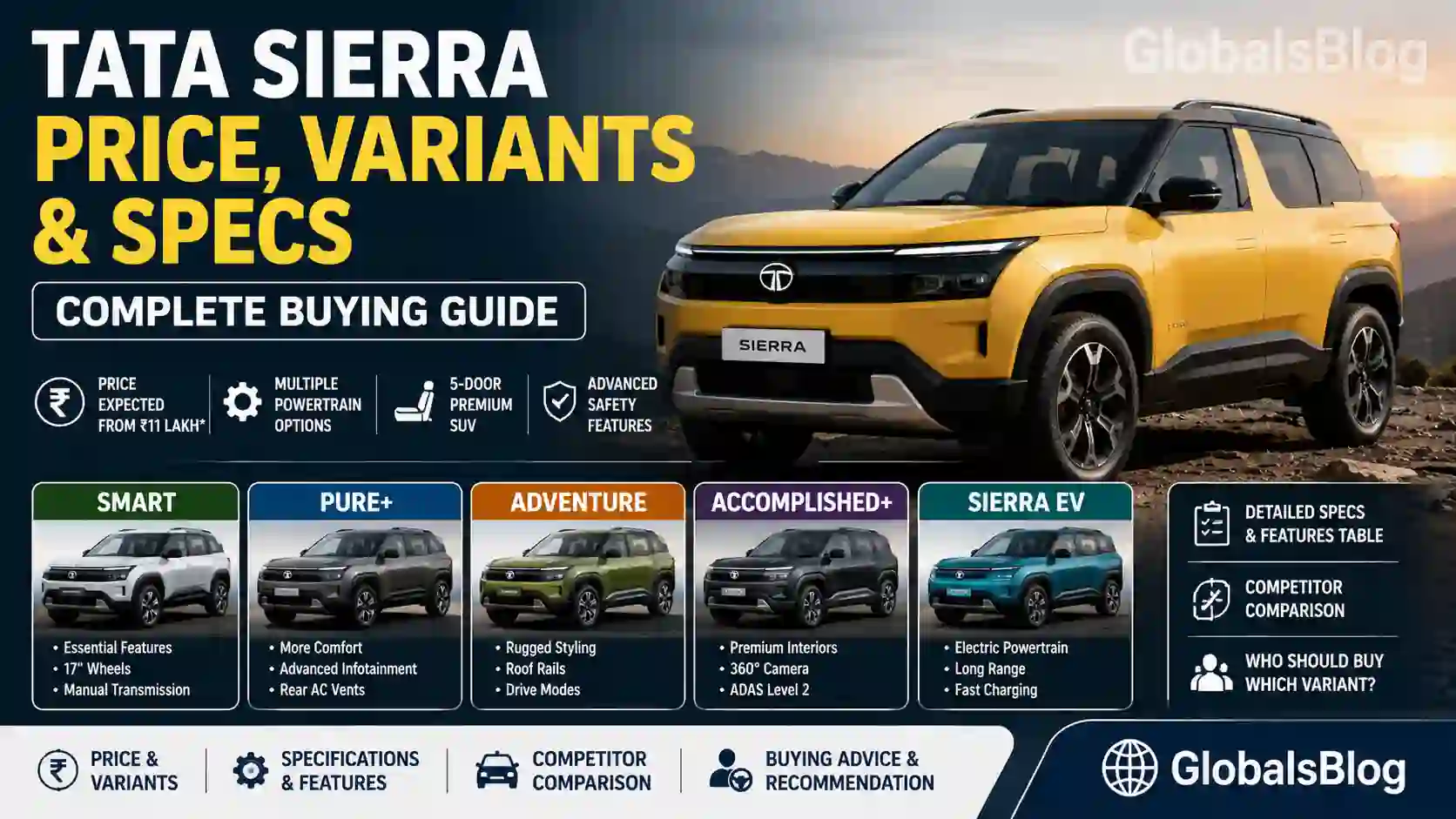
The Tata Sierra is back — 30 years after the original iconic SUV that defined Indian roads in the 1990s, Tata Motors has revived the Sierra nameplate as a modern electric and ICE SUV with a panoramic roof, retractable rear quarter glass, and unmistakable silhouette. Here is everything you need to know about price, variants, specs, and whether it is worth buying.
The Tata Sierra holds a unique place in Indian automotive history — the original Sierra (1991–2004) was India's first indigenously designed SUV, a 3-door monocoque vehicle with a distinctive raked rear window and raised ground clearance that became an icon of 1990s aspiration on Indian roads. When Tata Motors unveiled the Sierra concept at Auto Expo 2020, the nostalgia was immediate and intense. The production version, launched as both an electric (Sierra EV) and a petrol/diesel ICE variant, retains the original's signature design elements — the retractable rear quarter glass, panoramic roof, and bold upright stance — while bringing fully modern powertrain options, ADAS safety features, and connected car technology. The Sierra competes in the mid-size premium SUV space against the Hyundai Creta, Kia Seltos, and Volkswagen Taigun on the ICE side, and the Tata Curvv EV and Mahindra BE 6 on the electric side. This guide covers the complete Tata Sierra price list, variant breakdown, specifications, features, and buying verdict.
Tata Sierra price range: ₹18–25 lakh (ex-showroom, estimated for ICE variants); Sierra EV expected ₹22–30 lakh ex-showroom. Key variants: Smart, Pure+, Adventure, Accomplished+. Engine options: 1.2L Hyperion turbo-petrol (130 PS) and 1.5L diesel (115 PS) for ICE; 55 kWh and 79 kWh battery packs for EV. Key features: panoramic sunroof, retractable rear quarter glass, Level 2 ADAS, 12.3-inch touchscreen, wireless charging, ventilated seats (top variants). Competitors: Hyundai Creta, Kia Seltos, Volkswagen Taigun (ICE); Tata Curvv EV, Mahindra BE 6 (EV). Best variant: Accomplished+ for maximum features; Adventure for mid-range value.
Tata Sierra Variants and Price List
The Smart is the base variant of the Tata Sierra ICE lineup — designed to bring the Sierra nameplate within reach of buyers stepping up from the Nexon price bracket. The Smart variant comes with the 1.2L Hyperion turbo-petrol engine (130 PS, 215 Nm) paired with a 6-speed manual transmission. Standard features include a 10.25-inch infotainment system with wireless Android Auto and Apple CarPlay, a 7-inch digital instrument cluster, LED headlights, automatic climate control, and 4 airbags. The Smart does not get the panoramic sunroof, ventilated seats, or ADAS features that distinguish the higher variants — but it does carry the Sierra's design DNA including the iconic silhouette and retractable rear quarter window. For buyers who want the Sierra's looks and the petrol efficiency without paying for premium features, the Smart is the entry point — though the jump to Pure+ adds significant feature content for a modest price increase.
The Pure+ adds meaningful features over the Smart at a modest price premium — making it a significantly better value proposition for buyers who plan to keep the vehicle for 5+ years. Key additions over Smart: a 12.3-inch larger touchscreen infotainment, 6 airbags (up from 4), leather-wrapped steering wheel, rear AC vents, power-adjustable driver seat, and wireless charging pad. The Pure+ is available with both 6-speed manual and 7-speed DCT (dual-clutch automatic) transmission options — the DCT option costs approximately ₹1–1.5 lakh more. The Pure+ still does not get the panoramic sunroof or Level 2 ADAS but it does receive the Sierra's full connected car suite (iRA connected car technology with remote start, geofencing, over-the-air updates). For most budget-conscious Sierra buyers, the Pure+ DCT (petrol automatic) represents the sweet spot — full connected features, automatic gearbox, and the Sierra's distinctive design at a price competitive with the top-end Hyundai Creta.
The Adventure is the variant where the Sierra's most distinctive design feature arrives — the panoramic glass roof that spans nearly the full length of the cabin. Unlike a conventional sunroof, the Sierra's panoramic roof is a fixed glass panel with no opening section (similar to the Tata Nexon's approach) but covers the entire roofline, flooding the cabin with light and giving a genuinely airy, premium feel. The Adventure also adds: ventilated front seats (a significant comfort feature in Indian summers), a 360-degree surround-view camera, 18-inch alloy wheels (up from 17-inch on Pure+), and the Sierra's retractable rear quarter window — which allows rear passengers to open the distinctive side glass panel. The Adventure is also the first variant to receive the 1.5L diesel engine option (115 PS, 260 Nm) as an alternative to the petrol — the diesel's highway fuel efficiency (estimated 18–20 kmpl) makes it relevant for buyers who cover high annual mileage. The Adventure is the recommended variant for buyers who want the full Sierra visual experience without the top-spec price.
The Accomplished+ is the fully-loaded Sierra — the variant where every feature Tata has developed for the platform arrives together. Over the Adventure, the Accomplished+ adds Level 2 ADAS (Advanced Driver Assistance Systems) including adaptive cruise control, lane keep assist, lane departure warning, automatic emergency braking, blind spot monitoring, and rear cross-traffic alert. Additional features over Adventure: a JBL premium sound system (9-speaker setup), a heads-up display (HUD) projecting speed and navigation onto the windscreen, a driver attention monitor (DMS camera), memory function for driver seat, and a dual-zone climate control. The Accomplished+ is positioned to compete directly with the Volkswagen Taigun GT Plus and Kia Seltos X-Line in the ₹23–26 lakh space — but offers more distinctive design and Tata's own technology ecosystem. For buyers who will keep the Sierra for 6–8 years, the ADAS features and premium audio are features that age well and justify the Accomplished+ premium over the Adventure.
The Tata Sierra EV is built on Tata's Gen 2 EV architecture (the same platform underpinning the Curvv EV and Punch EV) and offers two battery pack options — a 55 kWh standard range (estimated 400–440 km ARAI range) and a 79 kWh long range (estimated 550–580 km ARAI range). The EV variant carries all the visual Sierra identity — panoramic roof, retractable rear quarter glass, signature design — with the addition of EV-specific features: recuperation paddles on the steering wheel, EV-specific drive modes (Eco, City, Sport, Drive), and a dedicated EV monitoring screen within the 12.3-inch infotainment. Charging: AC charging (7.2 kW onboard, 0–100% in 8–9 hours) and DC fast charging (50 kW CCS2, 10–80% in approximately 56 minutes for 55 kWh / 80 minutes for 79 kWh). The Sierra EV competes with the Mahindra BE 6 and Tata Curvv EV — see our Tata Nexon EV vs Mahindra BE 6 comparison for context on how Tata positions its EV lineup. FAME III subsidy applicability (if applicable at time of purchase) can reduce effective price by ₹1–1.5 lakh.
Tata Sierra Specifications — ICE and EV
| Specification | Sierra Petrol | Sierra Diesel | Sierra EV (55 kWh) | Sierra EV (79 kWh) |
|---|---|---|---|---|
| Engine / Battery | 1.2L Hyperion Turbo | 1.5L Diesel | 55 kWh Li-ion | 79 kWh Li-ion |
| Power | 130 PS | 115 PS | ~150 PS | ~200 PS (AWD) |
| Torque | 215 Nm | 260 Nm | ~215 Nm | ~350 Nm (AWD) |
| Transmission | 6-MT / 7-DCT | 6-MT / 6-AT | Single speed auto | Single speed auto |
| Fuel efficiency / Range | ~16–18 kmpl | ~18–22 kmpl | 400–440 km ARAI | 550–580 km ARAI |
| Length | ~4,345 mm | ~4,345 mm | ~4,345 mm | ~4,345 mm |
| Wheelbase | ~2,600 mm | ~2,600 mm | ~2,600 mm | ~2,600 mm |
| Ground clearance | ~210 mm | ~210 mm | ~190 mm | ~190 mm |
| Boot space | ~480 litres | ~480 litres | ~450 litres | ~450 litres |
| Seating | 5 | 5 | 5 | 5 |
Note: Specifications are based on pre-launch information and may vary at final production. Verify exact figures with Tata Motors dealership at time of purchase.
Tata Sierra vs Competitors
| Model | Price Range | Engine | Power | Key Differentiator |
|---|---|---|---|---|
| Tata Sierra (Petrol) | ₹18–26 lakh | 1.2L Turbo | 130 PS | Iconic design, panoramic roof, retractable rear glass |
| Hyundai Creta | ₹11–20 lakh | 1.5L Petrol / Diesel / Hybrid | 115–160 PS | Wide variant range, proven reliability, strong resale |
| Kia Seltos | ₹11–21 lakh | 1.5L Petrol / Diesel / Turbo | 115–160 PS | Feature-rich, sporty design, 360 camera from mid |
| Volkswagen Taigun | ₹12–20 lakh | 1.0L / 1.5L TSI | 115–150 PS | European build quality, DSG gearbox, driving dynamics |
| Mahindra XUV 3XO | ₹8–16 lakh | 1.2L Turbo / 1.5L Diesel | 110–130 PS | Value pricing, ADAS from lower variants |
| Tata Sierra EV | ₹22–30 lakh | 55/79 kWh battery | 150–200 PS | Long range, iconic design, Tata EV ecosystem |
| Mahindra BE 6 | ₹19–27 lakh | 59/79 kWh battery | 228–282 PS | Higher performance, futuristic design, ADAS |
Tata Sierra Key Features
| Feature | Smart | Pure+ | Adventure | Accomplished+ |
|---|---|---|---|---|
| Panoramic glass roof | ❌ | ❌ | ✅ | ✅ |
| Retractable rear quarter glass | ❌ | ❌ | ✅ | ✅ |
| Infotainment screen | 10.25" | 12.3" | 12.3" | 12.3" |
| Ventilated front seats | ❌ | ❌ | ✅ | ✅ |
| 360-degree camera | ❌ | ❌ | ✅ | ✅ |
| Level 2 ADAS | ❌ | ❌ | ❌ | ✅ |
| JBL premium audio | ❌ | ❌ | ❌ | ✅ |
| Heads-up display (HUD) | ❌ | ❌ | ❌ | ✅ |
| Wireless charging | ❌ | ✅ | ✅ | ✅ |
| Airbags | 4 | 6 | 6 | 6 |
| iRA connected car | ❌ | ✅ | ✅ | ✅ |
Tata Sierra Buying Guide — Who Should Buy Which Variant
- Buy Smart if: you want the Sierra design at the lowest entry price and don't need a panoramic roof or ADAS. It is the brand entry point — honest value but missing the features that make the Sierra distinctive. The step to Pure+ is worth considering before settling on Smart
- Buy Pure+ DCT (petrol automatic) if: you want automatic convenience for city driving with full connected car features (iRA) and are comfortable without the panoramic roof. The DCT gearbox makes a significant real-world quality of life difference in stop-start urban traffic. Best Sierra value for city commuters
- Buy Adventure if: you want the complete Sierra visual experience — panoramic roof, retractable rear quarter glass, ventilated seats, 360-degree camera — at a mid-range price. This is the variant that delivers everything that makes the Sierra distinctive over its competitors. Petrol DCT for city buyers; diesel manual for highway-heavy mileage
- Buy Accomplished+ if: you value ADAS safety features for highway driving, want JBL premium audio, and plan to keep the vehicle for 6–8 years. The Level 2 ADAS package — adaptive cruise, lane keep assist, AEB — is a genuine safety upgrade on national highways and justifies the premium for high-mileage drivers
- Buy Sierra EV if: you have a home charging setup (or access to workplace charging), your daily commute is under 80km round trip, and you want to eliminate fuel costs long-term. The 79 kWh long-range variant makes the Sierra EV viable for intercity travel; the 55 kWh standard range is ideal for city-centric use. The EV's instant torque and silent operation make it the most pleasant Sierra to drive in urban conditions
- For EV comparison see our best electric cars under 20 lakhs and Tata Nexon EV vs Mahindra BE 6 guides for context on the full EV market
Disclaimer: Tata Sierra prices, variant availability, features, and specifications mentioned in this guide are indicative and subject to change. The Sierra was in pre-launch phase at time of writing — actual prices and variants may differ at official launch. Always verify current ex-showroom and on-road prices with your nearest authorised Tata Motors dealership before making a purchase decision.
Adventure for the Full Sierra Experience. Accomplished+ for Maximum Safety. Sierra EV for Zero Running Costs. Pure+ DCT for City Commuters.
The Tata Sierra's return is one of the most emotionally significant new car launches in India in years — a modern SUV that carries genuine design heritage and brings it forward with a panoramic roof, retractable rear quarter glass, Level 2 ADAS, and both petrol/diesel and full electric powertrain options. The Adventure variant delivers the complete Sierra visual experience at a competitive mid-range price. The Accomplished+ adds the safety and premium audio features that justify the top-spec price for long-distance drivers. The Sierra EV makes sense for buyers with home charging infrastructure who want to eliminate running costs. At ₹18–30 lakh across the range, the Sierra competes across multiple price segments — and offers something no competitor in this space can match: a design with 30 years of Indian road DNA.
The Tata Sierra price range is estimated at ₹18–26 lakh ex-showroom for ICE (petrol and diesel) variants across Smart, Pure+, Adventure, and Accomplished+ trims. The base Smart petrol manual is estimated at ₹18.00–19.50 lakh, while the top Accomplished+ petrol DCT is estimated at ₹24.00–26.00 lakh. The Tata Sierra EV is estimated at ₹22–25 lakh for the 55 kWh standard range variant and ₹27–30 lakh for the 79 kWh long range. These are indicative pre-launch estimates — actual prices at official launch may differ. Always verify current ex-showroom prices with your nearest Tata Motors dealership and calculate on-road price by adding registration charges, insurance, and applicable taxes in your state.
The Tata Sierra ICE is offered with two engine options: a 1.2L Hyperion turbocharged petrol engine producing 130 PS and 215 Nm of torque, paired with either a 6-speed manual or 7-speed DCT (dual-clutch automatic) transmission; and a 1.5L diesel engine producing 115 PS and 260 Nm, paired with a 6-speed manual or 6-speed torque converter automatic. The petrol engine is suited for city-heavy usage with good refinement and the DCT gearbox for stop-start traffic. The diesel's higher torque (260 Nm vs 215 Nm) and better highway fuel efficiency (estimated 18–22 kmpl vs 16–18 kmpl for petrol) make it the preferred choice for buyers with high monthly mileage or frequent highway use. The Sierra EV uses an electric motor producing approximately 150 PS (55 kWh front-wheel drive) or 200 PS (79 kWh dual motor AWD).
The best Tata Sierra variant depends on your use case: For city commuters who want the Sierra's features with automatic convenience — Pure+ DCT (petrol automatic, est. ₹20.50–22.50 lakh) offers connected car technology, 12.3-inch screen, and DCT gearbox at the best value price point. For buyers who want the complete Sierra visual experience — Adventure (est. ₹21.50–23.50 lakh) is the recommended pick, bringing the panoramic glass roof, retractable rear quarter glass, ventilated seats, and 360-degree camera that make the Sierra distinctive over competitors. For maximum features and highway safety — Accomplished+ with Level 2 ADAS, JBL audio, and HUD is worth the premium for high-mileage drivers. For EV buyers — Sierra EV 55 kWh for city-centric use (est. ₹22–25 lakh); 79 kWh long range for intercity capability (est. ₹27–30 lakh).
Tata Sierra vs Hyundai Creta: The Creta (₹11–20 lakh) is significantly more affordable than the Sierra (₹18–26 lakh) and occupies a lower segment. The Creta offers more powertrain options (petrol, diesel, mild hybrid, strong hybrid) and has established resale value and dealer network advantages from years in market. The Sierra offers a more distinctive design (panoramic roof, retractable rear quarter glass, iconic 1990s Sierra heritage), larger battery EV options, Level 2 ADAS in top variants, and Tata's connected car ecosystem. The Sierra's higher price positions it above the mainstream Creta — it competes more directly with the Creta's top variants and the Volkswagen Taigun GT in the ₹19–22 lakh overlap zone. Choose Creta if proven reliability, wide service network, and aggressive resale value matter most; choose Sierra if design distinctiveness, EV long range, and ADAS features at this price justify the premium for you.
The Tata Sierra EV is offered with two battery pack options: a 55 kWh standard range pack with an estimated ARAI-certified range of 400–440 km, and a 79 kWh long range pack with an estimated ARAI range of 550–580 km. Real-world range is typically 20–25% lower than ARAI figures — expect approximately 320–360 km real-world from the 55 kWh and 430–470 km from the 79 kWh under mixed driving conditions. Highway driving at 100–120 km/h reduces range further (estimate 280–320 km for 55 kWh at sustained highway speeds). Charging: AC home charging (7.2 kW onboard charger) takes 8–9 hours for a full charge from 20%; DC fast charging at 50 kW CCS2 (available at Tata Power, Statiq, and other public chargers) takes approximately 56 minutes for 10–80% on the 55 kWh pack and 80 minutes for the 79 kWh pack.
The Tata Sierra was in the pre-launch / upcoming launch phase at the time this guide was written. Tata Motors first showcased the Sierra concept at Auto Expo 2020 and has been developing the production version since. The Sierra EV was confirmed for launch ahead of the ICE variants. Launch timelines and final pricing may have evolved since this guide was published — always check the Tata Motors official website (tatamotors.com) or visit your nearest Tata Motors dealership for the current launch status, confirmed variant list, and official pricing. You can also register your interest through Tata's official booking portal to receive launch date and price announcements directly.
Reader Experiences