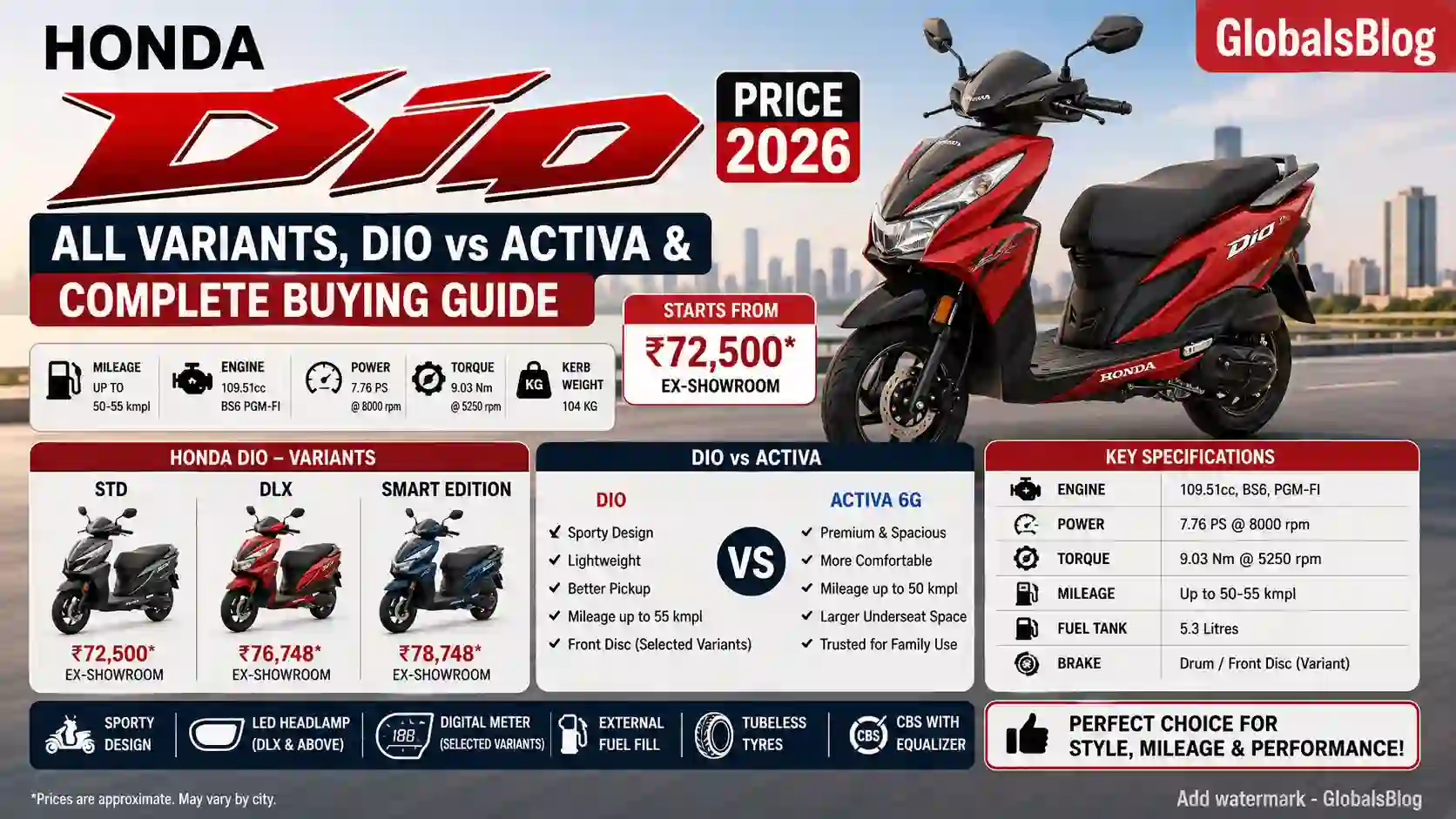
The Honda Dio is India's most popular sporty scooter — a 110cc commuter with more personality than the Activa, a lower seat height that works for shorter riders, and Honda's OBD2-compliant fuel injection that makes it the most fuel-efficient scooter in its category. At ₹72,500–82,500 ex-showroom, it is the definitive college scooter in India.
A reader from Pune had been choosing between a Honda Activa and a Honda Dio for her daughter's college commute. The Activa was the safe, obvious choice — proven, practical, comfortable, excellent for all riders. The Dio offered something different: a sportier, lower silhouette, a step-through body design that worked better for shorter riders (her daughter is 5'1"), and a younger visual identity that the Activa's utilitarian design does not project. After one test ride each, her daughter chose the Dio on the grounds that she would actually want to ride it to college rather than use it as a transport appliance. The Dio and the Activa use the same Honda 110cc engine — the difference is entirely in character and ergonomics. This guide covers everything about the Honda Dio: all variants, prices, specifications, and who should choose it over the Activa.
Honda Dio price (August 2026): Ex-showroom ₹72,500 (DLX base) to ₹82,500 (Smart Edition top). On road Delhi approximately ₹83,000–₹95,000. Engine: 110cc OBD2 Honda single-cylinder fuel injection, 7.69 PS, 9.09 Nm. Mileage: 57 kmpl ARAI (claimed). Variants: DLX (₹72,500), DLX Special Edition (₹76,500), Smart Edition (₹82,500). Rivals: TVS NTorq 125 (₹84,900 ex), Yamaha RayZR (₹77,300 ex), Suzuki Avenis 125 (₹85,100 ex). Best variant: DLX Special Edition for the balance of features and price. The Dio's defining advantage over the Activa: lower seat height (765mm vs 770mm), sportier profile, younger visual identity, and a lower body width that makes it easier to handle in traffic.
Honda Dio Price — All Variants (August 2026)
| Variant | Ex-showroom | On Road Delhi (approx) | Key Features |
|---|---|---|---|
| DLX | ₹72,500 | ~₹83,000 | Base — fuel injection, CBS (Combined Braking System), digital-analogue instrument cluster, USB charging |
| DLX Special Edition | ₹76,500 | ~₹87,800 | All DLX + special colour schemes, body graphics, chrome accents — same mechanicals |
| Smart Edition | ₹82,500 | ~₹94,800 | All DLX + Honda Navi connectivity (Bluetooth, turn-by-turn navigation on cluster), smart key system |
All prices ex-showroom India, August 2026. On road Delhi adds registration (approximately 4% of vehicle value for two-wheelers above ₹60,000 in Delhi), first-year insurance (₹2,000–4,000 for a scooter at this price), and handling charges. The DLX base at ₹72,500 is the starting point; the DLX Special Edition at ₹76,500 is the best value variant (better colours, same mechanicals, ₹4,000 more); the Smart Edition at ₹82,500 adds Bluetooth connectivity and smart key.
Honda Dio Engine and Specifications
The Honda Dio uses the same 110cc single-cylinder fuel-injected engine as the Honda Activa 110 — with Honda's eSP (Enhanced Smart Power) technology that reduces internal friction through a roller rocker arm, offset cylinder, and ACG starter motor (which replaces the conventional kickstarter system with a quieter, smoother auto-start). The engine meets OBD2 (On Board Diagnostics) and BS6 Phase 2 norms — the most stringent emission standards currently applicable to two-wheelers in India. At 7.69 PS and 9.09 Nm, the Dio's output is modest but appropriate for its weight (107 kg kerb) and its intended use as an urban commuter. The real-world performance: quick 0-40 km/h acceleration for traffic gap-finding, adequate 60 km/h cruise for city roads, and slightly strained above 70 km/h — consistent with its category and price. The fuel injection (PGM-FI — Honda's Programmed Fuel Injection) is more refined than carburettor systems, providing consistent starting in all temperatures, better cold-start behaviour, and marginally better efficiency than carburettor equivalents.
Honda Dio vs Activa vs NTorq — Which Scooter?
| Model | Price (ex) | Engine | Best For | Character |
|---|---|---|---|---|
| Honda Dio | ₹72,500–₹82,500 | 110cc, 7.69 PS | College students, shorter riders, urban style | Sporty-looking, lower profile, same engine as Activa |
| Honda Activa 110 | ₹76,000–₹85,000 | 110cc, 7.79 PS | All-purpose commuter, families, utility focus | Proven, practical, slightly higher seat, more utility |
| TVS NTorq 125 | ₹84,900–₹98,900 | 125cc, 9.3 PS | Performance seekers, 18–25 college riders | Most powerful in class, smartphone connectivity, racy |
| Yamaha RayZR 125 | ₹77,300–₹84,000 | 125cc, 8.2 PS | Style-focused riders, women buyers | Slim and stylish, Yamaha reliability, lightweight |
| Suzuki Avenis 125 | ₹85,100–₹93,000 | 125cc, 8.7 PS | Feature seekers, highway-comfortable | Feature-rich, Bluetooth, comfortable for taller riders |
Dio vs Activa: The most common Dio decision. Both use the same Honda 110cc engine, same PGM-FI fuel injection, same CBS braking. The Dio is 5mm lower seat height (765mm vs 770mm), has a sportier visual profile with a step-through gap that works better for shorter riders with longer skirts or churidar, and projects a younger visual identity. The Activa has slightly more underseat storage (18L vs Dio's 12.6L) and marginally higher resale value due to higher recognition. For riders aged 16–25 who care about how their scooter looks: Dio. For all-purpose utility commuters who want maximum practicality and resale: Activa. Neither is objectively better — they serve different rider profiles with the same reliable engine.
Dio vs 125cc rivals: The NTorq, RayZR, and Avenis offer 125cc engines (14–20% more displacement) with 8.2–9.3 PS versus Dio's 7.69 PS. The performance difference is perceptible — the 125cc scooters pull more strongly above 50 km/h and feel less strained at highway speeds. The Dio's advantages: Honda reliability reputation (the most trusted scooter brand in India), ₹7,000–25,000 price advantage at comparable specs, and Honda's ubiquitous service network. For riders who do regular city commuting below 60 km/h: the Dio's 110cc is entirely adequate. For riders who regularly cruise at 70–80 km/h or carry a pillion on highways: consider the 125cc alternatives.
Which Dio Variant to Buy?
The DLX Special Edition at ₹76,500 ex is the recommended Honda Dio variant for most buyers — it adds Honda's special colour schemes and graphic packages (typically metallic dual-tone options that are significantly more attractive than the DLX's standard colours) at a ₹4,000 premium over the DLX base. The mechanicals are identical — same 110cc engine, same CBS braking, same USB charging port, same instrument cluster. For a scooter bought largely for its visual personality, the colour and graphics upgrade is meaningfully worth ₹4,000. The DLX base at ₹72,500 is available in standard colours only — adequate but not the Dio at its most distinctive.
The Smart Edition at ₹82,500 ex adds Honda Navi connectivity — a Bluetooth link to your smartphone that brings turn-by-turn navigation directions to the instrument cluster, call alerts, and music playback information. It also includes a smart key system (no conventional key insertion — proximity-based unlocking and ignition). For young tech-oriented riders who would use the navigation and don't want to handle a phone on the handlebar, the Smart Edition's ₹6,000 premium over the DLX Special Edition is justified. The navigation on the cluster (arrow indicators showing turn direction rather than a full map display) is genuinely useful in unfamiliar cities. At ₹94,800 on road Delhi, the Smart Edition starts competing in price with the base TVS NTorq 125 (which offers more performance at a similar price) — so the ₹94,800 price point requires a conscious choice for Honda brand trust and the Dio's specific ergonomic advantages over the more power-oriented NTorq.
✓ Honda Dio Buying Tips
- The Dio and Activa use the same engine — choose based on ergonomics and style: The Honda Activa and Honda Dio both use the 110cc eSP fuel-injected engine with near-identical specifications. Performance, mileage, and reliability are essentially identical. The Dio's lower seat height (765mm vs 770mm), narrower body width, and sportier visual profile make it the better choice for shorter riders (under 5'4") and riders who prioritise visual personality over maximum storage utility. Test-sit both before deciding — the 5mm seat height difference is small but the visual difference is meaningful
- CBS (Combined Braking System) is standard on all Dio variants — this is a genuine safety feature: Honda's CBS (required on all BS6 two-wheelers above 125cc) distributes braking force between front and rear wheels when the rear brake is applied — reducing the risk of rear wheel lockup during emergency braking. The system is transparent in normal use; it only activates during aggressive braking. It is one of the most important safety features available on an Indian scooter and is part of why Honda scooters at this price point are recommended over cheaper alternatives without CBS
- Real-world mileage is 45–50 kmpl — plan your range accordingly: The 57 kmpl ARAI claim is a test-cycle number. In typical Pune or Delhi city riding with AC ambient temperatures (traffic, AC on helmet, load, stop-start), expect 45–50 kmpl. With a 5.3L fuel tank, this gives a practical range of 240–265 km per fill — requiring refuelling every 6–8 days at a typical 35 km daily commute. Plan accordingly and do not let the tank drop below the 1L mark — the fuel injection system benefits from a consistent fuel level for optimal operation
- Honda's service network is the Dio's most underrated advantage: Honda two-wheeler dealerships (Honda Activa and Dio service) are available across 4,000+ locations in India including smaller cities and towns. The Dio's service interval is 6,000 km or 6 months (whichever comes first) and the average service cost per visit is approximately ₹500–800 (oil change + inspection) — significantly lower than premium 125cc competitors. For buyers in smaller cities where brand service availability matters, the Honda network is unmatched
- The Smart Edition at ₹94,800 on road competes with NTorq 125 base — compare before buying: The TVS NTorq 125 base starts at ₹84,900 ex (~₹97,000 on road Delhi) and offers a 125cc engine (9.3 PS), full Bluetooth SmartXonnect app, and a more performance-oriented character. If you are considering the Smart Edition Dio specifically for the connectivity feature, the NTorq 125 base is worth a test ride — it offers more engine performance and similar connectivity at a ₹2,000–3,000 higher on road price
✗ Honda Dio Buying Mistakes to Avoid
- Buying a Dio expecting Activa-level underseat storage: The Honda Activa has approximately 18L of underseat storage — enough for a full-face helmet in most configurations. The Dio has approximately 12.6L — sufficient for a half-face or open-face helmet but not a full-face. If you use a full-face helmet daily or regularly carry a laptop bag in the underseat compartment, the Activa is the more practical choice. The Dio's storage trades utility for its sportier profile design. This is not a defect — it is a deliberate design choice — but buyers should be aware of the trade-off before purchasing
- Expecting 57 kmpl real-world mileage: The ARAI 57 kmpl is a test-cycle figure that no rider will achieve in typical Indian traffic conditions. Real-world city mileage of 45–50 kmpl is excellent for a 110cc scooter — but the expectation gap (from 57 kmpl advertising to 46 kmpl actual) causes frustration for buyers who didn't account for the difference. Set your expectation at 46–48 kmpl for an accurate assessment of running costs: at ₹103/litre petrol and 46 kmpl, the Dio costs approximately ₹2.24/km — among the cheapest transport options in India
- Choosing the Dio for highway riding: The Dio's 110cc engine is comfortable and happy up to 60 km/h. Between 60–70 km/h it is usable but audibly working. Above 70 km/h, the engine is strained and the small fuel tank (5.3L at 50 kmpl = 265 km range) requires frequent stops. The Dio is a city scooter — for regular highway rides above 50 km, the TVS NTorq 125, Suzuki Avenis 125, or Honda Activa 125 are better suited. The Dio's small wheels (12-inch front and rear) also handle highway irregularities less comfortably than larger-wheeled scooters
- Not comparing with the Activa 110 at the same dealership: The Honda Activa 110 starts at ₹76,000 ex — only ₹3,500 more than the Dio DLX — and offers more underseat storage, marginally better pillion comfort, and stronger resale value. Many buyers who think they want the Dio's sporty look end up more satisfied with the Activa after comparing. Visit the Honda dealer and sit on both before deciding. The ergonomic difference between them is small but meaningful, and seeing them side by side often clarifies the choice
⚠️ Disclaimer: Honda Dio prices and variant availability are subject to change. All prices listed are ex-showroom India as of August 2026. On road prices vary by state road tax. Mileage figures are ARAI-certified claims — real-world mileage varies with riding style, load, traffic conditions, and tyre pressure. Verify current pricing at your nearest Honda two-wheeler authorised dealership.
DLX for Entry Honda Quality. DLX Special Edition for Best Colours. Smart Edition for Connectivity. Dio vs Activa — Same Engine, Different Personality. Choose the One You Want to Ride.
The Pune reader's daughter who chose the Dio over the Activa made the correct decision for the correct reason — she would actually want to ride the Dio to college. Two-wheelers are different from four-wheelers in one important respect: you use them more readily when you enjoy the experience of being on them. The Dio and the Activa cover the same road with the same fuel consumption and the same Honda reliability. The Dio does it with a sporty profile that projects a visual personality the Activa's utilitarian form doesn't try to. At ₹87,800 on road Delhi for the DLX Special Edition, the Honda Dio is among the best-value decisions available in the Indian two-wheeler market — a genuinely reliable, fuel-efficient, well-engineered urban scooter at a price that makes it accessible for most households. The DLX Special Edition is the recommended variant: ₹87,800 on road, Honda reliability, the best colour options, 45–50 kmpl real-world, and a profile that makes college parking a statement rather than an afterthought.
Honda Dio price in India (August 2026): DLX (base) ₹72,500 ex-showroom; DLX Special Edition ₹76,500 ex-showroom; Smart Edition (top) ₹82,500 ex-showroom. On road Delhi approximately: DLX ₹83,000; DLX Special Edition ₹87,800; Smart Edition ₹94,800. Engine: 110cc single-cylinder fuel injection, 7.69 PS, 9.09 Nm. Mileage: 57 kmpl ARAI (real-world approximately 45–50 kmpl). Kerb weight: 107 kg. Seat height: 765mm. Fuel tank: 5.3 litres. CBS (Combined Braking System) standard. OBD2 compliant, BS6 Phase 2. Sold at Honda two-wheeler authorised dealerships across India. The DLX Special Edition at ₹76,500 is the recommended variant for most buyers.
Honda Dio vs Honda Activa 110 comparison: Engine — identical 110cc Honda eSP fuel-injected engine, virtually same power (7.69 PS Dio vs 7.79 PS Activa), same mileage (57 kmpl ARAI for both). Seat height — Dio 765mm, Activa 770mm (Dio is 5mm lower — useful for shorter riders under 5'3"). Underseat storage — Activa approximately 18L (fits full-face helmet), Dio approximately 12.6L (fits open/half-face only). Body profile — Dio is sportier, narrower, step-through profile works better with certain clothing types. Activa is more conventional, wider, utility-focused. Price — Activa 110 from ₹76,000 ex (₹3,500 more than Dio DLX at same level). Resale — Activa has marginally better resale due to higher buyer recognition. Pillion comfort — Activa slightly more comfortable for pillion over longer distances. Verdict: Dio if you are shorter, prefer the sporty profile, and style matters. Activa if you prioritise maximum storage, are a utilitarian commuter, or regularly carry a full-face helmet. Same reliability, same service network, same engine — the choice is entirely about ergonomics and personality.
Honda Dio mileage (2026): ARAI claimed — 57 kmpl. Real-world city mileage — approximately 45–50 kmpl in typical Indian city conditions with moderate stop-start traffic. Real-world highway at 60 km/h — approximately 52–55 kmpl. Factors affecting mileage: riding style (aggressive acceleration reduces significantly), tyre pressure (properly inflated improves by 3–5%), load (solo vs pillion), air filter condition, and ambient temperature. With the 5.3L fuel tank and 46 kmpl average real-world mileage, the Dio's practical range per fill is approximately 240–255 km — adequate for 6–8 days of typical urban commuting at 35 km/day. Running cost at ₹103/L petrol and 46 kmpl: approximately ₹2.24 per km — among the most economical commuter vehicles available in India.
Honda Dio on road price in Delhi (August 2026): DLX base approximately ₹83,000; DLX Special Edition approximately ₹87,800; Smart Edition (top) approximately ₹94,800. Delhi on road prices for two-wheelers include: ex-showroom + road tax (approximately 4–6% for two-wheelers above ₹60,000 in Delhi) + registration fees (₹500–1,000) + first-year comprehensive insurance (₹2,000–4,000 for a 110cc scooter at this IDV) + handling charges. On road prices vary by state: Maharashtra and Karnataka charge higher road tax making Mumbai and Bengaluru on road prices approximately ₹3,000–6,000 more than Delhi. Always get an itemised on road price from your local Honda dealer before finalising — the components are the same across dealers but exact insurance premium varies by insurer.
Yes — the Honda Dio is one of the most recommended scooters for women riders in India. The Dio's specific advantages for women: lower seat height (765mm) makes it easier to touch the ground for shorter women (under 5'4"); lighter kerb weight (107 kg) compared to 125cc scooters (typically 110–115 kg) makes low-speed maneuvering easier; step-through body design works well with salwar kameez, sarees, and similar clothing that can be difficult with a step-over design; CBS (Combined Braking System) provides safer emergency braking for less experienced riders; fuel injection provides reliable starting in all conditions including cold mornings; Honda reliability means low maintenance worry. The Dio is not ideal for women over 5'7" who may find the 765mm seat height comfortable but the shorter step-through body cramped — they may prefer the TVS NTorq or Activa 125. For women aged 16–30 doing urban commuting: the Honda Dio is one of India's best choices in the 110cc scooter segment.
Honda Dio vs TVS NTorq 125: Engine — NTorq 125 has a 125cc engine (9.3 PS, 10.5 Nm) vs Dio's 110cc (7.69 PS, 9.09 Nm). The NTorq is 20% more displacement and perceptibly stronger at 60–80 km/h. Price — NTorq 125 starts at ₹84,900 ex vs Dio DLX at ₹72,500 ex — NTorq is ₹12,400 more at entry level. Connectivity — NTorq SmartXonnect Bluetooth app offers more features than Dio Smart Edition's Honda Navi. Mileage — Dio 57 kmpl ARAI vs NTorq 40 kmpl ARAI — Dio is significantly more fuel-efficient. Reliability — Honda wins on long-term reliability reputation; TVS is good but not at Honda's level in owner feedback. Weight — NTorq 112 kg vs Dio 107 kg — marginally heavier. Best for: NTorq 125 for performance-focused riders, highway use, riders who want more power and modern connectivity. Dio for reliability-first buyers, shorter riders, mileage priority, Honda brand trust, and college commuting where fuel costs matter. If budget allows: NTorq 125 offers meaningfully more performance. If fuel economy and reliability are primary: Dio wins.
Leave a comment
Share a quick thought about this story.
Thanks for sharing your view. It is ready for review.
Please try again in a moment.