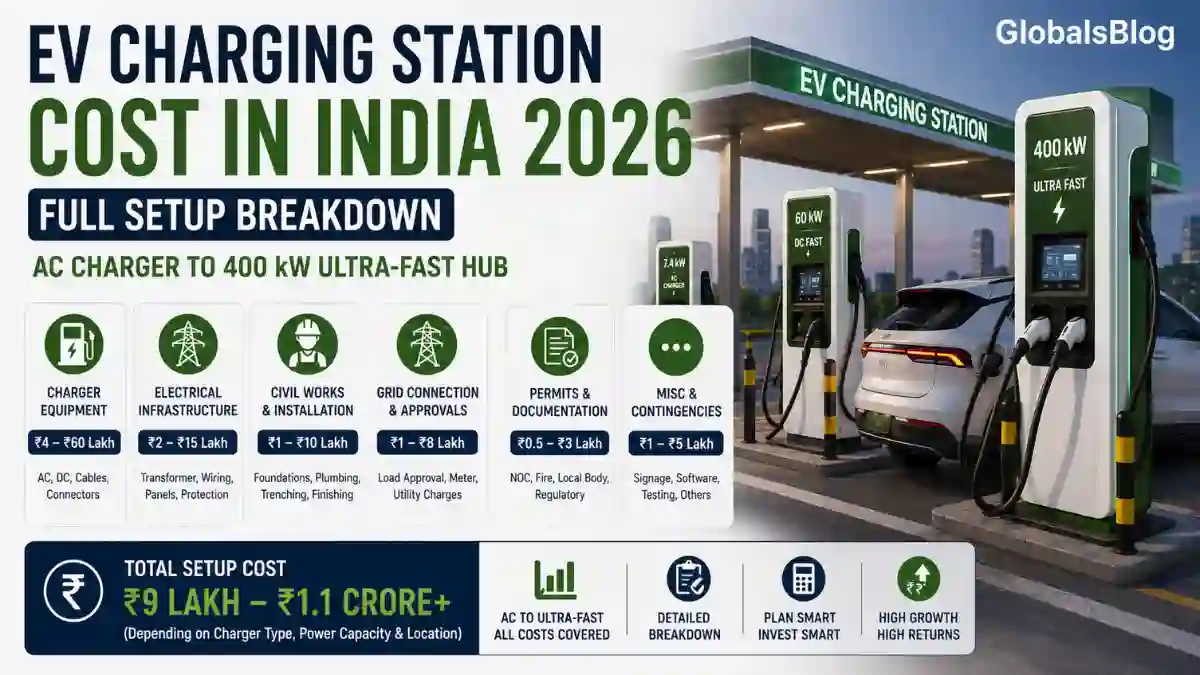
From ₹1.5 lakh for a small AC setup to ₹1 crore+ for an ultra-fast hub — every rupee itemised with 2026 market pricing.
🔥 Trending in this cluster
- The Hidden Costs of EV Charging Stations Nobody Tells You About Before You Invest
- Should You Start with AC or DC Chargers? The Cost Analysis That Decides Everything
- Government Is Subsidising Up to 80% of Infrastructure Cost — But Only If You Apply Before Installation
The most common question from entrepreneurs entering India's EV charging space is also the most incomplete one: "How much does it cost?" The honest answer has four components — equipment, electrical infrastructure, civil works, and ongoing operational costs — and most guides only cover the first one. The equipment cost of a charger is only 30–50% of the total investment for a real commercial station.
This guide breaks down the EV charging station cost in India for 2026 across every category and every station type: from a 2-charger AC setup at an apartment complex to a 400 kW ultra-fast DC hub on a national highway. All figures are based on current 2026 market pricing from verified sources including Zevpoint, IMARC Engineering, and Shriram Finance's industry analysis.
Cost by Station Type — Full Breakdown
Small AC Charging Setup (2–4 Chargers)
Best for: apartments, offices, restaurants, small malls
The most accessible entry point into the EV charging business. AC chargers (7–22 kW) are slower but dramatically cheaper to install — one DC fast charger costs roughly the same as 10 AC units. For locations where vehicles park for 2+ hours, AC is often the higher-ROI choice despite lower per-session revenue.
DC Fast Charger Station (30–60 kW)
Best for: high-traffic malls, fuel stations, corporate parks, highway stops
The workhorse of India's public charging network. A 30–60 kW DC charger adds 60–120 km of range in 20–30 minutes — appropriate for the use case where drivers need a meaningful charge in a limited stop window. Higher revenue per session than AC but requires more robust electrical infrastructure.
Multi-Point DC Fast Charging Hub (60–150 kW)
Best for: expressway stops, large malls, EV fleet depots
The hub model — multiple DC chargers at a single location — is what makes an EV charging station a destination rather than a facility. 4–8 chargers at 60–150 kW serve both private car owners and commercial fleet operators, generating the utilisation volumes needed for strong ROI. Requires a sanctioned load of 50–150 kVA and 550–1,200 sq ft of space.
Ultra-Fast Charging Hub (150–400 kW)
Best for: expressways, premium urban, fleet operators — 150 km range in 15 minutes
ChargeZone's 400 kW Mega Charger in Vadodara — capable of simultaneously charging six vehicles and adding 150 km in 15 minutes — represents the frontier of India's charging infrastructure. This tier requires serious capital, grid infrastructure, and site size but commands the highest revenue per hour and the fastest ROI on a per-charger basis when utilisation is high.
The Hidden Costs Most Guides Don't Mention
⚠️ Hidden & Ongoing Costs — Budget for These Before You Launch
- DISCOM load sanction timeline: Physically installing chargers takes days. Getting the load sanction and new meter from DISCOM takes 1–3 months. Factor this into your launch planning and cash flow projections
- Annual maintenance contract (AMC): ₹15,000–50,000 per year depending on charger count and type. Skipping this is a false economy — charger downtime is the fastest path to zero utilisation
- Network software subscription: OCPP 2.0.1-compliant management software is legally mandated for public stations. Annual fees range ₹24,000–1,20,000 depending on provider and feature set
- Electricity demand charges: High-power DC chargers attract demand charges from DISCOMs that aren't in the per-kWh rate. These can add 15–25% to your effective electricity cost — check your local DISCOM's commercial tariff schedule
- Insurance: ₹8,000–25,000 annually for equipment and liability coverage — often overlooked until there's a fault or accident
- Working capital buffer: 3–6 months of fixed costs (rent, electricity minimum, maintenance) before the station reaches profitable utilisation levels
Cost Comparison: AC vs DC — Which Type Wins on ROI?
| Factor | AC (7–22 kW) | DC Fast (30–60 kW) | DC Ultra (150–400 kW) |
|---|---|---|---|
| Charger unit cost | ₹35–50K | ₹3–6 lakh | ₹15–30 lakh |
| Total station setup | ₹1.5–3 lakh | ₹8–18 lakh | ₹50L–1Cr+ |
| Charging speed | 2–6 hrs full charge | 20–45 mins | 10–20 mins |
| Revenue per session | ₹80–200 | ₹200–600 | ₹400–1,200 |
| Best location type | Long-stay parking | Malls, fuel stations | Highways, fleet depots |
| ROI timeline | 2.5–4 years | 2–3 years | 18–30 months |
The strategic insight: AC is lower risk, DC is higher reward. For your first station, AC minimises capital exposure while you learn operations and build a user base. As your site proves demand, adding DC capacity to an existing AC station is significantly cheaper than standalone DC because the DISCOM connection and civil infrastructure already exist.
"The cost of EV charging station in India has matured significantly by 2026. Home AC charging can never be beaten for savings. As an entrepreneur, the figures tend to come out favourable — calculate your local tariff, select the appropriate charger type, and the numbers work."— Hydromo Industry Analysis, April 2026
✓ Cost Reduction Strategies for 2026
- Apply for PM E-DRIVE and state capital subsidies before procuring equipment — subsidies are unavailable retroactively after installation in most schemes
- Integrate solar panels from the planning phase: in states like Gujarat, Rajasthan, and Telangana, solar cuts electricity cost by 40–60% and transforms the margin profile
- For a first station, consider partnering with an established CPO for backend software and billing rather than building independently — it reduces both cost and operational complexity significantly
- Check government subsidy options — Karnataka's 25% capital subsidy, Delhi's ₹6,000 per charger subsidy, and Gujarat's electricity duty exemption can materially reduce your outlay
- Also review our Home EV Charging Station Cost Guide if your first project is a residential society installation
Know the Full Cost Before You Commit.
The EV charging station cost in India in 2026 ranges from ₹1.5 lakh to ₹1 crore+ depending on station type and scale. What matters more than the total number is understanding which components are fixed, which are variable, and which are reducible through government subsidies and smart site selection. Once you know where your money goes, you can make the investment decision with confidence.
Leave a comment
Share a quick thought about this story.
Thanks for sharing your view. It is ready for review.
Please try again in a moment.