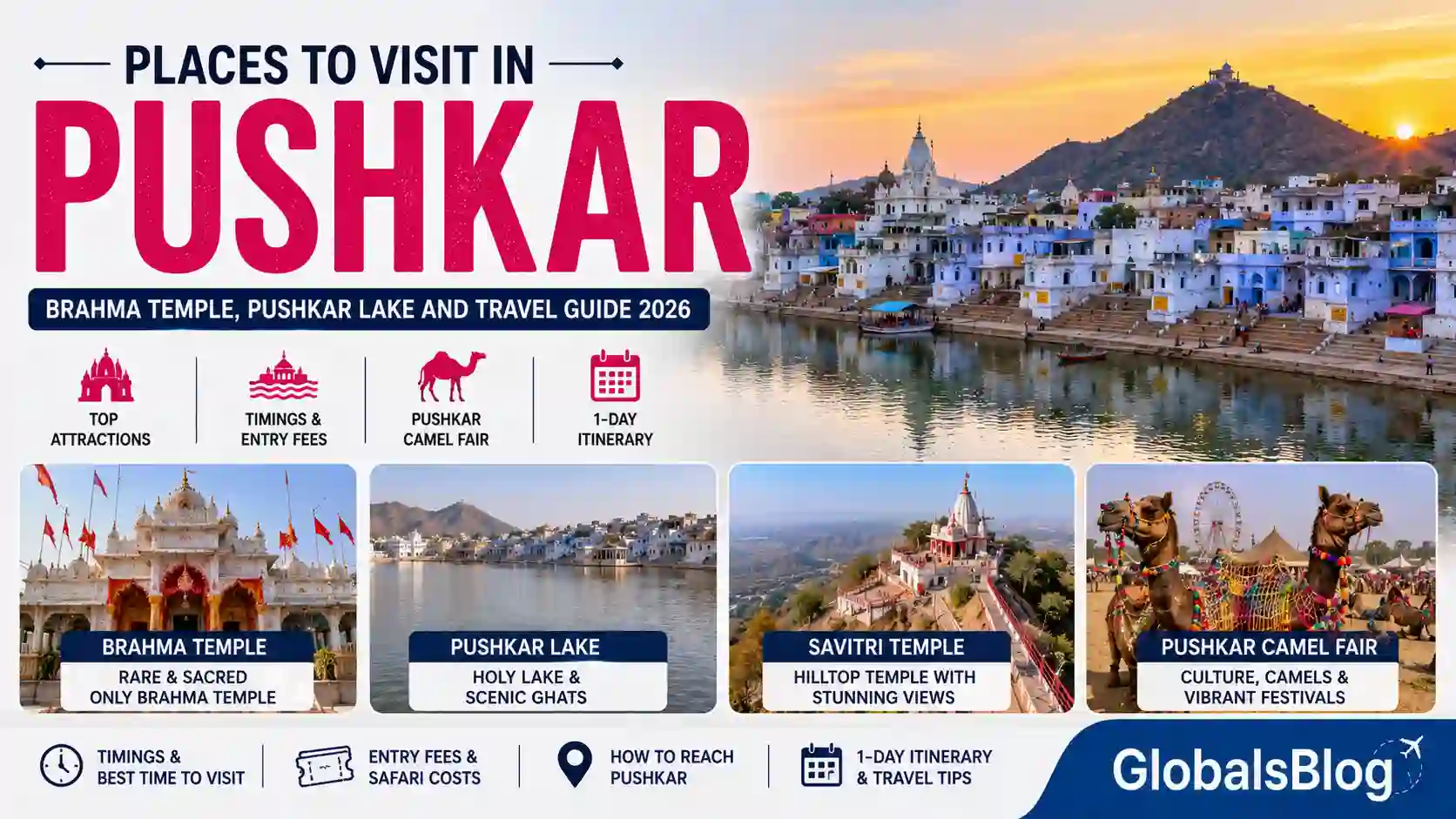
Pushkar has the world's only major temple to Brahma, one of Hinduism's most sacred lakes, a camel fair that brings 200,000 people to a town of 15,000, and a bazaar that smells of rose oil and incense. It is India's most spiritually concentrated town.
Pushkar is a small pilgrim town — population 15,000, area roughly 3 km by 3 km — that punches extraordinarily above its size. Pushkar is one of the oldest and most sacred towns in Rajasthan, home to the Brahma Temple — one of the very few temples in the world dedicated to Lord Brahma, the creator deity in the Hindu Trinity. According to Hindu mythology, Brahma performed a yagna (sacred fire ritual) at this location, and the sacred Pushkar Lake formed when lotus petals fell from his hand. The lake is surrounded by 52 ghats and over 400 temples — the evening aarti ceremony at the ghats, oil lamps floating on the water in the rose-pink Aravalli dusk, is one of India's most quietly beautiful religious experiences. The Pushkar Camel Fair (Maru Mela) in November draws pilgrims, traders, and visitors from across the world — one of the world's largest livestock fairs, 50,000+ camels, 200,000+ visitors, a 400-year-old tradition. Pushkar is 11 km from Ajmer (Dargah Sharif — India's most visited Islamic shrine) and 145 km from Jaipur, making it one of the most logically positioned stops on the classic Rajasthan circuit.
Best places to visit in Pushkar: Brahma Temple (free, 6 AM–8:30 PM — world's most prominent Brahma temple, 14th-century marble and red shikhara), Pushkar Lake (free — 52 ghats, 400+ temples, evening aarti most beautiful at dusk), Savitri Temple (cable car ₹50–100 — hilltop panoramic view of entire Pushkar), Varaha Temple (₹25–50 — ancient Vishnu temple with remarkable carvings), Rangji Temple (free — South Indian architecture in Rajasthan), Pushkar Market (free — rose products, tie-dye, leather, silver). Pushkar is best as 1–2 days on the Jaipur–Ajmer–Pushkar–Udaipur circuit. The evening ghat aarti is the single most important experience — arrive at the ghats 30 min before sunset.
Places to Visit in Pushkar — Complete Guide
The Brahma Temple in Pushkar is one of the very few temples in the world dedicated to Lord Brahma, the creator in Hindu mythology. Built in the 14th century (with origins believed to extend much further back), the temple is made of marble and stone, featuring a distinct red pinnacle (shikhara) and a hamsa (swan) bird motif. The temple sanctum holds the four-headed image of Brahma with his consort Gayatri. The reason for the scarcity of Brahma temples is explained by the mythology — Brahma's wife Savitri, agitated that he had completed a yajna with another consort in her absence, cursed him that he would never be worshipped by anyone except in Pushkar. She later relented and permitted his worship here alone. This mythological uniqueness draws both devout pilgrims and curious travellers to a temple that is unusual in the Hindu pantheon. The morning hours (6–8 AM) are the most atmospheric for darshan — devotees in prayer, temple bells, incense, and the relative quiet before the day's tourist traffic. The evening aarti at 7:00 PM with oil lamps lit in the courtyard is the temple's most visually beautiful moment. Shoes must be removed at the temple gate. Dress code: modest clothing, head covering for women customary.
Pushkar Lake is the spiritual heart of the town, revered for its divine significance in Hinduism. Pilgrims from across the world visit to cleanse themselves of sins by bathing in its holy waters. The lake is surrounded by 52 ghats and over 400 temples, making it a prominent site for religious rituals and prayers. The ghats — stone steps descending to the lake's edge — are the theatre of Pushkar's daily spiritual life: priests conducting puja ceremonies for visiting pilgrims (₹150–300 per ritual), flower offerings placed on the water, conch shells blown at prayer time, and the constant movement of devotees and visitors. The most important hour at Pushkar Lake is the evening aarti — at each of the major ghats (Brahma Ghat, Varah Ghat, Gau Ghat), priests conduct simultaneous flame rituals as the sun sets behind the Aravalli hills, the lake turns pink-gold, and oil lamps are floated on the water. Arrive at any ghat 30 minutes before sunset to secure a seat on the steps. No photography during the aarti at some ghats — follow posted instructions. The lake itself has no entry fee; individual temples at the ghats may have small donations or entry fees.
Savitri Temple is situated atop a hill overlooking the town, dedicated to Goddess Savitri — Lord Brahma's first wife — who cursed Brahma to be worshipped only in Pushkar after he completed his yajna with another consort. The temple offers some of the most beautiful panoramic views of Pushkar and the surrounding Aravalli landscape. Access is by ropeway (cable car, ₹50–100 one-way approximately) or by a 30-minute hike up the hill path. The hilltop view — Pushkar town below, the sacred lake glinting in the centre, the desert plain spreading to the west, and the Aravalli hills curving around — is the finest panoramic vista available in Pushkar. Sunrise from Savitri Temple is the most recommended time: the lake catches the first light before the town wakes, the air is cool, and there are almost no other visitors at 6 AM on the hilltop. The sunset view is equally dramatic but draws more visitors. The temple itself is a modest white structure — the view is the reason to visit.
Varaha Temple is dedicated to Vishnu's Varaha (boar) avatar — the divine boar who lifted the earth from the cosmic ocean in Hindu mythology. The temple is among the most ancient in Pushkar, with origins traced to the 12th century; it was largely destroyed by the Mughal Emperor Aurangzeb and rebuilt in the 18th century by the Maharaja of Amber. The temple's stone carvings — particularly the boar avatar panels and the subsidiary shrines surrounding the main sanctum — are Pushkar's finest examples of medieval temple sculpture. At ₹25–50 entry it is one of Pushkar's most affordable formal attractions and significantly less crowded than the Brahma Temple, making it the best place in town for quiet temple exploration without the pilgrimage crowd.
Rangji Temple (dedicated to Ranganatha, a form of Vishnu) is Pushkar's most architecturally distinctive temple — built in 1823 by a wealthy South Indian merchant in the Dravidian style, its 12-metre high gopuram (tower gateway) covered in painted stucco figures is entirely incongruous with the surrounding Rajasthani architecture. The contrast of the South Indian temple form against the Aravalli desert backdrop is remarkable. Inside, the temple follows the traditional South Indian arrangement with a mandapam (pillared hall), a processional chariot (rath), and the main sanctum in the garuda-style. The temple's religious calendar includes a Rath Yatra (chariot procession) on the 11th day of Vaishakh month — one of Pushkar's most vibrant local festivals, largely unknown to tourists. Free entry.
Pushkar's main bazaar is a 500-metre stretch of shops along the road leading from the bus stand to the lake — one of the most atmospheric markets in Rajasthan, combining genuine pilgrimage merchandise (rudraksha beads, ritual items, religious clothing) with tourist-oriented craft goods. Pushkar is notably India's rose oil capital — the rose fields surrounding the town (most visible October–March) produce large quantities of rose petals used for attar (rose essential oil), rose water, and gulkand (rose preserve). The best and cheapest rose products in India are available in Pushkar's bazaar at a fraction of urban prices. Other recommended purchases: tie-dye (bandhej) textiles, embroidered shoes (jootis), silver jewellery, leather goods, and traditional Rajasthani clothing. Bargaining is expected and effective — quoted prices are typically 2–3x the final price for tourist-oriented goods.
Pushkar Camel Fair 2026 — Maru Mela
The Pushkar Camel Fair (Maru Mela) is one of the world's largest camel fairs and India's most extraordinary rural spectacle — 50,000+ camels, 200,000+ visitors, 400 years of tradition. The fair takes place over 5 days around Kartik Purnima (full moon of the Kartik month), which falls in November 2026. The Pushkar Camel Fair has two distinct dimensions: the commercial livestock fair (camel, cattle and horse trading that has been happening here for centuries, entirely independent of tourism) and the cultural program added for the tourist market (camel races, turban tying competition, Rajasthani folk dance, Mr and Miss Pushkar contest at Sam Sand Dunes). The commercial dimension — thousands of decorated camels, traders in turbans, the smell of desert livestock and chai, the soundscape of hooves and bells — is more genuinely extraordinary than the staged cultural program. Visit the fairground at dawn and dusk when the camels are most active and the light is most photogenic. Book accommodation 3–4 months ahead for Camel Fair dates — every guesthouse in Pushkar fills months before the event.
Pushkar Timings and Entry Fees — 2026 Reference
| Attraction | Entry Fee | Timings | Best Time |
|---|---|---|---|
| Brahma Temple | Free (donations) | 6 AM–8:30 PM | 6–8 AM or 7 PM aarti |
| Pushkar Lake | Free | All day | 30 min before sunset for aarti |
| Savitri Temple | Cable car ₹50–100 | Dawn–dusk | Sunrise or sunset |
| Varaha Temple | ₹25–50 | 6 AM–12 PM, 4–9 PM | Morning |
| Rangji Temple | Free | 8 AM–1 PM, 5–9 PM | Morning |
| Pushkar Bazaar | Free | All day | 9–11 AM or 5–8 PM |
Pushkar Itinerary — 1 Day and 2 Days
1-Day Pushkar Itinerary:
6:00 AM: Brahma Temple morning darshan — temple bells, incense, quiet (30–45 min). 7:00 AM: Pushkar Lake ghats at dawn — sit on steps, watch morning rituals begin, observe without participating (45 min). 8:00 AM: Pushkar bazaar opening — rose products, breakfast at a lakeside café. 9:30 AM: Varaha Temple — ancient carvings, quiet exploration (45 min). 10:30 AM: Rangji Temple — South Indian gopuram, unusual architecture (30 min). 11:30 AM: Savitri Temple by cable car — panoramic Pushkar view, Aravalli hills, desert horizon (1 hour). 1:30 PM: Lunch at Om Shiva Garden Restaurant or Honey & Spice café (both lakeside, reliable). 3:00 PM: Pushkar bazaar — rose oil shopping, tie-dye, silver (1.5 hours). 5:00 PM: Return to lake ghats — find a seat for the evening aarti. 5:30 PM: Evening aarti at Brahma Ghat — oil lamps on the lake, sunset over Aravalli, the most important half-hour in Pushkar (30–45 min). 7:00 PM: Brahma Temple evening aarti. 8:00 PM: Dinner at a rooftop restaurant overlooking the lake.
2-Day Pushkar Itinerary:
Day 1 as above. Day 2: 6:00 AM — Savitri Temple sunrise by hike (30–40 min steep path, spectacular light). 8:30 AM — Breakfast back in town. 9:30 AM — Camel safari in the desert surrounding Pushkar (₹300–500 for 1–2 hours — much simpler than Jaisalmer but authentic). 11:30 AM — Day trip to Ajmer (11 km, 20 min) — Dargah Sharif of Khwaja Moinuddin Chishti (India's most visited Islamic shrine, one of South Asia's most important pilgrimage sites, free entry). 2:00 PM — Return to Pushkar. 5:00 PM — Lake ghats second sunset visit. Optional: Merta or Kishangarh miniature painting village day trip for art enthusiasts.
Pushkar and Ajmer — The Twin Pilgrimage Circuit
Pushkar and Ajmer are 11 km apart and together form India's most religiously diverse pilgrimage circuit — Hindu sacred lake and Brahma temple in Pushkar, the Sufi dargah of India's most beloved Muslim saint in Ajmer. The Dargah Sharif of Khwaja Moinuddin Chishti in Ajmer is India's most visited Islamic pilgrimage site — the 13th-century Sufi saint's tomb draws 150,000+ visitors daily during the Urs festival (death anniversary, held in the 6th month of the Islamic calendar). The dargah is open to all faiths, free entry. The qawwali performances at the dargah — devotional Sufi music performed at the saint's tomb morning and evening — are among the finest anywhere in South Asia. A Pushkar stay with a half-day Ajmer dargah visit is one of the most distinctive religious travel experiences available in India.
Pushkar Travel Tips 2026
- The evening ghat aarti is the single most important Pushkar experience: The simultaneous flame rituals at multiple ghats as the sun sets, oil lamps floating on the lake, the call of conch shells — this happens every evening and is free. Arrive at a ghat (Brahma Ghat or Varah Ghat recommended) 30 minutes before sunset. Sit on the steps, stay quiet, and observe. This is the Pushkar moment that most visitors describe as one of their most affecting Indian experiences
- Be prepared for pushy priests at the ghats: Priests at Pushkar ghats approach visitors to perform a "Pushkar puja" — flowers, water from the lake, a blessing, and a red thread tied on the wrist. The puja itself may be genuine but the donation expectation after can be firm and the pressure significant. Decide in advance whether you want to participate. A polite firm refusal ("nahi chahiye, dhanyavaad") is entirely acceptable
- Pushkar is strictly vegetarian and alcohol-free: The town prohibits meat and alcohol entirely — all restaurants are vegetarian, no alcohol is available anywhere in Pushkar. This is a genuine religious prohibition, not a tourist policy. Plan accordingly before arriving
- Book 3–4 months ahead for the Camel Fair: The Pushkar Camel Fair in November is one of Rajasthan's most compelling travel experiences and one of its most logistically challenging — every guesthouse fills completely, prices triple, and transport to and from Pushkar becomes difficult. Book accommodation, transport, and any photography tours well in advance
- See our Jaipur guide (145 km from Pushkar) for the most common starting point on this circuit, and our Rajasthan complete guide for how Pushkar fits the full state circuit
Brahma Temple at 6 AM. Pushkar Lake Aarti at Sunset. Savitri Temple for the View. Bazaar for Rose Oil. Ajmer Dargah for the Qawwali. That Is the Complete Pushkar.
Pushkar rewards one full day and benefits from a second. The Brahma Temple and a bath in Pushkar Lake at Kartik Purnima are said in Hindu tradition to bring spiritual merit that atones for sins — but even for secular visitors, the temple's singular status and the lake's 52-ghat complexity make Pushkar unlike any other town in Rajasthan. The evening ghat aarti is the experience that most visitors describe as one of their finest hours in Rajasthan — more intimate than Jaipur's spectacle, more spiritually present than any fort. Pushkar is strictly vegetarian and alcohol-free, small enough to walk entirely, and peaceful enough to reward slow movement. On the classic Rajasthan circuit (Jaipur → Pushkar → Udaipur → Jodhpur → Jaisalmer), it is the quietest stop and consistently the most personally affecting for travellers who are open to its spiritual atmosphere.
The best places to visit in Pushkar are the Brahma Temple (free, 6 AM–8:30 PM — the world's most prominent temple dedicated to Lord Brahma, the Hindu creator deity; one of very few such temples globally), Pushkar Lake (free — 52 ghats, 400+ temples, evening aarti ceremony at sunset is the most beautiful experience in Pushkar), Savitri Temple (cable car ₹50–100 — hilltop panoramic view of Pushkar, best at sunrise), Varaha Temple (₹25–50 — ancient Vishnu temple with medieval carvings), Rangji Temple (free — unusual South Indian Dravidian architecture in Rajasthan), and Pushkar Bazaar (free — rose oil and rose water at best prices, tie-dye, silver jewellery). For the Pushkar Camel Fair: November 2026, 5 days around Kartik Purnima — one of India's most extraordinary events, book 3–4 months ahead.
Brahma Temple Pushkar timings: 6:00 AM–8:30 PM daily (may vary slightly by season). Entry fee: Free — no formal ticket, but voluntary donations are expected and appreciated. Evening aarti (lamp ceremony) is held at approximately 7:00 PM and is the most visually beautiful time to visit the temple. Morning hours (6–8 AM) are recommended for quiet darshan before crowds arrive. The temple closes on some festival days and requires visitors to remove footwear at the gate. Dress code: modest clothing, covered shoulders and knees. The temple is located in central Pushkar, 5 minutes walk from the main lake ghats. Photography inside the sanctum is generally not permitted; photography in the courtyard is usually allowed.
The Pushkar Camel Fair (Maru Mela) in 2026 is held in November around Kartik Purnima (the full moon of the Kartik month in the Hindu lunar calendar). The fair runs for approximately 5 days, with the peak being the Kartik Purnima full moon day and night when pilgrims bathe in Pushkar Lake and the fairground reaches maximum activity. The fair brings 50,000+ camels and 200,000+ visitors to a town of 15,000 — book accommodation 3–4 months ahead as all guesthouses fill completely and prices triple. The fair combines a genuine commercial livestock market (camel and cattle trading, centuries old) with a cultural program (camel races, turban competition, folk dance) added for the tourist dimension.
One full day is the minimum for Pushkar — covering Brahma Temple, Pushkar Lake, Savitri Temple, Varaha Temple, Rangji Temple, the bazaar, and the evening ghat aarti in a single well-planned day is achievable. Two days is more comfortable and allows the Ajmer Dargah half-day trip (11 km, India's most important Sufi pilgrimage site), a camel safari, a second evening at the lake ghats at a more relaxed pace, and the sunrise view from Savitri Temple. Pushkar is often combined with Ajmer as a 1–2 night stop on the classic Jaipur → Pushkar → Udaipur circuit. During the Camel Fair, 2–3 nights is recommended to experience both the livestock fair and the cultural program at different times of day.
Reader Experiences