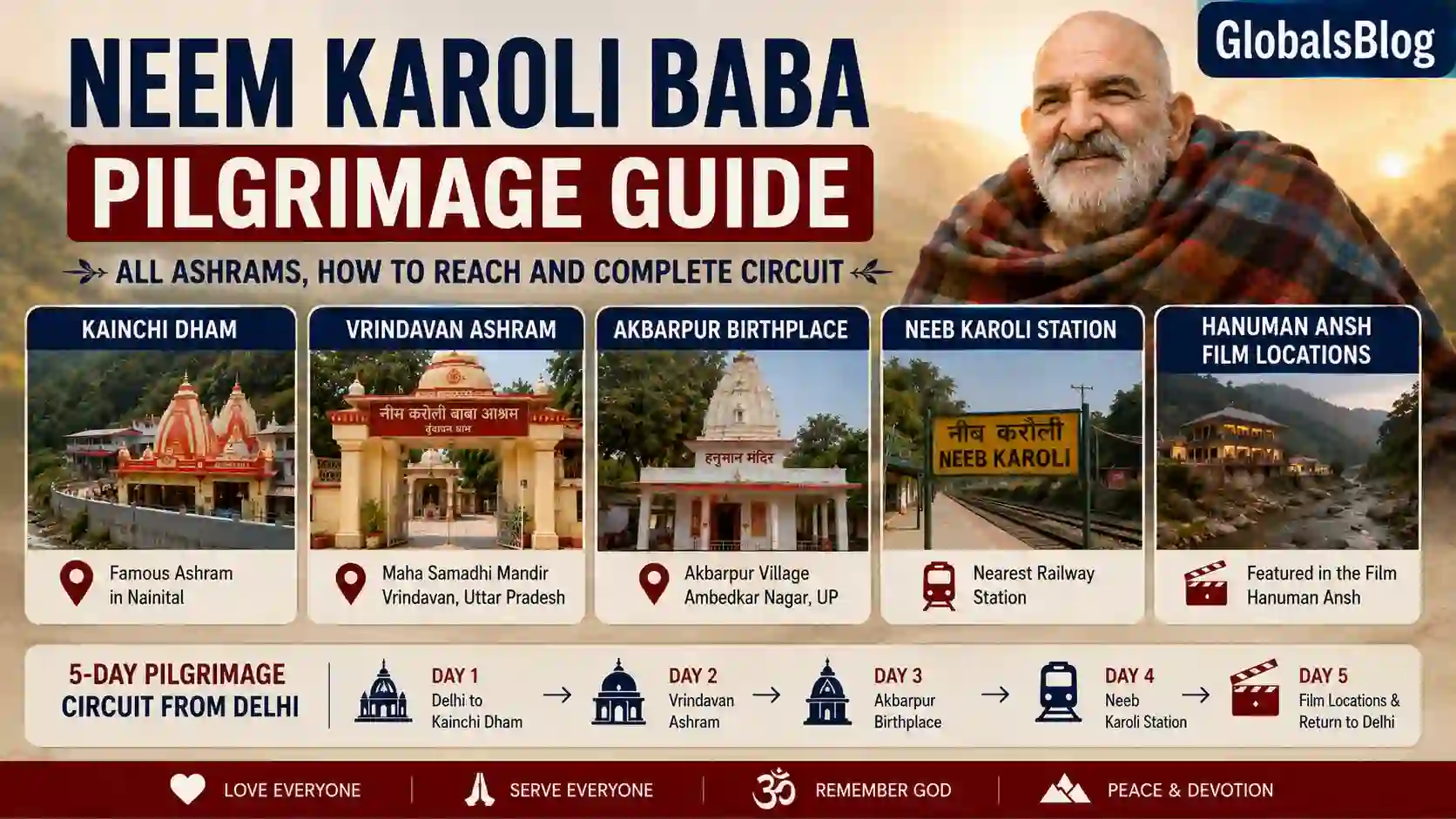
Neem Karoli Baba — Maharaj Ji — never wrote a book, gave no long sermons, and left no formal doctrine. He sat with people, fed them, and sometimes said almost nothing. Yet he influenced Steve Jobs, Mark Zuckerberg, Julia Roberts, and Ram Dass. His teaching fits in one breath: Love everyone. Feed everyone. Serve everyone. Remember God. This guide covers every place connected to his life — all three ashrams, the birthplace, the filming locations of the Hanuman Ansh film, and how to plan the complete pilgrimage.
The Hanuman Ansh film (2026) crossed ₹48 crore at the Indian box office entirely on word of mouth — no promotions, no star power, a ₹2 crore budget. The film is based on Neem Karoli Baba's life, was launched with its poster at Kainchi Dham, and was filmed in Chitrakoot. The people who watched it and were moved by it are now searching for his ashrams, his birthplace, the train station where he got his name, and the Chitrakoot temples where the film was shot. This guide exists for those people — and for every devotee who has been planning the Maharaj Ji pilgrimage and needed a single, complete resource. Three stops. One saint. One complete journey.
The complete Neem Karoli Baba pilgrimage has three essential stops: Kainchi Dham (Nainital, Uttarakhand — main ashram, 330km from Delhi, Hanuman temple founded 1964, Steve Jobs visited 1974, annual Bhandara June 15); Vrindavan Ashram (Vrindavan, UP — where Maharaj Ji died Sept 11, 1973, Maha Samadhi Mandir, 144km from Delhi); Akbarpur (Ambedkar Nagar, UP — birthplace village, Hanuman Mandir, 110km from Lucknow, 60km from Ayodhya). A fourth meaningful stop: Neeb Karori station (Farrukhabad, UP — where the train miracle gave him his name). Film-related: Chitrakoot (filming location of Hanuman Ansh 2026 — Punjabi Baba Ashram, Hanuman Dhara Temple). Suggested 5-day circuit from Delhi covers all stops. Entry to all ashrams is free.
Who Was Neem Karoli Baba — The Complete Story
Neem Karoli Baba was born Lakshman Narayan Sharma around 1900 in Akbarpur village, Ambedkar Nagar district, Uttar Pradesh — into a wealthy Brahmin zamindar family. His parents married him at eleven. He left home not long after to become a wandering sadhu, moving through the plains of North India with no fixed destination. He took different names in different places. At the village of Neeb Karori in Farrukhabad district, UP, he was ejected from a train for not having a ticket. He sat under a neem tree by the tracks. The train refused to move. When railway officials asked him to return, he agreed on two conditions: feed the poor at the station and build a station at Neeb Karori for local people. The train moved. He became Neem Karoli Baba — the baba from Neeb Karori.
He spent decades wandering, gradually acquiring devotees who described experiences in his presence that defied ordinary explanation. He eventually settled enough to establish ashrams across North India — the most significant being Kainchi Dham (Uttarakhand, 1964) and Vrindavan (UP, 1960s). His teaching was entirely without elaboration: love, service, devotion, and the name of Ram. He was a complete devotee of Hanuman — he built and blessed Hanuman temples throughout his life, and his followers consider him a Hanuman avatar, hence the film title: Hanuman Ansh, the essence of Hanuman.
In 1974, Steve Jobs came to Kainchi Dham to meet him — Maharaj Ji had died the previous year. Jobs stayed anyway. Mark Zuckerberg came before Facebook's IPO. Julia Roberts became a devotee. Ram Dass (Richard Alpert of Harvard) became his most famous Western disciple and wrote Be Here Now, the book that introduced Maharaj Ji to a generation of American seekers. Neem Karoli Baba never left India, never gave a press conference, never had a management team. The reach of his presence continues to expand through the people who carry it.
He died on September 11, 1973, at Vrindavan. He is buried at the Vrindavan Ashram in the Maha Samadhi Mandir. His main ashram at Kainchi Dham continues to receive thousands of visitors daily. The Hanuman Ansh film (2026), made on ₹2 crore with no stars, crossed ₹48 crore on word of mouth alone — the film's own trajectory being, perhaps, the most Maharaj Ji thing about it.
The Three Pilgrimage Stops — Overview
Kainchi Dham is the most significant and most visited Neem Karoli Baba site in India — the ashram Maharaj Ji founded on June 15, 1964, on the Bhowali–Almora road in the Kumaon hills of Uttarakhand, 18km from Nainital. The Hanuman temple here, inaugurated by Maharaj Ji himself, is the devotional heart of the ashram. The Kosi River runs alongside the compound. Free langar (meals) are served daily. Phones are strictly not permitted inside. The annual Bhandara on June 15 — Foundation Day — draws tens of thousands for the famous malpua prasad distribution. It is here that Steve Jobs came in 1974 and Mark Zuckerberg came before the Facebook IPO. The film Hanuman Ansh (2026) was officially launched with its poster at Kainchi Dham. Darshan timings: 6am–6pm daily; Tuesday extended to 9pm with evening kirtan and free dinner. Best base: Nainital (18km).
The Vrindavan Ashram on Baba Neem Karori Marg is where Neem Karoli Baba died on September 11, 1973, and where his body is interred in the Maha Samadhi Mandir. The ashram is quieter than Kainchi — more meditative, more inward, the stillness of completion rather than the energy of active life. The Maha Samadhi Mandir is the most sacred Neem Karoli Baba site in India. Also within the compound: Hanuman Ji Temple (1968), Kirtan Hall (1970), Ram Darbar, Vrindavaneshwari Maa Temple, and Gaushala. The ashram sits within Vrindavan — one of India's most sacred Krishna pilgrimage towns — making it possible to combine the NKB ashram with Prem Mandir, ISKCON, and Banke Bihari Mandir in a single day. At 144km from Delhi via Yamuna Expressway, it is the easiest NKB stop to visit from the capital. Darshan: 5:30am–12pm and 4pm–8pm. Entry free.
Akbarpur in Ambedkar Nagar district, UP, is where Neem Karoli Baba was born as Lakshman Narayan Sharma around 1900. The Akbarpur Hanuman Mandir is the birthplace temple — confirmed by the Hanuman Ansh (2026) film cast, which credits "Akbarpur Hanuman Mandir Pujari" as a named character. This is the origin: the village the wandering sadhu left behind, the place where the boy who would become Maharaj Ji came from. Akbarpur is not a developed pilgrimage site like Kainchi — it requires local guidance and more planning. The natural combination is Ayodhya (60km away): Ram Mandir morning darshan + Hanuman Garhi + Akbarpur afternoon in one day from a Lucknow overnight base. The Akbarpur railway station (code AWB) is on the Lucknow–Varanasi line.
The Neeb Karori railway station in Farrukhabad district, UP, is where the famous train miracle occurred — the sadhu ejected without a ticket, the train that refused to move, the two conditions met, the name given. The station still operates as a small rural halt on the Farrukhabad rail line. For devoted pilgrims who want to stand at the place where Lakshman Narayan Sharma became Neem Karoli Baba, this is it. It is best treated as a brief stop (30–45 minutes) en route between Agra and Lucknow, not a standalone destination. Farrukhabad is approximately 160km from Agra and 200km from Lucknow.
Hanuman Ansh Film — Real Locations You Can Visit
| Film Connection | Real Location | What Happened | Can You Visit? |
|---|---|---|---|
| Poster unveiled here | Kainchi Dham, Uttarakhand | Official film launch event at Maharaj Ji's main ashram | ✅ Yes — open daily, free entry |
| Opening scene filming | Punjabi Baba Ashram, Chitrakoot | First scenes of the film shot at this ashram | ✅ Yes — Chitrakoot open to visitors |
| Hanuman idol installation scene | Chitrakoot, UP/MP border | Key sequence filmed in Chitrakoot's ashram area | ✅ Yes — part of Chitrakoot pilgrimage |
| "Akbarpur Hanuman Mandir Pujari" — named character in cast | Akbarpur Hanuman Mandir, Ambedkar Nagar UP | Real temple, real priest, real birthplace connection | ✅ Yes — ask locally for the temple |
| Film's subject | Vrindavan Ashram, UP | Where Neem Karoli Baba died and is interred | ✅ Yes — 5:30am–8pm daily, free |
The Hanuman Ansh film is not a documentary — it is a biographical spiritual drama. The filming took place in Chitrakoot (not at the real Kainchi Dham ashram). But the real places associated with Neem Karoli Baba's life — Kainchi Dham, Vrindavan Ashram, Akbarpur — are all visitable and are covered in detail in the guides linked from this page.
The Complete 5-Day Pilgrimage Circuit from Delhi
| Day | Route | Key Activity | Overnight |
|---|---|---|---|
| Day 1 | Delhi → Kathgodam by overnight train (or Delhi → Nainital by road) | Travel day. Arrive Nainital by morning. Rest and acclimatise | Nainital |
| Day 2 | Nainital → Kainchi Dham (18km) → Nainital | Kainchi Dham full day: morning aarti, Hanuman temple darshan, Maharaj Ji murti, Kosi River, langar. Return Nainital | Nainital |
| Day 3 | Nainital → Delhi (road or Kathgodam train) | Morning: Optional Nainital lake and Mall Road. Afternoon/evening: travel back to Delhi | Delhi |
| Day 4 | Delhi → Vrindavan (144km, Yamuna Expressway) | Morning: Vrindavan Ashram darshan — Maha Samadhi Mandir, Hanuman Ji temple, morning aarti 6am. Afternoon: Prem Mandir, ISKCON, Banke Bihari. Evening: return Delhi or overnight Mathura/Vrindavan | Delhi or Vrindavan |
| Day 5 | Delhi/Lucknow → Ayodhya (60km from Akbarpur) → Akbarpur | Morning: Ram Mandir darshan Ayodhya + Hanuman Garhi Temple. Afternoon: drive Ayodhya → Akbarpur (60km). Birthplace Hanuman Mandir visit. Return Lucknow or fly back | Lucknow |
Budget estimate for the full 5-day circuit (per person, mid-range): Train Delhi–Kathgodam return ₹800–2,000 + Nainital accommodation 2 nights ₹3,000–6,000 + local taxis Nainital/Kainchi ₹1,000–2,000 + Delhi–Vrindavan cab return ₹3,000–5,000 + flight or train to Lucknow ₹1,500–5,000 + Lucknow accommodation 1 night ₹1,500–3,000 + Ayodhya–Akbarpur cab ₹1,500–2,500. Total estimated range: ₹12,000–₹25,000 per person for the complete circuit. All ashram entries are free.
Use our trip cost calculator to estimate your specific circuit cost based on travel dates, starting city, and accommodation preference.
All Neem Karoli Baba Ashrams in India
| Ashram | Location | Significance | Status |
|---|---|---|---|
| Kainchi Dham | Nainital, Uttarakhand | Main ashram — Hanuman temple 1964, living centre of Maharaj Ji's legacy | ✅ Highly active, fully managed |
| Vrindavan Ashram | Vrindavan, UP | Final ashram — Maha Samadhi Mandir, where Maharaj Ji rests | ✅ Active daily worship |
| Bhumiyadhar Ashram | Near Kainchi, Uttarakhand | Smaller ashram near Kainchi — Hanuman temple built 1965, harijans community temple | ✅ Active, less visited |
| Kakrighat Dham | 22km from Kainchi, Uttarakhand | Associated with Himalayan monk Shri Somvaree Maharaj — restored by Siddhi Ma, Maharaj Ji's disciple | ✅ Active pilgrimage site |
| Lucknow Ashram | Lucknow, UP | Open kitchen — feeds hundreds daily. Seva tradition of Maharaj Ji continues here | ✅ Active |
| Taos Hanuman Temple | Taos, New Mexico, USA | Founded by Ram Dass — first Hanuman temple in USA. White marble Hanuman from Jaipur | ✅ Active (international) |
Essential Ashram Rules — All Sites
| Rule | Kainchi Dham | Vrindavan Ashram | Akbarpur |
|---|---|---|---|
| Entry fee | Free | Free | Free |
| Phones | ❌ Strictly not permitted inside | Restricted near Samadhi Mandir | Standard temple etiquette |
| Footwear | Off at Juta Ghar before entering | Off before temples and Samadhi | Off before entering temple |
| Dress code | Modest — no shorts, no sleeveless | Modest — no shorts, no sleeveless | Modest — standard temple dress |
| Leather | No leather items inside | Respectful — leave outside | Standard practice |
| Photography | Not permitted inside ashram | Restricted inside — no Samadhi photos | Standard temple courtesy |
| Open to all faiths | ✅ Yes | ✅ Yes | ✅ Yes |
✓ Neem Karoli Baba Pilgrimage Tips
- Start with Kainchi Dham — it is the most complete experience: If you can only do one stop on the Neem Karoli Baba pilgrimage, make it Kainchi Dham. It has the Hanuman temple Maharaj Ji built himself, the Kosi River, the langar, the Tuesday extended kirtan, and the setting in the Kumaon hills that gives the experience its specific character. The Vrindavan Ashram is essential for serious devotees; Akbarpur for those who want the complete arc. But if one stop, Kainchi
- Tuesday at Kainchi, morning at Vrindavan: The two best timing choices in the circuit. Tuesday at Kainchi Dham (6am–9pm, evening kirtan, free dinner, most devotionally alive) and morning at Vrindavan Ashram (5:30am–12pm, morning aarti at 6am, Samadhi Mandir at its most peaceful before day-visitor traffic). Plan both around these specific timings and the circuit changes character significantly
- All three entries are free — your only costs are travel and accommodation: Unlike many pilgrimage circuits in India, the Neem Karoli Baba ashrams charge nothing to enter. Kainchi Dham, Vrindavan Ashram, and Akbarpur Hanuman Mandir are all free. The langar at Kainchi is free. The Maha Samadhi Mandir at Vrindavan is free. Your pilgrimage budget covers only transport and accommodation — both of which can be done modestly on this circuit
- The Hanuman Ansh film is the best preparation for the pilgrimage: Before visiting Kainchi Dham or Vrindavan, watching Hanuman Ansh (available in theatres as of September 2026, OTT date not yet announced) provides the biographical and emotional context that makes the ashram visits more meaningful. The film is not a documentary but it is a sincere portrayal of Maharaj Ji's teachings — arriving at Kainchi Dham having just seen the film produces a different quality of attention than arriving cold
- Combine stops with existing travel: The circuit does not require a dedicated 5-day Neem Karoli trip — it can be built into existing travel. Vrindavan is 73km from Agra (add it to any Taj Mahal day trip). Kainchi Dham is 18km from Nainital (add it to any Nainital trip). Akbarpur is 60km from Ayodhya (add it to any Ram Mandir trip). Three stops, three existing pilgrimage circuits — Maharaj Ji fits naturally alongside the journeys people are already making
✗ Neem Karoli Baba Pilgrimage Mistakes to Avoid
- Treating the pilgrimage as a tourist itinerary rather than a devotional one: The Neem Karoli Baba ashrams are not monuments or tourist attractions. They are active places of worship in daily use. The difference in experience between a visitor who sits quietly in the Kainchi Dham ashram with no agenda and a visitor who arrives with a checklist and a time pressure is significant. Give each stop more time than you think you need. The most frequently reported experience across all three sites is that the value arrives when you stop trying to extract it
- Taking your phone inside Kainchi Dham: The no-phone rule at Kainchi Dham is the one rule that consistently catches first-time visitors. Leave your phone in the car — not in your bag, not in your pocket — before reaching the gate. The rule is enforced by volunteers at the entrance and is non-negotiable. Planning to document the visit on your phone is the wrong approach to this particular ashram
- Visiting Vrindavan Ashram during the 12pm–4pm closure: The Vrindavan Ashram closes for the afternoon break from 12pm to 4pm. Visitors who arrive at 2pm find closed gates. If driving from Agra (73km), leave Agra by 1:30pm to arrive in Vrindavan for the 4pm re-opening — or leave earlier to catch the morning session
- Skipping Akbarpur because it is "too far" or "not developed enough": The Akbarpur birthplace requires more effort than Kainchi or Vrindavan — it is less signposted, less managed, and requires local guidance. But it is where the story began. For devotees who take the Maharaj Ji pilgrimage seriously, skipping the origin because it is inconvenient is a choice worth reconsidering. The effort to reach Akbarpur is itself a form of seva
⚠️ Disclaimer: All ashram timings, rules, and information are accurate as of September 2026 and subject to change on festival days and special occasions. Kainchi Dham Bhandara (June 15) requires accommodation booked 2–3 months in advance. All entries are free. Verify current timings before travelling. The Hanuman Ansh film (2026) is a biographical drama — filming locations (Chitrakoot) are separate from the real ashrams covered in this guide. Travel costs are indicative estimates; verify current fares before booking.
Three Stops. One Saint. Love Everyone. Feed Everyone. Serve Everyone. Remember God. Kainchi Dham in the Hills. Vrindavan in the Sacred Land of Krishna. Akbarpur Where It All Began. The Pilgrimage Is the Practice.
The Hanuman Ansh film ends — like all good spiritual stories — not with an arrival but with a continuation. Neem Karoli Baba's story does not end at any of the three stops on this pilgrimage circuit. It continues in every person who leaves Kainchi Dham a little quieter than they arrived, who sits for forty minutes in the Vrindavan Samadhi Mandir and cannot quite explain what happened, who stands in Akbarpur and thinks about a boy who left everything to find the one thing worth keeping. The pilgrimage is not a checklist. It is an orientation. The three stops are not destinations — they are doors. What you find behind them is your own business. But the doors are there, and they are open, and they are free.
The main Neem Karoli Baba pilgrimage places in India are: 1. Kainchi Dham, Nainital district, Uttarakhand — the main ashram founded by Maharaj Ji on June 15, 1964. Hanuman temple, Kosi River, free langar, Tuesday kirtan till 9pm, annual Bhandara (June 15 malpua prasad). 330km from Delhi. No phones inside. Free entry. 2. Vrindavan Ashram, Vrindavan, UP — where Neem Karoli Baba died on September 11, 1973. The Maha Samadhi Mandir is the most sacred NKB site in India. Hanuman Ji Temple (1968), Kirtan Hall, Ram Darbar. 144km from Delhi. Darshan 5:30am–12pm and 4pm–8pm. Free entry. 3. Akbarpur, Ambedkar Nagar, UP — birthplace village where Maharaj Ji was born as Lakshman Narayan Sharma (~1900). Akbarpur Hanuman Mandir associated with birthplace. 110km from Lucknow, 60km from Ayodhya. Free entry. Additional: Neeb Karori station (Farrukhabad, UP) — where the train miracle gave him his name. Chitrakoot (UP/MP border) — primary filming location of the Hanuman Ansh (2026) film. All ashram entries across the circuit are free of charge.
Planning a Neem Karoli Baba pilgrimage from Delhi — 5-day circuit: Day 1: Delhi to Nainital by overnight train (Kathgodam station, 38km from Kainchi Dham) or road (330km). Stay Nainital. Day 2: Nainital to Kainchi Dham (18km, 40 min). Full day at the ashram — morning aarti, Hanuman temple darshan, Maharaj Ji murti, langar, Kosi River. If Tuesday, stay for evening kirtan (6am–9pm). Return Nainital. Day 3: Return Delhi (train from Kathgodam or road). Rest or overnight. Day 4: Delhi to Vrindavan (144km, Yamuna Expressway, 3–4 hrs). Morning aarti at Vrindavan Ashram (6am), Maha Samadhi Mandir, Hanuman temple. Afternoon: Prem Mandir, ISKCON, Banke Bihari. Return Delhi or overnight Mathura/Vrindavan. Day 5: Delhi or Lucknow (fly) to Ayodhya — Ram Mandir morning darshan + Hanuman Garhi. Drive Ayodhya to Akbarpur (60km, 1.5 hrs). Birthplace Hanuman Mandir visit. Return Lucknow or fly back to Delhi. Budget: ₹12,000–25,000 per person total (transport + accommodation). All ashram entries free.
Neem Karoli Baba's famous devotees include: Steve Jobs (Apple co-founder) — visited Kainchi Dham in 1974 at age 19, arrived after Maharaj Ji's death but stayed and described the experience as foundational to Apple's values. Mark Zuckerberg (Facebook CEO) — visited Kainchi Dham before Facebook's IPO at Jobs' recommendation, sought clarity on the company's direction. Julia Roberts (Hollywood actress) — became a devotee and practices Hinduism partially through the NKB tradition. Ram Dass (Richard Alpert, Harvard professor) — became Maharaj Ji's most famous Western disciple, wrote Be Here Now (1971) which introduced NKB to a generation of Western seekers. Krishna Das (kirtan musician) — NKB devotee, became the most popular kirtan musician in the Western yoga world. Larry Brilliant (epidemiologist, helped eradicate smallpox) — NKB devotee who worked in India at Maharaj Ji's direction. Bhagavan Das (American musician and author). Dada Mukerjee (Indian devotee, wrote extensively about Maharaj Ji). Siddhi Ma (direct disciple who managed the ashrams after Maharaj Ji's passing).
Neem Karoli Baba was a complete devotee of Lord Hanuman — the most central devotional relationship of his life. He built Hanuman temples throughout his life: the main temple at Kainchi Dham (1964), the Hanuman Ji temple at Vrindavan Ashram (1968), and others across North India. His followers consider him to be an avatar (divine manifestation) of Lord Hanuman — this is the meaning of the 2026 film's title: Hanuman Ansh, meaning "the essence of Hanuman" or "born of Hanuman." The film depicts Neem Karoli Baba as Hanuman Ansh because of his total devotion, his miraculous acts, his selfless service, and his feeding of all who came to him — qualities associated with Hanuman's seva (service) tradition. Whether one accepts the avatar interpretation or simply recognises the exceptional devotion, the Hanuman connection is the most defining spiritual characteristic of Neem Karoli Baba's life and legacy. All his major ashrams are centred on Hanuman temples. His most frequently heard teaching includes the worship of Ram, whose greatest devotee is Hanuman.
Hanuman Ansh (2026) is a Hindi-language biographical spiritual drama directed by Vishal Chaturvedi, based on the life of Neem Karoli Baba (Maharaj Ji). The film follows young Lakshman Das — Neem Karoli Baba's name before he became a saint — who leaves home after losing his mother and searches for God. Through encounters with the divine and acts of selfless service (feeding the poor, silent blessing), he embodies the teachings of Neem Karoli Baba and is called Hanuman Ansh — the essence of Hanuman. The film was made on a ₹2 crore budget, released August 7, 2026, opened to just ₹1.30 crore in its first two weeks, and then grew entirely on word-of-mouth to cross ₹48.78 crore net by September 1, 2026 — one of the most significant underdog box office stories in recent Hindi cinema. Real-world connections: the film's poster was unveiled at Kainchi Dham (Maharaj Ji's main ashram); principal photography took place in Chitrakoot (Punjabi Baba Ashram — opening scene); the cast credits include "Akbarpur Hanuman Mandir Pujari" confirming the birthplace temple connection. The film is planned as the first of a trilogy.
Best time to visit Neem Karoli Baba ashrams: Kainchi Dham (Uttarakhand) — February to June and September to November. Best weather for the Kumaon hills: March–June (pleasant 15–25°C, roads clear). October is excellent — post-monsoon clarity, fewer crowds than peak season. Avoid July–August monsoon (heavy rain, traffic on mountain roads). The Bhandara (June 15) is the most spiritually significant single day — book accommodation 2–3 months ahead. Tuesday (any week) is the best regular day — extended hours 6am–9pm with kirtan and free dinner. Vrindavan Ashram — open year-round. Vrindavan in winter (October–February) is pleasant and aligned with the Krishna pilgrimage season when the town has most energy. Avoid summer (April–June) in Vrindavan — the UP plains heat can be extreme. Morning visit (5:30am–12pm) is recommended year-round. Akbarpur — year-round accessible. October–February has the most comfortable weather in UP. Avoid May–June heat. The overall best month for the full circuit: October–November — post-monsoon clarity in Uttarakhand, comfortable in UP, all roads and ashrams operational, no extreme heat or monsoon complications.
Leave a comment
Share a quick thought about this story.
Thanks for sharing your view. It is ready for review.
Please try again in a moment.