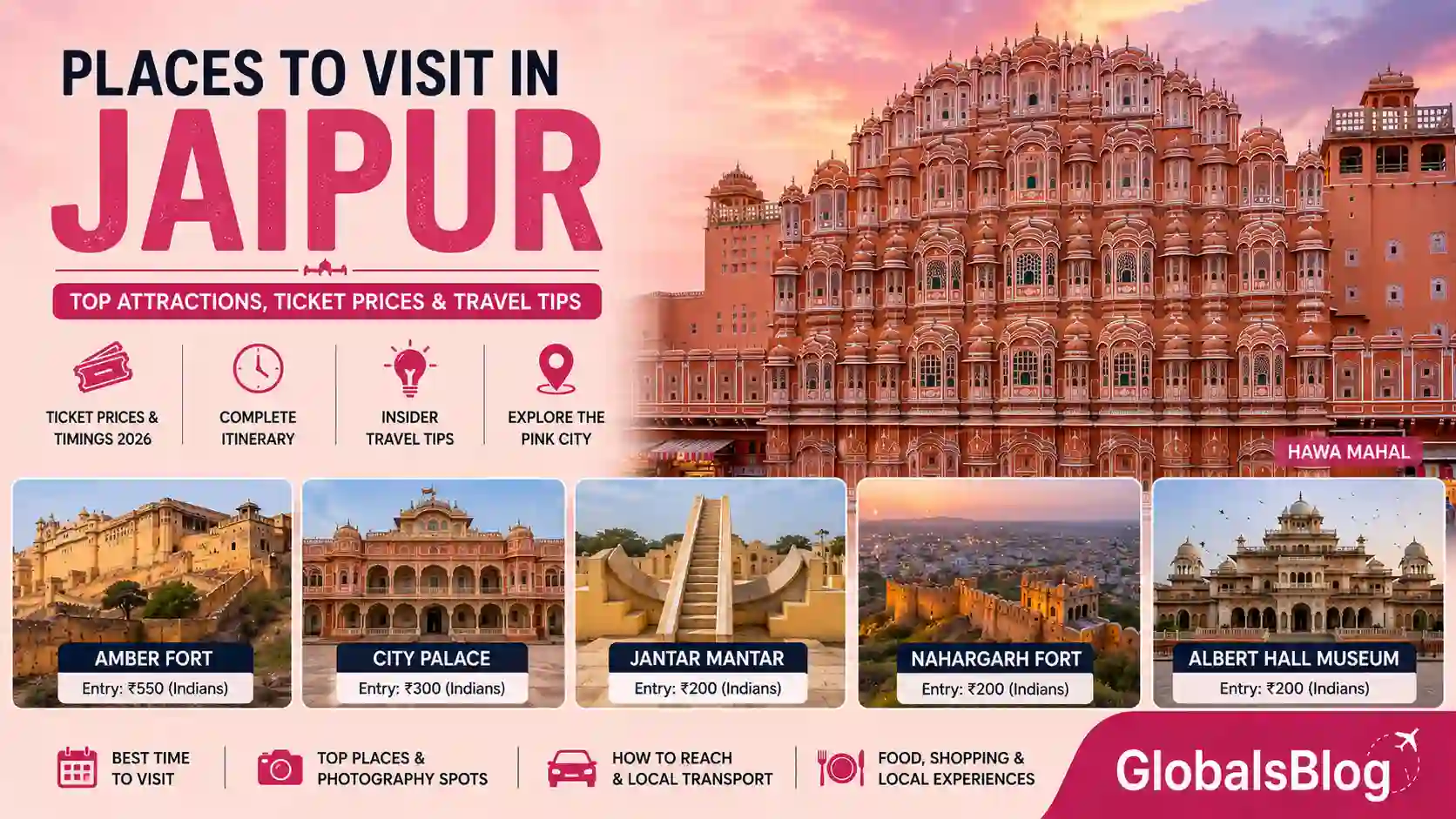
Jaipur was built to a precise grid in 1727, painted pink for a royal visit in 1876, and has not changed the colour since. The result is the only city in India where the architecture, the street life, and the history form a single coherent visual experience.
Jaipur is the gateway to Rajasthan and one of India's three most-visited cities — but unlike Delhi and Agra, which visitors often rush through, Jaipur rewards slow exploration. City Palace Jaipur was built by Maharaja Sawai Jai Singh II between 1729 and 1732 when he moved his capital from Amber to the newly founded city of Jaipur. The palace complex has been expanded by successive rulers, creating a unique blend of Rajput, Mughal, and European design elements — the intricate stone carvings, elaborate mirror work, delicate frescoes, and beautiful courtyards reflecting the artistic excellence of Rajasthan's golden era. Amber Fort remains one of Jaipur's top attractions in 2026 — a 16th-century hilltop palace built by Raja Man Singh I, known for its Rajput-Mughal architecture, courtyards, and views of Maota Lake, and listed as a UNESCO World Heritage Site. Jaipur also offers a composite ticket (₹300 for Indians, ₹1,000 for foreigners) covering City Palace, Amber Fort, Jantar Mantar, Hawa Mahal, and Nahargarh Fort — valid for 2 days. This guide covers every major attraction with 2026 ticket prices, exact timings, and the order to visit them in.
Best places to visit in Jaipur: Amber Fort (UNESCO, 11 km from city, ₹200 Indians, open 8 AM–5:30 PM), City Palace (royal family still lives here, ₹150 Indians, 9:30 AM–5 PM), Hawa Mahal (953 windows, ₹50 Indians, 9 AM–5 PM), Jantar Mantar (UNESCO observatory, ₹50 Indians, 9 AM–4:30 PM), Nahargarh Fort (best sunset view, ₹150 Indians), Jaigarh Fort (world's largest cannon on wheels, same hill as Amber), Jal Mahal (water palace, free — viewed from road), Albert Hall Museum (₹40 Indians). Buy the composite ticket (₹300 Indians) covering 5 major sites, valid 2 days — saves both money and queue time. Start at Amber Fort at 8 AM before crowds arrive.
Places to Visit in Jaipur — Complete Attractions Guide
Amber Fort is a 16th-century hilltop palace in Jaipur, built by Raja Man Singh I in 1592. It is known for its Rajput-Mughal architecture, its series of courtyards, and breathtaking views of Maota Lake below. The fort opens daily from 8:00 AM to 5:30 PM, with night visits available from 6:30 PM to 9:00 PM for the light and sound show. The fort's defining interior is the Sheesh Mahal (Mirror Palace) — a room whose walls and ceiling are clad in thousands of tiny convex mirrors and coloured glass, arranged so that a single candle flame reflects across the entire surface like a field of stars. The Ganesh Pol (Elephant Gate) is the most photographed entrance — a soaring arched gateway covered in frescoes depicting Hindu mythology. A thorough visit requires a minimum of 2.5 to 3 hours. Ascent options: jeep (₹100–150/person return) or on foot via the steep main ramp (15 minutes, rewarding views). Guide: ₹400 for groups of 1–4 people — strongly recommended for first-time visitors, as the fort's stories are largely invisible without context.
City Palace Jaipur is an essential stop on any Rajasthan itinerary. The palace occupies one-seventh of the old walled city and showcases an extraordinary fusion of Rajput, Mughal, and European design elements. The Chandra Mahal (Moon Palace) is a seven-storey palace still inhabited by the Jaipur royal family. Key attractions include the Mubarak Mahal (Welcome Palace, now Textile Museum), the Peacock Gate — one of four gates each representing a season, decorated with peacock motifs in vivid blue and green — and the museum displaying royal attire, armory, manuscripts, and portraits of the Maharajas. The City Palace is 800 metres from Jantar Mantar — walking between them through the old city bazaars is itself an experience. A guide costs ₹500 and is worthwhile for a first visit — City Palace is not just one building but a complex of courtyards, museums, and royal sections where the significance of each element is easily missed without explanation.
The Hawa Mahal is Jaipur's most instantly recognisable image — a five-storey pink sandstone façade of 953 small latticed windows (jharokhas) stacked in a honeycomb pattern, built in 1799 by Maharaja Sawai Pratap Singh. The original purpose was functional: the screened windows allowed royal women (purdah-observing zenana) to watch street processions and bazaar life below without being seen. The design channels wind through the lattices even in summer heat — the palace's name means exactly what it says. The Hawa Mahal is best seen from outside (the famous façade shot is taken from the street or from the café rooftops across the road) — the interior chambers are simple in comparison to the exterior drama. Entry fee: ₹50 for Indian nationals, ₹200 for foreign nationals, ₹20 for Indian students. Combine with the City Palace (5-minute walk) and Jantar Mantar in a single half-day old city circuit.
Jantar Mantar is located 800 metres from the City Palace and can be reached in 5–7 minutes on foot through the market. Built in the 18th century by Maharaja Sawai Jai Singh II, it is an astronomical observatory where large stone and marble instruments were built to measure the positions of the sun, moon, and planets. The Samrat Yantra is the largest and most famous of these — considered the world's largest stone sundial, accurate to within 2 seconds. Due to its unique scientific design and historical significance, it has been declared a UNESCO World Heritage Site. Jantar Mantar's 19 instruments look like abstract modern sculpture until you understand what each one measures — an audio guide (₹200) or a live guide makes the difference between an interesting garden and an extraordinary scientific encounter. The Jai Prakash Yantra (a hemispherical bowl that plots the sun's position) and the Ram Yantra (a cylindrical structure for measuring altitude and azimuth) are the most remarkable after the Samrat Yantra.
Nahargarh Fort sits on the rugged Aravalli hills overlooking Jaipur. Built in 1734 by Maharaja Sawai Jai Singh II as a resting place for the royal family, the fort has undergone several expansions. Though less grand than Amber Fort, Nahargarh's charm lies in its scenic location and the Madhavendra Bhawan — a palace within the fort complex with suites for the king and his queens, each suite identical in layout so no queen would feel privileged over another. The fort offers the most panoramic view of Jaipur available — the entire walled city spread below, turning amber and rose at sunset. Nahargarh has been a filming location for Bollywood (Rang De Basanti, Shuddh Desi Romance) and houses a contemporary art installation (SteynArt/Nahargarh Art Gallery) worth exploring. The fort's Padao restaurant terrace is the finest sunset dining spot in Jaipur — arrive by 5:00 PM to secure a view table.
Jaigarh Fort sits on the same Aravalli ridge as Amber Fort, 1 km above it and connected by a covered passage — always combine both in a single visit. Don't miss the Jaivana — the world's largest cannon on wheels — and the breathtaking views over the surrounding terrain from the fort ramparts. The Jaivana cannon (built in 1720) has a barrel 20 feet long, weighs 50 tonnes, and was reportedly fired only once in its history — the cannonball landed 35 km away. Jaigarh's museum contains royal arms and armoury, cannon manufacturing equipment, and photographs of excavations where Maharaja Man Singh's treasury was said to be buried (it was never found). The fort is less visited than Amber despite being on the same hill — the relative quiet makes exploration more pleasant. A common plan is to visit Amber in the morning and Jaigarh in the afternoon, then head to Nahargarh for sunset.
Jal Mahal (Water Palace) sits at the centre of Man Sagar Lake, 6 km north of Jaipur on the route to Amber Fort — it is viewed from the lakeside road rather than visited directly (the palace interior is closed to public access). The palace appears to float on the lake's surface — at sunset, when the water turns gold and the five-storey structure reflects in the still water, it is one of Jaipur's most effortlessly beautiful images. Stop here on the return journey from Amber Fort at dusk — the golden hour light on the water is the best photography window. No entry fee, no queue, no ticket — just a pull-over on the roadside and a view that appears on every Jaipur travel mood board.
The Albert Hall Museum in Ram Niwas Garden is Rajasthan's oldest museum, housed in a magnificent 1887 Indo-Gothic building. Entry fee: ₹40 for Indian nationals, ₹300 for foreign nationals. The collection spans Egyptian mummies (one of the finest outside Egypt), Rajasthani folk art, jewellery, carpets (including a famous 17th-century Persian carpet), natural history, pottery, and royal portraits. The building itself is worth seeing — designed by Sir Swinton Jacob, the architect responsible for many of Jaipur's finest colonial-era structures, with Saracenic and Mughal elements woven into a Victorian Gothic framework. The museum is relatively uncrowded compared to Amber and City Palace — a peaceful morning stop before the main sightseeing begins. The garden outside (Ram Niwas) has a zoo and free walking space popular with Jaipur residents.
Jaipur Ticket Prices — Complete 2026 Reference
| Attraction | Indians | Foreigners | Timings | Time Needed |
|---|---|---|---|---|
| Amber Fort | ₹200 | ₹1,000 | 8:00 AM–5:30 PM | 2.5–3 hours |
| Jaigarh Fort | ₹150 | ₹150 | 9:00 AM–4:30 PM | 1–1.5 hours |
| Nahargarh Fort | ₹150 | ₹200 | 10:00 AM–5:30 PM | 1–2 hours |
| City Palace | ₹150 | Higher | 9:30 AM–5:00 PM | 1.5–2 hours |
| Jantar Mantar | ₹50 | ₹200 | 9:00 AM–4:30 PM | 45–60 min |
| Hawa Mahal | ₹50 | ₹200 | 9:00 AM–5:00 PM | 30–45 min |
| Albert Hall Museum | ₹40 | ₹300 | 9:00 AM–5:00 PM | 1 hour |
| Jal Mahal | Free | Free | Sunrise–sunset | 15–20 min |
| Composite Ticket | ₹300 | ₹1,000 | Valid 2 days | Covers 5 sites |
The composite ticket (₹300 Indians, ₹1,000 foreigners) covers City Palace, Amber Fort, Jantar Mantar, Hawa Mahal, and Nahargarh Fort — valid for 2 days. Buy it at any of the covered sites. Students with valid ID get significant discounts at most monuments — carry ID. Professional photography and video require separate permission at all ASI and state-managed monuments.
Jaipur Itinerary — 1 Day, 2 Days, 3 Days
1-Day Jaipur Itinerary:
7:45 AM: Depart for Amber Fort (11 km). 8:00 AM: Amber Fort — Sheesh Mahal, Ganesh Pol, Diwan-i-Aam (2.5 hours). 10:30 AM: Jaigarh Fort — Jaivana cannon, rampart views (1 hour). 12:00 PM: Return to city, lunch at LMB or Lassiwala on MI Road. 1:30 PM: City Palace — Peacock Gate, textile museum, Diwan-i-Khas (1.5 hours). 3:00 PM: Jantar Mantar — with audio guide (1 hour). 4:00 PM: Hawa Mahal — exterior photo from café rooftop across road (30 min). 4:45 PM: Drive to Nahargarh Fort for sunset (5:00–5:30 PM). 6:30 PM: Jal Mahal photo stop on return (golden hour).
2-Day Jaipur Itinerary:
Day 1 (Fort Circuit): 8:00 AM Amber Fort → 11:00 AM Jaigarh Fort → 1:00 PM lunch in Amer town → 2:30 PM Panna Meena Ka Kund step-well → 4:00 PM Jal Mahal sunset photo → 5:30 PM Nahargarh for dusk → 7:00 PM old city dinner at Handi Restaurant. Day 2 (City Circuit): 9:00 AM Albert Hall Museum → 10:30 AM City Palace → 12:30 PM Jantar Mantar → 2:00 PM Hawa Mahal and Johari Bazaar gem shopping → 4:00 PM Birla Mandir at dusk → 7:30 PM rooftop dinner at Peacock Rooftop or Bar Palladio.
3-Day Jaipur Itinerary:
Add to 2-day above: Day 3 — Amer village bazaar at 8 AM (before the tourist crowds), Sisodia Rani Ka Bagh (18th-century garden, ₹30 entry), Galta Ji (Monkey Temple, 10 km east, free), afternoon at Bapu Bazaar for blue pottery and block print shopping, Chokhi Dhani evening (Rajasthani cultural village and dinner, ₹800–1,200 per person, 20 km from city).
Jaipur Famous Places at Night
Amber Fort night light and sound show: 6:30–9:00 PM, runs in Hindi and English on alternate nights — the fort lit against the dark sky from the Maota Lake viewpoint is extraordinary. Check current schedule at the Rajasthan Tourism website before visiting — shows can be cancelled for weather or events.
Nahargarh Fort at sunset: The Padao restaurant terrace (inside the fort) is open until late and offers the finest sunset city view in Jaipur. Reservation recommended in peak season (November–January).
Albert Hall Museum night viewing: Open 7:00–10:00 PM Tuesday–Sunday — the Indo-Gothic building illuminated at night is one of Jaipur's most beautiful sights. Free entry for the night exterior viewing from Ram Niwas Garden.
Old city after dark: The walled city's bazaars (Johari Bazaar, Bapu Bazaar, Tripolia Bazaar) are most atmospheric from 6:00–9:00 PM — the shops lit, the streets crowded, the pink walls reflecting the streetlights. Not a specific attraction but the most immersive Jaipur evening experience available at no cost.
Jaipur Shopping — Best Bazaars
| Bazaar | Best For | Location |
|---|---|---|
| Johari Bazaar | Gemstones, jewellery, Kundan, Meenakari | Old city — near City Palace |
| Bapu Bazaar | Blue pottery, block print textiles, bangles, shoes (jootis) | MI Road area |
| Tripolia Bazaar | Lac jewellery, traditional Rajasthani items, lamps | Old city |
| Nehru Bazaar | Embroidered shoes (jootis) — Jaipur's most famous footwear market | Old city |
| Anokhi | High-quality block print clothing and home textiles — fixed price | Multiple — C-scheme flagship |
Places to Visit Near Jaipur
| Destination | Distance | Best For | Day Trip? |
|---|---|---|---|
| Abhaneri (Chand Baori) | 95 km (2 hr) | India's deepest and largest step-well — 3,500 steps, 13 storeys deep | ✅ Yes |
| Ranthambore | 160 km (2.5 hr) | Tiger safari — best booked as overnight stay | Overnight better |
| Pushkar | 145 km (2.5 hr) | Brahma temple, sacred lake, camel fair | ✅ Day trip or overnight |
| Samode Palace | 42 km (1 hr) | Heritage hotel — Sheesh Mahal rooms, pool, Rajput ambience | ✅ Day trip or overnight |
| Shekhawati | 165 km (2.5 hr) | Painted haveli towns — Mandawa, Nawalgarh | Overnight ideal |
See our full Rajasthan travel guide for the complete state circuit from Jaipur.
Jaipur Travel Tips 2026
- Start Amber Fort at 8:00 AM sharp: Amber Fort in the first 90 minutes after opening has perhaps 20% of the crowds it has at 11 AM. The Sheesh Mahal, the courtyards, and the Ganesh Pol are best experienced in relative quiet. By 10:30 AM the fort is packed with tour groups — plan arrival for exactly opening time
- Buy the composite ticket first: The Jaipur composite ticket (₹300 Indians, ₹1,000 foreigners) covers City Palace, Amber Fort, Jantar Mantar, Hawa Mahal, and Nahargarh Fort and is valid for 2 days. Buying separately costs more and means separate queues at each monument. Buy at the first monument you visit
- Jaipur in summer (April–June) requires early mornings only: Temperatures reach 42–45°C by noon. All sightseeing must be completed by 11:30 AM and resumed after 5:00 PM. October–March is the only fully comfortable window for a complete Jaipur experience
- The old city is best on foot or by cycle rickshaw: The lanes between Hawa Mahal, City Palace, Jantar Mantar, and Johari Bazaar are too narrow and congested for cars. A cycle rickshaw (₹50–100 per short hop) or walking is faster and infinitely more atmospheric than an auto or taxi for the old city circuit
- Hire a guide at Amber Fort and City Palace — skip the audio guide at Hawa Mahal: The Amber Fort guide (₹400 for groups of 1–4) reveals architectural details and historical narratives invisible on a self-guided walk. The Hawa Mahal guide adds little — the façade is the experience, and the interior chambers are simple
- See our Rajasthan complete guide for onwards travel to Pushkar, Udaipur, Jodhpur, and Jaisalmer from Jaipur
Amber at 8 AM. Jaigarh After. Jal Mahal at Sunset. City Palace and Jantar Mantar in the Old City. Nahargarh for the View. Composite Ticket for Everything.
Jaipur rewards planning more than almost any Indian city — the difference between arriving at Amber Fort at 8 AM versus 11 AM is the difference between experiencing one of the world's great palaces in quiet majesty and fighting through tour groups. A common and excellent plan is to visit Amber and Jaigarh in the morning, then head to Nahargarh for sunset. The composite ticket at ₹300 (Indians) covering five major sites valid for two days is the single best purchase a first-time Jaipur visitor can make. Two days is the comfortable minimum — one day for the fort circuit (Amber, Jaigarh, Nahargarh), one for the old city (City Palace, Jantar Mantar, Hawa Mahal, bazaars). Three days adds Abhaneri step-well, Chokhi Dhani evening, and unhurried shopping in Johari Bazaar. Jaipur done well is one of the finest 2–3 day travel experiences available anywhere in India.
The best places to visit in Jaipur are Amber Fort (UNESCO, ₹200 Indians, 8 AM–5:30 PM — the 16th-century hilltop palace with the Sheesh Mahal mirror room is the city's finest attraction), City Palace (₹150 Indians, 9:30 AM–5 PM — royal family still resides here, Peacock Gate and textile museum), Hawa Mahal (₹50 Indians, 953 windows, best photographed from café rooftops across the road), Jantar Mantar (₹50 Indians — UNESCO astronomical observatory with the world's largest stone sundial), Nahargarh Fort (₹150 Indians — best sunset panoramic view of Jaipur), Jaigarh Fort (same hill as Amber — world's largest cannon on wheels), Jal Mahal (free — water palace viewed from the lake road, best at sunset), and Albert Hall Museum (₹40 Indians — Rajasthan's oldest museum with Egyptian mummy). Buy the composite ticket (₹300 Indians) covering five sites, valid 2 days.
City Palace Jaipur ticket price in 2026: ₹150 for Indian nationals (₹20–50 for students with valid ID). Foreign nationals are charged a higher rate. The City Palace is also included in the Jaipur composite ticket (₹300 Indians, ₹1,000 foreigners) which covers City Palace, Amber Fort, Jantar Mantar, Hawa Mahal, and Nahargarh Fort — valid for 2 days. Timings: 9:30 AM–5:00 PM daily (last entry 4:30 PM). Guide available at entrance: ₹500. Audio guide: ₹200. The Chandra Mahal interior (where the royal family lives) requires a premium Royal Grande ticket at a higher price — the standard ticket covers all major areas including the Peacock Gate, Mubarak Mahal, and the textile and armoury museum.
Two days is the comfortable minimum for Jaipur to cover the essential attractions without rushing. Day 1: Amber Fort (2.5–3 hours) + Jaigarh Fort (1 hour) + Jal Mahal at sunset. Day 2: City Palace (1.5 hours) + Jantar Mantar (1 hour) + Hawa Mahal (30 min) + old city bazaars + Nahargarh sunset. Three days adds Abhaneri step-well (95 km day trip), Chokhi Dhani cultural evening, and relaxed shopping in Johari Bazaar. One day is possible as a Delhi day trip and covers Amber Fort, City Palace, and Jantar Mantar if you start at 8 AM — but two days delivers a fundamentally different and more complete experience.
Jaipur is famous for being India's first planned city (founded 1727, designed on a grid by Maharaja Sawai Jai Singh II), its distinctive pink sandstone buildings (painted pink for Prince Albert's visit in 1876, a tradition maintained to this day), two UNESCO World Heritage Sites (Amber Fort and Jantar Mantar, plus the walled old city itself), the Hawa Mahal's 953-window façade, the City Palace where the royal family still resides, the world's largest stone sundial (Samrat Yantra at Jantar Mantar), and its gemstone and jewellery trade (Jaipur is one of the world's largest coloured gemstone cutting and trading centres). Jaipur is also famous for blue pottery (a distinctive blue and white craft with Persian roots), block print textiles, lac jewellery, and embroidered shoes (jootis).
Reader Experiences