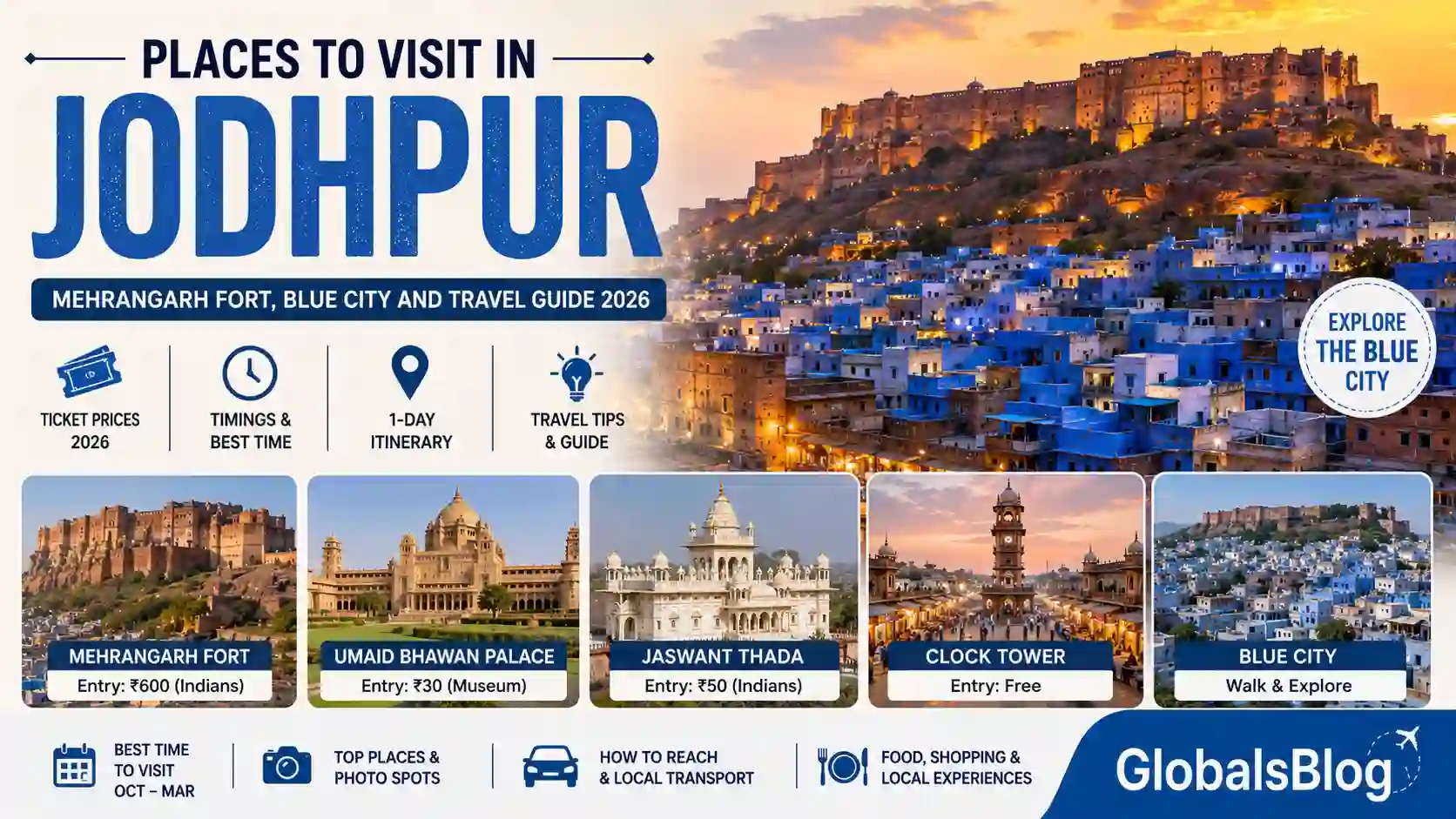
Mehrangarh Fort sits on a 125-metre rock outcrop above the blue city. Every story about Jodhpur begins there — from the fort's cannon gates to the blue quarter below to the Thar Desert beginning at the city's western edge. Jodhpur is Rajasthan at its most dramatic.
Jodhpur is Rajasthan's second city and, for many travellers, its most visually arresting. Mehrangarh Fort opens daily from 9 AM to 5 PM; entry costs about ₹100 for Indians and ₹600 for foreign visitors. The fort is one of the largest in India — it sits on a 125-metre rock outcrop above the city, with walls up to 36 metres high and 21 metres wide at some points. Below the fort lies the blue city — the densely packed Brahmin quarter of the old city, painted indigo by tradition since the 15th century, that gives Jodhpur its most photographed image. Jodhpur is known for Mehrangarh Fort, the blue-painted houses, and royal culture. The city offers a perfect mix of history and local traditions. Mehrangarh Fort is one of the largest and most impressive forts in India, offering panoramic views of the blue city below. Umaid Bhawan Palace is one of the world's largest private residences, blending Rajput, European and Art Deco architectural styles — commissioned during a drought to provide employment to thousands, it remains part luxury hotel, part museum, and part royal residence. This guide covers every major Jodhpur attraction with 2026 ticket prices, timings, and the one-day itinerary that covers the essential city without rushing.
Best places to visit in Jodhpur: Mehrangarh Fort (₹100 Indians, 9 AM–5 PM — most dramatic fort in Rajasthan, museum, blue city views), Jaswant Thada (₹30 Indians — white marble cenotaph, "Taj Mahal of Marwar"), Umaid Bhawan Palace (₹25 + ₹50 museum Indians, 10 AM–4:30 PM — royal family still lives here), Clock Tower and Sardar Market (free — best street food and handicrafts), Mandore Gardens (free — ancient Marwar capital with royal cenotaphs), Toorji ka Jhalra step-well (free — most photogenic spot in old city), Rao Jodha Desert Rock Park (₹100 Indians — desert ecosystem next to fort). Classic 1-day Jodhpur: Mehrangarh 9 AM → Jaswant Thada → Umaid Bhawan → Clock Tower evening + Sardar Market.
Places to Visit in Jodhpur — Complete Attractions Guide
Mehrangarh Fort is one of India's largest forts — massive walls up to 36 metres high and 21 metres wide dominate the skyline from a 125-metre rock outcrop above Jodhpur. The fort contains several exquisite palaces, including the Moti Mahal, Sheesh Mahal, and the Phool Mahal — the richly decorated hall that served as a royal reception area, known for its intricate gold work. The museum inside Mehrangarh is the finest royal collection in Rajasthan — superior in depth and curation to City Palace Udaipur or Amber Fort Jaipur — with galleries covering Rajasthani miniature paintings, royal palanquins, armoury, textiles, and a renowned collection of elephant howdahs. The best times are early morning (9–11 AM) for photography, cool weather, fewer crowds, and clear blue city views below, and late afternoon (3–5 PM) for golden hour photography and sunset views from the ramparts. Avoid midday (12–2 PM) — very hot and crowded. The Flying Fox zip line (Asia's longest, 6 lines across the fort complex) is available for those who want an aerial perspective of Mehrangarh and the blue city. The Rajasthan International Folk Festival (RIFF) is held at Mehrangarh Fort in October — a spectacular cultural celebration with world music, dance, and performances inside the fort.
Jaswant Thada is a beautiful white marble cenotaph constructed in 1899 to pay tribute to Maharaja Jaswant Singh II. Known as the Taj Mahal of Marwar, it features delicate carvings and a peaceful atmosphere. The cenotaph's intricately carved marble lattice screens and pretty domes give an insight into Jodhpur's glorious past, and the portraits of the rulers of Jodhpur displayed within are a quiet gallery of Marwar history. Jaswant Thada sits 1 km from Mehrangarh Fort — always combine both, as the walk between them passes through the base of the fort with some of the finest views of Mehrangarh's wall from below. Jaswant Thada feels like a deep breath after the intensity of Mehrangarh — the marble has a calm that makes people speak softer and walk slower, and even children automatically reduce noise levels, like the stone is asking for quiet. At ₹30 for Indians, it is the cheapest significant monument in Jodhpur and one of the most serene.
Umaid Bhawan Palace is one of the world's largest private residences. Commissioned during a severe drought and famine (1929–1942) to provide employment to thousands of workers, the construction of Umaid Bhawan Palace lasted 15 years. The palace blends Rajput, European, and Art Deco architectural styles — its golden-yellow Chittar sandstone façade is a striking contrast to the arid desert surroundings. The palace is now divided into three parts: the royal family's private residence, a Taj luxury hotel, and a museum open to the public. The museum section houses an extraordinary collection of vintage cars (including a 1937 Rolls Royce), Art Deco clocks, royal memorabilia, photographs of the Jodhpur royal family, and the maharaja's personal trophy collection from around the world. Umaid Bhawan Palace feels like calm after the storm of Mehrangarh — the palace's wide corridors, polished marble floors, and Art Deco detailing create an unexpectedly intimate experience for a building this scale. The grounds can be walked even without a museum ticket — the gardens and exterior are freely accessible for hotel guests and day visitors alike.
The Clock Tower (Ghanta Ghar) at the heart of the old city is Jodhpur's most vibrant public space — a Victorian-era tower surrounded by Sardar Market, the largest bazaar in Jodhpur, selling spices, textiles, handicrafts, silver jewellery, leather goods, and the blue pottery that Jodhpur is known for alongside Jaipur. The area around the Clock Tower is the finest street food destination in Rajasthan: makhaniya lassi (saffron-cream lassi at Shri Mishrilal Hotel, a Jodhpur institution since 1927), mirchi bada (chilli-stuffed potato pakoras), mawa kachori (deep-fried sweet pastry with reduced milk filling), and pyaaz kachori (onion-filled pastry) are all available within 200 metres. The Clock Tower and Sardar Market evening circuit (street food, shopping, people-watching, and nighttime photography of the tower) is the essential Jodhpur evening experience — a sequence that most first-time visitors report as unexpectedly memorable. Free entry, no ticket, no timing restriction.
Toorji ka Jhalra is an 18th-century step-well (bavdi) in the old city, built by the consort of Maharaja Abhay Singh and restored in 2020 — one of the finest examples of step-well architecture in Rajasthan and the most photogenic spot in Jodhpur's old city. The baoli descends in a series of symmetrical stone steps to the water level, framed by carved pillars and arched galleries — the blue city buildings visible above the rim create a layered image of historic water architecture against the indigo-painted quarter. Unlike Jaipur's Panna Meena Ka Kund (tourist-heavy) or Abhaneri (95 km away), Toorji ka Jhalra is within the old city, completely free, and sees relatively few tourists despite being one of Rajasthan's most-photographed interiors. Visit at 8:00 AM before the day warms up — the step-well catches the morning light at its most flattering angle and is virtually empty before 9:30 AM.
Mandore was the original capital of Marwar before Jodhpur was founded in 1459 — the gardens contain the cenotaphs (chhatris) of the Jodhpur maharajas, a hall of heroes (15 colossal figures carved from single rocks depicting deities and heroes of the Marwar legend), a museum of local sculpture, and a deer park. The royal cenotaphs at Mandore are architecturally distinct from those elsewhere in Rajasthan — multi-storey chhatris of red sandstone with intricate carved towers rather than the marble-and-dome form used at Jaswant Thada. Mandore Gardens is best visited in the late afternoon as the sun lowers — casual strolling, sunset among cenotaphs, and the deer park at dusk creates a leisurely close to a Jodhpur day. At 9 km from the city (25 min by auto), Mandore is best treated as a half-day addition on Day 2 rather than a primary Day 1 attraction. Free entry, large grounds, rarely crowded.
Rao Jodha Desert Rock Park is a 72-hectare restored desert ecosystem directly adjacent to Mehrangarh Fort's base — an ecological restoration project that cleared the invasive Vilayati Babool (mesquite) which had overrun the rocky terrain, and reintroduced 80+ native Thar Desert plant species. The result is a nature trail through desert scrub at the base of one of India's most dramatic fortified rock outcrops — the combination of wild desert vegetation, massive fort walls rising above, and the blue city visible in the middle distance produces a landscape unique in Rajasthan. The park opens at 7:00 AM — making it the only Jodhpur attraction suitable for a pre-fort morning walk before Mehrangarh's 9 AM opening. At ₹100 Indians for a 2.5 km trail with blue city views, it is one of the best-value outdoor experiences in any Rajasthan city.
Jodhpur Ticket Prices — Complete 2026 Reference
| Attraction | Indians | Foreigners | Timings | Time Needed |
|---|---|---|---|---|
| Mehrangarh Fort | ₹100 | ₹600 (incl. audio) | 9 AM–5 PM | 2.5–3 hours |
| Jaswant Thada | ₹30 | ₹50 | 9 AM–5 PM | 30–45 min |
| Umaid Bhawan Palace | ₹25 + ₹50 museum | ₹30 + ₹100 | 10 AM–4:30 PM | 1–1.5 hours |
| Rao Jodha Desert Rock Park | ₹100 | Higher | 7 AM–5:30 PM | 1.5–2 hours |
| Clock Tower + Sardar Market | Free | Free | 10 AM–6 PM | 1–2 hours |
| Toorji ka Jhalra | Free | Free | All day | 20–30 min |
| Mandore Gardens | Free | Free | 8 AM–8 PM | 1–2 hours |
Jodhpur Itinerary — 1 Day and 2 Days
1-Day Jodhpur Itinerary:
7:00 AM: Toorji ka Jhalra step-well (pre-crowd, morning light — 30 min). 7:30 AM: Rao Jodha Desert Rock Park dawn walk (optional, adjacent to fort — 1 hour). 9:00 AM: Mehrangarh Fort — palaces, museum, Phool Mahal, ramparts, blue city view (3 hours). 12:00 PM: Jaswant Thada — marble cenotaph, quiet garden (45 min). 1:00 PM: Lunch at Gypsy Restaurant or Jhankar Choti Haveli (rooftop fort view). 2:30 PM: Umaid Bhawan Palace — museum, vintage cars, Art Deco interiors (1.5 hours). 4:30 PM: Drive to Clock Tower. 5:00 PM: Sardar Market — spices, textiles, handicrafts. 6:00 PM: Makhaniya lassi at Shri Mishrilal Hotel + mirchi bada street food. 7:00 PM: Clock Tower lit at night + old city walking.
2-Day Jodhpur Itinerary:
Day 1: As above (fort circuit + Umaid Bhawan + Clock Tower evening). Day 2: 7:30 AM blue city dawn walk through Brahmin quarter (hire a local guide, ₹300–500 — the lanes are a maze and the stories of the indigo-painting tradition are worth knowing). 9:30 AM: Mandore Gardens — cenotaphs, deer park, Hall of Heroes (1.5 hours). 11:30 AM: Drive to Osian (65 km, 1.5 hours) — ancient Jain and Hindu temples in desert sand, 8th–12th century, virtually no tourists. 2:00 PM: Return to Jodhpur. 4:00 PM: Mehrangarh Fort sunset from ramparts (golden hour over blue city). 6:00 PM: Clock Tower + dinner at Indique Restaurant (rooftop Mehrangarh view).
The Blue City — Jodhpur's Most Famous Visual
The blue city is not a formal attraction — it is a residential neighbourhood. The Brahmin quarter of the old city has been painted indigo blue since the 15th century, originally to identify Brahmin (priestly caste) residences, repel insects in the desert heat, and keep interiors cool. The tradition persists today, perpetuated partly by its now-famous tourist appeal and partly by genuine community continuation. The blue city is best seen from Mehrangarh Fort's western ramparts — the full sweep of the indigo-blue quarter spreading below, with the Thar Desert beginning at the city's edge, is the defining image of Jodhpur. At ground level within the lanes, the blue is more muted — faded patches of paint on old walls, newer buildings in different shades, the photogenic intensity of the aerial view giving way to the reality of a working neighbourhood. For photography: ramparts at dawn for the overview, street level at 7–8 AM for lane shots when light is soft and activity is human-scale without tourist crowds.
Places to Visit Near Jodhpur
| Destination | Distance | Best For | Day Trip? |
|---|---|---|---|
| Osian | 65 km (1.5 hr) | Ancient Jain + Hindu temples in desert sand, 8th–12th century — virtually no tourists | ✅ Half-day |
| Bishnoi Village | 25 km (40 min) | Bishnoi community village safari — wildlife, pottery, traditional lifestyle | ✅ Half-day |
| Jaisalmer | 285 km (4.5 hr) | Golden City, living fort, Thar desert camp — always overnight | Overnight (2 nights) |
| Nagaur Fort | 135 km (2 hr) | Impressively restored fort, UNESCO tentative list, almost no tourists | ✅ Day trip |
See our Rajasthan complete guide for the Jodhpur to Jaisalmer desert circuit, and our Jaisalmer guide for the onward journey into the Thar.
Jodhpur Travel Tips 2026
- Arrive at Mehrangarh at 9 AM exactly: The best time for Mehrangarh is 9–11 AM — cool weather, fewer crowds, and the blue city below catching morning light before the sun goes overhead. The fort in the first hour after opening is a fundamentally different experience from midday. The audio guide (included in foreigners' ticket, available separately for Indians at the fort) transforms the visit — do not skip it
- The makhaniya lassi at Shri Mishrilal Hotel is non-negotiable: Founded in 1927, the shop near Clock Tower serves a saffron and cream lassi that has been consistently described as the finest in Rajasthan for nearly a century. Open from approximately 6 AM. The queue at peak hour (8–9 AM) is part of the experience. ₹60–80 per glass
- Hire a guide for the blue city morning walk: The lanes of the old Brahmin quarter are a maze with no signage. A local guide (₹300–500 for 2 hours) not only navigates the lanes but explains which buildings have the oldest paint layers, which families maintain the tradition, and the architectural logic of the quarter. Without a guide, the blue city walk produces photographs but not understanding
- The RIFF festival in October transforms Mehrangarh: The Rajasthan International Folk Festival at Mehrangarh in October is one of India's finest cultural events — world music performances inside the fort, folk artists from across Rajasthan, and the fort lit at night for performances. Book accommodation and tickets 3–4 months ahead for RIFF dates
- See our Jaipur guide and Udaipur guide for the full Rajasthan circuit context
Mehrangarh at 9 AM. Jaswant Thada After. Umaid Bhawan Afternoon. Clock Tower at Dusk. Makhaniya Lassi Always. That Is the Definitive Jodhpur.
Jodhpur in one day is genuinely achievable and deeply satisfying — Mehrangarh Fort (3 hours, ₹100), Jaswant Thada (45 min, ₹30), Umaid Bhawan Palace museum (1.5 hours, ₹75), and the Clock Tower evening circuit (free, priceless) covers the essential city in under ₹250 per person and a single well-organised day. The Clock Tower and Sardar Market evening — street food, shopping, people-watching, nighttime photography of the tower — is the experience that most first-time Jodhpur visitors report as unexpectedly memorable. Two days adds the blue city dawn walk, Mandore Gardens, and either Osian temples or the Bishnoi village. Jodhpur is also the natural staging point for the desert journey west to Jaisalmer — the classic Rajasthan circuit flows Udaipur → Jodhpur → Jaisalmer in a westward arc that ends in the Thar's golden dunes.
The best places to visit in Jodhpur are Mehrangarh Fort (₹100 Indians, 9 AM–5 PM — India's most imposing fort on a 125m rock outcrop, finest royal museum in Rajasthan), Jaswant Thada (₹30 Indians — white marble cenotaph known as the Taj Mahal of Marwar), Umaid Bhawan Palace (₹75 Indians — world's largest private residences, museum with vintage cars and Art Deco interiors, Taj luxury hotel), Clock Tower and Sardar Market (free — best street food in Rajasthan: makhaniya lassi, mirchi bada, mawa kachori), Toorji ka Jhalra step-well (free — most photogenic spot in old city), Mandore Gardens (free — ancient Marwar capital with royal cenotaphs and deer park), and Rao Jodha Desert Rock Park (₹100 — restored desert ecosystem next to fort). The blue city (Brahmin quarter painted indigo) is best seen from Mehrangarh ramparts and explored on a dawn walking tour.
Mehrangarh Fort ticket price in 2026: ₹100 for Indian nationals. ₹600 for foreign nationals (includes audio guide). Children under 5 free. Photography with mobile or personal camera is included in the ticket — professional/tripod photography requires separate permission. Audio guide available separately for Indians (₹150 approximately). Guided tour costs vary by group size. Timings: 9:00 AM–5:00 PM daily, last entry 4:30 PM. The fort is located on a 125-metre rock above Jodhpur old city — accessible by auto-rickshaw (₹50–80 from Clock Tower area) or on foot via the steep approach road. The Flying Fox zip line across the fort requires a separate booking — not included in the entry ticket.
One full day covers the essential Jodhpur circuit: Mehrangarh Fort (9 AM, 3 hours) + Jaswant Thada (45 min) + Umaid Bhawan Palace museum (1.5 hours) + Clock Tower and Sardar Market evening. Two days adds the blue city dawn walk, Mandore Gardens, and either Osian temples (65 km) or Bishnoi village safari. Jodhpur is typically a 1–2 night stop on the classic Rajasthan circuit (Jaipur → Pushkar → Udaipur → Jodhpur → Jaisalmer). As a standalone destination, 2 nights is the ideal duration — enough for the fort circuit, the food, and the blue city morning without rushing.
Jodhpur is called the Blue City because its Brahmin quarter (the oldest residential area of the old city) has been painted indigo blue since the 15th century. The original reasons for the blue paint were: to identify Brahmin (priestly caste) residences in a city with a mixed caste population; to repel insects such as termites and mosquitoes (copper sulphate in the traditional limewash paint has insect-repelling properties); and to keep interiors cooler in the desert heat through the paint's reflective properties. Over time, the tradition spread beyond the Brahmin quarter as other residents adopted the colour for its aesthetic appeal. Today, the blue city is Jodhpur's defining visual identity — best seen from Mehrangarh Fort's western ramparts, where the entire sweep of the indigo quarter spreads below with the Thar Desert beginning at the city's edge.
Reader Experiences