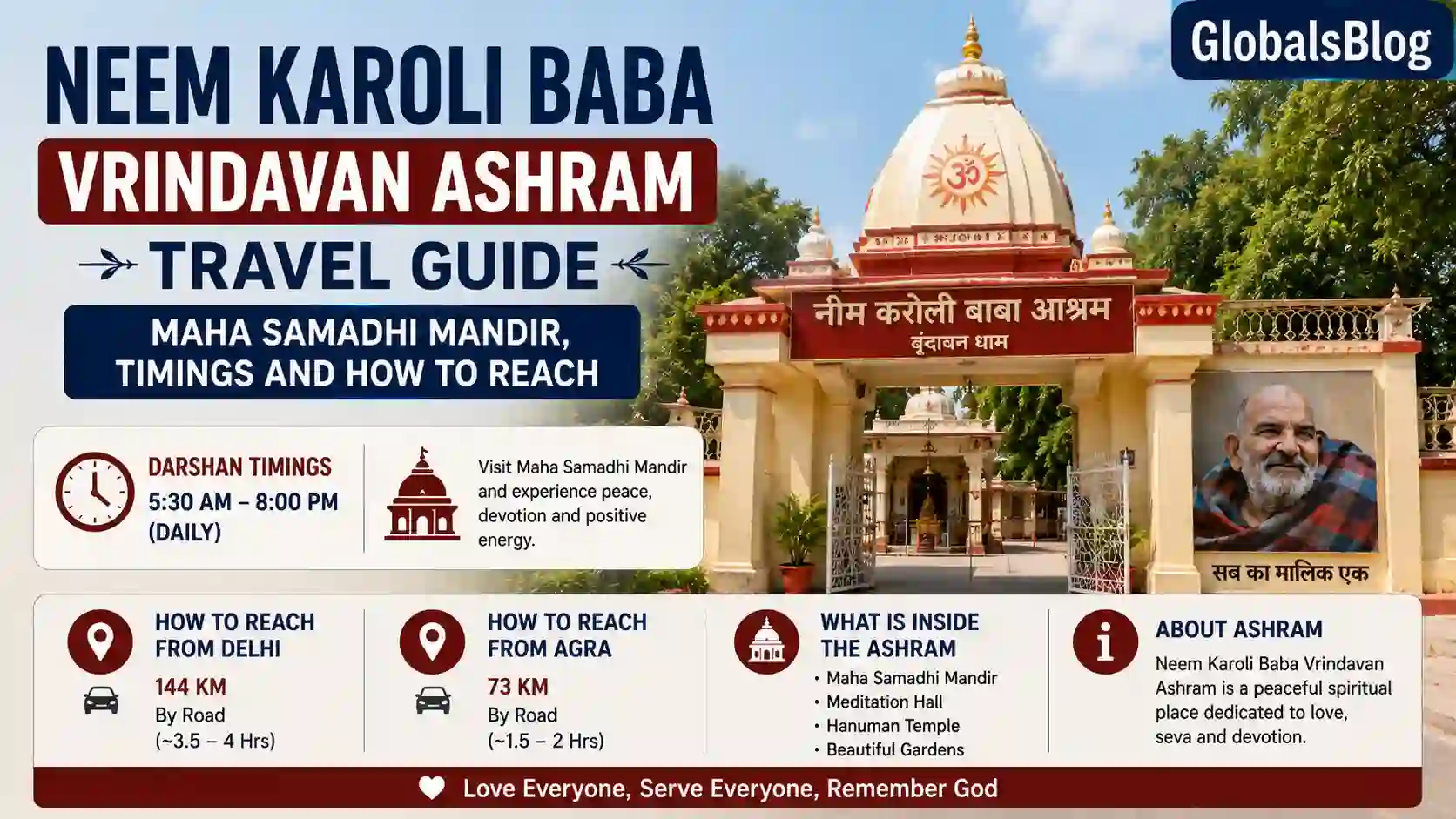
Vrindavan is where Neem Karoli Baba chose to spend his final days — and where, on September 11, 1973, Maharaj Ji left his body. The ashram on Baba Neem Karori Marg is quieter than Kainchi Dham, more inward, more meditative. Where Kainchi is alive with pilgrims and the sound of the Kosi River, Vrindavan holds the stillness of completion. The Maha Samadhi Mandir — where Baba's body rests — is the spiritual heart of the ashram and the most sacred Neem Karoli Baba site in all of North India.
A devotee from Bengaluru had visited Kainchi Dham twice and felt, both times, that something remained unfinished. A senior devotee at the ashram told her: "Kainchi is where Maharaj Ji lived. Vrindavan is where he completed everything." She drove from Agra (73km) to Vrindavan on her next trip — not planning it, just going — and found the Samadhi Mandir at the back of the ashram compound. She sat for forty minutes. She described the experience afterward as the most complete silence she had encountered at any spiritual site in India — not the silence of emptiness but the silence of something fully present. This guide covers the Vrindavan Ashram in full: what is inside, how to reach it, how to combine it with Kainchi Dham and the broader Neem Karoli Baba pilgrimage circuit, and what makes this quieter ashram essential to any genuine Maharaj Ji visit.
Neem Karoli Baba Vrindavan Ashram essentials: Address — Baba Neem Karori Marg, Atalla Chungi Road, Vrindavan, Uttar Pradesh. Darshan timings — 5:30am–12pm and 4pm–8pm. Morning aarti at 6am. Entry free. How to reach — from Delhi 144km (3–4 hrs via Yamuna Expressway → Mathura → Vrindavan 11km). From Agra 73km (1.5 hrs). Train to Mathura Junction then auto/e-rickshaw to Vrindavan (11km, ₹50–100). What's inside — Hanuman Ji Temple (1968), Maha Samadhi Mandir (where Baba rests), Vrindavaneshwari Maa Temple, Kirtan Hall, Ram Darbar Temple, Gaushala. This is where Neem Karoli Baba died on September 11, 1973. The Samadhi Mandir is the most meditative and sacred Neem Karoli Baba site in India. Combine with Kainchi Dham for the complete pilgrimage — see our full circuit guide.
Why the Vrindavan Ashram Matters — The Story Behind It
Neem Karoli Baba spent much of his life moving between his ashrams across North India — Kainchi Dham in Uttarakhand, the Lucknow Ashram, Bhumiyadhar, and Vrindavan. He chose Vrindavan, the sacred town of Lord Krishna on the banks of the Yamuna, as the place of his final residence. On September 11, 1973, he went into Maha Samadhi here — the yogi's conscious departure from the body. His body was interred at the Vrindavan Ashram, and the Maha Samadhi Mandir built over the site has since become the most sacred Neem Karoli Baba location in all of India.
The Vrindavan Ashram was established in the late 1960s by devotees under Maharaj Ji's guidance. The Hanuman Ji temple was constructed in 1968 by devotee Sri Mangatu Ram Jaipuriya in memory of his brother. The Kirtan Hall was built in 1970. The Maha Samadhi Mandir was completed after Maharaj Ji's passing. Today the ashram functions as a living centre of daily worship — morning aarti, Hanuman Chalisa recitation, bhajans, and the quiet sitting of devotees who come from across the world to be near Maharaj Ji's samadhi.
The character of the Vrindavan Ashram is markedly different from Kainchi Dham. Kainchi is kinetic — pilgrims moving, the river sound, the mountain air, the crowd energy of a major devotional destination. Vrindavan is inward — the ashram sits in a lane off the Parikrama Marg, the surrounding streets full of the sounds of Vrindavan's Krishna temples, but inside the compound there is a meditative stillness that devotees consistently describe as Maharaj Ji's most concentrated presence. For the complete Neem Karoli Baba pilgrimage circuit, Vrindavan is the essential second stop after Kainchi Dham.
What Is Inside the Vrindavan Ashram
The Maha Samadhi Mandir is the heart of the Vrindavan Ashram — the shrine built over the place where Neem Karoli Baba's body was interred after his Maha Samadhi on September 11, 1973. The mandir is not architecturally grand — it is intentionally simple, in keeping with Maharaj Ji's own indifference to display and ceremony. What devotees experience here is not defined by the architecture but by the atmosphere: many visitors describe sitting in the Samadhi Mandir as the most complete stillness they have found at any spiritual site in India. Devotees offer flowers, light diyas, chant Ram Naam softly, and sit in silence. Many report that the experience begins when they stop trying to make something happen and simply sit. The Bengaluru devotee's forty minutes of silence was typical of what regular visitors describe. The Maha Samadhi Mandir is open during the ashram's morning and evening darshan hours.
The Hanuman Ji Temple was constructed in 1968 by devotee Sri Mangatu Ram Jaipuriya in memory of his brother — during Maharaj Ji's own lifetime and under his direct blessing. The temple houses a significant Hanuman murti (the idol, brought from Jaipur, was found broken on arrival at Vrindavan but restored miraculously according to ashram accounts — a story that deepened its sacred significance for devotees). Daily puja is conducted at the Hanuman temple, with morning aarti at approximately 6am and evening aarti around 7pm. The Hanuman Chalisa is recited daily. The temple is the most active part of the ashram for regular devotional life — while the Samadhi Mandir holds the contemplative energy, the Hanuman temple holds the devotional energy. Both are essential to the full Vrindavan Ashram experience.
The ashram complex holds several other spaces beyond the Samadhi Mandir and Hanuman temple. The Kirtan Hall (built 1970, adjacent to the Hanuman Mandir) was constructed because Maharaj Ji was deeply fond of kirtan — devotional singing — and encouraged devotees to participate. The Kirtan Hall hosts daily bhajans and occasional extended kirtan sessions that carry on into the evening. The Ram Darbar Temple (pranpratishtha 1996 in the Kirtan Hall) enshrines Ram, Sita, Lakshman, and Hanuman together — a complete devotional space for the Ramayana tradition that Maharaj Ji revered. The Vrindavaneshwari Maa Temple was also established within the compound. The Gaushala (cow sanctuary) reflects Maharaj Ji's reverence for gau mata — cow service was one of the sacred practices he upheld across all his ashrams. Visitors who wish to do seva (service) at the ashram can participate in Gaushala activities during their visit by arranging with the ashram management.
Darshan Timings and Ashram Rules
| Session | Timings | Key Activity |
|---|---|---|
| Morning darshan | 5:30am – 12:00pm | Morning aarti (~6am), Hanuman Chalisa, Samadhi Mandir open, quiet sitting |
| Afternoon break | 12:00pm – 4:00pm | Ashram closed for visitors — midday rest period |
| Evening darshan | 4:00pm – 8:00pm | Evening aarti (~7pm), bhajans in Kirtan Hall, Samadhi Mandir open |
Rules at the Vrindavan Ashram: Entry is free. Remove shoes before entering the main temple and Samadhi Mandir areas. Modest dress — no shorts, no sleeveless. The Samadhi Mandir is a place of deep reverence — maintain silence, speak softly, do not use phones near the samadhi. Photography is restricted inside — observe signage and use judgement near devotees in prayer. The ashram is open to all — Hindu and non-Hindu, devotee and curious visitor. Maharaj Ji's teaching of "Love all" extended to his ashrams: there is no restriction by faith or background.
How to Reach Neem Karoli Baba Vrindavan Ashram
| Mode | From | Distance | Duration | Cost | Notes |
|---|---|---|---|---|---|
| Road (self-drive/cab) | Delhi | 144km | 3–4 hrs | ₹1,500–2,500 cab one-way | Via Yamuna Expressway → Mathura → Vrindavan (11km). Most comfortable |
| Train + auto | Delhi | Train to Mathura + 11km | 2.5–3 hrs train + 30 min | ₹150–600 train + ₹50–100 auto | Multiple trains Delhi → Mathura Junction daily. Auto/e-rickshaw to Vrindavan ashram |
| Road | Agra | 73km | 1.5 hrs | ₹800–1,200 cab | Natural pairing — Agra day trip + Vrindavan Ashram. See our Agra guide |
| Road | Mathura | 11km | 20–30 min | ₹50–100 auto / ₹150–200 cab | Mathura is the nearest city — auto-rickshaws and e-rickshaws run frequently |
| Bus | Delhi ISBT Kashmere Gate | ~150km | 3–4 hrs | ₹150–300 | UP Roadways / private buses to Mathura, then local transport to Vrindavan |
From Delhi by Road — The Yamuna Expressway Route
Delhi to Vrindavan via the Yamuna Expressway is the most time-efficient approach — 144km, approximately 3–3.5 hours in moderate traffic. Take the Yamuna Expressway south from Noida, exit at Mathura, and continue 11km to Vrindavan. The ashram is on Baba Neem Karori Marg, off Atalla Chungi Road — use Google Maps with "Neem Karoli Baba Ashram Vrindavan" for navigation (the ashram is well-known locally and drivers know it by name). Vrindavan's inner lanes are narrow and busy — park on the main road and walk the last 200–300 metres to the ashram entrance.
From Delhi by Train
Multiple trains run daily from Delhi (Hazrat Nizamuddin, New Delhi, or Old Delhi station) to Mathura Junction (MTJ). Journey time: 1.5–2.5 hours depending on train. From Mathura Junction, Vrindavan is 11km — auto-rickshaws charge ₹60–100, shared e-rickshaws ₹20–30 per person, and prepaid taxis ₹150–200. The Mathura–Vrindavan passenger train also operates (approximately 30 minutes, ₹5–10). The Neem Karoli Baba Ashram is known to all local auto drivers in Vrindavan — ask directly for "Maharajji ka ashram" or "Neem Karoli Baba Ashram" and you will be taken there without any navigation.
From Agra — Natural One-Day Circuit
Agra is 73km from Vrindavan — making the combination of Taj Mahal (Agra) and Neem Karoli Baba Ashram (Vrindavan) a completely practical single-day itinerary from Delhi. Morning: Taj Mahal at Agra (arrive by 7am, leave by 10am). Then drive Agra → Vrindavan (73km, 1.5 hrs via Mathura). Vrindavan Ashram afternoon darshan (4pm–8pm). Return Delhi via Yamuna Expressway. Total driving from Delhi: approximately 350km in a day — ambitious but achievable. See our Agra travel guide for the complete Taj Mahal and Agra visit plan.
Combining Vrindavan Ashram with the Full Neem Karoli Baba Circuit
The Vrindavan Ashram is the second essential stop on the Neem Karoli Baba pilgrimage — the first being Kainchi Dham in Uttarakhand (the main ashram, 330km from Delhi), and the third being Akbarpur in Uttar Pradesh (his birthplace village). Together these three stops form a complete Neem Karoli Baba pilgrimage:
| Stop | Location | Significance | Distance from Delhi | Days |
|---|---|---|---|---|
| Kainchi Dham | Nainital, Uttarakhand | Main ashram — where Maharaj Ji lived and built the central Hanuman temple (1964) | 330km | 1–2 days |
| Vrindavan Ashram | Vrindavan, UP | Final ashram — where Maharaj Ji died (Sept 11, 1973) and where his Samadhi Mandir rests | 144km | Half–1 day |
| Akbarpur | Ambedkar Nagar, UP | Birthplace — where Maharaj Ji was born as Lakshman Narayan Sharma (~1900) | 640km | Half day (combine with Ayodhya) |
See our complete Neem Karoli Baba pilgrimage guide for the full 5-day circuit plan, suggested routes, and how to combine all three stops efficiently from Delhi.
What to Do in Vrindavan Beyond the Ashram
Vrindavan is one of India's most sacred Krishna pilgrimage towns — the ashram sits within a city of hundreds of temples, ghats, and sacred sites connected to Lord Krishna's life. After the Neem Karoli Baba Ashram darshan, the following are natural extensions within walking or short auto distance:
Prem Mandir (1km from the ashram) — a large marble temple of spectacular architecture dedicated to Radha-Krishna and Ram-Sita, built by Jagadguru Kripaluji Maharaj. The evening light-and-music show at Prem Mandir is one of Vrindavan's most-attended attractions. ISKCON Vrindavan (2km) — the International Society for Krishna Consciousness temple, where foreign and Indian devotees chant together in the kirtan hall and communal prasadam is served. Banke Bihari Mandir (500m from the ashram) — one of Vrindavan's oldest and most crowded temples, with the characteristic curtain-drawing darshan where the deity is revealed and concealed repeatedly. Nidhivan and Seva Kunj — sacred forest groves where Krishna is believed to have performed the Raas Leela with the gopis; preserved as pilgrimage sites with ancient trees and a quiet, charged atmosphere. All these sites are within 2–3km of the Neem Karoli Baba Ashram and can be covered in a half-day of Vrindavan darshan.
✓ Vrindavan Ashram Practical Tips
- Morning darshan is more peaceful than evening: The Vrindavan Ashram's morning session (5:30am–12pm) is attended primarily by regular devotees — locals, long-term seekers, and pilgrims who plan specifically around the morning aarti. The ashram is at its most undisturbed between 6am and 9am. The evening session (4pm–8pm) sees more one-time visitors, tourists combining with Prem Mandir, and group visits. For sitting in the Samadhi Mandir without disturbance, the morning session is strongly recommended
- Come before or after the Vrindavan crowds — not during peak temple hours: Vrindavan's main temples (Banke Bihari, Prem Mandir) generate significant foot traffic on weekends and during Krishna Janmashtami (August), Holi, and other festivals. The Neem Karoli Baba Ashram is somewhat quieter than the main Vrindavan temples, but arriving on a festival weekend will mean the surrounding streets are congested. Weekday visits are significantly more peaceful. If visiting on a weekend: arrive at the ashram by 7am before the crowd builds, complete your darshan, and explore the other temples later in the morning
- Combine with Agra if travelling from Delhi: At 73km from Agra, Vrindavan makes a practical extension of a Taj Mahal trip. Most visitors to Agra drive or take the train from Delhi — continuing to Vrindavan (73km further north via Mathura) adds a meaningful spiritual dimension to the heritage trip. See our Agra guide for timing the Taj visit correctly so the Vrindavan afternoon works
- The auto-rickshaw driver outside Mathura station knows every ashram: Vrindavan is a pilgrimage city — every auto and e-rickshaw driver outside Mathura Junction knows "Maharajji ka ashram" immediately. You do not need the full address or Google Maps for the last leg. Tell the driver "Neem Karoli Baba Ashram, Vrindavan" and he will take you directly. Negotiate the fare before boarding — ₹60–100 from station to ashram is standard
- For the Kainchi Dham side of the pilgrimage — the main ashram in Uttarakhand — see our Kainchi Dham complete guide with timings, the Bhandara, and how to reach from Delhi by train and road
✗ Vrindavan Ashram Mistakes to Avoid
- Arriving during the afternoon break (12pm–4pm) and finding the ashram closed: The Vrindavan Ashram closes for a midday break from 12pm to 4pm — a standard practice at many traditional Hindu ashrams. Visitors who plan to visit Vrindavan in the afternoon should time arrival for 4pm or later. Arriving at 2pm to find the gates closed and having to wait two hours in Vrindavan's summer heat is entirely avoidable with this knowledge. Plan your Agra–Vrindavan itinerary accordingly: if leaving Agra after lunch, you will arrive in Vrindavan just as the afternoon session opens — this actually works perfectly
- Rushing the Samadhi Mandir to catch a temple tour schedule: Tour operators who include the Neem Karoli Baba Ashram as one item on a multi-temple Vrindavan day tour typically allocate 20–30 minutes for the entire ashram. This is insufficient to experience the Samadhi Mandir — the central reason most Maharaj Ji devotees make the Vrindavan trip. If the Samadhi Mandir is your primary purpose, allocate the ashram the first and longest slot of your Vrindavan visit. Sit for at least 30–40 minutes. The Banke Bihari and Prem Mandir darshans can be done quickly; the Samadhi Mandir cannot be properly experienced on a schedule
- Treating Vrindavan as a full Neem Karoli Baba pilgrimage without Kainchi: The Vrindavan Ashram is where Maharaj Ji's body rests — essential for any serious devotee. But Kainchi Dham in Uttarakhand is where he lived, built, taught, fed thousands, and where his living energy is most concentrated. The Vrindavan Ashram holds the stillness of completion; Kainchi holds the energy of life. Visiting only one and not the other means missing a fundamental dimension of the Maharaj Ji experience. See our complete pilgrimage circuit guide for the plan that covers both
- Skipping the ashram and only visiting Prem Mandir: Many day-trippers from Delhi plan a "Vrindavan trip" meaning Prem Mandir and Banke Bihari — and are not aware of the Neem Karoli Baba Ashram. After watching Hanuman Ansh (2026), many people search specifically for Vrindavan Ashram but end up at Prem Mandir when they cannot locate the NKB ashram. The ashram is on Baba Neem Karori Marg, off Atalla Chungi Road — your navigation should show "Neem Karoli Baba Ashram Vrindavan" specifically, not just "Vrindavan temple"
⚠️ Disclaimer: Neem Karoli Baba Vrindavan Ashram timings and rules are subject to change on festival days, Ekadashi, and special occasions. All information is accurate as of September 2026. Verify current timings before travelling. The ashram is a functioning place of active religious practice — visitor conduct should reflect this at all times. Entry is free; donations to the ashram trust are voluntary and support the langar, Gaushala, and maintenance of the sacred spaces.
Kainchi Is Where Maharaj Ji Lived. Vrindavan Is Where He Completed Everything. The Maha Samadhi Mandir at 5:30am. Morning Aarti at the Hanuman Temple. Forty Minutes of Silence. 144km from Delhi. The Pilgrimage That Needs Both.
The Bengaluru devotee who sat for forty minutes in the Maha Samadhi Mandir was not doing anything remarkable — she was doing exactly what thousands of devotees do every week in this quiet compound off the Parikrama Marg. The Vrindavan Ashram does not need to be dramatic. It is the place where Neem Karoli Baba chose to complete his life — not in the hills he loved at Kainchi, not in the plains where he wandered as a sadhu, but in Vrindavan, the land of Krishna, where the sacred and the everyday have been inseparable for three thousand years. The Samadhi Mandir holds whatever it holds. What the Bengaluru devotee described — the silence that is not emptiness — is the most honest account available. Come, sit, and find out for yourself.
Neem Karoli Baba Ashram in Vrindavan is located at Baba Neem Karori Marg, Atalla Chungi Road, Vrindavan, Uttar Pradesh. The ashram is within the Vrindavan town area, close to the Parikrama Marg (the circumambulation road around Vrindavan). It is approximately 500 metres from Banke Bihari Mandir and within 2–3km of Prem Mandir and ISKCON Vrindavan. From Mathura Junction (11km), auto-rickshaws and e-rickshaws go directly to the ashram — ask for "Maharajji ka ashram" or "Neem Karoli Baba Ashram" and all local drivers know it. For navigation: search "Neem Karoli Baba Ashram Vrindavan" on Google Maps for the exact pin. The ashram is not prominently signposted from the main road — it sits in a lane, and local guidance or navigation is recommended for first-time visitors.
Neem Karoli Baba Vrindavan Ashram darshan timings (2026): Morning session — 5:30am to 12:00pm. Afternoon break — 12:00pm to 4:00pm (ashram closed). Evening session — 4:00pm to 8:00pm. Morning aarti at approximately 6:00am. Evening aarti at approximately 7:00pm. Hanuman Chalisa is recited daily at the Hanuman Ji Temple. The Maha Samadhi Mandir is open during both the morning and evening darshan sessions. Entry is free. No entry fee for any part of the ashram. Timings may vary on major festivals — verify before travelling. The ashram is open daily throughout the year. Morning session (5:30am–12pm) is recommended for the most peaceful visit, particularly for time at the Maha Samadhi Mandir.
How to reach Neem Karoli Baba Ashram Vrindavan from Delhi: By road (recommended) — Delhi to Vrindavan is 144km via the Yamuna Expressway. Take the expressway south from Noida/Delhi, exit at Mathura, then continue 11km to Vrindavan. Drive time: 3–3.5 hours in moderate traffic. Cab one-way: ₹1,500–2,500. By train — multiple trains run daily from Delhi (Hazrat Nizamuddin or New Delhi station) to Mathura Junction (1.5–2.5 hours, ₹150–600 depending on class and train). From Mathura Junction, auto-rickshaw to Vrindavan ₹60–100, shared e-rickshaw ₹20–30. By bus — UP Roadways and private buses from Delhi ISBT Kashmere Gate to Mathura (3–4 hours, ₹150–300), then auto to Vrindavan. Combined Agra trip: Vrindavan is 73km from Agra — combine Taj Mahal (morning) with NKB Ashram darshan (afternoon) as a day trip from Delhi. Total Delhi-Agra-Vrindavan-Delhi circuit: approximately 450km, entirely practical in one day with early start.
Neem Karoli Baba chose Vrindavan as his final residence and entered Maha Samadhi — the yogi's conscious departure from the body — on September 11, 1973. His devotees believe the choice of Vrindavan was deliberate and spiritually significant: Vrindavan is the most sacred site in the Vaishnava tradition, associated with Lord Krishna's presence, and considered by devotees as a place where the boundary between the divine and the earthly is thinnest. Neem Karoli Baba, though primarily a Hanuman devotee, revered the entire Vaishnava tradition deeply. His physical samadhi at the Vrindavan Ashram is now enshrined in the Maha Samadhi Mandir, which has become the primary pilgrimage point for his devotees worldwide. Many of his closest devotees describe Vrindavan as where Maharaj Ji "completed" his earthly mission — hence the character of the Vrindavan Ashram being more meditative and inward than the active, living energy of Kainchi Dham.
Yes — the Neem Karoli Baba Vrindavan Ashram is open to visitors of all faiths and backgrounds. Neem Karoli Baba's teaching of "Love everyone, serve everyone" extended explicitly to his ashrams: there was no restriction by religion, caste, nationality, or background in his lifetime, and this principle continues at his ashrams. Western devotees have been part of the Neem Karoli Baba community since the 1960s and 70s — Ram Dass, the American spiritual teacher who brought Maharaj Ji's teachings to the West through the book Be Here Now, was among his closest disciples. The ashram today receives Indian and international visitors regularly. Conduct yourself with the respect appropriate to any active place of worship — modest dress, quiet speech, no shoes in the temple areas, no photography in the Samadhi Mandir — and you are entirely welcome.
The Maha Samadhi Mandir at the Neem Karoli Baba Vrindavan Ashram is the shrine built over the site where Neem Karoli Baba's body was interred after his Maha Samadhi (conscious departure from the body) on September 11, 1973. In the Hindu tradition, the samadhi of a realized saint is treated as a living sacred site — the saint's presence is believed to remain accessible at the samadhi, and devotees visit to receive blessings, offer flowers, chant, and sit in meditation. The Maha Samadhi Mandir is the spiritual heart of the Vrindavan Ashram and the most sacred Neem Karoli Baba site in India. It is open during the ashram's morning (5:30am–12pm) and evening (4pm–8pm) darshan sessions. Entry is free. The experience is one of profound quiet — many visitors describe it as unlike any other spiritual site they have visited, characterized by a stillness that devotees interpret as Maharaj Ji's living presence.
Leave a comment
Share a quick thought about this story.
Thanks for sharing your view. It is ready for review.
Please try again in a moment.