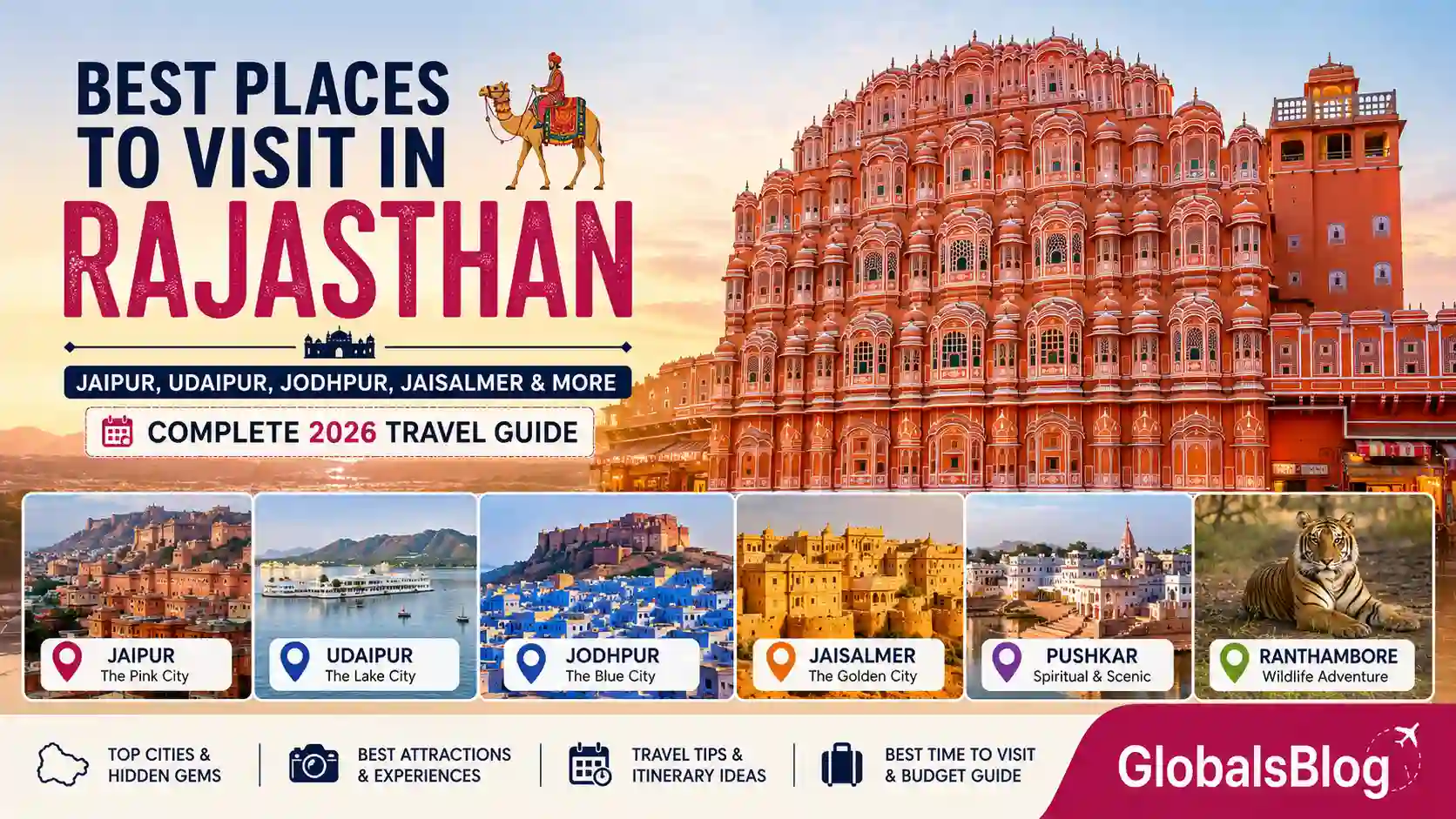
Rajasthan has six UNESCO World Heritage forts, the world's most romantic lake city, the Thar Desert at its most golden, and a Pink City founded on a 300-year-old grid. No Indian state rewards travellers more generously.
A traveller who has seen Rajasthan described it as "the India everyone imagines before they arrive — and then the India that exceeds even that." Rajasthan, India's largest state by area, is a legendary travel destination. It boasts imposing forts, opulent palaces, vibrantly painted havelis, the stark Thar Desert, and four storied cities each defined by a distinct colour: pink Jaipur, white Udaipur, blue Jodhpur, and golden Jaisalmer. The Rajput dynasties, rulers for over a thousand years, created one of the world's densest concentrations of fortified architecture, with six hill forts jointly inscribed on UNESCO's World Heritage List. Jaipur's walled old city is a UNESCO World Heritage Site, home to some of India's finest architecture and most vibrant street markets. This guide covers Rajasthan's best destinations by region — from the iconic to the undervisited — and the classic circuit that connects them.
The best places to visit in Rajasthan are Jaipur (Pink City — Amber Fort, Hawa Mahal, UNESCO walled city), Udaipur (Lake Pichola, City Palace, most romantic city in India), Jodhpur (Mehrangarh Fort, Blue City, best food), Jaisalmer (Golden Fort, desert camp, camel safari), Pushkar (only Brahma temple in world, camel fair), Ranthambore (best tiger reserve in India), Kumbhalgarh (world's second-longest fort wall), and Bundi (hidden gem — murals, step-wells, no crowds). The classic circuit connects Jaipur, Pushkar, Udaipur, Jodhpur, and Jaisalmer over 10–14 days, with optional forays to Ranthambore and Kumbhalgarh. Best time: October–March.
Best Places in Rajasthan — By Region
Jaipur is where most Rajasthan journeys begin — the state capital is a dizzying blend of Mughal and Rajput grandeur, alive with colour, commerce, and centuries of royal history. Founded in 1727 by Maharaja Jai Singh II, the city was designed on a precise grid system and painted a distinctive terracotta pink for the visit of Prince Albert in 1876 — a tradition that has never faded. Today, Jaipur's walled old city is a UNESCO World Heritage Site. Amber Fort (12 km from the city) is the crown jewel — a hilltop complex of courtyards, mirrored halls, and elephant gateways overlooking Maota Lake. The Hawa Mahal (Palace of Winds) — 953 small windows on a five-storey façade designed to allow royal women to observe street life — is Rajasthan's most photographed single image. Jantar Mantar (UNESCO) is the world''s largest stone astronomical observatory, built in 1734, still accurate today. The old city''s bazaars (Johari Bazaar for gems, Bapu Bazaar for textiles, Nehru Bazaar for shoes) are the finest market streets in Rajasthan. Jaipur is famous for blue pottery, gemstones, and block prints.
Shekhawati is Rajasthan''s most undervisited major attraction — a semi-arid region in northern Rajasthan where 18th and 19th-century merchant families (Marwaris) built elaborately frescoed havelis (mansion residences) covering every surface in mythological, historical, and quotidian scenes. The villages of Mandawa, Nawalgarh, Fatehpur, and Jhunjhunu collectively form one of the world's most remarkable concentrations of outdoor frescoes — paintings in a state of beautiful decay, discovered in courtyards, stairwells, and façades by visitors with no other tourist in sight. Mandawa''s castle-hotel (now the Castle Mandawa heritage hotel) is one of Rajasthan''s finest heritage stays. The Shekhawati experience is essentially "Rajasthan before the tourists arrived" — no entrance lines, no tour groups, genuine immersion in an architectural tradition that exists nowhere else. A two-day Shekhawati loop from Jaipur (150 km) is one of Rajasthan''s most rewarding detours.
Udaipur is one of the most romantic destinations in Rajasthan. Surrounded by lakes and hills, the city offers breathtaking views and peaceful surroundings. Boat rides on Lake Pichola during sunset are one of the most memorable experiences in Udaipur. The city is also known for luxury hotels and royal hospitality. Udaipur''s City Palace — the largest palace complex in Rajasthan, built over four centuries by 22 successive Mewar rulers — rises from the Lake Pichola shoreline in a layered cascade of balconies, towers, and courtyards. The Lake Palace Hotel (now a Taj property) sits on an island in Lake Pichola — one of the world''s most famous hotel locations. The old city''s narrow lanes, lined with galleries, rooftop cafés, and haveli guesthouses, produce the most consistently pleasant city wandering in Rajasthan. The Monsoon Palace (Sajjan Garh) at sunset — 3 km from the city — gives a panoramic view of the entire Udaipur bowl of lakes that is the finest evening viewpoint in the state. Udaipur is famous for miniature paintings.
Kumbhalgarh is the most impressive UNESCO fort in Rajasthan that most visitors skip in favour of Amber and Mehrangarh. The fort''s defensive wall stretches 36 km — the second-longest continuous wall in the world after the Great Wall of China — enclosing 360 temples, several palaces, and an entire ecosystem of villages within its perimeter. The fort was built in the 15th century by Rana Kumbha and is the birthplace of Maharana Pratap, Rajasthan''s most celebrated warrior king. The approach road through the Aravalli hills is some of the finest driving in the state. Kumbhalgarh is 84 km from Udaipur — combining it with the Ranakpur Jain temples (45 km away, five intricate white marble temples built on 1,444 pillars) makes one of Rajasthan''s finest single-day circuits. The Kumbhalgarh Wildlife Sanctuary surrounding the fort has leopards, wolves, and sloth bears — a dawn safari around the fort walls is exceptional.
Jodhpur is known for its blue-painted houses, grand forts, and royal culture. The city offers a perfect mix of history and local traditions. Mehrangarh Fort is one of the largest and most impressive forts in India, offering panoramic views of the city. Mehrangarh sits on a 125-metre rock outcrop above Jodhpur — the most imposing fort silhouette in Rajasthan, possibly in India. The museum inside is the finest royal collection in the state. The view from the fort''s ramparts over the blue-painted Brahmin quarter below — houses painted indigo to repel insects and identify caste, a 400-year tradition now perpetuated for beauty — is the defining Rajasthan image. Jodhpur''s food scene is the strongest in the state: mirchi bada (chilli pakoras), mawa kachori, dal baati churma, and the original "made in Jodhpur" jodhpuri jacket all originated here. Jodhpur is famous for furniture and bandhej (tie dye). The Umaid Bhawan Palace (part museum, part hotel, part royal residence) is one of the world''s most elegant palace hotels.
Located in the heart of the Thar Desert, Jaisalmer is famous for its golden sandstone architecture and desert experiences. Camel safaris, jeep safaris, folk dance performances, and desert camping make Jaisalmer one of the best places to visit in Rajasthan for adventure lovers. Jaisalmer Fort is one of the world''s few remaining "living forts" — approximately 3,000 people live within its walls, in a community that has been continuously inhabited for 800 years. The Patwon ki Haveli (cluster of five interconnected havelis) and Salim Singh ki Haveli are the finest examples of Jaisalmer''s golden sandstone jali (lattice) craftsmanship. The desert experience at the Sam Sand Dunes or the quieter Khuri dunes (35 km from Jaisalmer) — overnight in a luxury desert camp, camel safari at sunrise, Rajasthani folk music and dance around a fire — is the quintessential Rajasthan experience that no other destination replicates. Jaisalmer is famous for embroidery and leatherwork.
Ranthambore National Park is India''s most famous tiger reserve — and the one with the highest probability of tiger sightings in the subcontinent. Ranthambore is one of India''s most popular wildlife destinations, famous for tiger sightings and jungle safaris. Wildlife enthusiasts from across the world visit Ranthambore for safari experiences and photography. The unique feature that makes Ranthambore extraordinary is the 10th-century Ranthambore Fort (itself a UNESCO World Heritage site as one of Rajasthan''s six hill forts) within the park boundaries — tigers have been photographed inside the fort''s ruins, producing images of natural and historical heritage in a single frame. Two safari slots daily (morning and evening, approximately 3 hours each). Zone allocation is by lottery — Zone 3, 4, and 5 have the highest tiger sighting frequency. Book safaris online at the Rajasthan Tourism website at least 3–4 weeks ahead in peak season (November–February).
Bundi is a captivating destination that many tourists overlook. This small town was once the capital of a major Rajput state and remains largely untouched by modern development. The town is famous for its sublime palace, which Rudyard Kipling described as ''the work of goblins rather than of men.'' Inside, you'll find beautiful murals that showcase the region's rich artistic heritage. Bundi''s Taragarh Fort, the Garh Palace (Chitra Shala — a room of extraordinary Bundi-school murals depicting Krishna Leela on indigo walls), and 50+ step-wells (baoris) scattered across the old town make it the most complete example of a pre-tourist Rajasthan town. The town is 210 km from Jaipur and 35 km from Kota — most Rajasthan circuits skip it entirely, which is precisely why it retains the atmosphere that cities like Jaipur and Udaipur have partially lost. For travellers who want the Rajasthan of 30 years ago, Bundi is the most accessible answer still available.
Rajasthan''s Colour-Coded Cities — Quick Reference
| City | Nickname | Signature Attraction | Best For | Days |
|---|---|---|---|---|
| Jaipur | Pink City | Amber Fort + UNESCO walled city | Heritage, shopping, architecture | 2–3 |
| Udaipur | White / Lake City | Lake Pichola, City Palace | Romance, lakes, palaces | 2–3 |
| Jodhpur | Blue City | Mehrangarh Fort, blue quarter | Forts, food, dramatic views | 1–2 |
| Jaisalmer | Golden City | Living Fort, desert camp | Desert, adventure, unique culture | 2–3 |
| Pushkar | Holy City | Brahma Temple, Pushkar Lake | Pilgrimage, spirituality, camel fair | 1–2 |
| Bikaner | Camel City | Junagarh Fort, camel research centre | Forts, offbeat desert, cuisine | 1 |
| Ranthambore | Tiger City | Tiger safaris, UNESCO fort | Wildlife, photography | 2 |
| Kumbhalgarh | Fort City | 36km fort wall, wildlife sanctuary | History, trekking, leopards | 1 |
Rajasthan Itinerary — 7 Days and 14 Days
7-Day Rajasthan Itinerary (Classic Golden Triangle + Rajasthan):
Day 1–2: Jaipur — Amber Fort, Hawa Mahal, City Palace, old city bazaars. Day 3: Jaipur to Pushkar (145 km, 3 hours) — Brahma Temple, Pushkar Lake ghats, sunset. Day 4: Pushkar to Udaipur (270 km, 4.5 hours) — afternoon City Palace, evening boat on Lake Pichola. Day 5: Udaipur — Monsoon Palace sunset, old city lanes, miniature painting galleries. Day 6: Udaipur to Jodhpur (260 km, 4 hours) — Mehrangarh Fort, blue city walk at dusk. Day 7: Jodhpur — Umaid Bhawan, Mehrangarh museum, depart.
14-Day Rajasthan Itinerary (Complete Circuit):
Days 1–3: Jaipur (Amber, Hawa Mahal, Jantar Mantar, Nahargarh). Days 4–5: Shekhawati detour (Mandawa, Nawalgarh painted havelis — optional). Day 4 (without Shekhawati): Ranthambore (tiger safari). Days 5–6: Pushkar (Brahma temple, camel fair town, lake ghats). Days 7–9: Udaipur (City Palace, Pichola, Kumbhalgarh + Ranakpur day trip). Days 10–11: Jodhpur (Mehrangarh, blue city, Umaid Bhawan, Osian day trip). Days 12–14: Jaisalmer (living fort, havelis, Sam/Khuri desert camp overnight). Return to Jodhpur or Jaipur for flight.
Pushkar — Rajasthan''s Spiritual Heart
Pushkar is one of the oldest and most sacred towns in Rajasthan — home to the only Brahma Temple in the world. Pushkar''s sacred lake (Pushkar Sarovar) is surrounded by 52 bathing ghats — the evening aarti ceremony here, with oil lamps floating on the lake in the pink Aravalli dusk, is one of Rajasthan''s most quietly beautiful experiences. Pushkar is 11 km from Ajmer (dargah of Khwaja Moinuddin Chishti, India''s most visited Islamic shrine). The Pushkar Camel Fair (November, 5 days around Kartik Purnima full moon) is one of the world''s largest livestock fairs and India''s most extraordinary rural spectacle — 50,000 camels, 200,000 visitors, 400-year-old tradition. Book Pushkar accommodation 2–3 months ahead for the Camel Fair dates. See our November travel guide for timing details on the Pushkar Camel Fair.
Mount Abu — Rajasthan''s Only Hill Station
Mount Abu at 1,220m is Rajasthan''s only hill station — a forested Aravalli plateau that offers genuine cool air when the desert cities below are at 38°C. Nakki Lake is a popular tourist spot surrounded by hills and legends — visitors can enjoy boating, evening walks, and scenic sunset views. Guru Shikhar is the highest peak in Rajasthan, offering breathtaking panoramic views of the Aravalli Range. The Dilwara Jain Temples (11th–13th century) are Mount Abu''s most important attraction — five temples with marble carving of breathtaking intricacy, considered among the finest examples of Jain architecture in India. Mount Abu is 165 km from Udaipur — a viable day trip or one-night addition for travellers doing the south Rajasthan circuit.
Rajasthan Travel Tips
- October–March is the only comfortable time for most of Rajasthan: Temperatures in summer climb above 40°C, reaching 48°C in the desert. Sightseeing is uncomfortable from late morning to evening. The October–March window gives 15–27°C days with cool nights — plan your Rajasthan trip exclusively in this window unless visiting specifically for Mount Abu (pleasant year-round) or monsoon photography
- Book Udaipur and Jaisalmer accommodation 2–3 months ahead: Book accommodation in Udaipur and Jaisalmer two to three months ahead in peak season. The best lake-view heritage guesthouses in Udaipur and the finest desert camps in Jaisalmer fill months before Christmas–New Year
- The overnight train between cities is the most atmospheric Rajasthan transport: The Jaipur–Jodhpur–Jaisalmer overnight train covers desert terrain at night and delivers you at dawn — the correct way to arrive in Jaisalmer, emerging from the train into golden morning light with the fort visible across the desert
- Hire a local guide for Mehrangarh and Amber: Both forts have extraordinary histories that are largely invisible without context — the audio guide (included) is good, a live guide is better. Two hours with a good guide at Mehrangarh produces a different experience from two hours alone
- See our November travel guide and December travel guide for Rajasthan''s peak season timing context, and our February guide for the shoulder season opportunity
Jaipur to Start. Udaipur for the Soul. Jodhpur for the Fort. Jaisalmer for the Desert. Bundi for the Secret. Ranthambore for the Tiger. Kumbhalgarh for the Wall That Goes On Forever.
Rajasthan in 2026 is a perfect blend of heritage, culture, and adventure. Whether you''re exploring royal palaces in Jaipur, enjoying lakeside serenity in Udaipur, or experiencing desert life in Jaisalmer, every destination offers something unique. Plan your journey well, and Rajasthan will reward you with memories that last a lifetime. The classic 10–14 day circuit from Jaipur through Pushkar, Udaipur, Kumbhalgarh, Jodhpur, and Jaisalmer covers the essential Rajasthan in the most logical geographical flow. Add Ranthambore at the start (2 days from Jaipur) for wildlife. Add Bundi (near Kota) if you want the destination that most visitors miss and most repeat visitors consider their finest Rajasthan memory. Shekhawati for the painted havelis that exist nowhere else on earth. October to March — always.
The best places to visit in Rajasthan are Jaipur (Pink City — Amber Fort, Hawa Mahal, UNESCO walled city), Udaipur (City of Lakes — Lake Pichola, City Palace, most romantic city in India), Jodhpur (Blue City — Mehrangarh Fort, best food in Rajasthan), Jaisalmer (Golden City — living fort, desert camp, camel safari in the Thar Desert), Pushkar (only Brahma temple in the world, sacred lake), Ranthambore (India''s most famous tiger reserve), Kumbhalgarh (36km fort wall — world''s second longest after Great Wall of China), and Bundi (hidden gem — murals, step-wells, Rudyard Kipling''s favourite Rajasthan town). The classic circuit connects Jaipur, Pushkar, Udaipur, Jodhpur, and Jaisalmer over 10–14 days.
The best time to visit Rajasthan is October to March when temperatures are 15–27°C — cool and pleasant for fort visits, desert safaris, and city exploration. October and November are the best shoulder months — post-monsoon greenery (even in the desert), Diwali (October/November) and the Pushkar Camel Fair (November), and fewer crowds than December–January peak. December and January are peak season with perfect weather but highest prices and most tourists. February is excellent — warm days, cool nights, fewer tourists than December–January. April to June: temperatures above 40°C, reaching 48°C in Jaisalmer and the desert — only Mount Abu (1,220m) remains comfortable. Monsoon (July–September): Ranthambore closes, some roads flood, but Rajasthan''s forts and palaces look extraordinary against storm skies for those willing to visit.
A minimum of 7 nights covers the essential Rajasthan circuit: Jaipur (2 nights), Pushkar (1 night), Udaipur (2 nights), Jodhpur (1 night). Ten to fourteen nights is the recommended duration for the complete classic circuit adding Jaisalmer (2 nights for the desert camp experience) and Ranthambore (2 nights for tiger safaris). Twenty-one nights covers the full state including Shekhawati, Kumbhalgarh, Mount Abu, Bikaner, and Bundi. Rajasthan''s inter-city distances are significant — Jaipur to Jaisalmer is 575 km (9 hours by road, 14 hours by train). Never rush Rajasthan into fewer than 7 nights — the travel between cities is itself a substantial part of the experience.
Rajasthan is famous for its Rajput forts and palaces (six UNESCO World Heritage hill forts — Amber, Chittorgarh, Kumbhalgarh, Ranthambore, Gagron, and Jaisalmer), the four colour-coded royal cities (Pink Jaipur, White Udaipur, Blue Jodhpur, Golden Jaisalmer), the Thar Desert (India''s largest hot desert with camel safaris and desert camping), tiger safaris at Ranthambore, the Pushkar Camel Fair (November, one of the world''s largest livestock fairs), the Kalbeliya dance (UNESCO Intangible Cultural Heritage), traditional crafts including blue pottery (Jaipur), tie-dye bandhej (Jodhpur), and miniature paintings (Udaipur), and its cuisine — dal baati churma, mirchi bada, mawa kachori, and makhaniya lassi are Rajasthan''s most celebrated dishes.
Reader Experiences