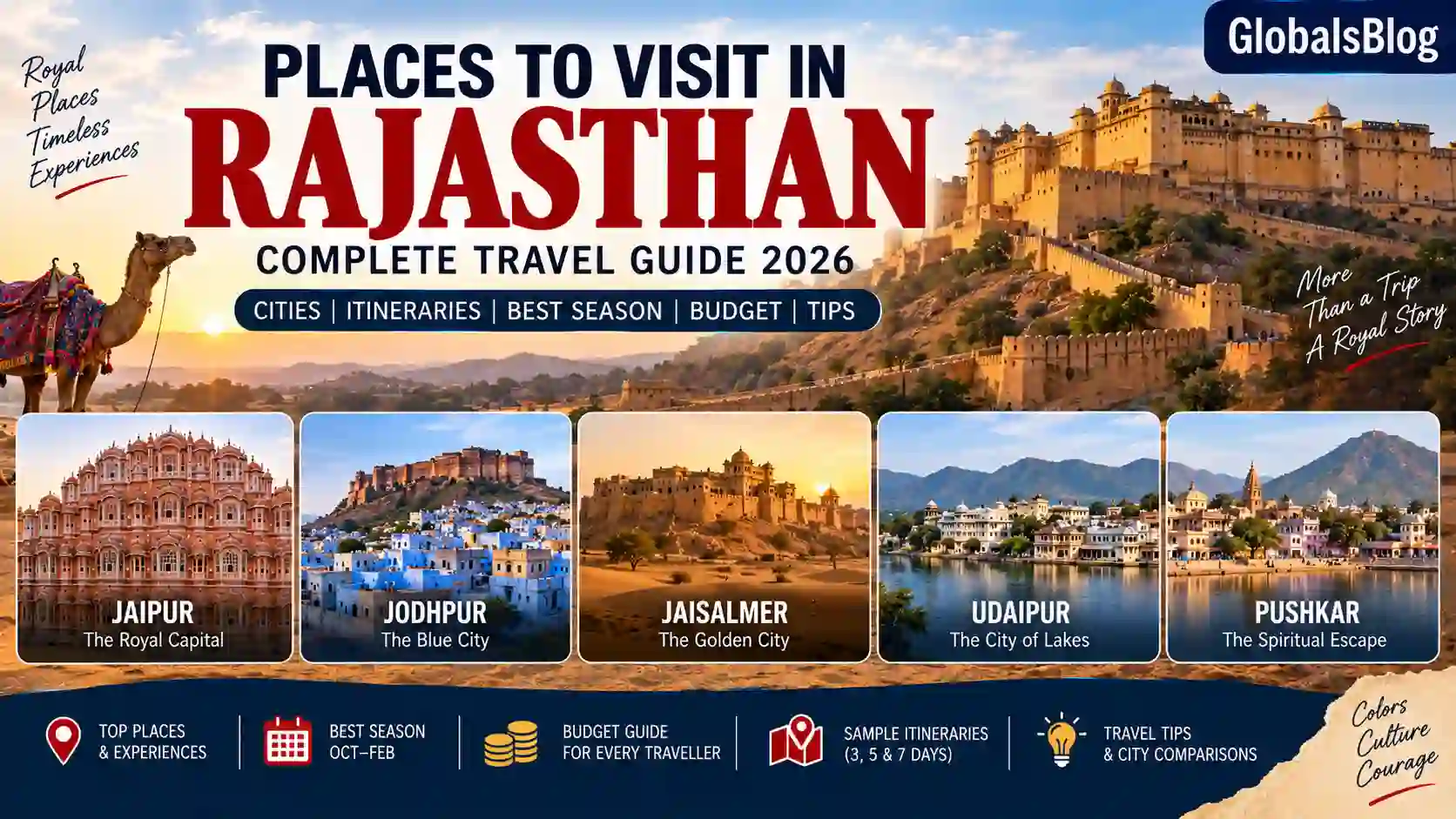
Rajasthan is India's largest state by area and its most cinematically dramatic — a landscape of Thar Desert sand dunes, medieval Rajput forts rising from bare rock, painted havelis in canyon-like bazaar lanes, and lake palaces that float at the centre of still water. No other state concentrates this density of UNESCO sites, living royal culture, and visual spectacle into a single destination. October through February is when all of it is at its best.
A family from Bengaluru spent eleven days in Rajasthan and came back describing it as the most concentrated travel experience they had ever had in India — more different from their daily life than three previous international trips. The father, a sceptic who had agreed only because of family vote, stood at the edge of the Sam Sand Dunes in Jaisalmer at sunset watching a camel silhouette against an orange sky and admitted that he had been wrong about Rajasthan being "too touristy." What they had done differently from most first-time visitors: they had spread the trip across four cities rather than spending the full time in Jaipur and Agra, and they had planned the entire thing for October — the first cool month after Rajasthan's brutal summer and the month when the state begins to come fully alive again after the heat. This guide is the one they wish they had before going.
Best season: October to February — cool, dry, all forts and palaces accessible, desert camps operational. Peak: November–January (most crowded, best weather). Budget: ₹2,500–8,000/person/day depending on accommodation category. Must-visit cities: Jaipur (Pink City, Amber Fort), Jodhpur (Blue City, Mehrangarh Fort), Jaisalmer (Golden City, desert camp), Udaipur (City of Lakes, Lake Pichola). Rajasthan circuit suggestions: Golden Triangle extension (Delhi → Jaipur, 2 days); Western Rajasthan (Jodhpur + Jaisalmer, 4–5 days); Complete Rajasthan (7–10 days covering all four major cities). All forts have entry fees ₹100–600 Indians. Jaisalmer desert camp: ₹3,000–15,000/night depending on category.
Rajasthan by City — Where to Go and Why
Jaipur is Rajasthan's capital and the entry point for most visitors — the first leg of the Golden Triangle circuit (Delhi → Agra → Jaipur) and the state's most accessible city from the rest of India. The old walled city was inscribed as a UNESCO World Heritage Site in 2019 — the entire grid-planned 18th-century urban layout is the heritage, not just individual monuments within it. The Amber Fort (11km outside the city, the finest Rajput fort complex in India — Sheesh Mahal's mirror inlay ceiling, Ganesh Pol's painted facade, the elephant ride or jeep up to the fort gate) requires a full half-day. City Palace (still the royal family residence, museum in the public sections, ₹700 Indians), Jantar Mantar (the 18th-century astronomical observatory that is a UNESCO site in itself — giant stone instruments that still accurately measure celestial positions, ₹200 Indians), Hawa Mahal (the 5-storey honeycomb screen palace designed for royal women to observe street life — best photographed from the opposite building's café, not from the facade side), and Nahargarh Fort (sunset view over Jaipur from the forested hill above the city). The walled city bazaars — Johari Bazaar for jewellery, Bapu Bazaar for textiles, jootis, and blue pottery — are best explored on foot in the morning before traffic peaks. See our detailed Jaipur complete travel guide for the full city breakdown.
Jodhpur's Mehrangarh Fort is, by many accounts, the single most impressive fort in India — rising 125 metres straight out of a rocky outcrop that itself sits above the city, with walls up to 36 metres high and 21 metres thick, and a collection of palace rooms (Moti Mahal, Phool Mahal, Sheesh Mahal — each a distinct jewel of Rajput court architecture) that the fort museum's audio guide covers in detail. The fort is still partially operated by the Jodhpur royal family and its maintenance shows — better preserved and more thoughtfully presented than any other Rajasthan fort. Below the fort, the old city's indigo-painted Brahmin houses create the famous "Blue City" effect — best viewed from the fort's bastions at sunrise, when the blue washes deepest in the early light. Jaswant Thada (the royal cenotaph in white marble, 1km from the fort, ₹50 Indians), Umaid Bhawan Palace (still home to the royal family, hotel in one wing, museum in another — ₹100 Indians for museum), and the Sadar Market clock tower at dusk (the most chaotic and atmospheric bazaar in Rajasthan) complete the Jodhpur circuit. See our Jodhpur complete guide.
Jaisalmer is the farthest and most dramatically rewarding city in Rajasthan — a fort city built entirely in yellow sandstone that glows golden in the desert sun, surrounded by the Thar Desert's sand dunes. Jaisalmer Fort (Sonar Quila — the Golden Fort) is the world's only fully inhabited medieval fort: 4,000 people still live inside the fort walls alongside the temples, havelis, hotels, and restaurants that have grown up within its boundaries over 850 years. The Patwon ki Haveli (a cluster of five adjacent merchant havelis with extraordinarily detailed stonework, ₹100 Indians), Nathmalji ki Haveli, and the 14th-century Jain Temples inside the fort complex are the architectural highlights. Outside the city: Sam Sand Dunes (42km, camel ride at sunset, desert camp overnight — the experience the Bengaluru father described) and Khuri Dunes (55km, quieter and less touristy alternative). The 2026 Pushkar Camel Fair (November, 90km from Jaisalmer circuit) is the natural extension for November visitors. See our Jaisalmer complete guide.
Udaipur is Rajasthan's most romantic city — and India's most photographed lake. Lake Pichola, the 14th-century artificial lake at the city's heart, has the City Palace on one bank (the largest palace complex in Rajasthan, ₹300 Indians — a 400-year accumulation of royal additions that takes 3–4 hours to explore properly), the Lake Palace in the middle (the white marble island palace, now a Taj hotel — worth taking the boat across for lunch even if not staying), and the Jag Mandir island palace on the far bank. The Bagore-ki-Haveli museum on Gangore Ghat (₹100 Indians, the best folk costume and puppet collection in Rajasthan, evening cultural show ₹60) is overlooked by most first-timers and is one of Udaipur's most atmospheric experiences. Saheliyon-ki-Bari (the Garden of Maids, ₹30 Indians, a 18th-century royal garden with fountains), Monsoon Palace (sunset view from the Aravalli hills above the city), and the Shilpgram crafts village (10km outside) complete a 2-day Udaipur circuit. See our Udaipur complete guide.
Pushkar is a small lake town 150km from Jaipur with two distinctions: it has the only major Brahma temple in India (most Hindu temples worship Vishnu, Shiva, or their avatars; Brahma — the creator — has almost no temples, and Pushkar's is the most significant), and it hosts the Pushkar Camel Fair in November (typically the 7th–15th of November 2026) — one of the world's most photographed events and India's most spectacular annual festival gathering, where 50,000+ camels, horses, and cattle are brought to trade alongside a massive cultural fair on the sand dunes at the lake's edge. The fair week requires accommodation booked 4–6 months ahead — tents on the fairground itself are the most atmospheric option (₹8,000–25,000/night during fair week). Outside fair season, Pushkar is a quiet, almost dreamlike small town with the holy Pushkar Lake (sacred Hindu bathing ghats, no leather or non-vegetarian food permitted within the town), the main bazaar (Rajasthani textiles, silver jewellery, and surprisingly good cafe culture left over from the backpacker circuit). See our Pushkar complete guide.
Rajasthan Itineraries — By Duration
| Duration | Cities | Highlights | Best For |
|---|---|---|---|
| 2–3 days | Jaipur only | Amber Fort, City Palace, Jantar Mantar, walled city bazaars | Golden Triangle extension, first-time Rajasthan |
| 4–5 days | Jaipur + Jodhpur | Amber Fort + Mehrangarh Fort + Blue City lanes | Fort-focused heritage trip, photography |
| 5–6 days | Jodhpur + Jaisalmer | Mehrangarh + Sam Sand Dunes + desert camp + Golden Fort | Desert experience, adventure, most dramatic |
| 7–8 days | Jaipur + Jodhpur + Jaisalmer | Complete western Rajasthan — forts + desert | Most popular Rajasthan circuit, good balance |
| 9–10 days | Jaipur + Udaipur + Jodhpur + Jaisalmer | All four major cities — lakes + forts + desert | Comprehensive, all landscapes, families |
| 11+ days | Above + Pushkar + Bikaner + Ranthambore | Complete Rajasthan — adds tiger reserve, camel breeding, holy lake | Serious Rajasthan travellers, Nov Camel Fair |
Best Time to Visit Rajasthan — Month by Month
| Month | Weather | Crowd Level | Verdict |
|---|---|---|---|
| October | 28–35°C, dry, clearing | Low–Medium | ✅ Good — post-monsoon clarity, few tourists, desert camp season starts |
| November | 18–28°C, ideal | Medium–High | 🔴 Best — Pushkar Camel Fair, perfect weather, Rajasthan in full swing |
| December | 12–22°C, cool nights | High (peak) | ✅ Excellent — Christmas–New Year peak, busiest month, book everything early |
| January | 8–18°C, cold nights | Very High | ✅ Excellent — Jaipur Literature Festival (Jan), Bikaner Camel Festival (Jan) |
| February | 15–25°C, pleasant | Medium | ✅ Very Good — Holi (late Feb/Mar), Pushkar winding down, shoulder prices |
| March | 20–32°C, warming | Low | ⚠️ Acceptable — Holi (March 2026), post-festival lull, heat building |
| Apr–Sep | 35–48°C, brutal | Very Low | ❌ Avoid — extreme heat, forts are difficult to explore in 45°C conditions |
How to Get to Rajasthan
| From | To | Best Mode | Duration | Cost |
|---|---|---|---|---|
| Delhi | Jaipur | Road (NH48) or train (Shatabdi / Ajmer Express) | 4.5 hrs road / 4.5 hrs train | ₹150–600 train / ₹200–400 bus |
| Delhi | Jodhpur | Train (Mandore Express overnight) or flight | 11 hrs train / 1.5 hrs flight | ₹400–900 train / ₹1,500–6,000 flight |
| Delhi | Jaisalmer | Train (overnight — Jaisalmer Express) or flight | 18 hrs train / 2 hrs flight | ₹600–1,200 train / ₹2,500–8,000 flight |
| Delhi | Udaipur | Flight (fastest) or Mewar Express (overnight train) | 13 hrs train / 1.5 hrs flight | ₹500–1,000 train / ₹1,500–6,000 flight |
| Mumbai | Udaipur | Flight (cheapest + fastest) or Mewar Express | 1 hr flight / 12 hrs train | ₹1,500–5,000 flight / ₹600–1,000 train |
| Jaipur | Jodhpur | Road (5 hrs, NH62) or overnight train | 5 hrs road | ₹1,200–2,000 cab / ₹250–600 train |
Within Rajasthan: hire a private cab (₹10–15 per km) for inter-city travel — public buses exist but are slow on desert routes. Rajasthan's main cities are connected by train but overnight sleepers are the practical option for the longer stretches (Jodhpur→Jaisalmer, Jodhpur→Udaipur). Intercity road travel in Rajasthan is comfortable — the National Highways are well-maintained and the desert plains make for fast driving once outside city limits.
✓ Rajasthan Travel Tips
- Book forts before arriving — entry tickets at the gate involve queues: All major Rajasthan forts now have online booking options via the ASI portal (Jantar Mantar, Amer Fort) or the Jodhpur/Jaisalmer royal trust websites. Booking ahead eliminates the entry gate queue (which runs 30–90 minutes on peak days in December–January) and confirms your slot for the audio guide. At Amer Fort specifically, the elephant and jeep rides up to the gate also require booking ahead during peak season — walk-ins get the longest waits
- Stay inside a heritage haveli or fort-hotel at least one night: Rajasthan has the best heritage accommodation inventory in India — converted havelis (merchant mansions), royal guest houses within fort compounds (Jaisalmer Fort has several), and palace hotels. The experience of waking up inside a 200-year-old structure is part of the Rajasthan travel value that no modern hotel can replicate. Budget options start at ₹1,200/night (haveli guesthouses in Jaisalmer Fort, Jodhpur's Blue City lanes). Mid-range heritage: ₹3,000–8,000. Premium palace hotels: ₹15,000–50,000
- The desert camp experience at Sam Sand Dunes is genuinely worth doing: The Bengaluru family's Sam Sand Dunes moment was not a tourist trap — the Thar Desert at sunset, the scale of the dunes, the camel silhouette, and the stars after dark (no light pollution in the desert) are experiences that no substitute provides. The ₹3,000–6,000 mid-range desert camp (fixed tents, attached bathroom, dinner, cultural show, morning jeep or camel) is the recommended price point — it includes everything without the inflated premiums of the ₹15,000 luxury camps for what is fundamentally an outdoor desert experience
- Rajasthan in October means fewer crowds and viable prices — November is better weather but higher cost: The first-mover advantage is real in Rajasthan. October visitors pay shoulder-season prices (30–50% below November–January rates at heritage hotels), face shorter queues at Amber Fort and Mehrangarh, and still get clear, post-monsoon beautiful landscape. The temperatures (28–35°C days, 20–25°C nights) are warmer than the ideal November 18–28°C but entirely comfortable for sightseeing, especially at dawn and dusk when the forts are at their most atmospheric anyway
- For individual city deep-dives: Jaipur, Jodhpur, Jaisalmer, Udaipur complete guides cover each city's full itinerary, accommodation, and transport from scratch
✗ Rajasthan Mistakes to Avoid
- Spending the entire trip in Jaipur and Agra: The Golden Triangle (Delhi–Agra–Jaipur) is a fine circuit but it captures only a fraction of what Rajasthan offers — Jaipur is the most accessible and most touristy city in the state. Jodhpur's Mehrangarh is a better fort. Jaisalmer's desert is a completely different landscape. Udaipur's lakes and palaces are more romantic. A visitor who has been to Jaipur and not to Jodhpur or Jaisalmer has not experienced the depth of Rajasthan. If time allows for only one additional city beyond the Golden Triangle: make it Jodhpur
- Visiting Rajasthan in May or June: Rajasthan's summer (April–June) sees temperatures regularly hitting 45–48°C in Jaisalmer and 42–45°C in Jaipur. The forts become genuinely dangerous in this heat — several tourists are hospitalised annually from heat exhaustion at Amber Fort in peak summer. Monsoon (July–September) brings some relief but also waterlogged roads on the desert routes. The October–February window is not a suggestion — it is the only comfortable and practical window for visiting Rajasthan
- Booking the cheapest desert camp without checking reviews: The Sam Sand Dunes area outside Jaisalmer has more than 200 desert camp operators ranging from genuine fixed-tent operations with attached bathrooms and good dinner to unannounced tarpaulin setups with communal toilet blocks. The ₹800–1,200 "budget camp" options consistently disappoint — the experience depends entirely on the camp quality. Mid-range camps (₹3,000–6,000 per person per night, including dinner, cultural show, camel/jeep ride) are the reliable choice. Read recent reviews specifically mentioning toilet quality and tent stability — these are the two variables that make or break the experience
- Trying to cover all of Rajasthan in 5 days: Rajasthan is larger than Germany. Jaipur to Jaisalmer is 575km. Udaipur to Jaisalmer is 475km. A 5-day itinerary covering all four major cities means spending most of the trip in transit rather than at the destinations. The 7–8 day itinerary (Jaipur + Jodhpur + Jaisalmer, or Jaipur + Udaipur + Jodhpur) covers Rajasthan properly. Anything shorter means choosing 2 cities and doing them well rather than 4 cities in transit-exhausted superficiality
⚠️ Disclaimer: All entry fees, accommodation prices, and transport costs are indicative as of September 2026 and subject to change. Fort entry fees change with ASI revision. Pushkar Camel Fair dates vary annually — verify 2026 exact dates before booking. Desert temperatures in October (28–35°C) require sun protection, hydration, and avoiding midday outdoor activity. Check state and district travel advisories before visiting border areas near Jaisalmer.
Jaipur for the UNESCO Walled City. Jodhpur for the Fort That Rises Straight Out of Rock. Jaisalmer for the Desert and the Stars. Udaipur for the Lake at Sunset. October to February. Book the Heritage Haveli. Do the Desert Camp. Come Back Changed.
The Bengaluru father who stood at Sam Sand Dunes at sunset and admitted he had been wrong had spent 11 days doing Rajasthan properly — four cities, each with genuine time rather than drive-through ticking, each one architecturally and geographically distinct from the last. Rajasthan is not one destination. It is a state of 342,000 square kilometres with multiple distinct landscapes, living royal cultures, and a concentration of UNESCO heritage that no Indian state matches. The October through February window is short in the calendar and long in reward. Use this guide to plan which part of it you want to start with — and then go.
Best places to visit in Rajasthan: Jaipur (Pink City, capital — Amber Fort, UNESCO Walled City, City Palace, Jantar Mantar, Hawa Mahal, Nahargarh Fort sunset); Jodhpur (Blue City — Mehrangarh Fort, India's finest fort, Jaswant Thada, Umaid Bhawan Palace, Sadar Market); Jaisalmer (Golden City — Sonar Quila living fort, Patwon ki Haveli, Sam Sand Dunes, desert camp overnight); Udaipur (City of Lakes — Lake Pichola, City Palace, Lake Palace boat crossing, Bagore-ki-Haveli cultural show); Pushkar (holy lake, only Brahma temple in India, November Camel Fair — world's largest); Ranthambore (tiger reserve, best Oct–Apr for tiger sightings); Bikaner (Junagarh Fort, camel research station, Karni Mata temple); Mount Abu (Rajasthan's only hill station, Dilwara Jain Temples). Best overall circuit: Jaipur + Jodhpur + Jaisalmer (7 days) covers the three most distinct Rajasthan landscapes and is the most popular itinerary. Best season: October to February.
Best time to visit Rajasthan: October to February is the only comfortable season. November is the single best month — ideal temperature (18–28°C), Pushkar Camel Fair (world's largest, typically first two weeks of November), and the state operating at full capacity for tourism. December is peak season with slightly cooler nights (8–15°C) — Jaipur Literature Festival in January follows. October is the shoulder month with post-monsoon clarity, fewer tourists, and 20–30% lower hotel prices than November–January. February has pleasant weather and the approach of Holi (February/March). Avoid April through September: Rajasthan summer (April–June) reaches 45–48°C in Jaisalmer, making fort visits dangerous. July–September monsoon brings relief but closes many desert routes. The October to February window (5 months) is Rajasthan's entire viable tourist season — plan within it.
Days needed for Rajasthan: 2–3 days for Jaipur only (Golden Triangle extension). 4–5 days for Jaipur + Jodhpur (two cities, forts focus). 6–7 days for Jaipur + Jodhpur + Jaisalmer (most popular complete western Rajasthan circuit — includes desert camp). 8–10 days for Jaipur + Udaipur + Jodhpur + Jaisalmer (all four major cities). 11–14 days for the above plus Pushkar, Ranthambore, and Bikaner (complete Rajasthan). The minimum meaningful Rajasthan trip is 5 days — enough for 2 cities done properly. 7–8 days is the sweet spot for most visitors: covers 3 cities with adequate time at each, includes the desert camp experience, and does not require a rushed transit between every destination. Avoid trying to cover 4+ cities in 5 days — Rajasthan's inter-city distances (Jaipur to Jaisalmer is 575km) mean a large portion of a short trip is spent in transit rather than at destinations.
Jaipur vs Jodhpur vs Jaisalmer — each offers a genuinely different Rajasthan experience: Jaipur (Pink City) — most accessible from Delhi (4.5 hrs), most diverse attractions (fort + palaces + bazaars + UNESCO city + observatory), most tourist infrastructure, but also most crowded. Best for: first-time India visitors, short trips, Golden Triangle extension. Jodhpur (Blue City) — has India's single most impressive fort (Mehrangarh, 125m above city), the photogenic indigo-painted old city lanes, and the authentic market atmosphere of Sadar Market. Less crowded than Jaipur, more visually dramatic. Best for: fort enthusiasts, photography, travellers who have already done Jaipur. Jaisalmer (Golden City) — the most remote and most unique. The only living fort city in the world, the Thar Desert's sand dunes, camel rides, and desert camps under stars. No equivalent experience exists anywhere else in India. Best for: desert experience, adventure, those who want the most distinct memory. The ideal trip includes all three — they do not overlap or substitute for each other.
Rajasthan trip budget (per person per day, October–February 2026): Budget traveller — ₹1,500–2,500/day: guesthouse dorms or budget privates ₹500–800, local dhabas ₹200–400/day, bus or shared jeep transport, fort entries. Mid-range — ₹3,000–6,000/day: heritage guesthouse or 3-star hotel ₹1,500–3,000, sit-down restaurants ₹400–800, private cab between cities, fort entries + audio guides. Premium — ₹8,000–20,000/day: palace hotels (Taj, Oberoi, RAAS) ₹5,000–15,000, fine dining ₹1,500–3,000, private vehicle throughout. Desert camp (Sam Sand Dunes, Jaisalmer): budget ₹800–1,500 (shared facilities), mid-range ₹3,000–6,000 (attached bathroom, dinner, cultural show), luxury ₹10,000–25,000 (premium camps). Total 7-day trip (Jaipur + Jodhpur + Jaisalmer): budget ₹15,000–20,000 per person (including flights from metro); mid-range ₹35,000–55,000; premium ₹1,00,000+. Festive season December–January pushes accommodation 30–50% above shoulder-season rates.
Rajasthan is famous for: Forts and palaces — the Hill Forts of Rajasthan (Amber, Mehrangarh, Chittorgarh, Kumbhalgarh, Ranthambore, Gagron, Jaisalmer) are a collective UNESCO World Heritage Site. The Thar Desert — India's only major desert, covering 200,000 sq km of western Rajasthan, with Sam Sand Dunes near Jaisalmer as the most accessible point. Royal culture — 22 princely states merged into Rajasthan at independence; the former royal families still live in some palaces (Udaipur's City Palace, Jodhpur's Umaid Bhawan) and operate them as heritage hotels. Textiles and handicrafts — block printing (Sanganer, Bagru), blue pottery (Jaipur), leather jootis, miniature painting, and Bandhani tie-dye. Food — dal baati churma (lentil curry with baked wheat balls), ghewar (festival sweet), Laal Maas (spicy mutton), and the Rajasthani thali. Festivals — Pushkar Camel Fair (November), Jaipur Literature Festival (January), Teej (monsoon), Desert Festival Jaisalmer (February). Wildlife — Ranthambore and Sariska tiger reserves, Keoladeo Ghana Bird Sanctuary (UNESCO), Great Indian Bustard sanctuary near Jaisalmer.
Leave a comment
Share a quick thought about this story.
Thanks for sharing your view. It is ready for review.
Please try again in a moment.