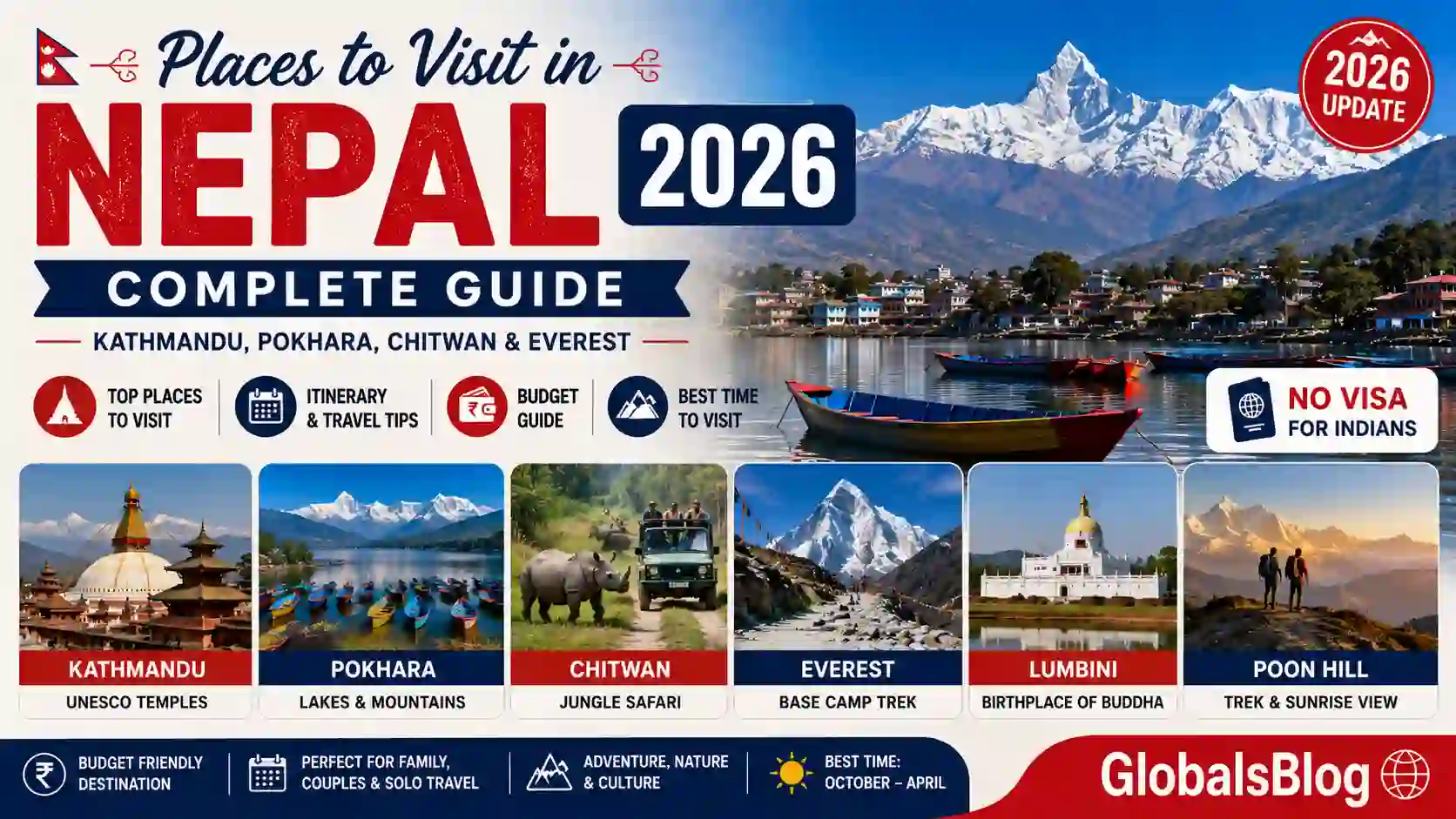
Nepal is India's most accessible international destination — no visa, Indian rupees accepted, Hindi widely understood, and a flight from Delhi to Kathmandu in just 1.5 hours. Eight of the world's ten highest peaks are here, including Everest at 8,849m. Kathmandu's seven UNESCO World Heritage Sites. Pokhara's Phewa Lake with the Annapurna range reflected in it. Chitwan's one-horned rhinos. Lumbini, where the Buddha was born. Nepal packs more into one country than almost anywhere on earth — and for Indian passport holders, it is the world's easiest international trip.
Nepal is a magical neighbouring country right next to India, packed with snow-capped mountains, ancient temples, and warm hospitality that feels like home. A trip to Nepal feels familiar yet refreshing, making it suitable for families, senior citizens, couples, and first-time international travellers. Home to serene lakes in Pokhara and the Everest Base Camp, this Himalayan gem offers thrills in the Chitwan jungles and spiritual vibes at Pashupatinath Temple. Indian citizens do not need a visa for Nepal — the longstanding India-Nepal Treaty of Peace and Friendship grants Indians the privilege of entering Nepal without a visa. Indian rupees are accepted at most places. A first trip to Nepal works well in 5 to 7 days, covering Kathmandu, Pokhara, and optionally Chitwan. Add a short trek such as Poon Hill for 10 days, or 12 to 16 days for Everest Base Camp or the Annapurna Circuit. This guide covers every major Nepal destination — Kathmandu, Pokhara, Chitwan, Lumbini, and the key treks — with timings, budgets, and India-specific practical advice for 2026.
Top places in Nepal 2026: Kathmandu (UNESCO temples — Pashupatinath, Boudhanath Stupa, Swayambhunath Monkey Temple, Durbar Squares), Pokhara (Phewa Lake, paragliding, Annapurna views, World Peace Pagoda), Chitwan National Park (one-horned rhino, Bengal tiger, elephant safari, jungle walks), Lumbini (birthplace of Buddha, UNESCO, Maya Devi Temple), Everest Base Camp trek (12–16 days), Poon Hill trek (4–5 days, best for beginners), Annapurna Base Camp trek (10–14 days). Indians: no visa needed. Budget: NPR 3,000–4,500/day (₹1,800–2,700) for mid-range travel. Best time: Oct–Nov and Mar–May.
Nepal for Indian Travellers — Why It's the Perfect First International Trip
| Factor | Nepal Advantage |
|---|---|
| Visa | No visa for Indian citizens — enter with Indian passport or voter ID (Aadhaar not accepted). No pre-application required |
| Currency | Indian Rupees accepted at 1 INR = 1.6 NPR. No currency exchange needed for most transactions |
| Language | Hindi widely understood and spoken across Nepal — Nepali and Hindi are mutually comprehensible at basic level |
| Culture | Hindu-Buddhist majority, Diwali/Holi/Dashain festivals shared, vegetarian food culture familiar to Indian palate |
| Food | Dal bhat (rice + lentils), momos, thukpa (noodle soup), chatamari — all familiar to Indian taste. Vegetarian widely available. Same spice profile |
| Flight time | Delhi to Kathmandu: 1.5 hours. Varanasi to Kathmandu: 1 hour. Multiple daily flights on IndiGo, Air India, Himalaya Airlines |
| Cost | Nepal is significantly cheaper than India's own hill stations (Manali, Shimla) for equivalent accommodation and food quality |
Nepal is one of the safest international destinations for Indian travellers. The two countries share a deeply warm relationship, Indian rupees are accepted without exchange at most places, Hindi is widely understood, and the Nepali people are consistently rated among the warmest and most welcoming in Asia. Carry your Indian passport (not just Aadhaar) — Aadhaar alone is not accepted at Nepal immigration though voter ID is. The Indian Rs 2,000 note is not accepted in Nepal — carry smaller denominations.
1. Kathmandu — The City of Temples
Kathmandu has Pashupatinath Temple — a sacred place popular amongst most Indians — the big Boudhanath Stupa, and ancient Durbar Squares. Kathmandu Valley is a must-visit place in Nepal with its classic mix of Hindu and Buddhist traditions.
| Attraction | Entry Fee | Timings | Highlight |
|---|---|---|---|
| Pashupatinath Temple | Indian SAARC nationals: NPR 1,000 (~₹625). Non-Hindus: NPR 1,000, inner sanctum restricted to Hindus | 4 AM–9 PM. Morning and evening Aarti most atmospheric | One of Hinduism's 12 Jyotirlingas on the Bagmati River. Ghats, sadhus, cremation platforms — India's most significant temple outside India for Hindu pilgrims |
| Boudhanath Stupa | NPR 400 (~₹250) | Sunrise–sunset. Kora (circumambulation) at dawn is most powerful | One of the world's largest Buddhist stupas — 36m high, UNESCO. Eyes of Buddha painted on four sides. Tibetan Buddhist monastery cluster around it. Best at dawn with monks performing kora |
| Swayambhunath (Monkey Temple) | NPR 200 (~₹125) | 5 AM–8 PM daily | 2,500-year-old stupa on hilltop — 365 steps, resident monkey population, panoramic Kathmandu valley views. UNESCO. Most photogenic at dawn with mist in the valley below |
| Kathmandu Durbar Square | NPR 1,000 (~₹625) for foreigners; Indian nationals lower rate — check locally | 6 AM–9 PM | UNESCO royal palace complex — Kumari Ghar (living goddess), Taleju Temple, Hanuman Dhoka palace. Damaged in 2015 earthquake, ongoing restoration — some structures still under repair |
| Patan Durbar Square | NPR 1,000 (~₹625) | 9 AM–5 PM | Often considered more beautiful than Kathmandu Durbar — better preserved, less touristic. Krishna Mandir (all-stone temple), Patan Museum. 30-min bus from Kathmandu |
| Bhaktapur Durbar Square | NPR 1,800 (~₹1,125) — includes all Bhaktapur attractions | 7 AM–7 PM | Best preserved medieval city in Nepal — 55-Window Palace, Nyatapola Temple (5-tiered, highest pagoda in Nepal), pottery square, traditional crafts. 13 km from Kathmandu |
Thamel is Kathmandu's tourist hub — hotels, restaurants, trekking gear shops, money exchange, and travel agencies concentrated in one walkable neighbourhood. Budget accommodation from NPR 500–1,500/night (₹310–940). Mid-range hotels NPR 3,000–8,000 (₹1,875–5,000). Nagarkot (32 km from Kathmandu, 2,175m altitude) is a recommended overnight stay for Himalayan sunrise views — clear-day views include Everest, Langtang, and Gaurishankar. The Chandragiri Cable Car (15 km from Kathmandu) provides city views and Himalayan panoramas without the Nagarkot drive — reasonable for families and seniors unable to trek.
2. Pokhara — Nepal's Most Beautiful City
Pokhara is relaxed and hospitable with its Lakeside area cafes, restaurants, and stores. Cultural sites like the World Peace Pagoda and old temples enhance the experience. Pokhara is easily accessible from the Indian border and Kathmandu by short flight or bus. Unlike peripheral trekking areas, Pokhara provides urban comfort and contemporary amenities.
| Attraction / Activity | Cost | Best Time | Highlight |
|---|---|---|---|
| Phewa Lake boating | NPR 500–800/hour rowing boat (NPR 100 if you row yourself) | Early morning (mirror-flat water, Annapurna reflection) | Tal Barahi Temple on lake island. Annapurna massif (7,219m) reflected in still water at dawn — one of Nepal's most iconic photographs |
| Sarangkot Sunrise | Free (jeep/taxi up: NPR 1,500–2,000 return) | Pre-dawn, arrive by 5:30 AM | Panoramic Annapurna + Dhaulagiri + Machapuchare (Fishtail Mountain, 6,993m) sunrise from 1,592m viewpoint. Best clear-day views of the Annapurna range accessible without trekking |
| Paragliding from Sarangkot | $70–100 USD pp (NPR 9,000–12,000) | 9 AM–3 PM (thermal windows) | 30-min tandem flight over Phewa Lake with Annapurna backdrop — consistently rated one of the world's best paragliding locations for scenery. Pokhara is Nepal's paragliding capital |
| World Peace Pagoda | NPR 200 (~₹125) + boat to lake crossing NPR 200 | Sunrise/Sunset | Japanese-built white stupa on hilltop overlooking Phewa Lake — 360° views of lake, city, and Annapurna. Short boat trip across lake + 30-min uphill walk |
| Davi's Falls + Gupteshwor Cave | NPR 50 each (~₹31) | Monsoon for full waterfall flow | Waterfall disappears underground into cave system — the cave below contains a Shiva shrine. Unusual geological formation. 3 km south of Lakeside |
Lakeside (Baidam) is Pokhara's tourist neighbourhood — restaurants, cafes, yoga centres, and trekking agency offices along the lake shore. Pokhara–Kathmandu: 40-min domestic flight (NPR 5,000–8,000 / ₹3,125–5,000) or 6–7 hour bus (NPR 700–1,200 / ₹437–750, the road between Kathmandu and Pokhara is the best in Nepal). Pokhara is the gateway for all Annapurna treks. New Pokhara International Airport (opened January 2023) can receive international flights including from India — direct Kathmandu–Pokhara flights by IndiGo/Himalaya Airlines available from select cities.
3. Trekking in Nepal — The Complete Overview
The best trekking destinations in Nepal: Everest Base Camp Trek (12–16 days, Khumbu region), Annapurna Base Camp Trek (10–14 days from Pokhara), Poon Hill Trek (4–5 days, ideal for beginners and families), Annapurna Circuit (15–20 days, the classic long-distance route), and Langtang Valley Trek (7–10 days, closest to Kathmandu).
| Trek | Duration | Difficulty | Max Altitude | Cost (approx) | Best Time |
|---|---|---|---|---|---|
| Poon Hill | 4–5 days | Easy–Moderate | 3,210m | $200–400 pp (guide+accommodation+food) | Oct–Nov, Mar–May |
| Annapurna Base Camp | 10–14 days | Moderate | 4,130m | $500–900 pp | Oct–Nov, Mar–May |
| Everest Base Camp | 12–16 days | Challenging | 5,364m | $1,200–2,000 pp | Oct–Nov, Mar–May |
| Langtang Valley | 7–10 days | Moderate | 4,984m | $400–700 pp | Oct–Nov, Mar–May |
| Annapurna Circuit | 15–20 days | Challenging | 5,416m (Thorong La) | $800–1,400 pp | Oct–Nov, Mar–May |
New regulations introduced in Nepal from April 2023 mandate that all trekking activities must be conducted with a licensed guide — applicable to all foreign tourists. A TIMS (Trekkers' Information Management System) card and national park permit are also required for most treks. Poon Hill is the recommended first Nepal trek for Indian families and first-time trekkers — 4 days, maximum 3,210m (altitude sickness risk manageable), daily teahouse accommodation (no camping required), stunning Annapurna sunrise views from the summit. The Kanchenjunga region in east Nepal (near the India-Nepal border) offers views of the world's third-highest peak — an excellent offbeat option. Australian Camp/Dhampus and Poon Hill are among the best places in Nepal to visit with family as the treks are easy but the views are no less spectacular.
4. Chitwan National Park — Nepal's Wildlife Gem
Chitwan is Nepal's top wildlife activities destination for wildlife enthusiasts. Chitwan National Park offers an exhilarating experience with one-horned rhinos, Bengal tigers, and a rich diversity of wildlife within the Terai (lowland) ecosystem.
| Activity | Cost | Duration | Best For |
|---|---|---|---|
| Jeep Safari | $25–50 pp | 3–4 hours | Best for one-horned rhino, gaur, deer. Tiger sighting possible but rare. Morning safari (6:30 AM) recommended |
| Elephant-back Safari | $30–60 pp (ethical operators only) | 2–3 hours | Traditional activity — choose operators certified by Nepal's Department of Forests. Ethical elephant standards improving in Chitwan |
| Canoe + Jungle Walk | $15–25 pp | Half day | Gharial crocodile and river birds by canoe on Rapti River, then 2-hour guided jungle walk — excellent for birdwatching (Chitwan has 543+ bird species) |
| Cultural Tharu Village Tour | $10–20 pp | Evening (2–3 hrs) | Traditional Tharu stick dance performance + village walk — authentic cultural immersion into Nepal's indigenous Terai community |
Chitwan is 150 km from Kathmandu (4–5 hours by tourist bus, NPR 700–1,200 / ₹437–750). Sauraha village is the main tourist base for Chitwan. Accommodation ranges from budget guesthouses (NPR 1,000–2,000/night) to luxury jungle lodges (NPR 15,000–40,000+/night). The one-horned Indian rhinoceros (Rhinoceros unicornis) is Chitwan's signature species — Nepal has significantly increased its rhino population from 372 (2000) to 752+ (2024), a conservation success story. Bengal tiger sightings are uncommon but possible — the Chitwan system has approximately 200 tigers. Best combined with Lumbini (75 km west of Chitwan — birthplace of the Buddha, UNESCO site) in a 5-6 day south Nepal circuit.
5. Lumbini, Everest Region and Beyond
Lumbini is the birthplace of Lord Buddha, which makes it especially meaningful for Indian visitors seeking spiritual connection. Lumbini UNESCO World Heritage Site features the Maya Devi Temple marking the exact birthplace, the Sacred Garden with the Ashoka Pillar (erected 249 BC by Emperor Ashoka), and an international monastery zone where 30+ countries have built monasteries in their own architectural styles. The Sacred Garden's Ashoka Pillar (one of the oldest inscribed monuments in South Asia) and the Maya Devi Temple's archaeological excavations revealing the exact birthplace site are the core spiritual focal points. The international monastery zone is architecturally spectacular — Thai, Japanese, Korean, Chinese, Sri Lankan, Myanmar, Tibetan, and German monasteries are among the 30+ built here, each representing distinct Buddhist architectural traditions. Entry to Sacred Garden: NPR 500 (~₹312). Flight from Kathmandu to Bhairahawa (nearest airport to Lumbini): NPR 5,000–8,000, 45 min. Bus from Chitwan: 3 hours, NPR 300–500.
The Everest Base Camp Trek (12–16 days, Khumbu region) is highly praised for its stunning landscapes and views of the world's highest peaks. Ideal for all trekkers, the trek starts with a scenic 45-minute flight from Kathmandu to Lukla (the world's most adventurous airport at 2,860m) and ascends to 5,364m at Base Camp. Best time: October to November and March to May. For travellers who cannot commit 12–16 days to trekking, two shorter alternatives exist: Everest Scenic Mountain Flight (45-min plane flight from Kathmandu around Everest from 3,600m, ~$200–250, no trekking) and Everest Helicopter Tour (fly to EBC or Kala Patthar at 5,545m, 3–5 hours total, ~$500–1,000 per person in group — the highest practical viewpoint accessible without days of trekking). Both alternatives provide genuine close-range Everest views without the physical commitment of the full EBC trek.
Nepal Itinerary — 7 Days and 10 Days
| Day | 7-Day Nepal | 10-Day Nepal (+Trek) |
|---|---|---|
| Day 1 | Arrive Kathmandu. Thamel evening, dinner | Same |
| Day 2 | Kathmandu: Pashupatinath + Boudhanath + Swayambhunath | Same |
| Day 3 | Bhaktapur day trip + Patan Durbar Square | Same |
| Day 4 | Fly/bus Kathmandu → Pokhara. Lakeside evening | Same |
| Day 5 | Pokhara: Sarangkot sunrise, paragliding, Phewa Lake | Same |
| Day 6 | Pokhara: World Peace Pagoda, free day, return Kathmandu | Pokhara → Nayapul, trek start (Day 1 Poon Hill: Ulleri) |
| Day 7 | Kathmandu: last shopping, depart | Trek Day 2: Ulleri → Ghorepani |
| Day 8 | — | Trek Day 3: Poon Hill sunrise (4:30 AM), descend to Tikhedhunga |
| Day 9 | — | Trek Day 4: return Pokhara. Evening: lakeside celebration |
| Day 10 | — | Fly Pokhara → Kathmandu, depart |
Nepal Travel Budget for Indian Travellers (2026)
| Category | Budget | Mid-range | Premium |
|---|---|---|---|
| Accommodation | NPR 500–1,500/night (₹312–940) | NPR 3,000–8,000 (₹1,875–5,000) | NPR 15,000–40,000+ (luxury lodges) |
| Food per day | NPR 600–1,200 (dal bhat, momos, local) | NPR 1,500–3,000 (restaurants) | NPR 4,000+ (luxury dining) |
| Transport (intercity) | NPR 700–1,200 (tourist bus KTM→PKR) | NPR 5,000–8,000 (domestic flight) | NPR 12,000+ (helicopter) |
| Activities per day | NPR 300–800 (temples + entry fees) | NPR 2,000–5,000 (safari + paragliding) | NPR 10,000+ (heli tours) |
| Total 7 days (ex-India flight) | NPR 12,000–20,000 (₹7,500–12,500) | NPR 35,000–60,000 (₹21,875–37,500) | NPR 1,00,000+ (₹62,500+) |
India to Nepal flights: Delhi → Kathmandu from ₹4,000–12,000 return (IndiGo, Air India, Himalaya Airlines). Varanasi, Lucknow, Patna, Kolkata also have direct Kathmandu connections. Road trip from India: Sunauli border crossing (UP-Nepal border, 270 km from Varanasi) → Bhairahawa → Lumbini → Chitwan → Kathmandu by road is a classic overland Nepal route. Nepal is one of Asia's most affordable and welcoming destinations, with budget travel possible from around NPR 3,000–4,500 a day (₹1,875–2,812).
Nepal Travel Tips for Indian Travellers 2026
- No visa — but carry passport, not just Aadhaar: Indian citizens do not need a visa for Nepal. However, you must carry a valid Indian passport or voter ID card. Aadhaar card alone is NOT accepted at Nepal immigration — confirmed as of 2026. The Rs 2,000 denomination Indian note is also not accepted in Nepal — carry Rs 500 and below or use ATMs in Kathmandu (Nepali ATMs accept Indian Maestro/Rupay cards, small fee). Exchange INR to NPR at the Nepal Rastra Bank rate (NPR 1 = INR 0.625 approximately)
- Altitude sickness is real — above 3,000m take precautions: Acute Mountain Sickness (AMS) can affect anyone regardless of fitness level. Above 3,000m: ascend no more than 300–400m per day in sleeping altitude, rest acclimatisation days, drink 3–4 litres water daily, avoid alcohol, know the symptoms (headache, nausea, dizziness, shortness of breath). Diamox (acetazolamide 125–250mg) helps but requires prescription and prior medical advice. EBC trek: take an acclimatisation day at Namche Bazaar (3,440m) and at Dingboche (4,410m) — mandatory for most trekkers to prevent severe AMS
- Trekking guide mandatory since April 2023: Nepal regulations introduced in April 2023 mandate that all trekking activities must be conducted with a licensed guide. Hire guides through government-registered trekking agencies (Nepal Tourism Board listing) — avoid unlicensed freelancers in Thamel who may not carry valid licenses. Guide fees: NPR 2,500–3,500/day (~₹1,562–2,187). Porter fees: NPR 1,500–2,500/day. TIMS card (NPR 2,000 for SAARC nationals) and national park permit (NPR 3,000 for Annapurna) required for most treks — buy at the Nepal Tourism Board office in Kathmandu
- Best time to trek vs best time for cultural visits: October–November: best trekking (post-monsoon clarity, maximum Himalayan views, stable weather). March–May: second-best trekking + rhododendron bloom season (Poon Hill in March is particularly spectacular). December–February: cultural tours of Kathmandu (pleasant, clear) + Chitwan/Lumbini/Terai (dry season). Avoid June–September for trekking (monsoon, landslides, poor visibility) but Kathmandu cultural sites remain accessible year-round
- For self-drive from India, the Tata Nexon EV can handle the Kathmandu-Pokhara road (Nepal's best highway) comfortably — though charging infrastructure in Nepal is limited. For a petrol car road trip, the Maruti Fronx CNG (28.51 km/kg) gives excellent range. Use our Trip Cost Calculator to estimate the Sunauli border crossing drive cost from your city
Kathmandu for Temples and Culture. Pokhara for Mountains and Lakes. Chitwan for Wildlife. Poon Hill for Your First Trek. Lumbini for Spiritual Depth. Nepal — India's Most Complete International Neighbour.
Nepal is a magical neighbouring country packed with snow-capped mountains, ancient temples, and warm hospitality that feels like home. A trip to Nepal feels familiar yet refreshing — suitable for families, senior citizens, couples, and first-time international travellers. It is super easy for Indians — no visa needed, short flights or even road trips from places like Delhi, and great value for money. A first trip to Nepal works well in 5 to 7 days, covering Kathmandu, Pokhara, and optionally Chitwan. Budget travel is possible from around NPR 3,000–4,500 a day. For Indian families making their first international trip, Nepal is the definitive answer — familiar culture, shared religion, accepted currency, understood language, and the most extraordinary mountain landscape on earth. Seven UNESCO sites, one of the world's most spiritual cities, the Annapurna reflection in Phewa Lake at dawn, and a Poon Hill sunrise — all without a visa, all at Indian pricing, all 1.5 hours from Delhi.
Top places to visit in Nepal 2026: Kathmandu (Pashupatinath Temple — one of Hinduism's 12 Jyotirlingas; Boudhanath Stupa — UNESCO, one of world's largest; Swayambhunath Monkey Temple — UNESCO 2,500 years old; Bhaktapur Durbar Square — best preserved medieval city in Nepal; Patan Durbar Square), Pokhara (Phewa Lake Annapurna reflection, Sarangkot sunrise viewpoint, paragliding capital of Nepal, World Peace Pagoda), Chitwan National Park (one-horned rhino, Bengal tiger jeep safari, canoe river trips, 543+ bird species), Lumbini (birthplace of the Buddha, UNESCO, Maya Devi Temple, Ashoka Pillar 249 BC, international monastery zone), Everest Region (EBC trek 12–16 days, Everest scenic flight ~$200, helicopter to EBC ~$500–1,000), Poon Hill (4–5 day beginner trek, 3,210m, Annapurna sunrise). Minimum recommended: 5–7 days for Kathmandu + Pokhara. 10 days adds Chitwan or Poon Hill trek.
Visa for Nepal (Indian citizens, 2026): No — Indian citizens do not need a visa for Nepal. The India-Nepal Treaty of Peace and Friendship grants Indians visa-free entry. Document required: valid Indian passport OR voter ID card. Aadhaar card alone is NOT accepted at Nepal immigration. Indian Rs 2,000 note NOT accepted in Nepal — carry Rs 100/200/500 denominations or use Kathmandu ATMs (Nepali ATMs accept Indian Maestro/Rupay cards). Entry points: Tribhuvan International Airport Kathmandu, Sunauli border (UP-Nepal), Raxaul border (Bihar-Nepal), Sonauli, Bhairahawa, Kakarbhitta. Indian rupees accepted across Nepal at most shops and restaurants (NPR 1 = INR 0.625, or 1 INR = 1.6 NPR). No length of stay restriction for Indian citizens — stay as long as you like. No registration requirement. Carry your original documents; photocopies may not be accepted.
Best time to visit Nepal (2026): October–November: Best for trekking — post-monsoon clear skies, maximum Himalayan visibility, stable weather. Peak trekking season, especially EBC and Annapurna. Dashain (Dussehra equivalent, Nepal's largest festival) in October adds cultural richness. March–May: Second-best for trekking + rhododendron bloom season. Poon Hill in March has pink/red rhododendron forests at lower altitudes alongside Himalayan views. Lower accommodation rates than Oct–Nov. December–February: Cultural tours of Kathmandu (clear, pleasant 15–20°C), Terai (Chitwan, Lumbini) in its dry season — excellent wildlife visibility. Cold in Pokhara (8–15°C) and Kathmandu (5–15°C) but manageable with warm layers. June–September: Monsoon — heavy rain, landslide risk on mountain roads and trekking trails, poor visibility for Himalayan views. Avoid for trekking. Kathmandu cultural sites accessible year-round. For Indian travellers: October aligns with Diwali/school holidays — book well ahead as this is Nepal's peak tourist month.
Days needed for Nepal (2026): Minimum 5 days: Kathmandu (3 days — 7 UNESCO sites + Thamel) + Pokhara (2 days — Phewa Lake, Sarangkot sunrise). Recommended 7 days: Kathmandu (3) + Pokhara (3) + Chitwan or Lumbini (1). With Poon Hill trek 10 days: Kathmandu (3) + Pokhara (2) + Poon Hill trek (4 days round trip from Pokhara) + return Kathmandu (1). With EBC trek 16+ days: Kathmandu (2–3) + Lukla + EBC trek (12–14 days) + Kathmandu (1). Most Indian families on a first Nepal trip: 7 days is ideal — covers Kathmandu's cultural highlights, Pokhara's scenic beauty, and optionally one day at Chitwan or Nagarkot. Separate trips for trekking (Oct or Mar, 10–16 days) and cultural/family (any time, 5–7 days) are the most efficient approach for families where not all members trek.
Poon Hill trek Nepal — complete guide (2026): Duration: 4–5 days round trip from Pokhara. Maximum altitude: 3,210m (Poon Hill viewpoint). Difficulty: Easy to Moderate — suitable for first-time trekkers and families with moderate fitness. No prior trekking experience required. Route: Pokhara → Nayapul (1 hr drive) → Ulleri (Day 1) → Ghorepani (Day 2) → Poon Hill summit 4:30 AM for sunrise (Day 3) → Tikhedhunga → Nayapul → Pokhara. Accommodation: teahouses with hot showers and meals throughout — no camping or sleeping bags required. Cost: approximately NPR 15,000–25,000/person (₹9,375–15,625) including guide (mandatory), food, accommodation, TIMS card and national park permit. What you'll see: Dhaulagiri (8,167m), Annapurna I (8,091m), Machapuchare/Fishtail (6,993m) from Poon Hill — one of Nepal's best Himalayan panorama viewpoints accessible in 3 days of walking. The Poon Hill sunrise (clear sky days) is Nepal's most accessible world-class mountain view. Rhododendron bloom March–April adds forest colour. Best time: October–November and March–May.
Nepal trip budget from India (2026): Flights: Delhi → Kathmandu return ₹4,000–12,000 (IndiGo, Air India, Himalaya Airlines). Book 4–6 weeks ahead. Direct connections also from Varanasi, Lucknow, Patna, Kolkata. No visa cost (free for Indians). Daily budget in Nepal: Budget: NPR 3,000–4,500/day (₹1,875–2,812) — guesthouse, dal bhat, local transport. Mid-range: NPR 8,000–15,000/day (₹5,000–9,375) — 3-star hotel, restaurant dining, guided activities. Premium: NPR 30,000+/day (₹18,750+) — luxury lodge, private guide, helicopter options. Key activity costs: Boudhanath entry NPR 400 (₹250), Bhaktapur NPR 1,800 (₹1,125), paragliding $70–100 (₹5,800–8,300), Chitwan jeep safari $25–50 (₹2,075–4,150), Poon Hill trek NPR 15,000–25,000 (₹9,375–15,625 total 4 days). 7-day Nepal trip total including flights: Budget ₹18,000–30,000. Mid-range ₹40,000–70,000. Nepal is cheaper than Indian hill stations — Manali 7-day mid-range costs more than Nepal 7-day mid-range when flights are similar.
Reader Experiences