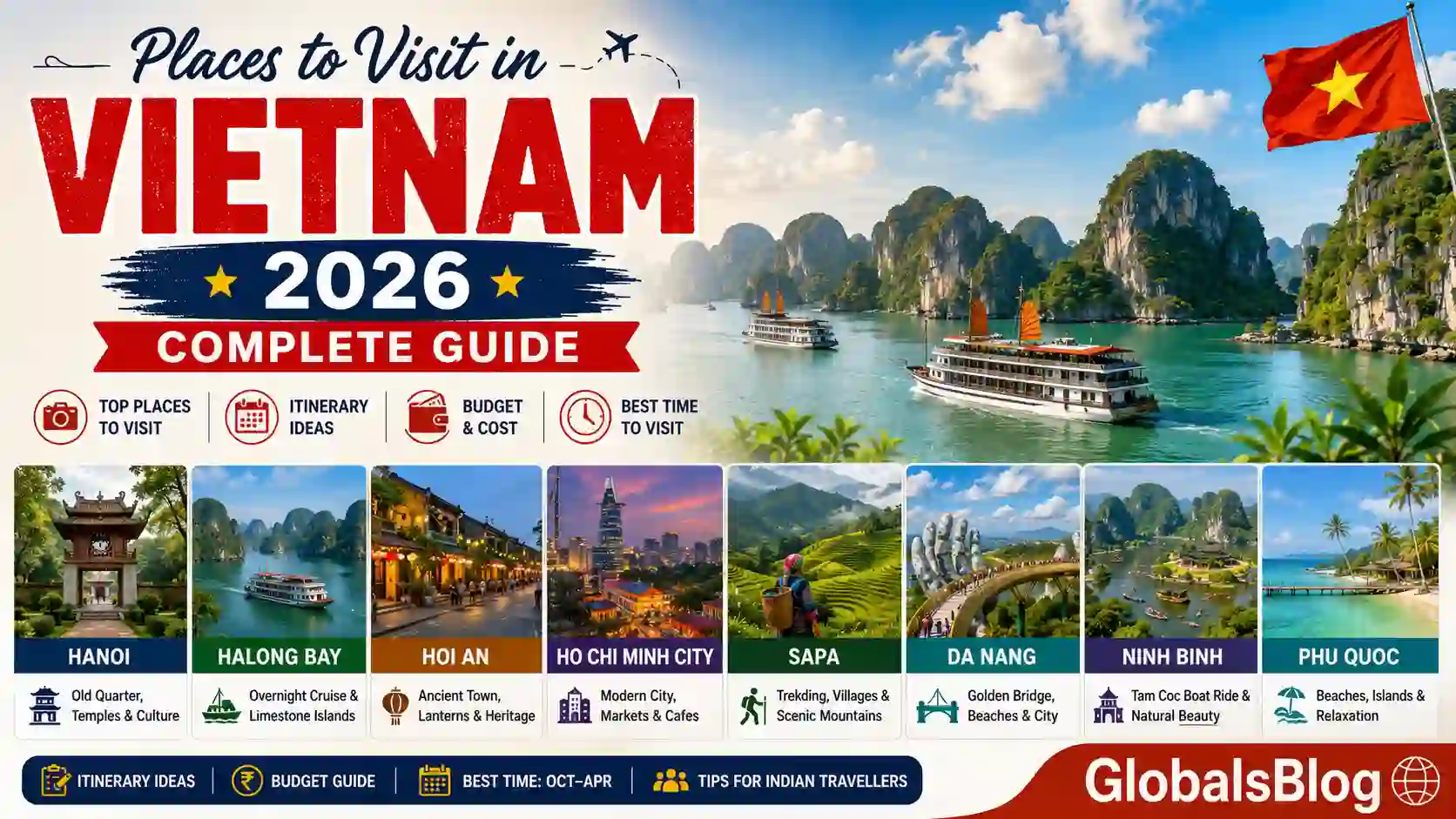
Vietnam is an S-shaped country of extraordinary contrasts — 3,444 km from north to south, 9 UNESCO World Heritage Sites, 54 ethnic groups, and some of the world's best street food. Halong Bay's 1,600 limestone islands rising from emerald water. Hoi An's lantern-lit Ancient Town. Hanoi's Old Quarter's 36 guild streets. Sapa's terraced rice fields at 1,600 metres. Ho Chi Minh City's relentless energy. Vietnam delivers a density of memorable experience per day that few countries match — and it does it affordably. This is the complete guide for 2026.
For first-time visitors, the recommended focus is the "Big Four" — Hanoi, Halong Bay, Hoi An, and Ho Chi Minh City — for a comprehensive Vietnam experience. Return visitors can explore lesser-known gems like Ha Giang Province, Phong Nha caves, or Con Dao Islands. Vietnam now has nine UNESCO World Heritage Sites: Ha Long Bay-Cat Ba, the Imperial Citadel of Hue, Hoi An Old Town, My Son Sanctuary, Phong Nha-Ke Bang National Park, the Thang Long Citadel in Hanoi, the Citadel of the Ho Dynasty, Trang An in Ninh Binh, and the Yen Tu-Vinh Nghiem-Con Son Kiep Bac complex added in 2025. Vietnam is notably affordable — the average cost for a 3-week trip ranges from $750 to $1,500 USD (approximately ₹62,000–₹1,25,000) depending on travel style. Expenses in major cities like Hanoi and Ho Chi Minh City tend to be higher than other destinations. For Indian travellers, Vietnam requires a visa — Indian passport holders can apply for an e-visa online (evisa.xuatnhapcanh.gov.vn) for $25 USD, valid 90 days, single or multiple entry. This guide covers every major destination with budget, itinerary, and practical details from an Indian traveller perspective for 2026.
Top places in Vietnam 2026: Hanoi (Old Quarter, Ho Chi Minh Mausoleum, Temple of Literature, egg coffee), Halong Bay (UNESCO, limestone karsts, overnight cruise, Sung Sot Cave), Hoi An (Ancient Town UNESCO, lantern lanes, Thu Bon River), Ho Chi Minh City (War Remnants Museum, Cu Chi Tunnels, Bui Vien), Sapa (rice terraces, Fansipan 3,143m, Hmong tribes), Da Nang (Golden Bridge, My Khe Beach, Marble Mountains), Ninh Binh (Tam Coc, Hang Mua, Hoa Lu), Phu Quoc (tropical island, beaches). Minimum days: 10–14. Budget per day: $30–80 USD (₹2,500–6,600). Best time: North — Oct–April; Central — Feb–Aug; South — year-round. India to Vietnam: flights from ₹15,000–35,000 return (Delhi/Mumbai to Hanoi/HCMC). E-visa: $25 USD, 90 days.
Vietnam at a Glance — North, Central, South
| Region | Key Destinations | Character | Best Time | Days |
|---|---|---|---|---|
| North | Hanoi, Halong Bay, Sapa, Ninh Binh | History, mountains, karsts, hill tribes | October–April | 5–7 |
| Central | Da Nang, Hoi An, Hue, Phong Nha | UNESCO heritage, beaches, imperial history | February–August | 4–6 |
| South | Ho Chi Minh City, Mekong Delta, Phu Quoc | Urban energy, river life, tropical beaches | Year-round (Nov–Apr driest) | 3–5 |
The north (Hanoi, Halong, Sapa) is best from October to April. The centre (Hue, Hoi An, Da Nang) from February to August, avoiding the October–November typhoons. The south is accessible year-round. A well-rounded itinerary for 10–12 days: Hanoi 2 days, Halong Bay 2 days, Hoi An 3 days, Phong Nha-Ke Bang 2 days, Ho Chi Minh City 2 days. For 14 days add Sapa 2–3 days or Ninh Binh.
1. Hanoi — Vietnam's Ancient Capital
Hanoi's highlights include wandering the Old Quarter, sipping egg coffee, visiting the Temple of Literature, and paying respects at the Ho Chi Minh Mausoleum. Hanoi is the cultural capital of Vietnam with centuries-old architecture and a distinctly French-colonial atmosphere alongside ancient Vietnamese tradition.
| Attraction | Entry Fee | Timings | Highlight |
|---|---|---|---|
| Old Quarter (36 Streets) | Free | 24 hours (best at dawn + evening) | Each street named after the guild it hosted — Hang Dao (silk), Hang Bac (silver), Hang Buom (sails). Vietnam's most atmospheric neighbourhood |
| Ho Chi Minh Mausoleum | Free | Tue–Thu + Sat–Sun, 8–11 AM (closed Oct–Nov for Ho Chi Minh's body maintenance trip to Russia) | Preserved body of Ho Chi Minh in glass sarcophagus — moving pilgrimage site for Vietnamese; formal dress required |
| Temple of Literature (Van Mieu) | 30,000 VND (~₹95) | 8 AM–5 PM daily | Vietnam's first university, founded 1070 — traditional Vietnamese architecture, stone turtle steles of doctoral laureates |
| Hoan Kiem Lake + Ngoc Son Temple | Lake free; Temple 30,000 VND | Lake 24 hrs; Temple 8 AM–5 PM | Turtle Tower at lake centre, Red Bridge to island temple — most photographed Hanoi landmark |
| Vietnam Museum of Ethnology | 40,000 VND (~₹125) | 8 AM–5:30 PM (closed Mon) | Best museum in Vietnam — 54 ethnic groups displayed with full-scale traditional houses. More interesting than War Museum for culture |
| Hoa Lo Prison (Hanoi Hilton) | 30,000 VND | 8 AM–5 PM daily | French colonial prison used for Vietnamese revolutionaries, then US POWs including John McCain — powerful and sobering |
Hanoi practical notes: Egg coffee (ca phe trung) at Cafe Giang or Cafe Dinh — must-have experience unique to Hanoi. Bun cha (grilled pork with noodles) at the restaurant Barack Obama and Anthony Bourdain famously visited is at 24 Le Van Huu. Walking Street (Hang Dao to Dong Kinh Nghia Thuc Square) runs Friday–Sunday evening with pedestrian-only atmosphere, street food stalls, and performances. Hanoi's newly expanded metro system, operational from recent years, has made the city significantly easier for visitors to navigate in 2026.
2. Halong Bay — Vietnam's Most Iconic Landscape
Halong Bay remains one of Vietnam's most iconic destinations, defined by its emerald waters and thousands of towering limestone karsts rising dramatically from the sea. Most travellers experience the bay via overnight or multi-day boat cruises, which typically include stops for kayaking, cave exploration and swimming among the dramatic rock formations that have made the bay a UNESCO World Heritage Site.
| Cruise Type | Duration | Price (approx) | Includes | Best For |
|---|---|---|---|---|
| Day Cruise | 1 day | $35–60 USD pp | Lunch, cave visit, kayaking — no overnight | Budget travellers, time-constrained |
| 2-Day/1-Night Cruise | Overnight | $80–200 USD pp | All meals, cabin, cave, kayak, sunset on deck | Most popular — recommended minimum for the full experience |
| 3-Day/2-Night Cruise | 2 nights | $150–400 USD pp | All above + Lan Ha Bay extension, cooking class, more remote areas | Families, couples, maximum immersion |
| Luxury Junk Boat | 2–3 nights | $250–600+ USD pp | Premium cabins, fine dining, private kayaking, smaller groups | Honeymoon, premium experience |
Halong Bay highlights: overnight cruises, Sung Sot (Surprise) Cave exploration, kayaking through floating fishing villages, swimming in turquoise water. Key booking advice: do not book the cheapest Halong Bay cruise. Budget cruises (under $50) cut corners on safety equipment, food quality, and vessel maintenance — the minimum recommended is $80–100 per person for a 2D/1N cruise from a reputable operator (Indochina Junk, Paradise Cruises, Stellar Cruises). Avoid booking at the Hanoi Old Quarter travel agency windows — book directly online for transparent pricing and reviews. Cat Ba Island (within Halong Bay) is an excellent land-based alternative to cruises for budget travellers — stay on Cat Ba Island and take half-day boat tours from there.
3. Hoi An — Vietnam's Most Beautiful Town
Hoi An Ancient Town is located on the banks of the Thu Bon River in central Quang Nam province, 30 kilometres south of Da Nang. It is an Eastern classic captivation — a UNESCO World Heritage Site preserved from its 15th–19th century trading port era with Japanese, Chinese, and European architectural influences fused in a single town.
| Experience | Cost | Best Time | Notes |
|---|---|---|---|
| Ancient Town walk | 120,000 VND (~₹380) entry ticket — includes 5 site visits | 5–8 AM (before tour groups) or after 5 PM (lantern hour) | Japanese Covered Bridge, Assembly Halls, merchant houses — wander freely after 5 PM when ticket inspection stops |
| Lantern Evening | Ancient Town ticket | Full moon night (14th of lunar month) — electricity off, only lanterns lit | Hoi An Full Moon Festival — most magical night in Vietnam. Floating lanterns on Thu Bon River ₹150–200 per lantern |
| Tailor-made clothing | $20–100 USD per item | Allow 24–48 hrs for fitting + alterations | Hoi An is Vietnam's tailoring capital — custom ao dai, suits, dresses in 24 hours from 500+ tailor shops. Yaly Couture, Hoi An Tailors recommended |
| Cooking class | $25–45 USD pp | Morning (visit market + cook lunch) | Morning market visit + cao lau/white rose dumpling cooking class — best food experience in Vietnam |
| An Bang Beach | Free (taxi ₹200 from town) | Morning | 3 km from Ancient Town — Hoi An's best beach, quieter than Da Nang's My Khe |
| My Son Sanctuary | 150,000 VND (~₹475) + taxi | 7–10 AM | 4th–13th century Cham civilisation Hindu temples — UNESCO, 40 km from Hoi An. The "Angkor Wat of Vietnam" |
Hoi An food musts: Cao lau (unique Hoi An noodles with pork, rice crackers, herbs — uses water from one specific ancient well in town, cannot be replicated elsewhere), White Rose dumplings (Banh Vac, only made by one family in town who supplies all restaurants), Banh Mi Phuong (Anthony Bourdain called it "the best sandwich I've ever had" — still operating, ₹50–80 per banh mi). Spending 3–4 nights in Hoi An allows for deeper exploration without rushing.
4. Ho Chi Minh City (Saigon) — Vietnam's Urban Powerhouse
War Remnants Museum is a must-visit in Ho Chi Minh City — one of the most significant museums in Southeast Asia documenting the Vietnam War from the Vietnamese perspective. The museum holds powerful photographic documentation and exhibits that are sobering and essential for understanding modern Vietnamese history.
| Attraction | Entry Fee | Highlight |
|---|---|---|
| War Remnants Museum | 40,000 VND (~₹125) | Vietnam War from Vietnamese perspective — Pulitzer Prize-winning photographs, defoliant/Agent Orange documentation, US military equipment displayed. Sobering and essential |
| Cu Chi Tunnels | 110,000 VND (~₹350) + transport | 65 km from HCMC — 250 km tunnel network used by Viet Cong. Crawl through actual tunnels, see booby traps. Half-day tour from HCMC |
| Ben Thanh Market | Free | HCMC's iconic central market — souvenirs, food, clothes. Tourist-priced but essential Saigon experience |
| Notre-Dame Cathedral Basilica | Free (exterior — renovation may affect access) | French colonial 1880, Neo-Romanesque brick cathedral — Saigon's most photographed colonial landmark |
| Bui Vien Walking Street | Free | HCMC's backpacker street — bars, restaurants, neon lights, street performances from 7 PM. Vietnam's most vibrant nightlife strip |
| Mekong Delta Day Trip | $15–35 USD pp (organised tour) | Can Tho (150 km, 3 hrs) — floating markets, river life, rice paddies. Half or full day from HCMC |
5. Sapa — Vietnam's Highland Trekking Capital
Sapa is a must for nature lovers — 370 km from Hanoi. Highlights include trekking through Muong Hoa Valley, conquering Fansipan Peak (3,143m — highest in Indochina by cable car or 2-day trek), and experiencing the traditions of the Hmong and Dao people. Sapa is home to several ethnic communities whose village life remains one of the most compelling cultural experiences in northern Vietnam.
| Activity | Cost | Duration | Notes |
|---|---|---|---|
| Fansipan Cable Car | 750,000 VND (~₹2,370) return | 2–3 hours total | Longest 3-wire cable car in world (6.29 km). Fansipan at 3,143m — summit views on clear days are extraordinary. Cable car built 2016 by Sun Group |
| Fansipan Trek | $60–120 USD pp (guide mandatory) | 2 days / 1 night | Technical mountain trek through forest, bamboo, rhododendron. Guide required. Best March–May, September–October (avoid monsoon) |
| Muong Hoa Valley Trek | $15–25 USD pp (guide) | Half or full day | Through rice terraces to Hmong and Red Dao villages — most popular Sapa day trek. Rice terraces most photogenic August–September (harvest) |
| Sapa Market | Free | Weekends best | Bac Ha Market (45 km from Sapa, Sunday only) — most authentic ethnic minority market in north Vietnam, less tourist-heavy than Sapa town |
Sapa practical notes: From Hanoi, overnight train (Victoria Express, ₹1,200–2,500 per berth, 8 hours) or overnight bus (₹400–700, 6 hours) — most travellers take the overnight train to Lao Cai then a 30-minute transfer to Sapa. The rice terraces of Mu Cang Chai (200 km from Sapa, accessible by motorbike or private car) offer less-developed, more dramatic terraces than Sapa itself. Sapa pairs well with nearby Mu Cang Chai for travellers seeking an extended highland trekking itinerary.
6. Da Nang, Ninh Binh and Phu Quoc
Da Nang combines modern city energy with stunning natural beauty. Its world-famous My Khe Beach stretches for miles of golden sand and clear turquoise water, while the iconic Golden Bridge at Ba Na Hills and the mysterious Marble Mountains attract thousands of visitors every year. As a convenient gateway to Hoi An and Hue, Da Nang also boasts lively rivers and a scenic coastline. The Golden Bridge (opened 2018) is Vietnam's most viral photo attraction — a 150-metre pedestrian bridge held up by two giant stone hands in the hills above Da Nang. Ba Na Hills entry (including cable car and Golden Bridge): approximately 1,000,000 VND (~₹3,160) per person. Marble Mountains: 40,000 VND, contains Buddhist caves carved into mountain. My Khe Beach: free, 29 km of sandy beach alongside Da Nang's coastline — safer swimming than many Vietnam beaches due to lack of strong riptide in the central section.
Ninh Binh is often called the "Halong Bay on land" thanks to its dramatic limestone karsts rising above lush rice paddies and peaceful rivers. Visitors love gliding by boat through the emerald waters of Tam Coc, climbing the 500 steps to Hang Mua viewpoint for sweeping panoramas, and wandering the ancient temples of Hoa Lu — the first capital of Vietnam. With its tranquil villages, cycling paths and warm local hospitality, Ninh Binh offers the perfect mix of nature, history and relaxation. Trang An (UNESCO, larger river loop with cave passages, 80,000 VND boat), Bich Dong Pagoda (cave temple, free), Cuc Phuong National Park (1 hour from Ninh Binh, Vietnam's oldest national park, primate rescue centre). Best day trip from Hanoi (95 km, 2 hrs) or overnight stay for more relaxed pace.
Phu Quoc is Vietnam's largest island and a special economic zone — notably, Indian passport holders can visit Phu Quoc for up to 30 days without a visa (the island has a special visa exemption policy separate from mainland Vietnam). The beaches (Long Beach, Sao Beach, Bai Dai) rival Thailand's best for water clarity and sand quality. VinWonders Phu Quoc (theme park) and the Grand World shopping/dining complex have transformed the island into a family resort destination since 2021. Snorkelling at the An Thoi Island cluster (30 min by speedboat, colourful coral), Phu Quoc National Park trekking, and Phu Quoc fish sauce (the world's highest-quality nuoc mam is made here) round out the island experience. Best time: November–April (dry season). Avoid May–October (heavy monsoon, rough seas, some resorts close).
Vietnam 10-Day Itinerary for Indian Travellers
| Day | Destination | Key Activities |
|---|---|---|
| Day 1 | Arrive Hanoi | Old Quarter evening walk, street food, Hoan Kiem Lake |
| Day 2 | Hanoi | Ho Chi Minh Mausoleum (AM), Temple of Literature, Vietnam Ethnology Museum, egg coffee |
| Day 3–4 | Halong Bay | 2D/1N cruise — Sung Sot Cave, kayaking, sunset deck, overnight on bay |
| Day 5 | Hanoi → Ninh Binh (or fly to Da Nang) | Ninh Binh day trip: Tam Coc boat + Hang Mua steps (if flying south, skip Ninh Binh) |
| Day 6 | Da Nang / Hoi An | Fly Hanoi → Da Nang. Golden Bridge at Ba Na Hills, My Khe Beach evening |
| Day 7 | Hoi An | Ancient Town morning, lantern evening, tailor fitting, cooking class |
| Day 8 | Hoi An | My Son Sanctuary, An Bang Beach, tailor pickup |
| Day 9 | Ho Chi Minh City | Fly Da Nang → HCMC. War Remnants Museum, Ben Thanh Market, Bui Vien night |
| Day 10 | HCMC / Depart | Cu Chi Tunnels half-day, Mekong Delta alternative. Depart evening |
Vietnam Travel Budget for Indian Travellers (2026)
| Category | Budget | Mid-range | Premium |
|---|---|---|---|
| Accommodation per night | $8–20 (hostel/budget hotel) | $30–70 (boutique hotel) | $100–400+ (resort) |
| Food per day | $5–10 (street food + local restaurants) | $15–30 (restaurant dining) | $50+ (fine dining) |
| Transport (local) | Grab (Vietnam Uber) $1–5/ride, bus $0.50 | Private driver $40–80/day | Private car + guide |
| Halong Bay cruise | $50–80 pp (basic 2D/1N) | $120–200 pp (mid-tier) | $300–600 pp (luxury) |
| Flights within Vietnam | $25–60 one way (VietJet/Bamboo advance) | $60–120 (Vietnam Airlines) | $150+ (last minute) |
| Total 10 days (ex-India flight) | $400–600 (₹33,000–50,000) | $800–1,400 (₹66,000–₹1,16,000) | $2,000+ (₹1,66,000+) |
Traveling in Vietnam is notably affordable — $750–$1,500 average for a 3-week trip including domestic transport and accommodation. India to Vietnam flights: Delhi/Mumbai → Hanoi/HCMC range from ₹15,000–35,000 return with IndiGo (via Bangkok), Air India, or Vietnam Airlines (via Bangkok/Singapore). Book 6–8 weeks ahead for the best fares.
Practical Vietnam Tips for Indian Travellers
| Topic | Details |
|---|---|
| Visa | E-visa required for mainland Vietnam ($25, 90 days, apply at evisa.xuatnhapcanh.gov.vn). Phu Quoc Island: 30-day visa exemption for Indian passports |
| Currency | Vietnamese Dong (VND). ₹1 = approximately 315–320 VND. Withdraw VND from ATMs on arrival (Techcombank, Vietcombank have lowest fees). USD accepted at major tourist sites |
| SIM card | Viettel or Mobifone SIM at airport — 30 days unlimited data from $5–8 USD. Much cheaper than Indian roaming |
| Transport | Grab app (Uber equivalent) works in all cities. Motorbike taxis (xe om) for short hops. Overnight trains Hanoi–HCMC (30+ hrs, book at 12go.asia). Domestic flights: VietJet, Bamboo, Vietnam Airlines |
| Food safety | Street food is generally safe — look for stalls with high turnover (queue = freshness). Avoid raw vegetables in low-hygiene settings. Bottled water always. Pho, banh mi, bun cha, cao lau, banh xeo are the essential Vietnam food experiences |
| Best time (India context) | October–March aligns with Indian peak travel season AND north Vietnam dry season — ideal overlap for most Indian travellers visiting Hanoi+Halong+Hoi An |
Vietnam Travel Tips for Indian Travellers 2026
- Apply for e-visa before departure — not on arrival: Vietnam does not offer visa on arrival for Indian passport holders. The e-visa ($25 USD) must be applied online at evisa.xuatnhapcanh.gov.vn before travel. Processing takes 3 business days typically. Single/multiple entry, 90 days. Carry both digital and printed copy at immigration. Phu Quoc Island only: 30-day visa exemption applies — no visa needed if staying on the island
- Book Halong Bay cruise directly — never through Old Quarter travel agents: The street-level travel agents in Hanoi's Old Quarter charge commission on top of cruise prices and may book you onto substandard vessels. Book directly with the cruise operator online (Indochina Junk, Paradise Cruise, Pelican Cruise, Dragon Bay) for transparent pricing and verified vessels. Minimum recommended: $80–100 pp for a 2D/1N cruise. Budget cruises under $50 are not recommended for safety and quality
- Vietnam food for vegetarian Indian travellers: Vietnam is not a naturally vegetarian-friendly country — most dishes contain fish sauce (nuoc mam) or meat broth as a base. However, Buddhist vegetarian (an chay) restaurants are found in every city and are completely meat-free. Look for the an chay sign or search "com chay" (vegetarian rice). Hoi An has the best vegetarian restaurant scene. Street food stalls rarely accommodate vegetarian without fish sauce
- Bargaining culture: Fixed prices exist at supermarkets (Vinmart, Co.op Mart) and official shops. Markets, street stalls, and taxis without meters require negotiation. Always establish the price before boarding a vehicle. Grab app eliminates taxi negotiation entirely — strongly recommended in all Vietnamese cities
- Sunscreen is essential: Vietnam's UV index is extreme in central and southern regions. The beach destinations (Da Nang, Phu Quoc, Nha Trang) have UV index 10–12+ year-round. Pack SPF 50 PA++++ and reapply every 2 hours. See our Plum SPF 50 PA++++ guide — the water-resistant formula is suited for Vietnamese beach conditions
Hanoi for History. Halong for Wonder. Hoi An for Beauty. HCMC for Energy. Sapa for Mountains. Vietnam for When You Want All of Asia in One Country.
For first-time visitors, the "Big Four" — Hanoi, Halong Bay, Hoi An, and Ho Chi Minh City — provides a comprehensive Vietnam experience covering urban history, natural wonder, UNESCO heritage, and modern Southeast Asian energy. Vietnam is notably affordable — a 3-week trip averages $750–$1,500 USD including accommodation, transport, and food. Apply for the $25 e-visa before departure. Book Halong Bay cruise directly online (minimum $80–100 pp). Spend at least 3 nights in Hoi An — it rewards slow exploration more than any other Vietnamese city. Use Grab in all cities. Carry cash in VND. And eat the street food — Vietnam has the best street food in Asia, and the banh mi at Phuong in Hoi An genuinely lives up to the Bourdain hype.
Top places to visit in Vietnam 2026: Hanoi (Old Quarter 36 streets, Ho Chi Minh Mausoleum, Temple of Literature, Hoan Kiem Lake, egg coffee), Halong Bay (UNESCO limestone karsts, overnight cruise, Sung Sot Cave, kayaking — 3 hrs from Hanoi), Hoi An (Ancient Town UNESCO, lantern evenings, tailor shops, My Son Sanctuary, cooking classes), Ho Chi Minh City/Saigon (War Remnants Museum, Cu Chi Tunnels, Bui Vien night street), Sapa (Fansipan cable car 3,143m highest peak Indochina, Muong Hoa Valley rice terrace trekking, Hmong village), Da Nang (Golden Bridge at Ba Na Hills, My Khe Beach, Marble Mountains), Ninh Binh (Tam Coc boat, Hang Mua 500-step viewpoint, Hoa Lu ancient capital — "Halong Bay on land"), Phu Quoc (tropical island, 30-day visa exemption for Indians, Sao Beach). Vietnam has 9 UNESCO World Heritage Sites. Minimum recommended visit: 10 days for Hanoi + Halong + Hoi An + HCMC circuit.
Visa requirements for India to Vietnam (2026): Mainland Vietnam: E-visa required for Indian passport holders. Apply online at evisa.xuatnhapcanh.gov.vn before departure. Cost: $25 USD. Validity: 90 days (single or multiple entry — choose multiple if visiting multiple times or transiting). Processing: typically 3 business days. Carry both digital and printed copy at immigration. Vietnam does NOT offer visa on arrival for Indian passports — you must have the e-visa before boarding. Phu Quoc Island exception: Indian passport holders can visit Phu Quoc Island for up to 30 days without any visa (special economic zone exemption). This applies only to Phu Quoc Island — if you travel to mainland Vietnam during the same trip, you need the e-visa. Important: always check the latest visa requirements before travel as policies can change. The evisa.xuatnhapcanh.gov.vn is the official government portal — avoid third-party visa agents who charge $50–100 for the same $25 e-visa.
Vietnam trip budget from India (2026): Flights: Delhi/Mumbai to Hanoi or HCMC return ₹15,000–35,000 (IndiGo via Bangkok, Air India, Vietnam Airlines — book 6–8 weeks ahead). E-visa: $25 USD (~₹2,075). Daily budget in Vietnam: Budget: $25–40/day (hostel, street food, local transport) = ₹2,075–3,320/day. Mid-range: $60–100/day (hotel, restaurants) = ₹4,980–8,300/day. Premium: $150+/day (boutique hotels, fine dining). Halong Bay cruise (unavoidable): $80–200 pp for 2D/1N = ₹6,640–16,600. 10-day Vietnam trip total (mid-range, excluding flights): approximately $800–1,000 (₹66,400–83,000). 10-day total including flights: ₹81,400–1,18,000. 3-week trip average: $750–$1,500 USD (₹62,250–₹1,24,500) all-inclusive. Vietnam is significantly cheaper than Thailand or Bali for equivalent travel standards.
Days needed for Vietnam (2026): Minimum 7 days: Hanoi (2) + Halong Bay (2) + Hoi An (2) + HCMC (1) — very rushed but covers the Big Four. Recommended 10 days: Hanoi (2) + Halong Bay cruise (2) + Ninh Binh (1) + Da Nang/Hoi An (3) + HCMC (2). Comfortable 14 days: adds Sapa (3 days trekking), Phong Nha caves, or Phu Quoc beach. Ideal 3 weeks: covers north + central + south + Sapa + beaches without rushing. Most Indian travellers do Vietnam on 10–12 days with Indian school/Diwali holidays. The Hanoi to HCMC route (north to south) is the classic direction — covers cultural highlights efficiently. Domestic flights (VietJet, Bamboo) are affordable ($25–60 one way) and avoid the 30-hour overnight train journey between major stops. The single most underestimated time requirement: Hoi An deserves 3 nights minimum — 1 night is inadequate for a UNESCO Ancient Town of this depth.
Best time to visit Vietnam from India (2026): Vietnam's climate varies significantly by region. Overall best: November to April — aligns with India's winter travel season and covers Vietnam's best conditions across most regions. North Vietnam (Hanoi, Halong Bay, Sapa): October–April (dry, cool 15–25°C). Avoid May–September (hot, rainy). Central Vietnam (Hoi An, Da Nang, Hue): February–August best. Avoid October–November (typhoon season — actual flooding risk in Hoi An Ancient Town). South Vietnam (HCMC, Mekong, Phu Quoc): November–April driest. May–October: rainy season but still functional. Phu Quoc: November–April only (heavy monsoon May–October closes beaches). For Indian travellers with Diwali/Christmas/New Year holidays: November is the perfect Vietnam timing — post-monsoon clarity in all regions, before Christmas price surge, pleasant 22–28°C across the country.
Vietnam is generally considered safe for Indian tourists (2026). Vietnam has a low violent crime rate and is consistently ranked among Southeast Asia's safer destinations. Specific precautions: Bag snatching from motorbikes is the primary tourist crime in HCMC and Hanoi — carry bags against your body rather than on your shoulder, avoid using phones on streets. Traffic safety: Vietnamese traffic (especially motorbikes) is chaotic — use pedestrian crossings slowly and steadily (motorbikes will flow around you if you move at a consistent pace; stopping suddenly is more dangerous). Taxi scams: use Grab app exclusively — meter taxis can overcharge. Food safety: street food is generally safe at high-turnover stalls. Drink bottled water only. Health: no mandatory vaccinations for Vietnam from India, but typhoid and hepatitis A vaccinations are recommended. Vietnam is particularly welcoming to Indian tourists — the Bollywood-aware culture in tourist areas means Indians are generally well received. No significant religious or cultural friction.
Reader Experiences