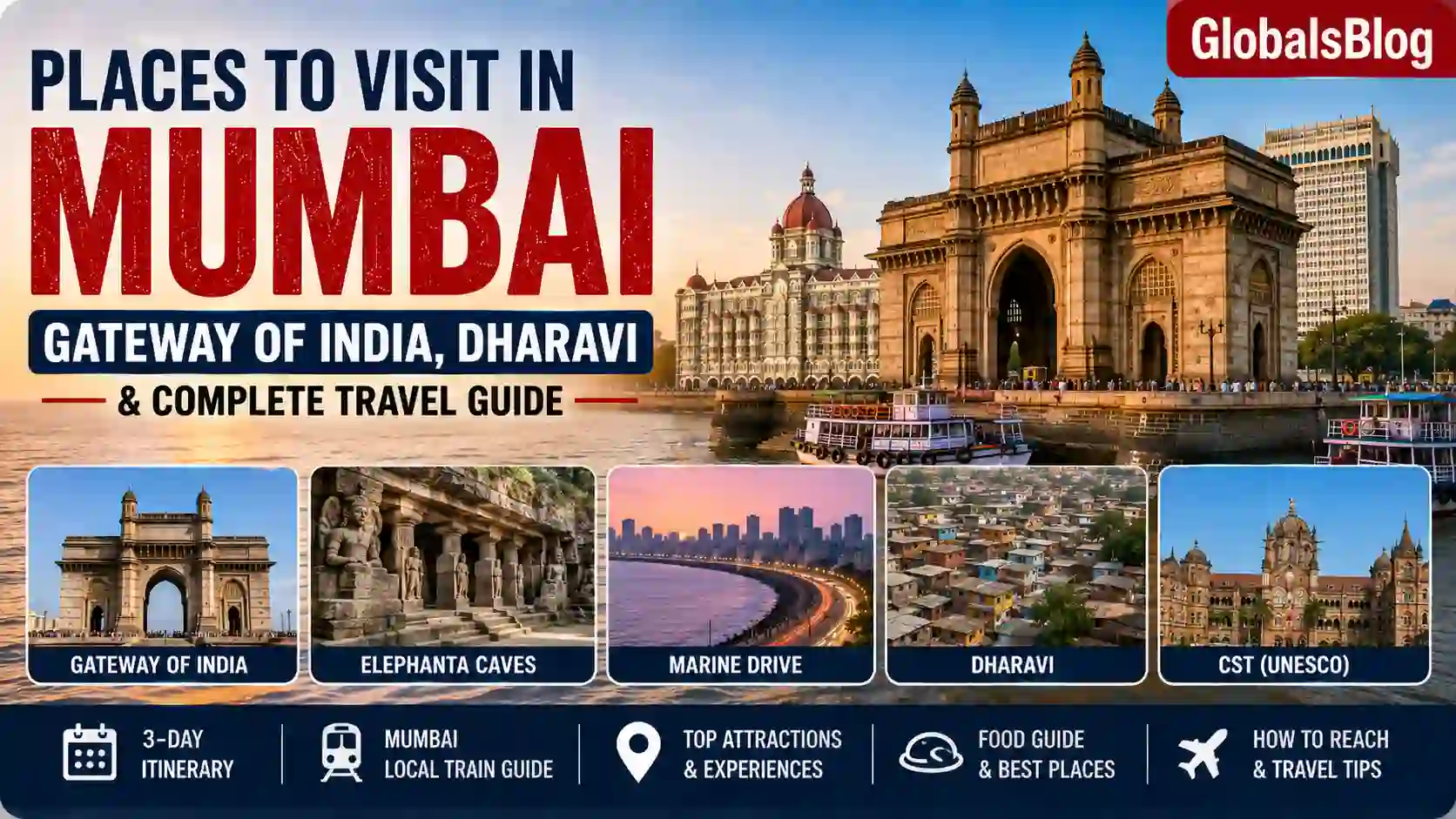
Mumbai is the city that never stops — 20 million people on a peninsula that runs out of land at both ends, a financial capital that contains Dharavi and the Antilia tower within 3 kilometres of each other, a food city where ₹30 vada pav and ₹3,000 tasting menus exist in the same neighbourhood. It is India's most contradictory and most energetic city, and it rewards every hour you spend outside the hotel.
A reader from Delhi had been to Mumbai eleven times on work trips — presentations in Bandra Kurla Complex, client dinners in Worli, flights home the next morning. On the twelfth trip she arrived a day early with no plan and took the suburban local train from CST to Churchgate on a Sunday morning, walked down Marine Drive at 7am while the city was running its Sunday loops, ate breakfast at Kyani & Co on Marine Lines (a Parsi Irani café that has been serving brun maska and chai since 1904), and then walked to the Gateway of India and took a boat to the Elephanta Caves. She said it was the first time in twelve trips she had experienced Mumbai as a place rather than a transit point. Mumbai's most important sites — the Art Deco marine drive, the Victorian Gothic university buildings, the Koli fishing villages that predate the city, the Dharavi that is not what most people expect, the caves, the beaches — are all accessible from the train. This guide covers them.
Best places in Mumbai: Gateway of India + Elephanta Caves (free gateway, ₹40 boat, ₹40 caves — UNESCO heritage), Marine Drive / Queen's Necklace (free, 3.6km promenade, best at dawn and sunset), Dharavi (guided tour ₹500–750 — Asia's most famous informal settlement, genuinely worth understanding), Chhatrapati Shivaji Maharaj Terminus CST (free, UNESCO — Mumbai's most magnificent building), Juhu Beach and Carter Road (free, sunset and street food), Colaba Causeway (free market, best for antiques and Mumbai street shopping), Elephanta Island (boat + caves), Sanjay Gandhi National Park (₹65, leopards in a national park within city limits). Best food: Vada pav everywhere, Kyani & Co for Irani café, Mahesh Lunch Home for seafood, Leopold Café for history, Swati Snacks for Gujarati. Best time: November–February. How to reach: flights from Delhi/Bengaluru (2 hrs), or Rajdhani Express.
Best Places to Visit in Mumbai
The Gateway of India — the 1924 basalt arch monument built to commemorate King George V's visit — is Mumbai's most photographed landmark and its symbolic entry point. The monument's history reverberates on multiple levels: the last British troops to leave India departed through this arch in February 1948, making it simultaneously the colonial welcome gate and the colonial farewell. The Gateway faces Apollo Bunder, the harbour where Bombay's early maritime trade was conducted, and now faces a constant activity of ferries, fishing boats, and tourists. Arrive at 6am to experience it before the day's overwhelming crowd arrives — the arch in the morning light with the Taj Mahal Palace Hotel behind it and the empty harbour before it is the most atmospheric single view in South Mumbai. The Elephanta Caves — reachable by a 25-minute ferry from the Gateway — are UNESCO World Heritage caves carved into the basalt of Elephanta Island (renamed Gharapuri, the City of Caves, in its original form) between the 5th and 8th centuries CE. The main cave contains the extraordinary Trimurti — a 6-metre-high three-faced bust of Shiva representing the three aspects of creation, preservation, and destruction — which is among the finest examples of Indian rock-cut sculpture anywhere in the world. The caves are carved directly into the island's basalt hillside and house multiple sculptural programmes depicting Shiva legends. The toy train from the ferry jetty to the cave entrance (₹10) carries visitors up the hill; the craft and souvenir market on the path is worth 15 minutes for specific Elephanta-themed items. Take the last ferry back to the mainland by 5:30pm.
Marine Drive is the most recognisable image of Mumbai — a 3.6km curved promenade along the Arabian Sea, lined on the inland side by Art Deco apartment buildings from the 1930s and 1940s that form part of the UNESCO Victorian Gothic and Art Deco Ensembles of Mumbai (recognised in 2018). The "Queen's Necklace" nickname comes from the view at night when the curved line of streetlights forms a necklace of light visible from the Malabar Hill viewpoints above. At dawn — 5:30–7am — Marine Drive belongs to Mumbai's walkers, runners, and fishing community; the sea is often misty, the light is oblique and golden, and the buildings' Art Deco facades catch the early sun in a way that midday doesn't replicate. At sunset — 6–8pm in winter — the entire city turns west and the Marine Drive parapet fills with residents watching the sun descend into the Arabian Sea. Walking the full 3.6km at a comfortable pace and returning by the same route takes approximately 1.5 hours — long enough to absorb the specific physical quality of Mumbai's seafront that no other city in India offers. The Nariman Point end has the Oberoi and Trident hotels; the Babulnath end approaches Chowpatty Beach (the site of the annual Ganesh Chaturthi immersion procession). Chowpatty at night, with bhel puri stalls and the sea visible behind them, is quintessential Mumbai street food culture.
Chhatrapati Shivaji Maharaj Terminus — CST, formerly Victoria Terminus or VT — is UNESCO World Heritage-listed and is the most magnificent railway station building in India and one of the finest examples of Victorian Gothic architecture anywhere in the world. Designed by Frederick William Stevens and completed in 1887, the building took ten years to construct and combines High Victorian Gothic elements (pointed arches, flying buttresses, gargoyles, peacock finials) with Indian decorative motifs (lotus flowers, traditional Indian figures alongside European griffins and tigers) in what Stevens described as "Indo-Saracenic Gothic." The central dome, the stained glass, the detailed stone carving, and the overall exuberance of the building are astonishing when encountered as a working railway station — approximately 3 million passengers pass through CST daily, making it one of the world's busiest stations housed in one of the world's most architecturally significant buildings. Stand outside on the traffic island directly facing the building's main façade at 7pm, when it is lit — the scale and the detail visible in the artificial light make CST the most impressive free experience in South Mumbai. The Heritage Gallery inside (ticket required, limited hours) covers the history of the Great Indian Peninsular Railway and the building's construction.
Dharavi is one of Mumbai's most misunderstood places — not a slum in the sense of a place of poverty and misery but a densely functioning urban settlement with an estimated GDP of $650 million annually generated by thousands of small industries (leather goods, pottery, recycling, textiles, food processing, embroidery) operating in the alleyways and ground-floor workshops. The settlement developed on what was originally mangrove land between Mahim and Sion as the city expanded — its 2.4 sq km houses approximately 600,000–1,000,000 people (estimates vary widely) and the community has been self-built, self-governed, and economically productive for over a century. A guided tour with Reality Tours and Travel (which directs 80% of its profits to local community projects) walks through the industrial sector — the recycling workshops where imported plastic is sorted, washed, and processed for resale; the pottery neighbourhood where Kumbharwada's potters have worked for generations; the bakeries and papad-making operations; and the residential lanes — with a guide who has grown up in Dharavi and can provide context that no outside observer can. Most visitors describe the Dharavi tour as the single most perspective-altering experience available in Mumbai. It is not poverty tourism — it is the most comprehensive education about how a city actually functions at its economic foundation, available nowhere else.
Colaba Causeway is Mumbai's most atmospheric street market — a long stretch of shops and pavement stalls selling antiques (genuine and reproduction), vintage items, silver jewellery, clothing, leather goods, and the accumulated detritus of Mumbai's colonial and post-independence past. The antique stalls are worth the most attention — genuine 19th and early 20th century items appear alongside reproduction pieces, and the experienced buyer can find remarkable objects at reasonable prices if willing to spend time. The Leopold Café (est. 1871, mentioned in Shantaram, still serving its unchanged combination of Irani café food and beer) and the Taj Mahal Palace Hotel (1903, the most historically significant hotel in India — where the Tata family opened to prove a point after Jamsetji Tata was refused entry to a European hotel) are both on this walk. The South Mumbai Heritage Walk is one of the most concentrated heritage architectural sequences available on foot anywhere in India: Gateway of India → Regal Cinema (1933 Art Deco) → Elphinstone College → University of Mumbai Rajabai Clock Tower (Gothic Revival, 1878) → High Court → Horniman Circle (originally the cotton exchange) → CST → Crawford Market (designed by William Emerson, with basreliefs by Kipling's father Lockwood Kipling). All within 3 kilometres of each other, all on foot.
Juhu Beach is Mumbai's most democratic public space — a 6km stretch of Arabian Sea shoreline in the western suburbs where Bollywood celebrities, middle-class families, and working-class residents of the northern suburbs all converge at sunset. The beach is not clean by tropical beach standards — it is an urban beach, and the quality of the experience is the city's energy rather than the sand's colour. The street food at Juhu (bhel puri mixed to order from the bhaiya vendors, pav bhaji at the permanent stalls, roasted corn) is some of Mumbai's most characteristically local food, available in profusion from 5pm onwards. Carter Road in Bandra — the promenade along the sea in the neighbourhood where much of Bollywood's residential and creative life happens — is a completely different texture: lined with cafés and restaurants (Candies, Prithvi Theatre's café nearby in Juhu), frequented by a creative and affluent crowd, with the best street-level café culture in the western suburbs. Versova, further north in Andheri, is quieter, has an active Koli fishing village adjacent to the beach, and gives the clearest picture of the traditional fishing community (Koli tribe) that inhabited the original seven islands of Mumbai before the city arrived around them.
Sanjay Gandhi National Park is one of the most extraordinary urban protected areas in the world — a 104 sq km national park with approximately 50 resident leopards, enclosed entirely within the boundaries of Greater Mumbai. The park hosts bird species (over 250 recorded), leopards, deer, and numerous reptile species within sight of the Borivali train station. The leopards occasionally venture into the urban areas on the park periphery — Mumbai's human-leopard interface is one of the most studied urban wildlife coexistence situations in the world — but within the park they are wild and the safari (open-top vehicle, morning or evening) offers genuine sightings in season. The Kanheri Caves within the park are an additional UNESCO-adjacent heritage experience — 109 rock-cut Buddhist caves carved between the 1st and 9th centuries CE, used as a monastic and learning complex at the height of Buddhist trade route activity in western India. The cave interiors contain inscriptions in several ancient scripts, water cisterns, prayer halls, and meditation cells carved directly into the basalt. Take the train to Borivali from CST (45 minutes) — the park entrance is a short auto-rickshaw ride from the station.
Mumbai's food culture is the most diverse in India — a city where Maharashtrian, Gujarati, South Indian, Parsi, Koli seafood, Muslim kebab, and cosmopolitan restaurant cuisines coexist in the same neighbourhood. The vada pav — a spiced potato fritter in a bread bun with dry garlic chutney — is Mumbai's quintessential street food, available at ₹20–30 at thousands of vendors across the city and consumed by approximately 12 million people daily. The Irani café tradition (Kyani & Co, Café Britannia, Café Mondegar — all in South Mumbai) is Mumbai's most specifically Zoroastrian contribution to its food culture: brun maska (a bread roll brushed with butter, the crust shattered and the inside soft and cold), Irani chai (dark, sweet, separately poured milk), and the specific unhurried café culture of a room where time moves differently. Mahesh Lunch Home (and its equivalent coastal Karnataka seafood restaurants in Fort) serve the most specific Mumbai seafood experience — bombil (Bombay duck fish) fried in semolina, surmai curry, crab in coconut masala, and the rawa-fried prawns that are the sea-facing contribution of the Koli fishing community to Mumbai's cuisine. Swati Snacks in Tardeo is the most refined Gujarati snack house in the city — the panki (rice flour pancake steamed in banana leaf), handvo (savoury lentil cake), and the thali represent the Gujarati community's specific contribution to a city whose merchant classes built much of its early commercial infrastructure.
Mumbai Tourist Places — Quick Reference
| Place | Entry | Best Time | Time Needed | Don't Miss |
|---|---|---|---|---|
| Gateway of India | Free | 6am dawn, evening | 30–45 min | Dawn without crowds |
| Elephanta Caves | ₹40 + ₹200 boat | 9am–3pm (catch last boat) | 3 hours total | Trimurti — 6m Shiva sculpture |
| Marine Drive | Free | Dawn 5:30am, sunset 6pm | 1–2 hours walk | Art Deco buildings, sea air |
| CST / VT | Free (station) | 7pm lit facade | 30–45 min | External Gothic façade at night |
| Dharavi | ₹500–750 tour | 9am–4pm (book ahead) | 2.5 hours | Industrial sector, Kumbharwada |
| Colaba + Heritage Walk | Free | 10am–2pm | 3–4 hours | Leopold Café, Taj Mahal Palace, Horniman Circle |
| Juhu + Carter Road | Free | Sunset 6–8pm | 2–3 hours | Bhel puri, Bandra café scene |
| Sanjay Gandhi NP | ₹65 + ₹1,130 safari | Dawn safari best | Half day | Leopard safari, Kanheri Caves |
Mumbai 3-Day Itinerary
Day 1 (South Mumbai — Heritage and Sea): 5:30am: Marine Drive at dawn — walk from Nariman Point to Chowpatty (3.6km). 7:30am: Brun maska and chai at Kyani & Co, Marine Lines (₹40 total). 9am: Depart for Elephanta Caves — boat from Gateway Jetty (9am first boat). 12:30pm: Return from Elephanta to Gateway. 1:30pm: Vada pav from a street vendor (₹20). 2pm: CST Heritage walk — CST façade, Horniman Circle, Crawford Market. 5pm: Rest/hotel. 7pm: Gateway of India at night — the lit arch, the Taj Hotel, the harbour. 8pm: Dinner at Mahesh Lunch Home (seafood, Fort).
Day 2 (Dharavi + Western Suburbs): 9am: Dharavi guided tour (Reality Tours, 2.5 hours — book in advance). 12pm: Lunch at a local restaurant near Dharavi. 2pm: Train from Dadar to Bandra (15 minutes). 3pm: Bandra West walk — Carter Road promenade, St Andrew's Church, Mount Mary Basilica (Bandra's most significant heritage church, above the sea). 5pm: Carter Road sunset. 7pm: Dinner in Bandra (Pali Village Café, The Smoke House Deli, or Bastian for seafood).
Day 3 (Sanjay Gandhi National Park + Colaba): 6am: Train to Borivali, Sanjay Gandhi National Park morning leopard safari (6:30am). 11am: Kanheri Caves (within SGNP, ₹25 extra, 109 Buddhist caves). 2pm: Return to South Mumbai by train. 4pm: Colaba Causeway shopping — antiques, vintage, silver. 6pm: Leopold Café for a beer and the tourist-meets-institution experience. 7pm: Swati Snacks (Tardeo, must reserve) for Gujarati evening meal.
How to Get Around Mumbai
| Mode | Best For | Cost | Notes |
|---|---|---|---|
| Suburban Local Train | All major north-south journeys | ₹5–30 per trip | CST→Bandra: 30 min; CST→Borivali: 50 min. Fast trains skip stations — check |
| Metro (Lines 1–6) | East-West connections | ₹10–50 per trip | Expanding network — Line 3 (Aarey–BKC underground) opened 2024 |
| Uber/Ola | Short distances, hotel to station | ₹80–300 per trip | Surge pricing in peak hours, traffic unpredictable |
| Black-and-Yellow Taxi | South Mumbai specifically | ₹30 minimum, meter-based | Mumbai's iconic taxis, comfortable, metered — ask for meter always |
| Auto-rickshaw | Suburbs only (not South Mumbai) | ₹20–100 per trip | Not permitted in South Mumbai below Mahim |
| Ferry/Boat | Gateway → Elephanta; Mandwa (to Alibaug) | ₹150–200 return | Best mode for specific island destinations |
The suburban local train is the single most important piece of transport infrastructure in Mumbai — carrying approximately 7.5 million passengers daily on three lines (Western, Central, Harbour) and connecting every major destination in the city from CST to Borivali in under an hour. For visitors, the local train is safe, fast, cheap, and the only way to experience Mumbai as Mumbai rather than as a traffic jam. Take the Western Line from Churchgate northward (Bandra, Andheri, Borivali) and the Central Line from CST (Dadar, Kurla, Ghatkopar). Peak hours (8–10am, 6–9pm) are extremely crowded — travel outside these windows when possible.
How to Reach Mumbai
| Mode | From | Duration | Cost | Notes |
|---|---|---|---|---|
| Flight (recommended) | Delhi / Bengaluru / Hyderabad | 2–2.5 hrs | ₹3,000–8,000 | CSMI Airport (T2) — 30km from South Mumbai, 45 min–1.5 hr by taxi |
| Train — Rajdhani | Delhi (Hazrat Nizamuddin) | 16–17 hrs | ₹1,200–3,500 AC | Mumbai Central or LTT — overnight, arrives morning. Book 60+ days ahead |
| Train — Tejas/Shatabdi | Ahmedabad | 7–8 hrs | ₹600–1,800 | Tejas Express — premium, good western India connection |
| Train | Pune | 3–3.5 hrs | ₹300–700 | Deccan Queen, Shatabdi — morning departure, full day in Mumbai |
| Road | Pune (expressway) | 3–4 hrs | Fuel + toll ₹800 | Mumbai-Pune Expressway — good road but Mumbai entry traffic unpredictable |
Flight is recommended from Delhi, Bengaluru, and Hyderabad — CSMI T2 is the primary airport, with good Metro (Line 3 now connects to BKC) and taxi connections. From the airport to South Mumbai (Colaba/Fort area) by taxi is ₹600–800 and approximately 45 minutes to 1.5 hours depending on traffic. Pre-paid taxi counter at arrival is reliable. The Rajdhani from Delhi is the recommended overnight train option — book well in advance as it is consistently waitlisted.
✓ Mumbai Travel Tips
- Take the local train — once, at minimum: The Mumbai suburban local train is one of the most important public infrastructure experiences available to any Indian traveller. The sheer scale of its operation — 7.5 million daily journeys, the precision of its headways during peak hours (trains every 2–3 minutes at CST), the specific social world of the compartment — is Mumbai made tangible. Take the Central Line from CST to Dadar or the Western Line from Churchgate to Bandra on a weekday mid-morning (avoiding peak crush) for the full experience without the dangerous crowd level. Buy a platform ticket (₹10) from the counter if not travelling by train, to walk the CST concourse
- Dawn at Marine Drive is the most important 90 minutes in Mumbai: At 5:30am, Marine Drive belongs to Mumbai's runners, the fishing community heading to the docks, the early morning yoga groups on the parapet, and the occasional insomniac sitting on the sea wall. The Art Deco buildings across the road are visible in the oblique early light, the sea is often misty, and the city is almost quiet. By 8am, the commuter traffic has taken Marine Drive back. The 90-minute window between 5:30am and 7am is the only time Marine Drive is simultaneously beautiful and quiet — and it requires only an alarm clock to access
- The Dharavi tour is not what you expect — and that is the point: Most first-time visitors to Dharavi expect visible poverty and social distress. The actual experience — the recycling industry's extraordinary efficiency, the pottery community's skill, the neighbourhood's tight social fabric, the guide's articulate pride in the community — is a correction of the narrative formed by slum tourism clichés. Go with Reality Tours specifically: they have the best community relationships and the most contextually informed guides
- Monsoon Mumbai (June–September) is extraordinary: Mumbai's monsoon is the most dramatic weather event of any Indian city — the Arabian Sea monsoon makes landfall with average rainfall of 2,000mm over 3–4 months, producing waterfall-conditions on the roads, a transformed coastal landscape, and the specific pleasure of the local train in rain. The heritage sites remain accessible; Elephanta boats may be cancelled in rough weather. Marine Drive in the monsoon — waves crashing over the parapet — is a completely different and equally compelling experience from the summer version
- See our Pune guide for the natural day trip from Mumbai, and our Goa guide for the overnight train destination from Mumbai
✗ Mumbai Mistakes to Avoid
- Spending all your time in South Mumbai and skipping the train: The visitor who stays in Colaba, goes to the Gateway, walks Marine Drive, and takes a cab to Bandra for dinner has experienced a version of Mumbai that is real but incomplete. Mumbai's distinct character — the scale, the democracy, the energy — is fully visible only on the local train, in the suburb stations like Dadar or Kurla at 6pm, at Juhu beach at sunset, in the Dharavi lanes. South Mumbai is the city's heritage face; the trains and the suburbs are its daily reality
- Missing the last Elephanta boat: The last regular ferry from Elephanta Island back to the Gateway is approximately 5:30pm. Missing it means waiting for a private chartered boat at a significantly higher price or staying on the island overnight (no tourist accommodation). Set a phone alarm for 4:45pm to begin returning to the jetty. The toy train from the caves to the jetty takes 10 minutes
- Taking a cab everywhere instead of the train: Mumbai's surface road traffic makes cab journeys between South Mumbai and the suburbs (Bandra, Andheri, Borivali) take 1–2.5 hours in peak traffic. The same journey takes 30–50 minutes by train. At ₹15–30 for the train versus ₹200–600 for a cab, and with the train being 3–5× faster, there is no reason to take a cab for major north-south journeys. The only exception: the airport run, for which there is no direct train option from South Mumbai
- Expecting Mumbai's beaches to be clean beach holidays: Juhu, Versova, Chowpatty, and Girgaon Chowpatty are urban beaches — their value is the city's energy, the food vendors, the sunsets, and the democratic public space they represent, not the sand quality or water cleanliness. If a clean beach holiday is the requirement, Alibaug (ferry from Gateway, 1 hour) is the nearest option and produces a completely different coastal experience
⚠️ Disclaimer: Mumbai entry fees, ferry timings, and local train routes change periodically. Elephanta ferry schedules are weather-dependent — the boat does not operate in rough monsoon sea conditions. All prices are indicative as of August 2026. Dharavi tour bookings should be made in advance at realitytoursandtravel.com. Verify current local train timetables and Sanjay Gandhi National Park safari booking requirements before visiting.
Marine Drive at Dawn. CST at 7pm. Dharavi With a Guide. Elephanta for the Trimurti. Kyani & Co for Chai. Mahesh for Seafood. The Local Train for Mumbai Itself. The City Rewards Every Hour Outside the Hotel.
The Delhi reader who spent eleven trips in BKC and Worli before discovering Mumbai on the twelfth made the journey that most visitors eventually make — from the city as a professional context to the city as a place. The local train from CST to Churchgate on a Sunday morning at 7am, the brun maska at Kyani & Co, the Elephanta boat, the Marine Drive at dawn — none of these require planning, money, or insider knowledge. They require leaving the hotel earlier and spending the money on a train ticket rather than a cab. Mumbai's rewards are entirely proportional to the attention paid. Walk Marine Drive at 5:30am. Take the train to Dharavi. Go to CST at 7pm and stand on the traffic island and look at the building. Eat a ₹20 vada pav at Dadar station. These are the experiences the city has been providing to anyone who showed up for them — for over a century.
Best places to visit in Mumbai: Gateway of India (free, Colaba — dawn visit essential, depart for Elephanta from here); Elephanta Caves (₹200 boat return + ₹40 caves — UNESCO 5th-9th century rock-cut caves, 6m Trimurti sculpture); Marine Drive (free, 3.6km Art Deco promenade — dawn 5:30am or sunset 6pm); CST / VT (free, UNESCO Victorian Gothic railway station — 7pm facade illuminated); Dharavi (₹500–750 guided tour with Reality Tours — Asia's most productive informal settlement); Colaba Causeway + South Mumbai Heritage Walk (free — antiques, Leopold Café, Taj Mahal Palace, Horniman Circle); Juhu Beach and Carter Road Bandra (free — sunset + bhel puri + Bandra café scene); Sanjay Gandhi National Park (₹65 + ₹1,130 safari — 50 leopards within city limits + Kanheri Caves). Best food: vada pav everywhere (₹20), Kyani & Co for Irani chai, Mahesh Lunch Home for coastal Karnataka seafood, Swati Snacks for Gujarati.
How to reach Elephanta Caves from Mumbai: Take a ferry from Gateway of India (Apollo Bunder, Colaba). Ferry timings: 9am–5:30pm daily (roughly every 30 minutes). Ticket: ₹200 return (AC launch) or ₹150 (regular launch) — buy at the jetty counter. Journey time: approximately 25 minutes each way. On the island: toy train from jetty to cave entrance (₹10 one way, 10 minutes) or walk uphill (20 minutes). Cave entry: ₹40 (Indians). Spend 1.5–2 hours in the caves. Important: the last regular ferry back to Gateway departs approximately 5:30pm — set an alarm for 4:45pm to start returning to the jetty. Missing the last ferry means arranging a private boat at significant extra cost. The ferry does not operate in rough weather during the monsoon (June–August) — check conditions before visiting.
Yes — a guided Dharavi tour with Reality Tours and Travel is consistently described by first-time visitors as the most perspective-changing experience available in Mumbai. Dharavi is not the poverty-tourism destination that its reputation as "Asia's largest slum" suggests — it is a densely functioning urban settlement with an estimated annual economic output of $650 million from thousands of small industries (recycling, leather goods, pottery, textile, food processing). The 2–2.5 hour walking tour covers the industrial sector, the Kumbharwada pottery neighbourhood, and the residential lanes with a guide who has grown up in the community. No photography of residents is permitted during the tour. Reality Tours directs 80% of profits to community development projects. Book at realitytoursandtravel.com, ₹500–750 per person, morning and afternoon departures. The tour is appropriate for adults and older teenagers; not recommended for young children due to the dense, narrow lanes. It is one of the most educational 2.5 hours available anywhere in India.
Best time to visit Mumbai: November to February is the most pleasant season — temperatures 15–30°C, lower humidity, all outdoor attractions comfortable. December is peak season — Christmas and New Year festivities on Marine Drive and in Bandra are excellent. October (Ganesh Chaturthi immersion at Chowpatty Beach) and Navratri (garba at various venues) are particularly culturally rich periods. Monsoon (June–September): Mumbai's monsoon is dramatic — the Arabian Sea storm surge, Marine Drive waves crashing over the parapet, and the lush greenery of Sanjay Gandhi National Park make it a visually extraordinary period. Elephanta ferries may be suspended in rough weather. The local trains continue operating in monsoon. Summer (March–May): hot and humid (33–38°C, 70–80% humidity), but all indoor attractions remain comfortable. Avoid peak Diwali (October–November) if you are noise-sensitive — Mumbai's Diwali is extremely loud. The city has no "bad" season — each period has a specific character worth experiencing.
Mumbai is famous for: Bollywood (Hindi film industry — the world's largest film industry by output, headquartered in Bandra, Juhu, and Film City Goregaon); the Gateway of India (1924, colonial arch monument); the Taj Mahal Palace Hotel (1903, India's most historically significant hotel); the suburban local train system (7.5 million daily journeys, world's most intensively used commuter rail); CST railway station (UNESCO World Heritage, 1887 Victorian Gothic); Marine Drive / Queen's Necklace (Art Deco promenade UNESCO ensemble); vada pav (Mumbai's street food icon, consumed by ~12 million people daily); Dharavi (one of the world's most-studied informal urban settlements, $650M annual economic output); Elephanta Caves (UNESCO, 5th–8th century Shiva rock-cut sculptures); Ganesh Chaturthi (the largest public festival in Mumbai, with Chowpatty immersion watched by millions); and as India's financial capital — home to BSE, NSE, RBI headquarters, and the majority of India's corporate headquarters.
3 days is the recommended minimum for Mumbai to cover the main attractions across South Mumbai and the western suburbs. Day 1: Marine Drive dawn + Elephanta Caves + South Mumbai heritage walk + Gateway of India evening. Day 2: Dharavi guided tour + Bandra Carter Road + Juhu sunset. Day 3: Sanjay Gandhi National Park + Kanheri Caves + Colaba Causeway + Swati Snacks. A single day covers Gateway, Marine Drive, and CST but misses Dharavi, the train experience, and the western suburbs. 4–5 days allows adding the Hanging Gardens (Malabar Hill viewpoint), Chhatrapati Shivaji Maharaj Vastu Sangrahalaya museum (Prince of Wales Museum), Haji Ali Dargah (mosque on an island, connected by a causeway at low tide), Worli Sea Face, and Alibaug day trip by ferry from Gateway. Mumbai rewards extended stays — the city reveals different characters at different times of day and in different neighbourhoods.
Leave a comment
Share a quick thought about this story.
Thanks for sharing your view. It is ready for review.
Please try again in a moment.