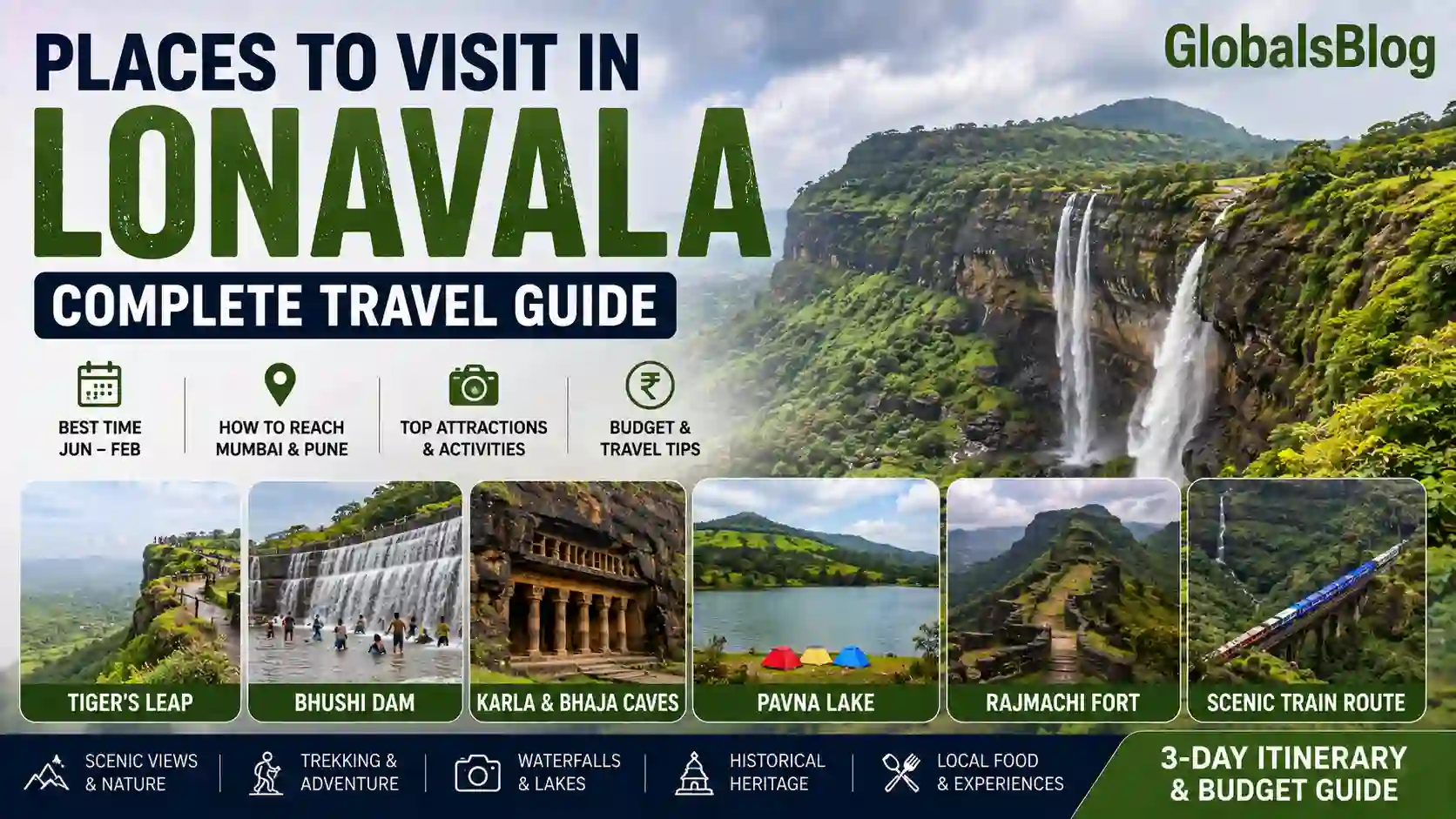
Tiger's Leap drops sheer for 650 feet into the Sahyadri valley — a granite escarpment that turns into a waterfall during monsoon. The Karla Caves contain one of the finest surviving examples of early Buddhist rock-cut architecture in India, dating to the 2nd century BCE. Bhushi Dam overflows in a white cascade every July and August. And chikki — Lonavala's legendary peanut-jaggery brittle — is sold from every shop on the main street. This is Maharashtra's most beloved hill station, and one of India's most visited weekend escapes.
Lonavala — 83km from Mumbai and 65km from Pune on the Mumbai–Pune Expressway — sits at 622m in the Sahyadri range of the Western Ghats, on the edge of the Deccan Plateau where it drops dramatically into the Konkan coast below. The name comes from Marathi "lena" (caves) and "vala" (valley) — referencing the extensive Buddhist rock-cut cave complexes (Karla, Bhaja, Bedse) that define the region's ancient history. The town was developed by the British as a hill resort in the 1870s, and has been Maharashtra's primary weekend escape ever since — a 1.5–2 hour drive from Mumbai and 1 hour from Pune makes it accessible for a Saturday morning departure and Sunday evening return. The town itself is a commercial strip of chikki shops, restaurants, and souvenir stalls — the charm is not in the town but in the Sahyadri landscape around it: the green valleys, the rock-cut caves, the forts, the waterfalls, the lake, and the viewpoints where the escarpment drops to the Konkan 600m below. Lonavala is most spectacular during monsoon (June–September) when the entire Sahyadri turns intensely green and every waterfall runs full — but it is visited year-round and has something to offer in every season. This guide covers every major Lonavala attraction, the Pavna and Mulshi lake circuits, the Rajmachi fort trek, practical logistics, and how to plan an ideal 2–3 day visit.
Best places in Lonavala: Tiger's Leap (650-foot viewpoint, best in monsoon when it becomes a waterfall), Karla Caves (2nd century BCE Buddhist rock-cut caves, finest chaitya griha in India), Bhaja Caves (older than Karla, monastery cells, carved chariots), Bhushi Dam (overflows in monsoon, family picnic spot), Lonavala Lake (walking distance from town, sunset), Lion's Point (sunrise and sunset views over Sahyadri), Pavna Lake (16km from Lonavala, camping and boating), Rajmachi Fort Trek (21km, Shrivardhan and Manaranjan forts, overnight camping). Best time: June–September (monsoon, green and waterfalls). How to reach: Mumbai 83km/1.5 hrs, Pune 65km/1 hr by expressway or train. Budget: ₹800–2,000/night.
Best Places to Visit in Lonavala
Tiger's Leap — locally called Waghdari — is Lonavala's most spectacular viewpoint: a projecting granite promontory that drops 650 feet sheer into the Sahyadri valley below, its shape resembling a leaping tiger when viewed from the valley. In the dry season (October–May), Tiger's Leap offers the finest panoramic views in the Lonavala area — the full sweep of the Sahyadri escarpment, the green-and-brown plateau above and the dense Konkan forest far below. In monsoon (June–September), the waterfall that forms on the leap's face runs white and full, visible from kilometres away — the leap becomes one of the finest waterfall viewpoints in Maharashtra. The site is 10km from Lonavala town on the road toward Khandala — accessible by vehicle to within 200 metres of the viewpoint, then a short walk. The Maharashtra Tourism Development Corporation (MTDC) manages a small garden at the viewpoint. Entry is free. The approach road from Lonavala passes through the Tungarli area — the whole drive is scenic in monsoon with waterfalls visible on the hillsides. Best visit: early morning (7–9am) for clear visibility before clouds build; or midday in monsoon when the leap is in full waterfall. The Khandala Ghats viewpoints (Duke's Nose, Sunset Point in Khandala) are on the same road and naturally combined with Tiger's Leap.
Karla Caves are the most significant historical attraction in the Lonavala region and one of the finest surviving examples of early Buddhist rock-cut architecture in India. The main attraction is the Great Chaitya (prayer hall) — a 45-metre-long, 14-metre-wide, and 15-metre-high rock-cut chaitya griha carved from solid basalt in the 2nd century BCE, with a wooden apsidal nave, carved columns with elaborate human and animal capitals, and the finest surviving wooden ribbed vault in any rock-cut cave in India. The main chaitya is among the largest and best-preserved early Buddhist prayer halls in the subcontinent — a space of genuine architectural grandeur that rewards a slow, attentive visit rather than a rapid tourist pass-through. The cave complex includes additional chaityas, viharas (monastery residences for monks), and a Shri Ekveera Devi Temple (a Hindu temple built within the cave complex in more recent times that is a major pilgrimage centre for Maharashtrian families). The 200-step staircase from the road to the cave entrance passes stalls selling prasad and souvenirs — often crowded on weekends. Entry is ₹35 per person (Indian). Open 9am–5pm. The Karla Caves are 11km from Lonavala town, easily combined with Bhaja Caves (6km further) in a morning circuit. A guide (available at the entrance, ₹200–300) is helpful for understanding the architectural significance and Buddhist symbolism of the carvings.
Bhaja Caves are the older and less-visited sister complex to Karla — 22 rock-cut monuments from the 2nd–1st century BCE set on a dramatic hillside 22km from Lonavala. While Karla has the finest single chaitya, Bhaja has a more complete collection of early Buddhist monastic life — the complex includes a chaitya (smaller than Karla's but equally atmospheric), 18 viharas (monk residence cells cut into the cliff face, each with a stone sleeping platform), a set of relief carvings showing a war chariot and elephant procession (among the earliest surviving such reliefs in India), and a spectacular waterfall that appears immediately beside the cave entrance during monsoon, turning the rock-cut complex into one of the most dramatically sited monuments in Maharashtra. Bhaja is significantly less crowded than Karla — the extra 11km discourages casual visitors, making it the better choice for travellers who want to experience the caves in relative peace. Entry is ₹35 per person. The walk to the caves from the road is a 15-minute uphill path. Combine Bhaja with Karla on the same day — Karla first (11km from Lonavala), then drive to Bedsa or Bhaja (17km further). The combination takes 4–5 hours including travel.
Bhushi Dam is Lonavala's most popular picnic destination — a small dam on the Indrayani River whose overflow during monsoon (July–September) creates a wide, cascading waterfall over the spillway steps that visitors wade and play in. The cascading overflow steps have become one of the most photographed spots in Maharashtra during the monsoon — the scene of families and groups wading in the knee-deep flow over the stone steps while the green Sahyadri hillsides rise behind. In the dry season (October–May), Bhushi Dam is a pleasant reservoir with boat rides available (₹50–100/person) and picnic areas around the water. The monsoon transformation is dramatic — the same site that is a quiet reservoir in March becomes a cascading waterfall scene in August. Important safety note: the flow over Bhushi Dam's steps during heavy monsoon can be stronger than it appears and has caused accidents. Do not enter the overflow area when the flow is above knee height, do not bring children into the flow without holding them firmly, and heed any barriers or safety announcements from the dam management. The site is 10km from Lonavala town and tends to be heavily crowded on July–August weekends — visit on a weekday morning for the best experience.
Lion's Point is Lonavala's finest sunrise viewpoint — a escarpment viewpoint 13km from the town that looks west over the full sweep of the Sahyadri range dropping to the Konkan below. The rock formation at the viewpoint's edge loosely resembles a lion's head, giving it its name. At sunrise (5:30–7am, varying by season), the valleys below are full of cloud that gradually burns off as the sun rises — the "sea of clouds" effect common at Sahyadri escarpment viewpoints is most reliable here in the monsoon months (June–September) when low cloud fills the Konkan valleys each morning. Lion's Point is less visited than Tiger's Leap because it requires a pre-dawn departure from Lonavala to arrive in time for sunrise — but the visitors who make the effort consistently rate it as their finest Lonavala experience. The 13km road is manageable in any vehicle. A small MTDC garden and tea stalls operate at the point from early morning (6am onwards). Combine Lion's Point sunrise with a Bhushi Dam visit (10km from Lonavala) on the return, then Karla Caves in the late morning — a full-day western circuit.
Pavna Lake — officially Pawna Dam reservoir — is a large reservoir 16km from Lonavala that has developed into one of Maharashtra's most popular camping destinations. The lake is surrounded by the Sahyadri peaks including the Rajmachi fort ridgeline, Tung Fort, and Tikona Fort — creating a dramatic landscape of water, fortified peaks, and green hillsides that is particularly spectacular in post-monsoon (September–November) and winter (December–February). Camping is the primary activity at Pavna: multiple operators along the lakeshore offer tent camping with bonfire and dinner packages (₹800–2,000/person including dinner, bonfire, and breakfast). Boating on the lake (sunrise and sunset boat rides, ₹150–300/person) is available through the camping operators. The camping at Pavna — with the Rajmachi and Tikona fort silhouettes visible across the water and the bonfire in the evening — is the most atmospheric overnight experience within easy reach of Mumbai or Pune. Pavna is also the basecamp for treks to Tung Fort (2 hours) and Tikona Fort (3 hours) — both uncrowded alternatives to the more visited Rajmachi that can be combined with a Pavna overnight. The lake is a 25-minute drive from Lonavala town. Camping operators: book in advance for weekends (the lakeside fills up), especially October–January.
Rajmachi Fort — actually two forts on two peaks of the same ridge (Shrivardhan at 840m and the slightly lower Manaranjan) — is the finest trek accessible from Lonavala. The route from Lonavala town (21km, 6–7 hours one-way) follows a forest path through the Sahyadri that is manageable without a guide for reasonably fit trekkers with experience. The fort complex at the summit dates from the 17th century and was a key strategic position in Shivaji's Maratha kingdom — the two fortified peaks controlled the ghats below and the Konkan trade routes. The view from Rajmachi's ramparts: Pavna Lake far below, the Konkan coast on clear days, and the surrounding Sahyadri peaks in every direction. The trek requires an overnight stay at Udhewadi village (3km before the summit) where home stays are available (₹300–500/person, basic but genuine — the village families serve Maharashtrian meals). Starting the Rajmachi trek at dawn from Lonavala allows reaching Udhewadi by late afternoon for the overnight, then Rajmachi summit the next morning in clear light, and returning to Lonavala by evening. The alternative route from Karjat (Konkan side) is shorter (13km) but requires more complex logistics. The Rajmachi trail passes through dense Sahyadri forest — particularly spectacular in monsoon when the forest is intensely green and mushrooms cover every fallen tree.
Lonavala Lake (2km from the main market) and Tungarli Lake (4km from town) are the two town-area water bodies that provide pleasant walking and sunset experiences without requiring a vehicle. Lonavala Lake is a small reservoir surrounded by the Sahyadri hills — a 30-minute walk from the town centre following the Lonavala Lake Road, with a path around the lake perimeter (approximately 3km total circuit) that is pleasant in the early morning and evening. The lake fills and its surroundings green during monsoon — July–August is the finest time for the lake walk. Tungarli Lake is slightly larger and quieter — 4km from town through a forested area. Both lakes are free. The Lonavala Lake area has a dam wall that overflows slightly in monsoon, a small garden, and the Lonavala Lake view (popular with cyclists and runners from the town). For visitors staying in Lonavala for a full weekend, an early morning walk to Lonavala Lake (6am, before the town wakes up) is one of the most pleasant ways to start a day in the area — the lake surface is mist-covered in monsoon mornings and the surrounding hills catch the first light before the crowds arrive at the main attractions.
The Lonavala main market (particularly the chikki shops on the Mumbai–Pune Old Highway in the town centre) is a mandatory experience — Lonavala is India's chikki capital, and the peanut-jaggery brittle that is the town's signature product is sold in hundreds of varieties across dozens of shops that have been competing for market share for generations. The original Lonavala chikki uses coarse jaggery (not refined sugar) and whole roasted peanuts in a recipe that has remained essentially unchanged since the late 19th century. Key chikki shops: Maganlal Chikki, Cooper's Chikki, and the Lonavala Chikki (the brand, not the generic product) — all three have been operating for multiple generations and all three produce genuinely different products (Maganlal's is crunchier and less sweet; Cooper's has the widest range including chocolate variations; Lonavala Chikki has the most retail-friendly packaging for gifting). Beyond chikki: Lonavala also produces choco-fudge (a dense, slightly bitter chocolate fudge unique to the town), strawberry jam (from the Mahabaleshwar strawberry season that reaches Lonavala shops), and walnut brittle. The entire main market strip is best explored in the evening (6–9pm) when shops are fully lit and active — budget ₹500–1,500 for a worthwhile chikki and fudge assortment for home.
Khandala — 3km west of Lonavala on the old Mumbai–Pune road — has its own set of escarpment viewpoints that complement Lonavala's sights. Duke's Nose is a prominent rocky outcrop on the escarpment edge above the Bhor Ghat (the ancient mountain pass that preceded the expressway) — a popular rock climbing and rappelling site as well as a viewpoint. The rock climbs at Duke's Nose are managed by local adventure operators and are among the most accessible beginner climbing routes in Maharashtra. Sunset Point in Khandala is the classic viewpoint for sunset over the Konkan and the lights of the cities below appearing at dusk. The Ghat section of the old Mumbai–Pune highway (Bhor Ghat) — the winding mountain road that predates the expressway — offers continuous valley views on the descent and is worth driving if you have a full day and want to experience the old ghat road versus the expressway. Combined with Tiger's Leap (10km from Lonavala in the same direction), Khandala's viewpoints complete the western escarpment circuit — Tiger's Leap + Duke's Nose + Khandala Sunset Point is a 3–4 hour half-day drive with multiple stops.
How to Reach Lonavala
| Route | Mode | Duration | Cost (approx) | Notes |
|---|---|---|---|---|
| Mumbai → Lonavala | Drive (Mumbai–Pune Expressway) | 83km · 1.5 hrs | ₹320 toll + fuel | Fastest — E-way direct to Lonavala exit |
| Mumbai → Lonavala | Train (Deccan Express, Shatabdi) | 1.5–2 hrs | ₹80–600 depending on class | Frequent CSMT/Dadar departures, direct to Lonavala station |
| Pune → Lonavala | Drive (Mumbai–Pune Expressway) | 65km · 1 hr | ₹280 toll + fuel | 30 minutes less than Mumbai drive |
| Pune → Lonavala | Train | 1 hr | ₹40–300 | Multiple daily trains, Lonavala station central |
| Mumbai → Lonavala | MSRTC bus (Shivneri / Asiad) | 2–2.5 hrs | ₹200–400 | From Mumbai Central and Dadar — frequent service |
The train is the recommended option for visitors without a car — Lonavala station is in the town centre, trains are frequent from both Mumbai and Pune, and the rail approach through the Sahyadri Ghats is itself scenic (particularly the Bhor Ghat section). For weekend trips requiring flexibility to reach Bhushi Dam, Karla Caves, and Pavna Lake, a car or hired vehicle is needed — auto-rickshaws and taxis within Lonavala can cover most sites but at higher cumulative cost than a full-day hired vehicle (₹1,500–2,500 for a car for the day from Lonavala station).
Lonavala 3-Day Itinerary
| Day | Morning | Afternoon / Evening |
|---|---|---|
| Day 1 | Arrive, Lonavala Lake walk (6am), town breakfast | Karla Caves + Bhaja Caves circuit (11am–3pm), chikki shopping evening market |
| Day 2 | Lion's Point sunrise (5am departure), Bhushi Dam (monsoon overflow) | Tiger's Leap + Khandala Duke's Nose, sunset from Khandala Sunset Point |
| Day 3 | Pavna Lake morning — sunrise boat ride | Rajmachi Fort base hike (4–5 hours partial) or return to Mumbai/Pune |
Lonavala Budget Guide
| Category | Budget | Mid-Range | Premium |
|---|---|---|---|
| Accommodation/night | ₹800–1,500 (guesthouses, lodges) | ₹2,500–6,000 (hotels) | ₹8,000–25,000 (resort, villa) |
| Food/day | ₹300–500 (local Maharashtrian, misal pav) | ₹700–1,200 | ₹1,500–3,000 |
| Transport/day | ₹300–600 (auto-rickshaw) | ₹1,500–2,500 (hired car) | ₹3,000–5,000 (private cab) |
| Activities/entry | ₹100–300 | ₹300–800 | ₹800–2,500 |
| Total/day (excl. travel) | ₹1,500–2,800 | ₹5,000–10,500 | ₹12,300–35,500 |
Lonavala Travel Tips
- Monsoon is the best season but requires safety awareness: June–September transforms Lonavala into the finest version of itself — the Sahyadri is intensely green, every waterfall runs, Bhushi Dam overflows, Tiger's Leap becomes a waterfall, and the Buddhist caves are framed by cascading water. However: Bhushi Dam overflow can be dangerously strong during heavy rain, trekking trails become slippery (use trekking shoes, not sandals), the expressway has higher accident rates in heavy rain (drive carefully), and visibility at viewpoints is often zero during active rain (fog and cloud completely close the view). Visit monsoon for the green landscape and waterfalls — check the dam water level before entering Bhushi overflow steps, and be prepared for zero-visibility viewpoint visits on rainy days
- Weekend overcrowding — visit weekday or very early Saturday: Lonavala is one of India's most visited weekend destinations — peak weekends in July–August can see 2-hour expressway queues from Pune and serious parking congestion at Bhushi Dam and Tiger's Leap. If your schedule allows, visit on a weekday (Friday–Monday gives you the benefit of post-weekend quiet on Monday). For weekend visits: arrive Friday evening or very early Saturday (6am) to beat the peak crowds that build from 9am onward
- Karla Caves on a weekday for the full experience: The Great Chaitya at Karla is extraordinary — one of India's finest ancient spaces. But on peak weekends (especially during the Navratri festival when the Ekveera Devi Temple draws massive crowds), the 200-step approach and the chaitya interior can have queues and noise that destroy the contemplative atmosphere. A Tuesday morning visit (low season, 9:30am arrival) allows the Great Chaitya in near-solitude for the first 30 minutes. If you can only visit on a weekend, arrive at opening time (9am) before tour buses arrive
- Lonavala food specialties worth seeking out: Beyond the famous chikki, Lonavala's local food scene has specific dishes worth finding. Misal pav (₹60–80) at the simple eateries near the bus stand is the best breakfast — the Maharashtrian spiced sprout curry with bread is more authentic here than at Mumbai restaurant chains. Vada pav from the morning street vendors (₹15–20) is excellent. The corn bhutta (roasted corn) sold at every viewpoint is a Lonavala tradition — the Sahyadri corn roasted on coal with butter, salt, and lime is the definitive viewpoint snack in the region
- Pavna Lake camping — book in advance for weekends: The Pavna lakeside camping fills up weeks in advance for October–January weekends — the prime camping season. For spontaneous visits (July–September monsoon, February–April off-season), walk-in availability is higher. Camping operators to look for: The Explorers Pawna Camp, Nature Camping Pawna, and Fireflies Camp are among the established operators with good infrastructure. Confirm the camping package includes quality tents, sleeping bags (it gets cold at 620m in December–January), and firewood for the bonfire
- For more Maharashtra weekend escapes see our weekend getaways from Mumbai guide and our places to visit in Meghalaya for a contrast — India's wettest region versus Maharashtra's monsoon hills
Disclaimer: Entry fees, dam water levels, road conditions, and seasonal availability at Lonavala attractions are subject to change. Bhushi Dam overflow conditions vary daily during monsoon — always check current water levels before entering the overflow area. Expressway toll charges are subject to revision. Cave timings may vary on public holidays. Verify current conditions with local authorities or your accommodation before planning activities, especially during monsoon season.
Karla for Ancient History. Tiger's Leap for Drama. Bhushi Dam for Monsoon Fun. Lion's Point for Sunrise. Pavna for Camping. Rajmachi for the Trek. Chikki for the Memory.
Lonavala rewards visitors who go beyond the standard Bhushi Dam–Tiger's Leap circuit. The Karla Great Chaitya is one of India's finest ancient spaces — 2,300 years old and architecturally extraordinary. The Rajmachi overnight trek through Sahyadri forest delivers a Maratha fort experience that most Lonavala visitors never find. The Pavna Lake bonfire evening is the finest night within 2 hours of Mumbai. And the morning at Lion's Point with the sea of clouds below at sunrise is the experience that makes Lonavala more than a weekend chikki run. The best Lonavala is early morning, weekday, monsoon green — with boots on the trail and the full Sahyadri ahead of you.
The best places to visit in Lonavala are: Tiger's Leap / Waghdari (650-foot escarpment viewpoint, monsoon waterfall, 10km from town), Karla Caves (India's finest early Buddhist chaitya, 2nd century BCE, 11km), Bhaja Caves (older than Karla, monsoon waterfall at entrance, 22km), Bhushi Dam (monsoon overflow cascade, family picnic, 10km), Lion's Point (best sunrise viewpoint, sea of clouds in monsoon, 13km), Pavna Lake (camping and boating, Rajmachi views, 16km), Rajmachi Fort Trek (21km overnight, Shrivardhan and Manaranjan forts, Maratha history), Lonavala and Tungarli lakes (town walks, morning mist), Duke's Nose and Khandala viewpoints (rock climbing, Sunset Point), and the Lonavala chikki market (main street, evening, original peanut-jaggery brittle from Maganlal, Cooper's, and Lonavala Chikki shops).
The best time to visit Lonavala is June to September (monsoon) for the most spectacular landscape — the Sahyadri turns intensely green, every waterfall runs full including Tiger's Leap, Bhushi Dam overflows with the cascading steps, and the Buddhist caves are framed by cascading water. However, monsoon requires safety awareness at Bhushi Dam (strong currents) and viewpoints may be clouded on rainy days. October to February is the second-best season: clear visibility at viewpoints, pleasant temperatures (15–25°C), post-monsoon greenery still visible in October–November, and the best trekking conditions for Rajmachi. March to May (summer): warmest months (30–38°C during the day), fewer crowds, but the landscape is dry and brown. November to February is peak season for Pavna Lake camping. December–January is coldest (12–18°C). For the definitive Lonavala experience — monsoon July–August with safety precautions and weekday timing to avoid weekend crowds.
How to reach Lonavala from Mumbai: By road — Mumbai–Pune Expressway (NH48) to Lonavala exit, 83km, approximately 1.5 hours in normal traffic. Toll approximately ₹320 (varies by vehicle type). Weekend morning traffic (Friday evening, Saturday morning) can extend to 2.5–3 hours due to expressway congestion near Khopoli — depart before 7am Saturday to avoid peak. By train — trains from Chhatrapati Shivaji Maharaj Terminus (CSMT), Dadar, Thane, and Kalyan to Lonavala station, approximately 1.5–2 hours, multiple daily departures. Shatabdi Express is the fastest (approximately 1.5 hours); local trains and express trains are cheaper but slower (2 hours). Lonavala station is in the town centre — all attractions are reachable by auto-rickshaw or hired vehicle from the station. By bus — MSRTC Shivneri and Asiad buses from Mumbai Central and Dadar, 2–2.5 hours, ₹200–400. Train is the recommended option for visitors without a car and the most reliable for weekend travel when road congestion is severe.
Yes — Lonavala in monsoon (June–September) is the most spectacular version of the destination. The reasons to visit monsoon: the entire Sahyadri range turns a deep, intense green that is absent for the rest of the year; Tiger's Leap transforms from a viewpoint into a waterfall; Bhushi Dam's overflow cascade creates the iconic Lonavala photo opportunity; the Buddhist caves (Karla, Bhaja) are framed by cascading water at their entrances; the trekking trails through Sahyadri forest are extraordinarily beautiful in the rain; and the overall atmosphere — mist, waterfalls, green hills, cool temperatures — is unique to monsoon Maharashtra. Safety considerations: Bhushi Dam overflow can have dangerously strong currents during heavy rainfall — do not enter when the flow is above knee height; expressway driving in heavy rain requires extra caution; viewpoints may be fully clouded during active rain (zero visibility); trekking trails are slippery (use proper trekking shoes). These considerations are manageable — monsoon Lonavala is absolutely worth visiting for anyone who enjoys the green Sahyadri landscape and takes reasonable safety precautions.
Lonavala is famous for: chikki — the peanut-jaggery brittle that is Maharashtra's most recognised food souvenir, made in Lonavala since the late 19th century and sold in hundreds of varieties from shops like Maganlal and Cooper's; Bhushi Dam overflow in monsoon — the cascading spillway steps where families wade in the monsoon waterflow, one of Maharashtra's most photographed monsoon scenes; Tiger's Leap — the dramatic 650-foot escarpment viewpoint that becomes a waterfall in monsoon; Karla Caves — 2nd century BCE Buddhist rock-cut chaitya, one of India's finest ancient monuments; Bhaja Caves — older Buddhist caves with monastery cells and carved reliefs; Pavna Lake camping — one of Maharashtra's most popular bonfire camping destinations with Sahyadri fort views; Rajmachi Fort trek — the finest Maratha fort overnight trek accessible from Mumbai or Pune; and as the quintessential Mumbai–Pune weekend escape — accessible within 1–1.5 hours of both cities, making it the most visited hill destination in Maharashtra.
Budget for a 2-day Lonavala trip from Mumbai: Budget ₹3,000–5,000 per person (train ₹150–300 return + budget guesthouse ₹800–1,500/night + local food ₹300–500/day + auto-rickshaw ₹300–500/day + cave entries ₹35–100 + chikki shopping ₹300–500). Mid-range ₹8,000–15,000 per person (drive or train + hotel ₹2,500–5,000/night + hired vehicle ₹1,500–2,500/day + restaurant meals). Premium ₹20,000–50,000+ per person with resort stay (multiple ₹8,000–25,000/night properties in Lonavala) and fully private vehicle. The most cost-efficient Lonavala trip: train from Mumbai (₹150), stay at a guesthouse near the station (₹800–1,000/night), hire a vehicle for the day (₹1,500–2,000), visit Karla, Bhushi, Tiger's Leap, and chikki market — total budget 2 days approximately ₹4,000–5,500 per person all-inclusive excluding chikki purchases.
Reader Experiences