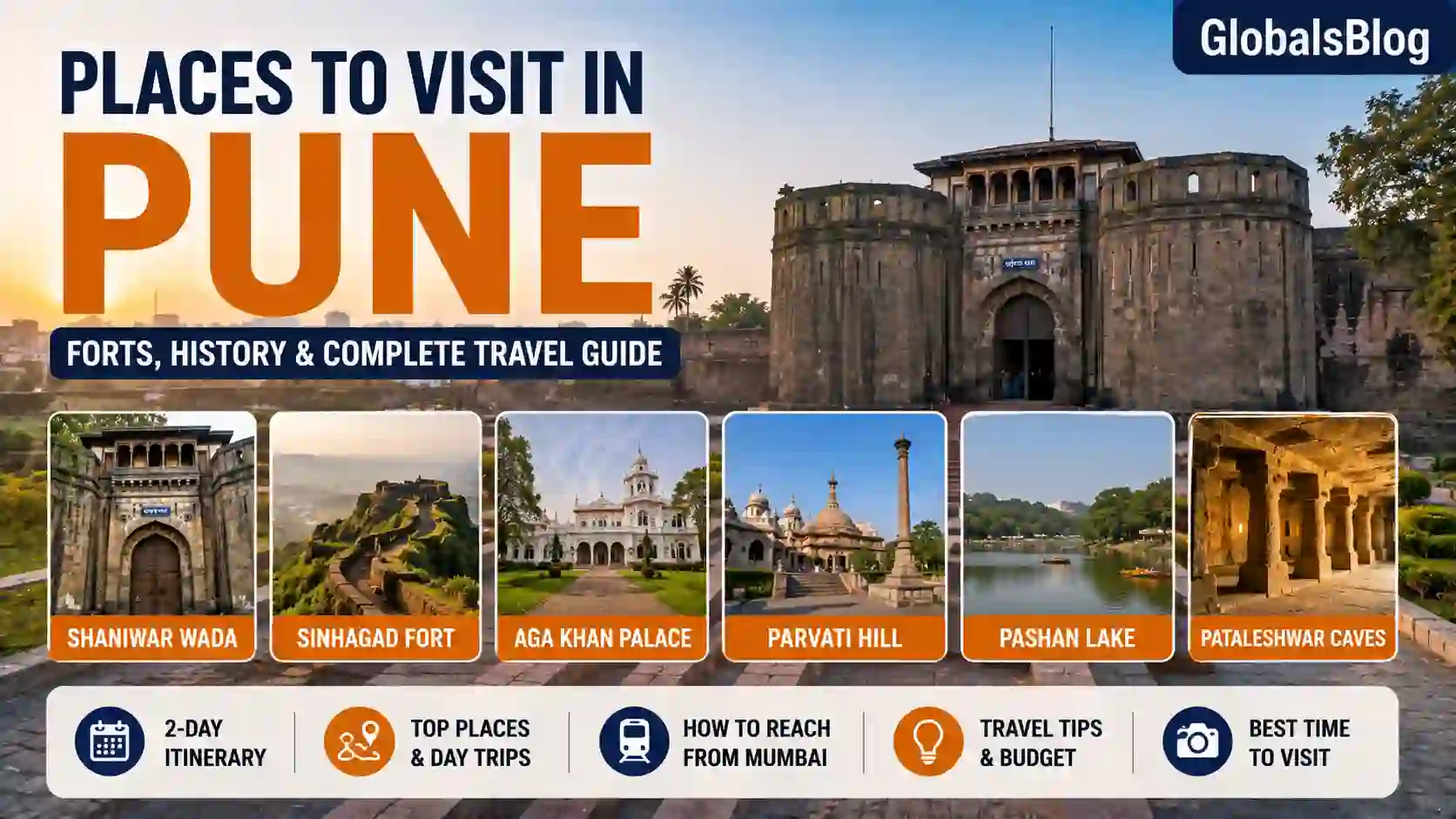
Pune sits at 560 metres in the Sahyadri foothills — a city of eight universities, 800,000 students, Maratha history, and weekend hills. The Shaniwar Wada fort, the Aga Khan Palace, the Osho ashram, and the Sinhagad fort are within an hour of each other. And the surrounding Western Ghats — Lonavala, Mulshi, Mahabaleshwar — make Pune the hill station launching pad of western India.
A reader from Delhi had moved to Pune for work and spent the first three months treating it as a smaller, slower, less interesting version of Mumbai — visiting the same Koregaon Park cafés every weekend and not exploring anything beyond the flat city grid. A colleague who had grown up in Pune took him to Sinhagad Fort on a Saturday morning — a 1,200-metre hill fort that Chhatrapati Shivaji Maharaj's commander Tanaji Malusare captured in a night assault in 1670, now accessible by a 45-minute climb through forest — and he described the view from the ramparts across the Khadakwasla reservoir and the Sahyadri range as "a completely different country from the city I had been living in for three months, 23 kilometres away." The Pune that most new residents and short-stay visitors miss is this one: the ring of hill forts, the Sahyadri streams, the Maratha history visible at every significant site in the surrounding landscape, and the city's specific cultural texture that is neither Mumbai nor any other Indian metro. This guide covers both Pune's city attractions and the surrounding region that makes it exceptional.
Best places in Pune: Shaniwar Wada (Maratha fort palace, ₹15 Indians, light and sound show evenings); Sinhagad Fort (25km, 1,200m, Tanaji Malusare memorial, trek or drive, free); Aga Khan Palace (Gandhi memorial, ₹25 Indians); Osho International Meditation Resort (Koregaon Park); Dagdusheth Halwai Ganesh Temple (free, most visited Ganesh temple in Pune); Parvati Hill (temple complex, panoramic city view, ₹5 entry, sunset); Katraj Snake Park (₹45). Day trips: Lonavala (65km), Sinhagad (23km), Rajgad Fort (60km), Mulshi Lake (45km), Mahabaleshwar (120km). Best time: October–March. How to reach: 3 hours from Mumbai by expressway or Shatabdi Express train.
Best Places to Visit in Pune
Shaniwar Wada is the defining monument of Pune — the palace-fort of the Peshwas, the prime ministers of the Maratha Empire, who made Pune their capital in the 18th century. The original palace complex was built in 1732 by Peshwa Baji Rao I and destroyed by a catastrophic fire in 1828, leaving only the massive stone bastions and outer walls standing while the wooden palace interior is gone. What remains is still substantial: five fortified gates named for the battles and deities of Maratha history (the Dilli Darwaza toward Delhi is the grandest), the interior courtyard with the outline of the palace garden, the Hazari Karanje fountain, and the memorial tower. The scale of the surviving walls gives a clear impression of the palace's original grandeur — the Peshwas at the height of their power in the 1770s controlled an empire from Attock in the northwest to Thanjavur in the south, and Shaniwar Wada was the administrative and ceremonial centre of that empire. The evening light and sound show (30 minutes) narrates the history of the Peshwas in dramatic form against the lit walls — the most atmospheric way to experience the site. The show runs in Marathi at 7:15pm and English at 8:15pm; book through the Archaeological Survey of India counter at the gate.
Sinhagad Fort — "Lion's Fort" in Marathi — is the most historically significant and most scenically dramatic of the dozens of Maratha hill forts surrounding Pune. At 1,200 metres above sea level, the fort commands 360° views of the Khadakwasla reservoir, the Sahyadri range, and on clear winter mornings the distant silhouette of Rajgad and Torna forts. The fort's history is dominated by the Battle of Sinhagad in 1670: Tanaji Malusare, one of Chhatrapati Shivaji Maharaj's most trusted commanders, led a night assault up the fort's steep rock face using a monitor lizard (ghorpad) to anchor a rope, captured the fort from the Mughal garrison, and died in the battle. Shivaji Maharaj's reported reaction on hearing of Tanaji's death — "The fort is won, but the lion is gone" — gave the fort its current name. The memorial samadhi (cenotaph) of Tanaji Malusare within the fort is the primary pilgrimage site. The 45-minute climb from the base follows a rock-cut path through forest — manageable for reasonably fit adults, strenuous for children or elderly. Jeeps from the Sinhagad base village reach the fort in 15 minutes for those who prefer not to climb. The fort is at its best at dawn — the Sahyadri peaks catching the first light while Pune lies in the valley below.
The Aga Khan Palace is one of India's most significant Gandhi memorial sites — a grand Italian-arch palace built in 1892 by Sultan Muhammad Shah Aga Khan III that was used by the British government as a prison for Mahatma Gandhi and other Congress leaders during the Quit India Movement (1942–44). Gandhi was interned here for two years with Kasturba Gandhi (his wife) and his secretary Mahadev Desai; both Kasturba Gandhi and Mahadev Desai died in captivity at the palace and their samadhis (memorials) stand in the garden. The palace museum contains photographs, documents, and personal effects from Gandhi's incarceration — his spinning wheel, correspondence, and the room where he was held are preserved. The surrounding gardens (17 acres) are well-maintained and quiet. For visitors interested in Indian independence history, the Aga Khan Palace provides historical context unavailable at Pune's Maratha-focused monuments. The palace's architectural beauty (Romanesque arches, 19th-century Italian-influenced design) is also noteworthy as one of Pune's most handsome heritage buildings.
Dagdusheth Halwai Ganapati is the most visited Ganesh temple in Pune — a 135-year-old temple housing a Ganesh idol adorned with approximately 8kg of gold and 1kg of diamonds, offering continuous darshan from 6am to 10:30pm. The temple was established in 1893 by Seth Dagdusheth Halwai, a sweet-maker whose child died during an epidemic and who was advised by his spiritual guru to build a Ganesh temple as a response to grief. The temple is considered one of the Manacha Ganpati (Five Revered Ganesh Temples of Pune) and during Ganesh Chaturthi receives millions of visitors over 10 days. The temple trust runs extensive charitable work across Pune. The idol's decoration includes the daily alankaran (fresh flower decoration) and arti ceremonies that are remarkable for their scale and devotion. The surrounding Budhwar Peth area is Pune's oldest commercial neighbourhood — the area around the temple has shops selling puja materials, traditional Pune snacks, and the small lanes that give the historic city centre its character.
Parvati Hill is the most accessible hilltop viewpoint in Pune city — a small hill 3km from the city centre with a 103-step climb to a complex of temples and the finest panoramic view of Pune available without leaving the city. The hill's temple complex includes the Devdeveshwar Temple, Parvati Temple, Vishnu Temple, Kartik Temple, and a small museum of Peshwa-era objects (weapons, domestic items, manuscripts). The Parvati Hill museum is particularly useful for contextualising Pune's Peshwa history — the objects on display span the 18th century height of the Maratha Empire. The hilltop view at sunset — Pune's city grid extending to the horizon in every direction, the Sahyadri hills visible in the west and southwest, the Peshwa-era tanks visible below — is the most complete aerial view of Pune available without a vehicle. Best visited late afternoon (4:30–6pm) to arrive at the top for golden hour and stay for sunset. The climb takes 10–15 minutes and is accessible for most fitness levels.
The Rajiv Gandhi Zoological Park at Katraj is Pune's primary wildlife facility — a zoo combined with Maharashtra's most significant snake park, housing over 2,000 reptiles including Indian cobras, pythons, Russell's vipers, and rare species. The snake park is the most educationally substantive in Maharashtra — informative for children and adults on snake species identification, venom science, and the importance of non-venomous species in Indian ecosystems. The adjacent zoo includes Indian wildlife (leopards, sloth bears, sambar deer, Indian python in naturalistic enclosures) and a rescue and rehabilitation centre for injured wildlife. The adjacent Katraj Lake and butterfly garden complete the complex. The zoo's emphasis on Maharashtra's endemic wildlife and the snake park's educational programming make it more substantive than a conventional zoo visit. Best for families with children ages 6–14 and for the specific snake education that no other Pune attraction provides.
The Osho International Meditation Resort is Pune's most internationally known attraction — the ashram and meditation centre of the spiritual teacher Osho (Bhagwan Shree Rajneesh, 1931–1990) that continues to operate as one of India's largest meditation centres, drawing visitors from across Europe, Japan, South Korea, and Israel. The campus covers 40 acres in Koregaon Park with meditation facilities, swimming pools, a spa, restaurant, bookstore, and the Osho Samadhi (his memorial and burial site). Day visitors and residential participants engage with the Osho Active Meditation techniques, of which Dynamic Meditation (5am daily) and the evening White Robe Brotherhood meditation are the most well-known. The resort is controversial in its history and operates with specific visitor protocols. The surrounding Koregaon Park neighbourhood is independently worth visiting — Pune's most international neighbourhood has the city's finest cafés, restaurants, and nightlife, and the tree-lined lanes give it a character distinct from the rest of the city.
Saras Baug is a heritage garden established by the Peshwas in the 18th century — an island garden in what was originally a lake (now largely filled), containing the Saras Baug Ganapati Temple, one of Pune's most revered Ganesh shrines (another of the Manacha Panch Ganpati). The garden is a local Pune institution — morning walkers, families, and pilgrims use it throughout the day. The combination of the garden's heritage character, the Ganesh temple at its centre, and the adjacent Parvati Hill (visible from the garden) makes Saras Baug the most characteristically "Pune" experience available — a place that belongs entirely to the city's culture and daily rhythm rather than to the tourist circuit. Best visited early morning (6–8am) when the temple is most active and the garden is at its quietest. The 5-minute walk to Parvati Hill makes combining both in a single morning the most efficient approach.
Pune Tourist Places — Quick Reference
| Place | Distance | Entry | Best Time | Don't Miss |
|---|---|---|---|---|
| Shaniwar Wada | City centre | ₹15 | Morning + 7:15pm show | Dilli Darwaza, light and sound show |
| Sinhagad Fort | 23km | Free | Dawn, weekdays | Tanaji samadhi, Sahyadri views |
| Aga Khan Palace | 5km | ₹25 | Morning 9am | Kasturba Gandhi samadhi, museum |
| Dagdusheth Temple | City centre | Free | 6–8am or darshan | Gold-adorned Ganesh idol, arti |
| Parvati Hill | 3km | ₹5 | 4:30–6pm sunset | Panoramic city view, temple complex |
| Katraj Zoo/Snake Park | 10km | ₹45 | Morning weekday | Snake park, Indian wildlife |
| Osho Resort | Koregaon Park | Day pass | Any day | Dynamic Meditation, Samadhi garden |
| Saras Baug | City centre | Free | 6–8am | Ganesh temple, Peshwa heritage garden |
Best Day Trips from Pune
| Destination | Distance | Time | Best For | Don't Miss |
|---|---|---|---|---|
| Lonavala | 65km | 1.5 hrs | Waterfalls (monsoon), forts, chikki | Lohagad Fort, Bhushi Dam, Tiger's Leap |
| Rajgad Fort | 60km | 1.5 hrs + 2 hr trek | Maratha history, serious trekking | Shivaji's first capital, Padmavati Machi |
| Mulshi Lake | 45km | 1 hr | Scenic drive, lakeside, quiet | Tamhini Ghat road, waterfall walks monsoon |
| Mahabaleshwar | 120km | 2.5 hrs | Hill station, strawberries, valley views | Venna Lake, Pratapgad Fort, Arthur's Seat |
| Lavasa | 60km | 1.5 hrs | Planned lakeside town, scenic drive | Dasve lake waterfront, Sahyadri views |
| Bhimashankar | 110km | 2.5 hrs | Jyotirlinga temple, wildlife sanctuary | Bhimashankar temple, shekru (giant squirrel) |
| Torna Fort | 60km | 1.5 hrs + 2 hr trek | First Maratha fort captured by Shivaji | Mengai Devi temple, Sahyadri views |
The Pune hill fort circuit (Sinhagad → Rajgad → Torna → Purandar) is one of the finest trekking sequences in the Western Ghats — four major Maratha forts within a 60km radius, each offering a full day of trekking and Maratha history. For weekend trekkers based in Pune, this circuit represents months of weekends. Lonavala (65km) is the most accessible day trip for non-trekkers — the Mumbai-Pune Expressway makes it a 75-minute drive and the combination of waterfalls (monsoon), British-era hill station architecture, and the massive Lohagad Fort creates a full day without any serious trekking.
Pune 2-Day Itinerary
Day 1 (Pune History + Fort): 6am: Saras Baug morning walk and Ganesh darshan. 7am: Breakfast at Vaishali (FC Road institution — misal pav, dosa, filter coffee). 9am: Aga Khan Palace (1.5 hours). 11am: Dagdusheth Halwai Ganesh Temple darshan and old Pune walk (Budhwar Peth, Tambdi Jogeshwari Temple). 1pm: Lunch at Shreyas or Durvankur for traditional Pune thali. 3pm: Shaniwar Wada full interior visit (1.5 hours). 5pm: Parvati Hill sunset. 7:15pm: Shaniwar Wada light and sound show (Marathi version is more atmospheric). 9pm: Dinner at Koregaon Park café.
Day 2 (Sinhagad + Lonavala or Mulshi): 5:30am: Depart for Sinhagad Fort. 6:30am: Arrive at base, begin climb (45 minutes). 7:30am: Fort ramparts — Tanaji samadhi, Sahyadri views in morning light. 9am: Zunka Bhakar (traditional Sinhagad breakfast at fort stalls — highly recommended, cheap, authentic). 10:30am: Return to Pune. 12pm: Choice: drive to Mulshi Lake (45km, scenic, quiet, monsoon waterfalls) or Lonavala (65km, Lohagad Fort, Bhushi Dam, chikki). Return by 7pm.
How to Reach Pune
| Mode | From | Duration | Cost | Notes |
|---|---|---|---|---|
| Train (recommended) | Mumbai CST/Dadar | 3–3.5 hrs (Shatabdi/Deccan Queen) | ₹300–700 AC Chair | Deccan Queen (100+ years old, daily 7:15am) or Shatabdi — book IRCTC ahead |
| Road (Expressway) | Mumbai | 2.5–3.5 hrs (traffic dependent) | Toll ₹290 + fuel | Mumbai-Pune Expressway — fastest when traffic is clear, slow on Friday evenings |
| Bus (Volvo) | Mumbai (Dadar, Borivali) | 3–4 hrs | ₹300–500 | MSRTC AC Shivneri — most frequent, comfortable |
| Flight | Delhi, Bengaluru, Chennai | 1.5–2 hrs | ₹2,500–7,000 | Pune International Airport, IndiGo/Air India — good connectivity from major cities |
| Train | Delhi (Hazrat Nizamuddin) | 18–22 hrs | ₹600–1,800 | Duronto, Rajdhani, or other expresses — overnight options available |
The Deccan Queen Express (Train 11007, Mumbai CST → Pune, departs 7:15am daily) is India's oldest regularly running express train — a Pune institution since 1930. The morning departure makes it perfect for a Pune day trip from Mumbai: arrive Pune by 10:30am, full day, return on the evening train or next morning. The Mumbai-Pune Expressway (NH48) is the fastest road option when traffic is clear — avoid Friday evenings and Monday mornings when Mumbai outbound traffic extends the journey to 4–5 hours.
✓ Pune Travel Tips
- Sinhagad Fort at dawn on a weekday: Sinhagad on a Saturday morning in October is one of the most crowded hill forts in Maharashtra — thousands of Pune residents treat it as a weekend trek. On a Tuesday morning in November, you can reach the Tanaji samadhi in 45 minutes of quiet climbing, sit on the ramparts with an unobstructed view of the Khadakwasla reservoir, eat zunka bhakar at the fort stalls (₹30–40 per plate, the best simple meal near Pune), and complete the entire experience in 3 hours before the city gets busy. This is the definitive Pune-within-reach experience and it requires a weekday or very early Saturday start
- Vaishali restaurant FC Road for the essential Pune breakfast: Vaishali on Fergusson College Road has been Pune's most beloved breakfast institution since 1960 — the outdoor café under the trees, the misal pav (sprouted moth bean curry with pav, an acquired taste that defines Pune food culture), the masala dosa, and the filter coffee that accompanies it. Arrive by 8:30am to avoid the queue; arrive at 7am if you want a table immediately. The food is inexpensive (₹50–100 per person) and the outdoor seating under old trees in the morning is a specific Pune experience
- Monsoon Pune for waterfall chasing — but check road safety: Pune's surrounding Sahyadri hills receive 3,000–4,000mm of rain between June and September, producing waterfalls across every road: the Tamhini Ghat road (Mulshi direction), the Khandala Ghat (Lonavala direction), and the Sinhagad road all produce roadside waterfalls in July and August that make the drives as beautiful as the destinations. However, waterfall sites attract crowds and occasionally unsafe behaviour — confirm current conditions and avoid overflow zones marked by warning signs
- Pune's food trail — beyond Vaishali: Misal pav (Bedekar or Café Goodluck for the spicier Kolhapuri variant), sabudana khichdi and vada (Shreyas restaurant, a Pune classic), Chitale Bandhu mithaiwale for bakarwadi (the spiral crispy Marathi snack Pune is famous for), and the Budhwar Peth sweets shops for Puran Poli and Shrikhand. Pune's food culture is distinct from Mumbai's — more traditional Maharashtrian, less street food, more sit-down thali
- See our Lonavala guide for the most popular Pune day trip, and our Manali guide for the Himalayan alternative to Pune's Sahyadri hill experience
✗ Pune Mistakes to Avoid
- Treating Pune as a Mumbai extension for a weekend: Pune has its own distinct character — Maratha history, student culture, Sahyadri access — that is unrelated to Mumbai. Visitors who arrive expecting a smaller, quieter Mumbai and spend their time in Koregaon Park's international cafés are missing the city's specific identity. Shaniwar Wada, Sinhagad, and the old city lanes are where Pune's distinctiveness lies
- Skipping Sinhagad because "it's just a fort": Sinhagad is not a conventional monument — it is a working outdoor experience, a Maratha history pilgrimage, and the finest view in the Pune region. The 45-minute climb through forest at dawn, the Tanaji samadhi, and the Khadakwasla reservoir view from the ramparts are things that cannot be adequately described and need to be experienced. It is 23km from the city and 45 minutes of easy trekking — the barrier is lower than any other comparable experience in the Pune region
- Visiting Lonavala on a monsoon weekend without planning: Lonavala on a monsoon weekend (July–August Saturday) is one of the most crowded tourist destinations in Maharashtra — the Mumbai-Pune Expressway backs up for kilometres, the Bhushi Dam has seen drowning incidents during overflow conditions, and the entire experience becomes a traffic and crowd management exercise. Lonavala in monsoon on a Tuesday morning is extraordinary; Lonavala on a monsoon Sunday is a lesson in crowd dynamics
- Missing the zunka bhakar at Sinhagad Fort stalls: The food stalls at Sinhagad Fort serve zunka bhakar — a traditional Maharashtrian breakfast of chickpea flour curry with jowar bhakri (flatbread), typically accompanied by raw onion and green chilli, for ₹30–50 per plate. This is both the most traditional and most contextually appropriate meal available anywhere near Pune — eating 18th-century hill fort food at a 17th-century Maratha fort is the complete Pune experience in one plate. Do not substitute with the overpriced "Pune café" food available at the fort stalls targeting tourists
⚠️ Disclaimer: Entry fees, fort access, and waterfall-site safety conditions in and around Pune change seasonally. Sinhagad Fort entry may be restricted during heavy monsoon. All prices are indicative as of August 2026. For Lonavala waterfall sites, verify safety conditions locally before visiting during monsoon — overflow drowning incidents occur at unsupervised sites. Verify current train and bus schedules on IRCTC and MSRTC websites before travel.
Shaniwar Wada in the Morning. Sinhagad at Dawn. Aga Khan Palace for History. Parvati Hill at Sunset. Vaishali for Breakfast. Zunka Bhakar at the Fort. Pune is Best Before the City Wakes Up.
The Delhi reader who spent three months in Pune without visiting Sinhagad Fort is the most common version of the Pune story — a city that reveals itself to those who leave the flat grid of Koregaon Park and Viman Nagar and go toward the hills. Shaniwar Wada establishes the Peshwa history that makes Pune architecturally distinct. Sinhagad provides the Sahyadri experience that makes Pune geographically exceptional. The old city lanes of Kasba Ganpati and Budhwar Peth provide the food culture that makes Pune culinarily specific. None of these require more than 25km from the city centre. Come for a weekend with an early alarm for Sinhagad on Saturday morning, the light and sound show at Shaniwar Wada on Saturday evening, and Vaishali's misal pav at 7:30am Sunday. That is the complete Pune — and it is available year-round, 3 hours from Mumbai.
Best places to visit in Pune: Shaniwar Wada (Peshwa fort palace, ₹15, city centre — evening light and sound show 7:15pm); Sinhagad Fort (23km, 1,200m, Maratha history, free — best at dawn, 45-minute trek or jeep); Aga Khan Palace (₹25, Gandhi and Kasturba memorial, Yerwada); Dagdusheth Halwai Ganesh Temple (free, most famous Ganesh temple in Pune); Parvati Hill (₹5, 103 steps, panoramic city view — best at sunset); Katraj Snake Park and Zoo (₹45, India's largest snake park); Osho International Meditation Resort (Koregaon Park, day passes available); Saras Baug (free, Peshwa-era garden and Ganesh temple, morning walk). Day trips: Lonavala (65km, waterfalls, Lohagad Fort), Rajgad Fort (60km, Shivaji's first capital), Mulshi Lake (45km, scenic Sahyadri drive).
How to reach Pune from Mumbai: By train (recommended) — Deccan Queen Express (departs Mumbai CST 7:15am daily, arrives Pune ~10:35am, ₹150–300 second class, ₹400–700 AC Chair) or Shatabdi Express. Multiple trains throughout the day. By road — Mumbai-Pune Expressway (NH48), 150km, 2.5–3.5 hours depending on traffic (avoid Friday evenings, Monday mornings). Toll approximately ₹290 per car. By bus — MSRTC Shivneri AC Volvo from Dadar, Sion, Borivali (₹300–500, approximately 3–4 hours). The Deccan Queen is the most convenient public transport — the morning departure from Mumbai arrives in Pune by 10:30am giving a full day. Book IRCTC at least a week in advance, especially on weekends.
Yes — Sinhagad Fort is the single most rewarding experience near Pune. At 23km from the city and approximately 45 minutes of moderate trekking, Sinhagad offers the finest views in the Pune region (Khadakwasla reservoir, Sahyadri range, Rajgad and Torna visible on clear days), the most significant Maratha historical site near the city (Tanaji Malusare's 1670 capture of the fort for Shivaji Maharaj), and the best simple food near Pune (zunka bhakar at the fort stalls for ₹30–40). Best visited at dawn on a weekday when the climb is quiet and the morning light is extraordinary. Jeep transport available from the base village for those who prefer not to trek. Entry is free. The fort is crowded on weekend mornings — arrive by 6am to beat the Pune trekking groups.
Best time to visit Pune: October to March is the most pleasant season — comfortable temperatures (15–28°C), clear skies, all hill forts and day trip destinations accessible. October is excellent for the post-monsoon green Sahyadri hills with clear views from Sinhagad and Parvati Hill. December–January is the coolest (minimum 8–10°C at night) and least humid. February–March has warm days and is the best trekking season. Monsoon (June–September): Pune's surrounding hills are spectacularly green with waterfalls on every Ghat road — the Mulshi and Tamhini routes are extraordinary. However, fort trek paths become slippery, some road sections are risky, and waterfall crowding creates safety concerns. Monsoon Pune is for experienced hill visitors who know the terrain. Summer (April–May) is hot (35–38°C) but the hills remain accessible; avoid the valley floor midday.
Pune is famous for Maratha history (Shivaji Maharaj's empire was built around Pune's hill forts — Sinhagad, Rajgad, Torna, Purandar), Peshwa heritage (Shaniwar Wada, the Peshwa capital from 1732), Ganesh Chaturthi (the largest in Maharashtra, particularly the Dagdusheth and Kasba Ganpati celebrations), education (8 universities, 800,000 students — the "Oxford of the East"), the Osho International Meditation Resort (internationally famous meditation centre, Koregaon Park), IT and automotive industry (Hinjewadi tech park, Chakan auto hub), misal pav and puranpoli (signature Maharashtrian foods), bakarwadi (Chitale Bandhu), the Deccan Queen Express (India's oldest express train, running Mumbai–Pune since 1930), and the Mumbai-Pune Expressway (India's first six-lane expressway). Pune is also the closest major city to Lonavala (65km) and Mahabaleshwar (120km).
2 days is the recommended minimum for Pune to cover the city's main attractions and one day trip. Day 1: Shaniwar Wada, Aga Khan Palace, Dagdusheth Temple, Parvati Hill sunset, Shaniwar Wada light and sound show. Day 2: Sinhagad Fort at dawn, Lonavala or Mulshi day trip. A single day is possible as a Mumbai day trip focusing on Shaniwar Wada, Dagdusheth Temple, and the old city — but misses Sinhagad (the most important Pune experience). 3 days adds Rajgad Fort (full day trek, serious Maratha history), or the Mahabaleshwar hill station (120km, 1 night). Pune makes an excellent 4-night base for exploring the full Sahyadri hill fort circuit (Sinhagad, Rajgad, Torna, Lohagad) as separate day trips.
Leave a comment
Share a quick thought about this story.
Thanks for sharing your view. It is ready for review.
Please try again in a moment.