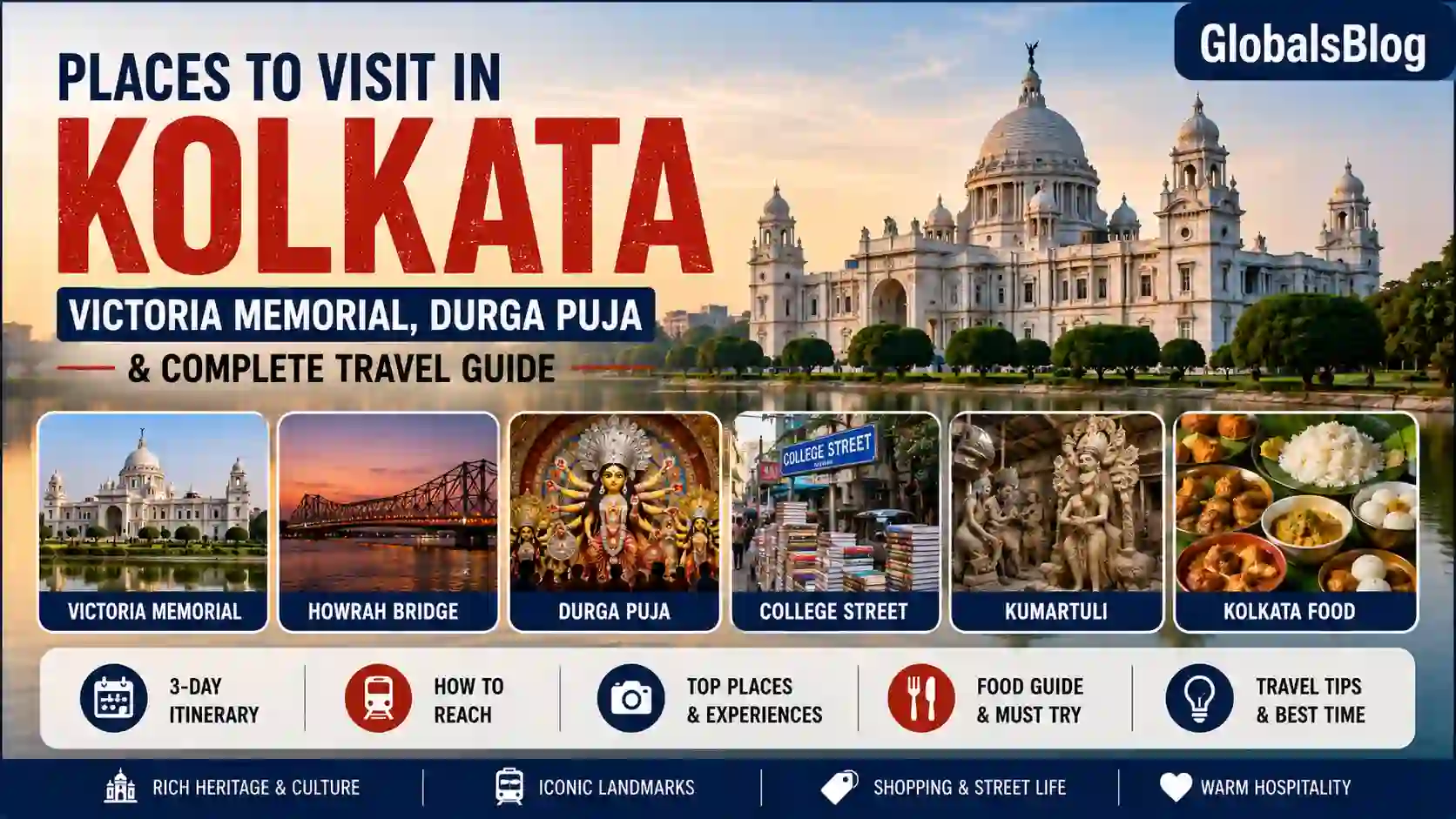
Kolkata is India's most literary city, its most colonial, and its most contradictory — a city of Victorian architecture and collapsing buildings, Nobel laureates and hand-pulled rickshaws, the world's most important Durga Puja and the quietest sunrise on the Hooghly. The Victoria Memorial at dawn, the Howrah Bridge at night, and the dal-baati at Indian Coffee House tell you more about what India is than most cities manage in a week.
A reader from Bengaluru had been to Kolkata twice — once for a conference and once for a friend's wedding — and both times had stayed in the hotel-airport-venue triangle without seeing the city. On the third visit, she had four days and the name of a college friend who had grown up in North Kolkata. The North Kolkata friend walked her through Kumartuli (the neighbourhood where sculptors make idols year-round, working in clay and bamboo on the Durga Puja figures that will be installed across the world), through the College Street book market (the largest second-hand book market in Asia, with pavements lined with tens of thousands of books in stacks), and along the riverside ghats at sunset. She described leaving Kolkata on the fourth day feeling that she had been to a city she had visited twice before but never actually seen. Kolkata requires that kind of navigation — it is not a city that presents itself through its landmarks. It is a city whose identity lives in its neighbourhoods, its food, and the specific texture of its daily life. This guide covers both the landmarks and the neighbourhoods that make Kolkata exceptional.
Best places in Kolkata: Victoria Memorial (British India's grandest building, ₹30 Indians, dawn or dusk best); Howrah Bridge (no entry, free, most photographed bridge in India); Indian Museum (oldest museum in India, ₹20 Indians); Dakshineswar Kali Temple (free, Ramakrishna's temple, Hooghly riverside); Belur Math (free, Swami Vivekananda's ashram, Hooghly riverside); College Street (Asia's largest book market, free to browse); Kumartuli (idol-making neighbourhood, free, must visit October if near Durga Puja); Marble Palace (free, North Kolkata heritage mansion); Park Street (restaurant and café strip, Kolkata's entertainment hub). Best time: October–February (Durga Puja in October is extraordinary). How to reach: flight from Delhi/Mumbai/Bengaluru (2–2.5 hrs), or Rajdhani Express from Delhi (17 hrs).
Best Places to Visit in Kolkata
The Victoria Memorial is the most magnificent building in Kolkata and one of the finest examples of Indo-Saracenic architecture in India — a white Makrana marble monument commissioned by Lord Curzon in 1906 to commemorate Queen Victoria, completed in 1921. At 103 metres long and 69 metres wide, with a central dome rising 56 metres, the Memorial's scale and the quality of its marble (the same Makrana marble used for the Taj Mahal) make it visually extraordinary in every light condition but especially at dawn — when mist rises from the surrounding gardens and the white marble reflects the first light — and at dusk, when the monument is gradually lit against the darkening sky. The museum inside (25 galleries) houses the most significant collection of colonial-era art, manuscripts, and artefacts in India: portraits of British governors-general and Mughal emperors, weapons from the Battles of Plassey and Buxar, Rabindranath Tagore's manuscripts, and Queen Victoria's personal writing desk. Allow 2–3 hours for the museum if you visit on a non-Monday. The surrounding Victoria Memorial Garden (free, opens at 5:30am) is the finest dawn walk in Kolkata — the white dome visible across the Maidan at first light is the image most associated with the city.
Howrah Bridge — officially Rabindra Setu — is Kolkata's most recognisable structure and one of the busiest bridges in the world. Opened in 1943, the cantilever truss bridge (assembled without a single nut or bolt — 26,500 tonnes of high-tensile steel joined entirely by rivets) spans the Hooghly River connecting Kolkata and Howrah, and carries over 100,000 vehicles and approximately 150,000 pedestrians daily. The bridge's most dramatic views are from the water — the Hooghly river boat (₹10–20 from Babu Ghat to Howrah Ghat) provides the classic view of the bridge's massive spans reflected in the river at dawn, when flower vendors carry their morning cargo across in baskets balanced on their heads. At night, the lit bridge against the dark Hooghly is Kolkata's finest urban image. Walking across the bridge takes 15–20 minutes — the pedestrian walkway on both sides offers views of the river activity, the ghats below, and the city skyline. The Mullick Ghat Flower Market directly below the Kolkata end of the bridge operates from approximately 4am and is one of Asia's largest wholesale flower markets — the pre-dawn flower trading beneath the bridge is a Kolkata experience available to very early risers.
Dakshineswar Kali Temple and Belur Math are the two most spiritually significant sites in Kolkata — both on the banks of the Hooghly River and best visited together by boat. Dakshineswar Kali Temple was the site where Sri Ramakrishna Paramahamsa — the 19th-century mystic whose teachings synthesised multiple spiritual traditions and influenced Swami Vivekananda — lived and practised for over 30 years. The temple complex (nine towers, the main Kali temple, temples to Radha-Krishna and Shiva, and Ramakrishna's room preserved as a museum) is one of the most visited religious sites in West Bengal. Belur Math — across the river, reachable by a short boat ride — is the headquarters of the Ramakrishna Mission, established by Swami Vivekananda in 1899. The main temple is designed to synthesise Hindu, Christian, Buddhist, and Islamic architectural elements in a single structure — an architectural statement of Vivekananda's philosophy of religious harmony. The surrounding ashram on the Hooghly bank is quiet, beautifully maintained, and a genuinely serene counterpoint to the city's energy. The boat journey between the two sites — 15 minutes on the Hooghly — is one of the finest short river experiences in India.
The Indian Museum on Park Street is the oldest and largest museum in India — founded in 1814 by the Asiatic Society of Bengal, making it older than the Smithsonian and contemporary with the earliest public museums in Europe. The six sections (Art, Archaeology, Anthropology, Geology, Zoology, Economic Botany) cover 35 galleries with approximately 1,00,000 objects spanning from Mohenjo-daro artefacts and Indus Valley ceramics to a genuine Egyptian mummy (brought to Kolkata in the 19th century), natural history specimens, Buddhist Gandhara sculptures, and the meteorite collection. The museum's colonial-era architecture (the 1875 building) is itself a heritage experience — the arcaded courtyard and the gallery proportions reflect Victorian museum design at its most ambitious. For visitors interested in Indian history, the archaeology section's coverage of Mohenjo-daro and Harappan civilisation alongside the Buddhist art collection is among the finest in India. At ₹20 for Indians, the Indian Museum is the most intellectually substantive ₹20 spend available anywhere in Kolkata. Allow a minimum of 2 hours; the full museum takes 4–5 hours for serious visitors.
College Street and Kumartuli are the two North Kolkata neighbourhoods that define Kolkata's intellectual and artistic character most directly. College Street — running past Presidency University, Calcutta University, and dozens of small publishers and book shops — is home to Asia's largest second-hand book market, where pavements are lined with tens of thousands of books in stacks: Bengali literature, English classics, academic texts, rare editions, and everything in between. Browsing College Street is a Kolkata experience unavailable anywhere else in India — the book density, the students, the small coffee shops, and the noise of the surrounding universities create an atmosphere specific to this neighbourhood. The Indian Coffee House at 15 Bankim Chatterjee Street (opened 1942, operated by a workers' cooperative) is the intellectual nerve centre of Kolkata — a café where generations of writers, artists, politicians, and activists have met. Kumartuli, 2km from College Street, is the neighbourhood of the kumars (sculptors) who make the clay-and-bamboo Durga, Kali, Saraswati, and Ganesh idols for the pandals (temporary temples) erected during the festival season. Year-round there are sculptors working — in the weeks before Durga Puja (September–October), the streets are dense with idols at various stages of construction, from bamboo frames to finished painted figures. It is one of the most visually extraordinary free experiences in Kolkata.
Park Street is Kolkata's most cosmopolitan neighbourhood — the cultural and restaurant hub of the city, home to the Indian Museum, the South Park Street Cemetery (one of the finest colonial-era cemeteries in Asia, dating from 1767 — free entry), and the concentration of restaurants and cafés that defines Kolkata's food culture for visitors. Peter Cat (the chelo kebab — a rice and kebab combination borrowed from Iranian cuisine, served on a sizzler plate — is one of Kolkata's signature dishes), Mocambo (white-tablecloth continental restaurant since 1956), and Flury's (Swiss tea room since 1927, serving the finest patisserie in East India) are all on or adjacent to Park Street. The neighbourhood's Christmas decorations — Park Street was historically home to the European community and retains its Christmas tradition — make it one of India's most festive December destinations. The South Park Street Cemetery (across from the Indian Museum) contains the graves of British administrators, soldiers, and civilians from the 18th and early 19th centuries — the inscriptions tell the history of early colonial Kolkata in a manner that no museum can fully replicate.
Marble Palace is the most extraordinary private home open to visitors in Kolkata — a 1835 mansion built by Raja Rajendra Mullick, a wealthy Bengali zamindar (landlord), filled with a Victorian art and curio collection that includes original paintings attributed to Rubens, Reynolds, and Titian; Venetian glass chandeliers; Belgian and Italian marble floors and columns throughout; Chinese porcelain; and an eclectic zoo of exotic birds and animals in the mansion's courtyard. The collection reflects the specific cultural moment when wealthy Bengali zamindars combined traditional patronage with European collecting — the result is a time-capsule of 19th-century upper-class Kolkata that no museum can replicate. Entry is free but the mansion is still family-owned — visiting requires either the government tourism office's recommendation or a polite direct request at the gate. The combination of the art collection, the architecture, and the very Bengali quality of extraordinary treasure sitting behind a modest gatepost in a North Kolkata lane is one of Kolkata's finest surprises.
Kolkata is India's most distinctive food city — the only major Indian metro where the food culture is entirely its own, rather than a variant of a broader regional cuisine. Kolkata biryani (with potato and boiled egg, a uniquely Awadhi-meets-Bengali synthesis) is different from every other Indian biryani. The Kathi Roll (paratha wrapper around egg and meat filling, invented at Nizam's restaurant in 1932) is Kolkata's specific contribution to Indian street food — the original is still made at Nizam's near New Market. Mishti Doi (sweetened set yoghurt in clay pots) is the Bengali sweet that defines Kolkata's dessert culture — Balaram Mullick and Radharaman Mullick in Paddapukur area is the most celebrated maker. Puchka (Kolkata's version of pani puri, with a sourer tamarind water and a slightly different crunch to the shell) is best on Decker's Lane or near Victoria Memorial. Roshogolla, Sandesh, and Chomchom at any Kolkata sweet shop. The afternoon jhalmuri (puffed rice with mustard oil and spices, sold in newspaper cones) on any Kolkata street. This is a food city that rewards walking and stopping frequently.
Kolkata Tourist Places — Quick Reference
| Place | Entry | Best Time | Time Needed | Don't Miss |
|---|---|---|---|---|
| Victoria Memorial | ₹30 / Garden free | Dawn 5:30am, dusk | 2–3 hours | Marble at dawn, gallery inside |
| Howrah Bridge | Free | Dawn, night | 30–45 min | River boat view, flower market below |
| Dakshineswar + Belur Math | Free (both) | 6–9am, sunset | 3–4 hours | Boat between them on Hooghly |
| Indian Museum | ₹20 | 10am–1pm weekday | 2–4 hours | Egyptian mummy, Indus Valley section |
| College Street + Kumartuli | Free | 10am–3pm | 3–4 hours | Indian Coffee House, idol sculptors |
| Park Street | Free | Evening, December | 2–3 hours | Peter Cat chelo kebab, Flury's |
| Marble Palace | Free (appointment) | Tue–Sun 10am | 1–1.5 hours | Rubens/Titian collection, mansion |
| Durga Puja pandals | Free | October (5 days) | All night | Kolkata's greatest cultural event |
Kolkata 3-Day Itinerary
Day 1 (Colonial Kolkata + Food): 5:30am: Victoria Memorial Garden at dawn — the white marble at first light is the finest single image in Kolkata. 8am: Breakfast at Flury's on Park Street (oldest café in Kolkata, best pastries in east India). 10am: Indian Museum (2 hours — Egyptian mummy and Indus Valley galleries essential). 12:30pm: Lunch at Peter Cat — chelo kebab. 3pm: Howrah Bridge walk from the Kolkata end, 30 minutes. Walk to Mullick Ghat flower market below the bridge. 5pm: River boat from Babu Ghat to Howrah Ghat and back (₹10–20, finest bridge view). 7pm: Park Street evening — South Park Street Cemetery at dusk (closes at sunset). 9pm: Dinner at Mocambo.
Day 2 (North Kolkata + Spiritual): 6am: Dakshineswar Kali Temple morning puja (best time for atmosphere — crowd arrives at 9am). 9am: Boat across the Hooghly to Belur Math. 11am: Return to city. 1pm: North Kolkata lunch — traditional Bengali thali at a Shyambazar area restaurant. 3pm: Kumartuli — idol-making neighbourhood walk. 5pm: College Street — browse books, coffee at Indian Coffee House. 8pm: Biryani dinner at Arsalan Park Circus.
Day 3 (Heritage + Sweets): 9am: Marble Palace — arrive early, polite gate request or tourism office appointment. 11am: New Market area — Nizam's for the original Kathi Roll. 1pm: Decker's Lane puchka — the Kolkata version with tamarind water. 2pm: Sweets tour — Balaram Mullick for Mishti Doi, any shop for Roshogolla and Sandesh. 4pm: Return to Victoria Memorial for dusk — the memorial lit at sunset. 7pm: Final evening on Park Street — window shopping, street food, jhalmuri in a paper cone.
Durga Puja — Kolkata's Greatest Event
Durga Puja is Kolkata's defining cultural event — a UNESCO Intangible Cultural Heritage recognised in 2021, and the world's largest public art festival. Over 5 days in October (Shashthi to Dashami), approximately 40,000 pandals (temporary structures) are erected across Kolkata, each containing an elaborate Durga idol and often designed around a specific artistic or social theme. The top pandals (Bagbazar Sarbojanin, College Square, Shribbhumi, Deshapriya Park) draw hundreds of thousands of visitors each night — the night-time pandal-hopping culture, where residents of all ages walk or travel by Metro and auto-rickshaw from pandal to pandal, is the most genuinely communal public event in any Indian city. For visitors arriving in Kolkata during Durga Puja: book accommodation 3–4 months in advance (the city fills completely), join the night pandal circuit after 10pm when the crowds are most festive, eat at the Puja food stalls rather than restaurants (most visitors eat on the street during Puja), and experience Dashami (the final day) at the river ghats where the idols are immersed at dawn. There is no other event in India like it.
How to Reach Kolkata
| Mode | From | Duration | Cost | Notes |
|---|---|---|---|---|
| Flight (recommended from most cities) | Delhi / Mumbai / Bengaluru | 2–2.5 hrs | ₹3,000–8,000 | Netaji Subhas Chandra Bose Airport — 16km from city centre |
| Train (recommended from Delhi) | Delhi (Hazrat Nizamuddin) | 17 hrs (Rajdhani Express) | ₹1,200–3,500 (AC) | Rajdhani Express is the fastest — overnight, arrives Howrah 10am |
| Train | Mumbai (CST) | 32 hrs | ₹1,500–4,000 | Gitanjali Express or Mumbai-Howrah Mail |
| Train | Chennai | 27 hrs | ₹1,200–3,500 | Chennai-Howrah Express |
| Road | Nearby (Bhubaneswar 480km) | 8–9 hrs | Fuel/toll | Road is practical from Odisha, Bangladesh border cities |
Flight is the recommended mode from Delhi, Mumbai, Bengaluru, Hyderabad, and Chennai — Kolkata's distance from other major cities makes overland travel practical only from nearby states. The Rajdhani Express from Delhi (departs evening, arrives Howrah next morning) is the finest train option — overnight and waking up at Howrah Bridge with the city beginning its morning is itself a Kolkata experience. From the airport: Metro from Airport station to central Kolkata (₹25–40, 45 minutes) or pre-paid taxi/Uber (₹300–450, 45 minutes to 1.5 hours depending on traffic).
✓ Kolkata Travel Tips
- October is when Kolkata becomes itself completely: Durga Puja in October is not just an event — it is the annual culmination of the city's cultural, artistic, and social identity. If you visit Kolkata only once, visit in October during the five Puja days. Book accommodation by June for October visits. Everything about the city — its hospitality, its food stalls, its street culture — operates at maximum intensity during those five days. The pandal circuits at night are specifically among the finest things available to any traveller in India
- The Metro is the fastest way around central Kolkata: Kolkata's Metro (India's oldest, operational since 1984) connects Dakshineswar in the north to New Garia in the south — covering Howrah Maidan, Park Street, Esplanade, and Shyambazar. Fare ₹5–25 depending on distance. For most tourist journeys in central Kolkata, the Metro is faster than surface roads in traffic. The yellow taxis (Kolkata's traditional Ambassador taxi) are also a specific cultural experience — ask for the meter
- Eat where Kolkatans eat — not where tourists are directed: The finest Kolkata food is not at tourist-facing restaurants but at the neighbourhood sweet shops, street food stalls, and smaller restaurants that serve local clientele. Mishti Doi at Balaram Mullick is in a non-touristic neighbourhood — the 30-minute auto-rickshaw ride to reach it is part of the experience. Puchka on Decker's Lane, jhalmuri from a street vendor near Victoria Memorial, and Kathi Roll at Nizam's are all authentic Kolkata experiences that require no tourist apparatus
- North Kolkata is the historic heart — not South Kolkata: Most newer visitors to Kolkata stay in South Kolkata (Ballygunge, Alipore, Salt Lake) and never venture into North Kolkata (Shyambazar, Sovabazar, Kumartuli, Chitpur, Jorasanko). North Kolkata contains the zamindar mansions, the oldest temples, the idol-making neighbourhood, and the architectural layers of 18th and 19th century Calcutta. One morning in North Kolkata with the right guidance reveals the city's original character better than any amount of time in the southern commercial districts
- See our Darjeeling guide for the natural extension from Kolkata to the hills, and our Varanasi guide for another Ganges-basin cultural city comparison
✗ Kolkata Mistakes to Avoid
- Spending all your time in South Kolkata's commercial districts: Salt Lake, New Town, Rajarhat, and the business districts of Ballygunge are modern, comfortable, and indistinguishable from commercial districts in any Indian metro. The Kolkata that is distinct from every other Indian city lives in the neighbourhood texture of North Kolkata, in the riverside ghats, in the College Street coffee houses, and in the Victoria Memorial at 5:30am. Visitors who stay in South Kolkata hotel areas and take day trips to the listed monuments see the city's objects but miss its character
- Visiting Victoria Memorial only during peak hours: The Victoria Memorial at 11am in October is a tourist site with crowds. The Victoria Memorial Garden at 5:30am on a November morning — white marble in the mist, the first light crossing the dome, almost no one present — is one of the finest architectural experiences in India. The ₹30 museum entry is worth it in the afternoon; the free dawn garden visit is the essential one
- Dismissing Kolkata as "decaying" or "sad" after a surface impression: The first impression of Kolkata — the heavy traffic, the crumbling buildings, the lack of the glass-and-chrome modernity of Bengaluru or Hyderabad — causes some visitors to write the city off after 24 hours. This is a category error: Kolkata is not a failed attempt at modern Indian urbanism. It is a city that chose differently, that preserved its intellectual and cultural life rather than its physical infrastructure, that maintained its bookshops and coffee houses and river ghats rather than converting them to malls. The Bengaluru reader who spent three visits in hotel corridors and discovered the city on the fourth is the correct model — Kolkata requires and rewards patient, neighbourhood-level exploration
- Not trying Kolkata biryani because it "has potato in it": The most common food mistake visitors make in Kolkata — avoiding the biryani because the potato seems wrong or gimmicky. Kolkata biryani's potato (and boiled egg) is an adaptation of the Awadhi biryani brought by the Nawabs of Awadh to Kolkata in the 19th century — the potato was added to stretch the meat and absorb the saffron and kewra water. At Arsalan or Aminia, the Kolkata biryani is one of the finest rice dishes available anywhere in India. Eat it
⚠️ Disclaimer: Kolkata entry fees, museum timings, and Durga Puja dates change annually. Marble Palace requires appointment confirmation before visiting — the residence is privately owned. All prices are indicative as of August 2026. Durga Puja dates vary by lunar calendar — confirm the exact October dates for your travel year. During Durga Puja, accommodation prices increase significantly and availability is extremely limited — book months in advance.
Victoria Memorial at Dawn. Howrah Bridge at Night. Dakshineswar by Boat. College Street in the Morning. Kumartuli Before Durga Puja. Chelo Kebab at Peter Cat. Kolkata Is Best When You Walk Toward the Unfamiliar.
The Bengaluru reader who spent three visits in hotel corridors found Kolkata on the fourth visit by walking toward the neighbourhoods she had never seen — Kumartuli at 9am, College Street at noon, the Indian Coffee House for an hour. What she discovered was not a city trapped in its past but a city that has chosen its present deliberately: the city that produced Rabindranath Tagore, Satyajit Ray, and Amartya Sen still produces writers, artists, and intellectuals at a density unmatched in India. The physical infrastructure may not gleam — but the intellectual and cultural life visible at College Street, at the coffee houses, in the pandal art of Durga Puja, and in the food culture is the richest in any Indian city. Come in October if possible. Walk into North Kolkata. Take a boat on the Hooghly. Eat the biryani with the potato. And visit Victoria Memorial at 5:30am before the rest of the city wakes up — the white marble in the morning mist is the correct beginning of Kolkata.
Best places to visit in Kolkata: Victoria Memorial (₹30, white marble monument, best at dawn 5:30am); Howrah Bridge (free, cantilever bridge over Hooghly, best at night and dawn); Dakshineswar Kali Temple (free, Ramakrishna's temple, Hooghly riverside); Belur Math (free, Swami Vivekananda's ashram, combine with Dakshineswar by boat); Indian Museum (₹20, oldest museum in India, Egyptian mummy and Indus Valley collection); College Street (free, Asia's largest book market, Indian Coffee House); Kumartuli (free, idol-making neighbourhood, extraordinary before Durga Puja); Park Street (free, Kolkata food hub — Peter Cat, Flury's, Mocambo); Marble Palace (free, appointment required, Victorian art mansion). October is the best month — Durga Puja transforms the city.
Best time to visit Kolkata: October (Durga Puja) is the definitive answer — the five-day festival transforms the city into the world's largest public art event, with 40,000+ pandals, night-long processions, and the full expression of Bengal's cultural identity. October also has the most pleasant post-monsoon weather (24–30°C). November–February: ideal weather (15–25°C), fewer crowds than October, all attractions accessible. Avoid March–June (heat reaches 40–42°C) and July–September (heavy monsoon, flooding in low-lying areas). December is pleasant and Park Street's Christmas decorations are famous. If visiting for Durga Puja: book accommodation by June, confirm exact Puja dates by lunar calendar (varies by year), and plan pandal circuits after 9pm when the atmosphere is most festive.
How to reach Kolkata from Delhi: By flight — 2–2.5 hours from Delhi IGI to Netaji Subhas Chandra Bose Airport, ₹3,000–8,000 depending on advance booking. By train — Rajdhani Express (Train 12301/12302, Hazrat Nizamuddin to Howrah) is the fastest at 17 hours, departs evening and arrives next morning at Howrah — ₹1,200–3,500 AC. The overnight Rajdhani is the recommended train option: you save a hotel night and arrive fresh at Howrah Bridge in the morning. Other trains available (Poorva Express, Kalka Mail, Duronto) at varying speeds and prices. Distance: Delhi to Kolkata approximately 1,450km. By flight is recommended for 2–3 day trips; train is recommended for longer trips where the Howrah arrival experience matters.
Kolkata is famous for Durga Puja (UNESCO Intangible Cultural Heritage, world's largest public art festival, October); Rabindranath Tagore (first Asian Nobel Prize winner in Literature, 1913, born in Jorasanko Kolkata); Victoria Memorial (British India's grandest monument, Makrana marble); Howrah Bridge (1943, no bolts, 100,000 vehicles daily); the Indian Museum (oldest museum in India, 1814); Satyajit Ray (filmmaker, Oscars honorary recipient, born in Kolkata); Amartya Sen (Nobel Prize Economics); Mother Teresa (spent her career in Kolkata); the Kolkata tram (India's only remaining tram system); Kolkata biryani (with potato and egg); Roshogolla (spongy syrup-soaked sweet, origin disputed with Odisha but Kolkata variety most famous); Indian Coffee House (intellectual hub since 1942); and its status as the cultural capital of Bengal and one of India's most literary cities.
3 days minimum for Kolkata to cover the main sights and neighbourhood experience. Day 1: Victoria Memorial dawn, Indian Museum, Howrah Bridge, Park Street evening. Day 2: Dakshineswar and Belur Math (morning, by boat), North Kolkata lunch, Kumartuli afternoon, College Street evening. Day 3: Marble Palace morning, New Market and Nizam's Kathi Roll, sweet shops, Victoria Memorial at dusk. 4–5 days allows adding the South Park Street Cemetery, Jorasanko Thakur Bari (Rabindranath Tagore's ancestral home, ₹50), Science City, and the Princep Ghat sunset. During Durga Puja: 5 nights minimum — the festival requires 4–5 nights to experience the pandal circuit across multiple neighbourhoods properly. A same-day trip from another city covers only 2–3 sites without neighbourhood immersion — Kolkata rewards staying at least 3 nights.
Durga Puja is Kolkata's most important cultural and religious festival — a five-day Hindu festival (Shashthi to Dashami, October) celebrating the goddess Durga's victory over the demon Mahishasura. In Kolkata, Durga Puja has evolved into what UNESCO recognised in 2021 as an Intangible Cultural Heritage of Humanity and what the city itself regards as the world's largest public art festival. Over 40,000 pandals (temporary decorated structures) are erected across the city, each containing an elaborately sculpted and decorated Durga idol — many pandals are designed around specific artistic or social themes, with some spending crores on the structure. Community organisations (puja committees) in every neighbourhood compete for artistic recognition. The five days involve pandal-hopping (moving from one puja to another, often all night), community meals, performances, and the final Dashami where the idols are immersed in the Hooghly at dawn. For visitors from outside Bengal, Durga Puja is the most immersive experience of Bengali cultural life available anywhere.
Leave a comment
Share a quick thought about this story.
Thanks for sharing your view. It is ready for review.
Please try again in a moment.