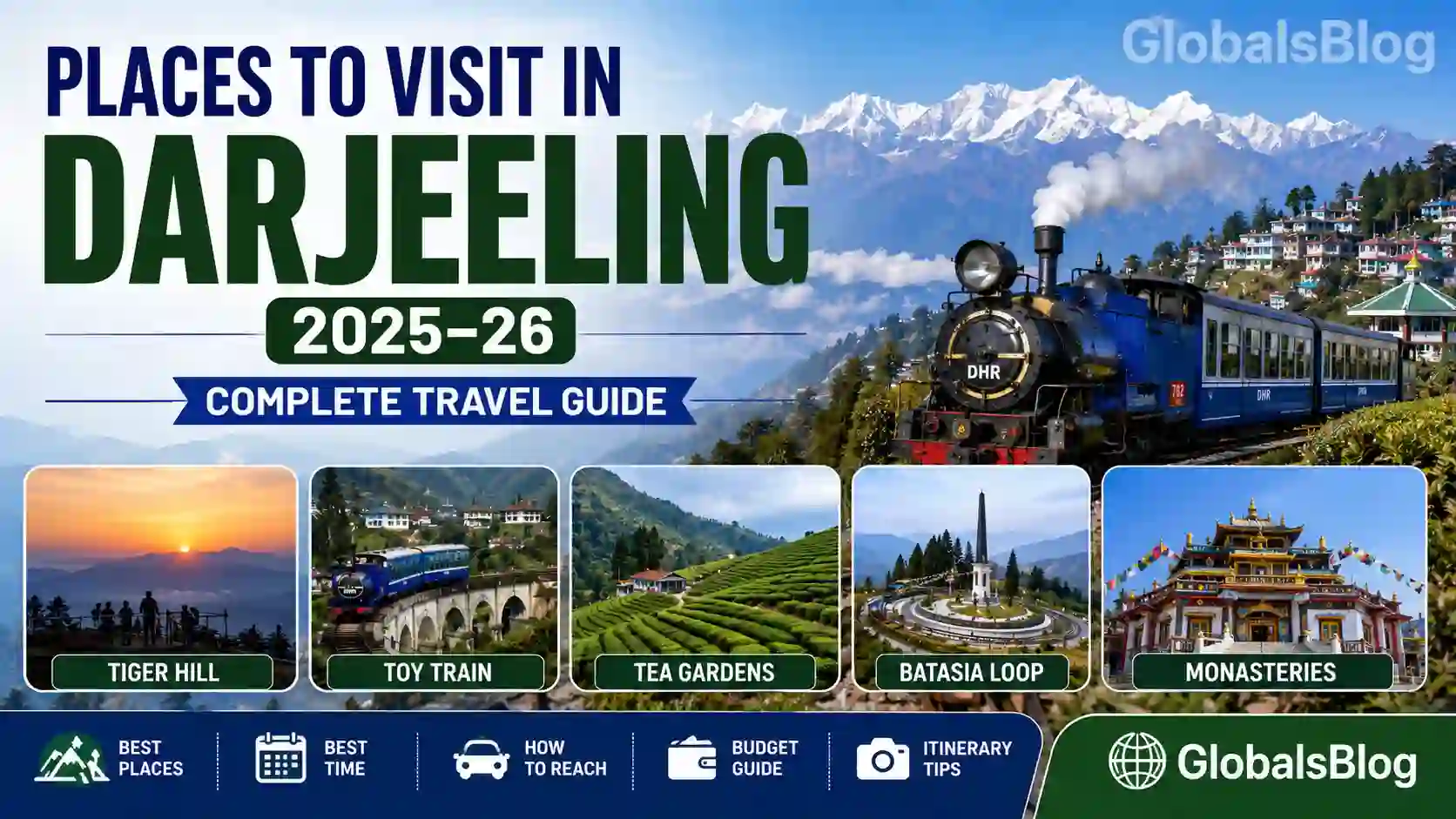
Tiger Hill at 4am delivers the most famous sunrise view in India — Kangchenjunga, the world's third-highest peak, turning gold against a pink sky. The Darjeeling Himalayan Railway Toy Train has been a UNESCO World Heritage Site since 1999. And the tea grown on these misty hillsides is the most expensive in the world. This is everything you need to plan Darjeeling right.
Darjeeling — from the Tibetan "Dorje Ling" meaning "Place of the Thunderbolt" — sits at 2,042m in the foothills of the Eastern Himalayas in West Bengal, perched on a ridge with views of the Kangchenjunga massif (8,586m, the world's third-highest peak) on clear days. The town was developed by the British as a hill station from the 1840s, combining a sanatorium, military cantonment, and — most crucially — a tea-growing experiment that became the world's most celebrated tea-producing region. Today Darjeeling is one of India's most visited hill stations, accessible by the famous Toy Train (the Darjeeling Himalayan Railway, a UNESCO World Heritage Site), by road from Siliguri (88km), and by air to Bagdogra Airport (70km). The town offers the Tiger Hill sunrise, colonial-era architecture, Himalayan monasteries, tea garden walks, and the unique Anglo-Indian-Tibetan-Bengali culture that has developed over 180 years of distinctive history. This guide covers every major Darjeeling destination, route, budget, and timing for 2025–26.
Best places in Darjeeling: Tiger Hill (sunrise — Kangchenjunga views, 4am jeep departures from Chowrasta), Toy Train / Darjeeling Himalayan Railway (UNESCO World Heritage, Darjeeling to Ghum, 7km joyride), Batasia Loop (spiral railway loop with war memorial), Padmaja Naidu Himalayan Zoological Park (red pandas, snow leopards), Himalayan Mountaineering Institute (Tenzing Norgay connection, climbing museum), Peace Pagoda (Japanese Buddhist stupa, panoramic views), Happy Valley Tea Estate (guided estate tour + tasting), Ghum Monastery (oldest in Darjeeling, 1850), Observatory Hill (sacred Hindu and Buddhist site). Best time: March–May (spring, clearest Himalayan views) and October–November (post-monsoon clarity). How to reach: Fly to Bagdogra (70km), then taxi 2.5–3 hrs; or Toy Train from NJP (88km, 7–8 hrs). Budget: ₹1,000–2,000/night guesthouses in town.
Best Places to Visit in Darjeeling
Tiger Hill is the defining Darjeeling experience — a viewpoint at 2,590m that offers, on clear days, the most spectacular Himalayan panorama accessible from any Indian hill station. The view encompasses Kangchenjunga (8,586m), Kabru (7,353m), Pandim (6,691m), and on exceptionally clear winter mornings, even the distant cone of Mount Everest (8,849m, 225km away). The sunrise turns these peaks gold, pink, then white as the sun rises — a sequence that takes approximately 25–30 minutes and that every Darjeeling visitor attempts at least once. The logistics: shared jeeps depart from Chowrasta (the town centre) at approximately 4am, reaching Tiger Hill in 30–35 minutes. The view deck charges a ₹60 entry fee; inside there is a covered gallery (₹60 additional) with better viewing angles in cold weather. Arrive by 5am — the sun clears the horizon between 5:30am and 6:30am depending on season. The hill is inside the Singalila National Park boundary — October to May offers the clearest views. June to September monsoon clouds obscure the peaks most mornings. On mornings when cloud cover blocks the main view, the experience is still worthwhile — the atmosphere of 200–300 people silently watching a pink sky in cold mountain air is itself memorable.
The Darjeeling Himalayan Railway (DHR) — universally known as the Toy Train — is a 2-foot narrow gauge railway built in 1881 that climbs from New Jalpaiguri (88m elevation) to Darjeeling (2,042m) over 88km, gaining 1,954m in altitude through a system of loops, zig-zags, and spiral bends that are engineering feats of the 19th century. The railway was designated a UNESCO World Heritage Site in 1999 alongside the Nilgiri Mountain Railway and the Kalka–Shimla Railway (added 2008) under "Mountain Railways of India." For most visitors, the practical choice is the Joyride — a 2-hour steam or diesel locomotive ride from Darjeeling station to Ghum and back (14km round trip), running at 10–15 km/h through the tea gardens and mountain scenery. The full Darjeeling–NJP journey (8 hours) is available but logistically demanding and best done by dedicated railway enthusiasts. The Joyride runs multiple times daily — check the DHR official website or Darjeeling station for current timings. Book in advance online (irctc.co.in) during peak season as seats sell out 2–3 weeks ahead.
Batasia Loop is a spiral railway loop built in 1919 to solve the gradient problem on the Darjeeling Himalayan Railway — the track spirals 360 degrees around a small hill, gaining altitude in a tight space that would otherwise require a more dramatic gradient. The loop is visually striking: watching the Toy Train complete the full spiral from the viewing platform is one of Darjeeling's most photographed moments. At the centre of the loop stands the Gorkha War Memorial — a monument to Gorkha soldiers who died serving India, inaugurated in 1995. The memorial garden is well-maintained with excellent 270-degree views of the Darjeeling hills and, on clear days, the Kangchenjunga range. Entry is ₹35 per person. The loop is a natural stop on the Tiger Hill return route — most shared jeep packages include Batasia Loop on the return journey after the sunrise. The loop is also a designated stop on the Toy Train joyride.
The Padmaja Naidu Himalayan Zoological Park is the highest altitude zoo in India (2,134m) and one of the most important conservation facilities for Himalayan fauna — it houses the largest captive population of red pandas in India, along with snow leopards, Himalayan black bears, clouded leopards, Tibetan wolves, and a variety of Himalayan birds. The zoo's red panda breeding programme has achieved significant success — Darjeeling's red pandas are regularly transferred to zoos worldwide for global conservation efforts. The zoo spans 67.56 acres of forested hillside — the animals are kept in naturalistic enclosures rather than bare concrete cages, and the forested setting makes viewing more naturalistic than a typical urban zoo. Plan 2–3 hours for a thorough visit. The Himalayan Mountaineering Institute (HMI) is adjacent to the zoo — a single entry ticket (₹100 for Indians) covers both. The zoo is a short walk downhill from Chowrasta and can be combined with Observatory Hill and the Mall Road on a leisurely morning walk.
The Himalayan Mountaineering Institute (HMI) was founded in 1954 by Prime Minister Jawaharlal Nehru, one year after Tenzing Norgay and Edmund Hillary's first ascent of Mount Everest (May 29, 1953). Tenzing Norgay — a Darjeeling Sherpa — served as the institute's first Director of Field Training until 1976. The institute's museum is the most significant Everest and Himalayan mountaineering museum in India — housing the original equipment used by Tenzing and Hillary on the 1953 summit climb, photographs, expedition journals, and a collection of mountaineering equipment spanning the history of Himalayan climbing. A life-size statue of Tenzing Norgay stands in the institute grounds. The Everest Museum section traces all major Everest expeditions chronologically. For history and mountaineering enthusiasts, HMI is easily the most substantive single attraction in Darjeeling beyond the sunrise view — it is underrated because it requires more engagement than the aesthetic stops on the standard circuit.
Happy Valley Tea Estate is the closest major tea garden to Darjeeling town centre — established in 1854, it is one of the oldest functioning tea estates in the Darjeeling region and produces some of the most sought-after First Flush (spring harvest, March–April) teas in the world. Darjeeling First Flush is classified as a GI (Geographical Indication) product — only tea grown in the 87 Darjeeling tea estates can legally be labelled "Darjeeling Tea." The guided tour (₹200 per person, 1–1.5 hours) walks through the plucking fields, shows the withering, rolling, fermentation, drying, and sorting processes at the estate factory, and culminates in a tasting of different grade teas. The best time to visit for the full process including active plucking: March–May (First Flush) and October–November (Second Flush). Factory is partially operational June–September (monsoon season, lower-quality rain tea). A 250g packet of estate tea purchased directly at Happy Valley costs ₹300–1,200 depending on grade — significantly cheaper than the same tea in Darjeeling gift shops.
Ghum Monastery — formally Yiga Choeling Gompa — is the oldest monastery in the Darjeeling hills, built in 1850 by a Mongolian monk and affiliated with the Gelugpa (Yellow Hat) school of Tibetan Buddhism. The monastery is famous for housing a 4.6-metre statue of Maitreya Buddha (Future Buddha) in its main prayer hall — one of the finest examples of Buddhist iconography in the region, surrounded by intricate Thangka paintings and butter lamp offerings. Ghum is at 2,438m — slightly above Darjeeling town — and sits adjacent to the Ghum railway station (the highest station on the Toy Train route). The monastery receives far fewer tourists than the better-publicised Darjeeling attractions and retains a genuinely devotional atmosphere — monks conduct regular puja ceremonies and the monastery functions as an active religious centre. The Toy Train Joyride stops at Ghum, making a brief monastery visit possible within the joyride itinerary.
Observatory Hill is the sacred forested hilltop above Chowrasta (the main town square) where Darjeeling's original Buddhist monastery once stood before it was converted to a Hindu temple by Nepalese rulers in the 19th century. Today the hill is a joint Hindu–Buddhist sacred site — at the summit is a Shiva temple (Mahakal Mandir) surrounded by colourful Buddhist prayer flags, hundreds of bells hung by devotees, and the characteristic red-faced monkeys (Rhesus macaques) that have lived here for generations. The atmosphere is distinctly syncretic — Tibetan prayer flags and Buddhist chortens coexist with Hindu shrines and incense stalls in a way that reflects Darjeeling's unique cultural layering. The 10-minute forested walk from Chowrasta to the summit is the most pleasant short walk in Darjeeling town, particularly at dawn or dusk. The hill is sacred and free — no entry fee. Photography is permitted but asked to be respectful inside the shrine area.
The Peace Pagoda is a Japanese-built white Buddhist stupa on a hilltop 3km from Darjeeling town, part of the international Nipponzan Myohoji order's global network of Peace Pagodas. The Darjeeling Peace Pagoda was constructed in the 1990s and stands on a broad hilltop with 360-degree views over the Darjeeling hills, the Teesta river valley below, and on clear days the Kangchenjunga range to the north. The pagoda is considerably less visited than Tiger Hill or the Mall Road area — making it the best spot in Darjeeling for solitary views without crowds. The walk from town (3km downhill, 4km return uphill) passes through residential Darjeeling and a forested section. An easier option is to take a shared jeep to the pagoda (₹50–80 per person) and walk back downhill to town. The pagoda area is peaceful and well-maintained — the monks resident here are welcoming to visitors.
Chowrasta is Darjeeling's main pedestrian square — a flat open area at the centre of town where four roads meet (chowrasta means "four roads" in Hindi) and where most of Darjeeling's social life happens. The square is surrounded by colonial-era buildings, a bandstand, café terraces, and the characteristic pony rides that Darjeeling visitors have been taking since the 1860s. The Mall Road (Nehru Road) runs from Chowrasta along the ridge — lined with shops selling Darjeeling tea, woollens, Tibetan handicrafts, and the local sweet momo-variety snacks. The square itself has excellent views of the Kangchenjunga range on clear mornings. Chowrasta is the assembly point for Tiger Hill jeep departures (4am), the start of the Observatory Hill walk, and the reference point for all Darjeeling navigation. In the evening, Chowrasta fills with locals and visitors — the most pleasant time to absorb Darjeeling's distinctive hill town atmosphere, with the smell of wood smoke and momos from nearby stalls, and the sound of Nepali and Bengali mixing in the crowd.
How to Reach Darjeeling
| Route | Mode | Distance / Duration | Cost (approx) | Best For |
|---|---|---|---|---|
| Delhi → Darjeeling | Fly to Bagdogra + taxi | Flight 2.5 hrs + taxi 2.5 hrs | ₹4,000–10,000 + ₹1,200 taxi | Fastest from North India |
| Kolkata → Darjeeling | Train to NJP + taxi or Toy Train | Train 8–10 hrs + taxi 3 hrs | ₹300–1,500 train + ₹1,200 taxi | Budget option from Kolkata |
| Siliguri → Darjeeling | Shared jeep or taxi | 88km · 3 hours | ₹150 shared / ₹1,200 private | Local transfer from NJP |
| NJP → Darjeeling | Toy Train (DHR) | 88km · 7–8 hours | ₹700–2,600 | Experience, railway enthusiasts |
| Gangtok → Darjeeling | Shared jeep or taxi | 96km · 4 hours | ₹300 shared / ₹2,000 private | Sikkim–Darjeeling circuit |
Bagdogra Airport (IXB) is the closest airport — 70km from Darjeeling, approximately 2.5 hours by taxi (₹1,200–1,500). Direct flights from Delhi, Kolkata, Mumbai, and Bengaluru. New Jalpaiguri (NJP) is the closest major railway station — 88km from Darjeeling, 3 hours by taxi. The Toy Train from NJP is the romantic option but takes 7–8 hours — most visitors do the Joyride from Darjeeling town itself rather than the full journey.
Darjeeling 4-Day Itinerary
| Day | Morning | Afternoon / Evening |
|---|---|---|
| Day 1 | Arrive Darjeeling, check in, Mall Road and Chowrasta walk | Observatory Hill at dusk, momos dinner at Chowrasta |
| Day 2 | Tiger Hill sunrise (4am departure), Batasia Loop, Ghum Monastery return | Toy Train Joyride (if not done on Tiger Hill jeep), rest |
| Day 3 | Padmaja Naidu Zoo + HMI Museum (combined ticket, half-day) | Happy Valley Tea Estate tour + tasting |
| Day 4 | Peace Pagoda walk, Tibetan Refugee Self-Help Centre | Depart — shared jeep to NJP or taxi to Bagdogra |
For a 2-day express visit: Tiger Hill sunrise + Batasia Loop + Toy Train Joyride (Day 1) and Zoo + HMI + Happy Valley Tea Estate (Day 2). See our Sikkim travel guide for combining Darjeeling with a Gangtok extension (96km, 4 hours).
Darjeeling Budget Guide
| Category | Budget | Mid-Range | Premium |
|---|---|---|---|
| Accommodation/night | ₹500–1,200 | ₹1,500–3,500 | ₹5,000–15,000 |
| Food/day | ₹300–500 (momos, thukpa, dhabas) | ₹700–1,200 | ₹1,500–2,500 |
| Local transport/day | ₹100–300 (shared jeeps) | ₹500–1,000 | ₹1,500–3,000 |
| Activities/entry | ₹100–300 | ₹300–700 | ₹700–2,000 |
| Total/day (excl. travel) | ₹1,000–2,300 | ₹3,000–6,400 | ₹8,700–22,500 |
Realistic 4-day Darjeeling trip from Delhi: Budget ₹12,000–18,000 total (flights ₹6,000–9,000 + local ₹6,000–9,000). Mid-range ₹25,000–40,000. Darjeeling is significantly more affordable than Shimla or Manali for equivalent accommodation quality. Tea purchases (₹300–2,000 for 250g premium First Flush) are often the biggest discretionary expense.
Darjeeling Travel Tips 2025–26
- Tiger Hill cloud gambling — manage expectations: Tiger Hill sunrise visibility depends entirely on cloud cover. October–November and March–May have the highest clear-day probability (60–70%). Monsoon months (June–September) have very low clear-day probability (15–25%). Check the morning weather before committing to the 4am jeep — your guesthouse owner will have a realistic read on that morning's likelihood based on the previous evening's cloud pattern
- Toy Train: book 2–3 weeks ahead in peak season: Joyride tickets sell out during April–May and October–November long weekends. Book online at irctc.co.in — specify "steam" if you want the steam locomotive experience (not all joyride services are steam). The steam joyride has a distinctly different atmosphere from the diesel version
- Darjeeling tea — buy at source, not gift shops: The same tea available in Darjeeling's tourist gift shops (Chowrasta, Mall Road) for ₹600–2,000 per 100g can often be purchased directly at Happy Valley or Makaibari Tea Estate for 30–50% less. Ask for the estate's own brand packaging — it also makes a more authentic gift than commercial packaging
- Carry cash — few ATMs and frequent outages: Darjeeling town has ATMs (SBI, UCO Bank near Chowrasta) but they run out during peak weekends. Carry ₹3,000–5,000 in cash on arrival — most guesthouses, restaurants, and activity operators are cash-only
- Altitude note: Darjeeling is not Ladakh: At 2,042m, Darjeeling is high enough for mild breathlessness on the first day for lowland visitors but not high enough to cause serious altitude sickness. The steep uphill walks (Observatory Hill, Mall Road gradient) feel harder than expected for the first 24 hours — pace yourself but no medical precautions are necessary beyond being reasonably fit
- See our Sikkim guide and Meghalaya guide for Northeast India circuits that combine naturally with Darjeeling
Tiger Hill for the Sunrise. Toy Train for the Journey. Tea Estates for the Flavour. HMI for the History. Chowrasta for the Atmosphere.
Darjeeling is one of India's most complete hill destinations — combining the most famous Himalayan sunrise view in the country, a UNESCO World Heritage railway, the world's finest tea, significant mountaineering history, and a distinctive Anglo-Indian-Nepali-Tibetan culture that no other Indian hill station replicates. The standard 4-day itinerary covers everything efficiently. Visit in March–May for the clearest views and First Flush tea harvest, or October–November for post-monsoon clarity and fewer crowds than the April peak. Book the Toy Train Joyride and Tiger Hill jeep the day before — both sell out on busy weekends. Buy tea at the estate, not the gift shop.
The best places to visit in Darjeeling are: Tiger Hill (2,590m — India's most famous Himalayan sunrise, Kangchenjunga views, 4am jeep departure), Toy Train / Darjeeling Himalayan Railway (UNESCO World Heritage, 2-hour Joyride from Darjeeling to Ghum, steam locomotive), Batasia Loop (spiral railway engineering + Gorkha War Memorial, en route from Tiger Hill), Padmaja Naidu Himalayan Zoological Park (largest captive red panda population in India, snow leopards), Himalayan Mountaineering Institute (Tenzing Norgay museum, 1953 Everest expedition equipment), Happy Valley Tea Estate (guided tour + First Flush tasting, ₹200), Ghum Monastery (oldest monastery 1850, 4.6m Maitreya Buddha), Observatory Hill (Hindu-Buddhist sacred site above Chowrasta, prayer flags + monkey colony), Peace Pagoda (Japanese Buddhist stupa, 360-degree views, low crowds), and Chowrasta Mall Road (town centre, shopping, atmosphere, Kangchenjunga morning views).
The best time to visit Darjeeling is March–May (spring) and October–November (post-monsoon). March–May: clearest Himalayan views of the year, rhododendrons in full bloom (March–April), First Flush tea harvest (March–April — the most celebrated Darjeeling tea of the year), comfortable temperatures 12–18°C. April and May have more tourist crowds. October–November: excellent post-monsoon clarity for Tiger Hill views, comfortable temperatures 8–14°C, Second Flush tea processing ongoing, fewer tourists than spring. Avoid June–September — monsoon season brings heavy rainfall, cloud cover obscures Tiger Hill views most mornings, and landslides can disrupt road access. December–February: cold (0–8°C, occasional frost in January–February) but very clear Himalayan views and low crowds — good for winter visitors.
How to reach Darjeeling from Delhi: Fastest route — fly Delhi IGI to Bagdogra Airport IXB (2.5 hours, IndiGo/Air India/SpiceJet, ₹4,000–10,000 one-way), then taxi from Bagdogra to Darjeeling (70km, 2.5 hours, ₹1,200–1,500 for private cab or ₹200 shared jeep from Siliguri). Total journey time: 5–6 hours. Train route — overnight train from Delhi to New Jalpaiguri NJP (several options: Darjeeling Mail, Teesta Torsa Express, 24–28 hours, ₹300–2,500 depending on class), then shared jeep or taxi from NJP to Darjeeling (88km, 3 hours, ₹150 shared / ₹1,200 private). For most travellers, the flight + taxi combination is strongly recommended for time efficiency.
Darjeeling Toy Train (Darjeeling Himalayan Railway) costs in 2025–26: Joyride (Darjeeling to Ghum and back, 2 hours, most popular option) — approximately ₹1,400 per person. Full journey NJP to Darjeeling — ₹700–2,600 depending on class (second class to first class AC). Book online at irctc.co.in or at Darjeeling station counter. The Joyride runs multiple times daily — typically 8:30am, 10:30am, and 1:30pm departures from Darjeeling station. Book 2–3 weeks ahead for April–May and October–November weekends. If you want the steam locomotive experience specifically, confirm "steam" when booking as some services use diesel. The steam joyride is a significantly different and more atmospheric experience.
Budget for a 4-day Darjeeling trip from Delhi (2025–26): Budget traveller — ₹12,000–18,000 total (flights ₹6,000–9,000 + local expenses ₹6,000–9,000 covering budget guesthouses, local dhabas, shared jeeps, momo street food). Mid-range — ₹25,000–40,000 total covering comfortable hotels, restaurant meals, private jeep for Tiger Hill and local sightseeing, Toy Train Joyride, tea estate tour. Premium — ₹55,000–1,00,000+ with boutique heritage hotels (₹5,000–15,000/night), private vehicle throughout, curated tea tastings. Key costs: Tiger Hill shared jeep ₹150–200, Toy Train Joyride ₹1,400, Zoo + HMI ₹100, tea estate tour ₹200. Darjeeling is one of India's most affordable quality hill destinations — very good value at all budget levels.
Darjeeling in monsoon (June–September) is significantly less recommended than spring or autumn. The main reasons to avoid monsoon: Tiger Hill views are obscured by cloud most mornings (15–25% clear-day probability versus 60–70% in March–May and October–November), heavy rainfall makes outdoor activities wet and uncomfortable, and landslides can periodically close road access between Siliguri and Darjeeling (sometimes for days at a time). The Toy Train Joyride operates but the surrounding scenery is often mist-covered. On the positive side: Darjeeling in monsoon is lush and deeply green, hotels are cheaper (30–50% below peak rates), and crowds are significantly lower. If you have to visit in monsoon, go in September when rainfall begins tapering and clear mornings become more frequent — the post-monsoon clarity often arrives in the second half of September.
Reader Experiences