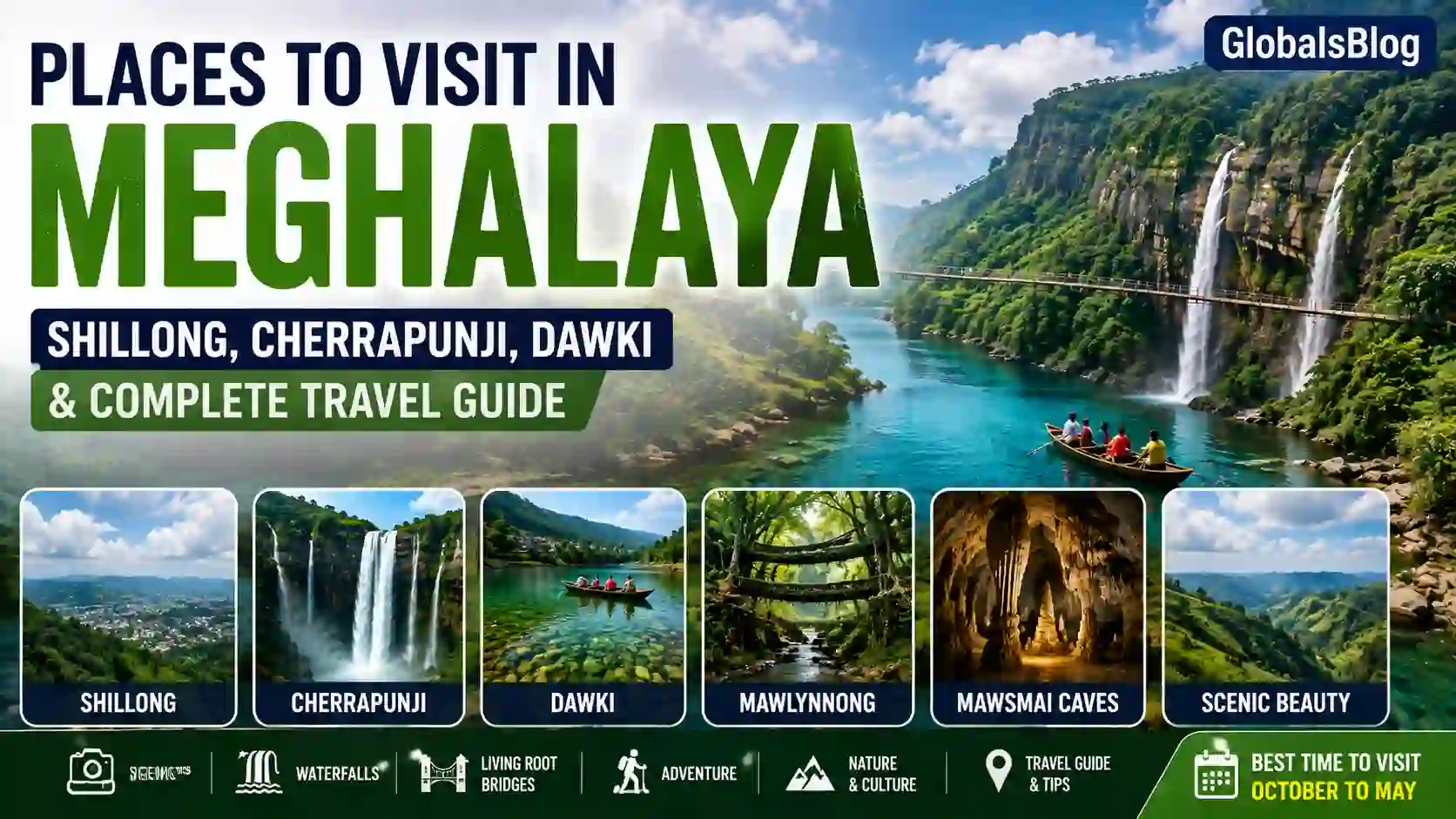
Meghalaya means "Abode of Clouds" in Sanskrit. It earns the name — the state receives some of the highest rainfall on earth, produces living bridges grown from tree roots, and has a river so clear you can read the inscription on a coin through 10 feet of water.
A reader from Delhi described Meghalaya as "the India trip I didn't know I needed." She had been to Rajasthan three times, Kerala twice, and Goa every December. A colleague from Shillong finally persuaded her. What she found: a state where Khasi matrilineal culture shapes daily life in ways visible in every market and household, where the world's wettest place (Mawsynram, receiving over 11,000 mm of rain annually) is a 45-minute drive from Shillong, where living root bridges grown over centuries from Ficus elastica trees cross gorges that no constructed bridge could survive, and where the Umngot River at Dawki is so transparent that boats appear to float on air. Meghalaya is one of the most distinctive travel experiences in India — and one of the most undervisited relative to what it offers. This guide covers all of it.
Best places to visit in Meghalaya: Shillong (state capital, Ward's Lake, Police Bazar, Don Bosco Museum), Cherrapunji / Sohra (living root bridges, Nohkalikai Falls, Mawsmai Caves, Seven Sisters Falls), Dawki (Umngot River — India's clearest river, Bangladesh border), Mawlynnong (Asia's cleanest village, single-decker root bridge), Mawphlang Sacred Forest (ancient khasi sacred grove), Nongriat (double-decker living root bridge — 2.5 hour trek), Krang Suri Falls (turquoise swimming waterfall in Jaintia Hills), and Nartiang (monoliths). Best time: October to May (dry season). Avoid June to September — heaviest rainfall blocks many roads and trekking routes. Permit required for Dawki and some border areas.
Best Places to Visit in Meghalaya — Ranked
Shillong is the logical base for any Meghalaya trip — it has the state's best accommodation range, the only significant airport (Umroi, 35 km from city), and excellent connectivity by road to every major attraction. The city earned the "Scotland of the East" nickname from British colonial administrators who found its rolling green hills and cool climate familiar — the Pine Forest, Ward's Lake, and the golf course laid out in 1898 are the most visible legacies of this comparison. But Shillong's more interesting identity is its position as India's rock music capital — the city has produced more per-capita rock musicians than anywhere else in the country, the result of a cultural influx of Western music during the colonial era that never left. The live music venues in Police Bazar and Laitumkhrah play original music most nights.
Ward's Lake is a pleasant artificial lake in the centre of the city — best visited early morning before crowds. The Don Bosco Centre for Indigenous Cultures (one of Asia's largest museums of indigenous culture — 7 floors covering the peoples of Northeast India) is the most intellectually substantive attraction in Shillong and is often skipped by visitors focused on the natural attractions around the city. It deserves a half-day. The Shillong Peak viewpoint (6 km from city centre, 1,966m altitude) provides views across the entire Khasi Hills on clear October-November mornings. Cathedral Catholic Church, built in 1891, is the city's most architecturally distinctive colonial structure.
Cherrapunji — locally called Sohra — is the destination most synonymous with Meghalaya internationally, and for good reason. It holds the record for most rainfall in a single month (9,300 mm in July 1861), is surrounded by Bangladesh's flatlands visible from the plateau edge on clear days, and is the access point for Meghalaya's most famous natural and cultural attractions. Nohkalikai Falls — at 340 metres, India's tallest plunge waterfall — drops into a green pool that turns turquoise in the monsoon aftermath. The name translates to "Jump of Ka Likai" — a tragic local legend about a woman named Likai whose grief drove her to the cliff edge. The waterfall is best at September-October when the monsoon has just ended and the volume is near maximum but roads are accessible.
Seven Sisters Falls (Nohsngithiang Falls) is a 315-metre cascade that splits into seven distinct streams during peak flow — the name references India's seven northeastern states. Visible from the road on the Cherrapunji plateau, it is one of Meghalaya's most photographed sights. Mawsmai Caves is the most accessible cave system in Meghalaya — a 150-metre illuminated passage through limestone formations, suitable for all fitness levels and particularly good for families. The cave passage is genuinely narrow in sections and requires some stooping — claustrophobic travellers should be aware. The living root bridges of Cherrapunji are accessed from the Tyrna village trailhead — most visitors do the single-decker bridge at Nohwet (1 hour each way, moderate difficulty). The famous double-decker bridge is at Nongriat — a separate, more demanding trek described below.
Dawki is where the Umngot River crosses from Meghalaya into Bangladesh, and it is where the photographs that have made Meghalaya famous on social media were taken — boats appearing to float on glass, the riverbed visible in photographic detail through 10 feet of clear water, the suspension bridge that has crossed the Umngot since 1932 reflected perfectly in the surface below. The clarity is real and consistent from October to April, when the monsoon's sediment has settled and the river runs over its clean limestone and granite bed in near-perfect transparency.
The boating experience is the primary reason to visit — a 30-45 minute boat ride on the Umngot looking down through the water at the riverbed is genuinely unlike any river experience available elsewhere in India. The Bangladesh border is visible from the river — the Tamabil border crossing on the Bangladesh side is the most active pedestrian border between the two countries. A riverside camp stay (several operators offer tents on the Dawki bank for ₹1,500–₹2,500 per night) provides the early morning light that produces the most striking photographs — the boats are fewer and the light is better before 9am. Arriving after 10am on weekends finds Dawki increasingly crowded with day-trippers from Shillong. The drive from Shillong passes through some of the most dramatic East Khasi Hills scenery in Meghalaya — worth stopping at Pynursla viewpoint on the return.
The double-decker living root bridge at Nongriat is the most photographed single image from Meghalaya and the reason many travellers plan the entire trip. Two levels of roots grown from Ficus elastica trees — guided by bamboo and stone frameworks over generations by the War Khasi people — cross a gorge above a clear mountain stream. The lower bridge is the older and more established; the upper level is younger and still actively growing. The entire structure has been living and growing for an estimated 180 years on the lower level.
The approach from Tyrna village descends 3,500 stone steps — the same steps that Cherrapunji's extraordinary rainfall has helped carve over decades of use. It takes 2.5 hours to reach Nongriat and significantly longer (3–3.5 hours) to climb back up. The calculus strongly favours an overnight at a Nongriat village homestay (₹500–₹800 per person with meals) rather than a same-day round trip — the bridge at dawn with no other tourists, the natural pool above the bridge for swimming, and the different light on the return morning make staying a genuinely different experience from rushing down and back. The Rainbow Falls (30 minutes walk from Nongriat) and the natural swimming pool near the bridge are additional reasons to stay. Wear rubber-soled shoes — the stone steps are frequently wet and slippery even in the dry season.
Mawlynnong received the "Asia's Cleanest Village" designation from Discover India magazine in 2003 and has maintained the standard — the village's communal cleaning ethic, bamboo dustbins on every street corner, and complete absence of plastic waste are immediately visible and genuinely impressive. The Khasi matrilineal cultural pride in collective maintenance of the village environment is the explanation — Mawlynnong is not clean because of a campaign or a prize, it is clean because cleanliness is embedded in how the community functions. The village has a single-decker living root bridge, a bamboo sky-walk treehouse with views across the Bangladesh plains below, and several homestays that offer an authentic experience of Khasi village life. At 12 km from Dawki, combining Mawlynnong and Dawki in the same day is the standard and sensible itinerary — leave Shillong early, Mawlynnong by 9am, Dawki by midday, return to Shillong or stay overnight at Dawki.
Mawphlang Sacred Forest is a Law Kyntang — one of Meghalaya's ancient sacred groves maintained by Khasi communities for centuries under religious protection that prohibits the removal of any living or non-living material from the grove. The result is a patch of primary forest that has never been logged, grazed, or cleared, producing a biodiversity and forest density that surrounding areas lost generations ago. The forest contains over 100 orchid species, ancient oaks over 400 years old, and medicinal plants used in traditional Khasi healing — guided walks explain both the botanical significance and the cultural practice of Law Kyntang. The guide is mandatory (genuinely so — no independent entry) and the requirement is respectful, not bureaucratic: the forest exists because of the taboo against removal, and understanding that context changes the experience from a walk in the woods to something considerably more interesting.
Krang Suri Falls is the most visually extraordinary waterfall in Meghalaya — a 25-metre cascade feeding into a turquoise pool of extraordinary clarity, surrounded by jungle in the Jaintia Hills. The turquoise colour comes from the limestone karst geology that filters the water and creates the mineral suspension that produces the colour. Swimming in the pool is permitted and is the primary reason most visitors make the 150 km journey from Shillong. The colour is at its most intense November to April when rainfall is minimal and the water runs clear. During monsoon the pool turns brown with sediment — the turquoise is entirely absent June through September.
Krang Suri is less visited than Cherrapunji and Dawki, making it the best option for travellers who want a less crowded Meghalaya experience. The Jaintia Hills route from Shillong passes through Jowai (Jaintia capital — worth a brief stop for the local market and Synthesis Falls) and the landscapes are distinctly different from the East Khasi Hills scenery around Cherrapunji — rolling tea estates, coal-bearing hills, and Jaintia villages that see fewer tourists than the more marketed East Khasi circuit.
At 340 metres, Nohkalikai is India's tallest plunge waterfall — the water drops in a single unbroken column from the Cherrapunji plateau to the gorge below, creating a mist cloud visible from 2 km away on high-flow days. The viewpoint is at the cliff edge of the Cherrapunji plateau, looking down into a pool that appears dark green from this height — the same pool that appears turquoise when photographed from the bottom, where the waterfall base can only be reached from the valley below via a different approach. The legend of Ka Likai (whose grief at discovering her infant daughter had been cooked by her second husband drove her to leap from this cliff) gives the falls their name and a darker context to a location of extraordinary natural beauty. The falls are typically visited as part of the same Cherrapunji day that includes Seven Sisters Falls, Mawsmai Caves, and the Eco Park viewpoints — one of Meghalaya's most densely rewarding single days.
Meghalaya Tourist Places — Quick Reference
| Place | Distance from Shillong | Time | Best Time | Don't Miss |
|---|---|---|---|---|
| Shillong | Base | — | Year round | Don Bosco Museum, music scene |
| Cherrapunji | 54 km | 2 hrs | Sep–Nov (falls), Oct–May (access) | Nohkalikai Falls, Seven Sisters, Mawsmai Caves |
| Dawki | 96 km | 3 hrs | Oct–Apr | Umngot River boat ride |
| Mawlynnong | 90 km | 3 hrs | Oct–May | Village walk, root bridge, treehouse |
| Nongriat | 60 km + trek | 2.5 hrs each way | Oct–May | Double-decker root bridge, overnight |
| Mawphlang | 25 km | 1 hr | Year round | Sacred forest guided walk |
| Krang Suri | 150 km | 3.5 hrs | Nov–Apr | Turquoise swimming pool |
| Nohkalikai Falls | 54 km (Cherrapunji) | 2 hrs | Sep–Nov | 340m plunge waterfall viewpoint |
| Shillong Peak | 6 km | 20 min | Oct–Jan | Panoramic Khasi Hills view |
| Elephant Falls | 12 km | 30 min | Year round | Three-tier waterfall near Shillong |
Meghalaya Itinerary — 4 Days and 7 Days
4-Day Meghalaya Itinerary (minimum recommended):
Day 1 (arrive Guwahati/Shillong): Fly or train to Guwahati, drive to Shillong (3 hours). Evening: Police Bazar, local music venue. Day 2: Cherrapunji full day — Nohkalikai Falls, Seven Sisters Falls viewpoint, Mawsmai Caves, single-decker root bridge at Nohwet (1 hour trek). Return Shillong. Day 3: Dawki + Mawlynnong — early start, Mawlynnong village 9am, Dawki Umngot River boat 12pm, Bangladesh border viewpoint, return Shillong via Pynursla. Day 4: Shillong city — Don Bosco Museum (half day), Ward's Lake, Shillong Peak, Police Bazar for khasi food and local shopping. Depart.
7-Day Meghalaya Itinerary (recommended for first visit):
Day 1: Guwahati → Shillong (3 hours). Day 2: Mawphlang Sacred Forest (25 km, morning) + Elephant Falls. Afternoon: Shillong city, live music evening. Day 3: Cherrapunji — Nohkalikai, Seven Sisters, Mawsmai Caves, Eco Park. Overnight Cherrapunji. Day 4: Tyrna → Nongriat trek (depart 7am) — double-decker root bridge, Rainbow Falls, overnight Nongriat. Day 5: Nongriat → Tyrna (morning return) → Dawki (2 hours). Overnight Dawki riverside camp. Day 6: Dawki sunrise boat ride, Mawlynnong village (12 km). Return Shillong via Sohra plateau. Day 7: Krang Suri Falls (150 km, Jaintia Hills) or Shillong departure.
How to Reach Meghalaya
| Mode | Route | Time | Cost | Notes |
|---|---|---|---|---|
| Flight + Drive | Fly to Guwahati (GAU) → drive Shillong | Flight + 3 hrs drive | ₹3,000–₹8,000 flight + ₹1,500–₹2,000 cab | Best option — Guwahati has most connectivity |
| Direct Flight | Fly to Shillong (SHL, Umroi Airport) | Direct + 45 min drive | ₹4,000–₹10,000 | Limited flights, mostly from Kolkata and Delhi |
| Train + Drive | Train to Guwahati → drive Shillong | Train varies + 3 hrs | ₹800–₹2,500 train + cab | Trains from Delhi (Rajdhani), Kolkata, Bengaluru |
| Bus from Guwahati | ASTC/private buses Guwahati → Shillong | 3.5–4 hrs | ₹200–₹500 | Frequent, comfortable, good for solo travellers |
Guwahati is the gateway to Meghalaya — better connected than Shillong's Umroi Airport for most travellers. The Guwahati to Shillong drive (NH6) is one of the most scenic approaches to any Indian state capital, ascending through Meghalayan pine forests from the Brahmaputra plains. Shared sumo (shared jeep taxis) run from Paltan Bazar in Guwahati to Shillong's Police Bazar throughout the day for ₹200–₹250 per seat — the most economical option for solo travellers.
✓ Meghalaya Travel Tips
- Carry rain gear regardless of season: Meghalaya can receive brief heavy showers even in the dry season — a compact waterproof jacket and a dry bag for electronics are essential. The living root bridges and waterfall trails are beautiful in light rain but slippery; rubber-soled shoes are non-negotiable for any trekking
- Hire a local driver for the entire trip: Meghalaya's attractions are spread across three hill districts (East Khasi, West Khasi, Jaintia) with varying road quality. A local driver knows which roads are accessible after rain, which viewpoints are less crowded at specific times, and the Khasi villages well enough to recommend genuine experiences beyond the tourist circuit. Budget ₹2,500–₹3,500 per day for driver + vehicle
- Respect the living root bridges: The bridges are living infrastructure maintained by Khasi communities — not tourist installations. Do not carve names, tie ribbons, or attach anything to the roots. The communities that maintain them ask only that visitors treat them as what they are: centuries-old engineering achievements that continue to grow
- Stay overnight at Nongriat if you trek there: The double-decker root bridge at dawn with no other visitors is a completely different experience from the midday arrival of day-trippers. The village homestay (₹500–₹800 with meals) is basic but clean, and the community benefits directly from overnight visitors
- Try the local food actively: Jadoh (rice cooked with pork blood and spices), tungrymbai (fermented soybean paste — the Khasi equivalent of miso), dohkhlieh (minced pork salad with onion), and kwai (betel nut with pan) are the foods that define Khasi culture. The best versions are in Police Bazar's local restaurants and in homestay meals, not in tourist-oriented cafes
- See our November travel guide for Meghalaya in the context of India's best October-November destinations
✗ Meghalaya Mistakes to Avoid
- Visiting in the monsoon without research: June to September in Meghalaya means the world's heaviest rainfall — Mawsynram averages over 900mm in June alone. The living root bridges become dangerously slippery, Nongriat trek is inadvisable due to leech infestation and unstable stone steps, road closures are frequent, and the Umngot River at Dawki turns completely opaque. Monsoon Meghalaya is beautiful in its own way (the forest is extraordinary green, waterfalls are at full volume) but very different from the clear-water, accessible version. Know what you are choosing
- Doing Nongriat as a same-day trip: The descent is 2.5 hours, the ascent is 3–3.5 hours, and attempting both in a single day means arriving at the bridge exhausted and returning in the heat of the afternoon. The overnight at Nongriat village costs ₹500–₹800 and changes the experience from a gruelling checkbox to one of the finest overnight experiences in Northeast India
- Skipping the Don Bosco Museum: Most travel itineraries for Meghalaya focus on the natural attractions and overlook the Don Bosco Centre for Indigenous Cultures — seven floors covering the peoples, crafts, music, and traditions of Northeast India's many communities. It is the best single resource for understanding the cultural context of everything else you see in Meghalaya, and it deserves a half-day
- Assuming any waterfall is good at any time: Krang Suri's turquoise colour exists only October to April — it is brown during monsoon. Dawki's transparency exists only October to April — it is turbid during and after monsoon. Research which attractions are season-dependent before planning specific sights
- Underestimating distances: Meghalaya is hilly — 54 km to Cherrapunji takes 2 hours, 96 km to Dawki takes 3 hours, 150 km to Krang Suri takes 3.5 hours. Do not plan more than two major destinations per day, and always account for the return journey in your schedule
Meghalaya — Practical Information
| Topic | Details |
|---|---|
| ILP (Inner Line Permit) | Not required for Indian citizens in Meghalaya (unlike Nagaland, Arunachal, Mizoram). Foreigners need Restricted Area Permit for areas near the Bangladesh border — check current requirements before travel |
| Currency | Cash preferred in villages and rural areas — ATMs in Shillong and Cherrapunji but unreliable in remote areas. Carry sufficient cash |
| Connectivity | BSNL has the most reliable network in rural Meghalaya. Airtel and Jio work well in Shillong and major towns but can be poor on hill roads and in gorge areas like Nongriat |
| Language | Khasi is the main language in East and West Khasi Hills; Jaintia in the Jaintia Hills; English is widely spoken due to strong Christian missionary education history — Meghalaya has one of India's highest English literacy rates |
| Culture | Meghalaya is predominantly Christian (over 80%) and matrilineal — children take the mother's family name, property passes through the maternal line. Sensitivity to local customs around dress, behaviour in churches, and community spaces is appreciated |
| Best months | October–December (post-monsoon, lush + clear + accessible), January–February (cool, clear, least crowded), March–May (warming up, some mist, flowers blooming). Peak: December–January |
Disclaimer: Entry fees, permit requirements, and road conditions in Meghalaya change seasonally and occasionally with state policy. Always verify current Inner Line Permit requirements for foreign nationals, current road accessibility for monsoon-affected routes, and current entry fees for specific attractions before travel. The Nongriat trek and living root bridge areas are managed by local Khasi communities — respect their rules and fee structures which support community income directly.
Shillong for the Base. Cherrapunji for the Waterfalls. Dawki for the River. Nongriat for the Bridge. Mawlynnong for the Village. Krang Suri for the Turquoise Pool. October to May for All of It.
Meghalaya is one of India's most genuinely distinctive travel destinations — not because of a single iconic sight but because of the accumulation of things that exist nowhere else: a river transparent enough to photograph its own riverbed from a boat, bridges built by growing them from tree roots over centuries, the world's wettest inhabited place, a village that won the cleanest in Asia designation through cultural practice rather than tourism infrastructure, and a state capital where rock music is as embedded in daily life as folk music is in Rajasthan. The right approach is not to rush it. The Nongriat overnight. The Dawki sunrise. The Mawphlang Sacred Forest with a guide who knows the names of every tree. Four days minimum. Seven is better. Avoid the monsoon unless you know what you are choosing. Go between October and May, and Meghalaya will be the India trip you did not know you needed.
The best places to visit in Meghalaya are Shillong (state capital, base for all trips — Ward's Lake, Don Bosco Museum, music culture), Cherrapunji or Sohra (Nohkalikai Falls — India's tallest plunge waterfall at 340m, Seven Sisters Falls, Mawsmai Caves, single-decker root bridges), Dawki (Umngot River — India's clearest river, boat rides, Bangladesh border view), Mawlynnong (Asia's cleanest village, single-decker root bridge, bamboo treehouse), Nongriat (double-decker living root bridge — 2.5 hour trek from Tyrna), Mawphlang Sacred Forest (ancient Khasi Law Kyntang grove, mandatory guided walk), and Krang Suri Falls in the Jaintia Hills (turquoise swimming waterfall, best November to April). A minimum of 4 days is needed for the main circuit; 7 days covers all major attractions.
The best time to visit Meghalaya is October to May. October and November are ideal — the monsoon has just ended, the landscape is extraordinarily lush and green, waterfalls (including Nohkalikai) are near maximum volume, the Umngot River at Dawki is beginning to clear, and temperatures are cool and pleasant. December to February is peak tourist season — clearest water at Dawki, best photography conditions, and cool weather (5–15°C in Shillong). March to May is good with warming temperatures and blooming orchids. Avoid June to September (heavy monsoon) unless you are specifically interested in the landscape under extreme rainfall — Nongriat trek is unsafe, Dawki river is opaque, Krang Suri's turquoise pool disappears, and road closures are frequent.
A minimum of 4 days covers Meghalaya's most essential circuit: Cherrapunji (full day — Nohkalikai, Seven Sisters, Mawsmai Caves), Dawki + Mawlynnong (full day), Shillong city including Don Bosco Museum, and Mawphlang Sacred Forest. For 7 days, add Nongriat overnight trek (the double-decker root bridge), Krang Suri Falls in the Jaintia Hills, and more time in Shillong for the music scene and local food. The Nongriat trek alone (2.5 hours each way) requires a dedicated day and strongly benefits from an overnight — making it a 2-day commitment that shapes the overall itinerary. Do not try to compress Meghalaya into 2 days — the distances and the quality of experience both demand more time.
Indian citizens do not require an Inner Line Permit (ILP) to visit Meghalaya — unlike neighbouring states Nagaland, Arunachal Pradesh, and Mizoram which require ILP for Indian nationals. Foreign nationals visiting areas near the Bangladesh border (including Dawki) require a Restricted Area Permit (RAP) or Protected Area Permit (PAP) — the requirements and processing times change periodically, so verify with the Meghalaya Tourism office or a registered tour operator before travel. Most standard tourist circuits in Meghalaya (Shillong, Cherrapunji, Mawlynnong, Nongriat, Mawphlang) are open to all Indian nationals without any permit.
The best way to reach Meghalaya is to fly to Guwahati (GAU) and then drive to Shillong (3 hours, 100 km on NH6). Guwahati has daily direct flights from Delhi (2 hours), Bengaluru (2.5 hours), Mumbai (2.5 hours), Kolkata (1 hour), and Chennai. From Guwahati, pre-booked cabs to Shillong cost ₹1,500–₹2,000, shared sumo taxis run throughout the day for ₹200–₹250 per seat from Paltan Bazar, and ASTC buses cost ₹150–₹200. Shillong's Umroi Airport has limited direct flights (mainly from Kolkata and Delhi) but the airport is 35 km from the city and flights are fewer. Train to Guwahati is also an option — Rajdhani and other trains connect Delhi (38 hours), Kolkata (14 hours), and Bengaluru (via Chennai, 48+ hours).
Meghalaya is famous for its living root bridges (bridges grown over centuries from Ficus elastica tree roots by Khasi communities — the double-decker bridge at Nongriat is the most famous), the Umngot River at Dawki (India's clearest river, boats appear to float on air), being the world's wettest region (Mawsynram receives over 11,000mm of rainfall annually), Nohkalikai Falls (India's tallest plunge waterfall at 340 metres), Mawlynnong (Asia's cleanest village), Khasi matrilineal culture (one of the world's largest matrilineal societies — property and family name pass through the mother's line), exceptional biodiversity (including over 325 orchid species), and Shillong's position as India's rock music capital. The name Meghalaya means "Abode of Clouds" in Sanskrit — apt for a state that receives some of the most extraordinary rainfall on earth.
Reader Experiences
Overnight at Nongriat was the best decision of the entire Meghalaya trip. Reached the double-decker bridge at 5pm on the way down — it was already crowded with day-trippers finishing their visit. By 6am the next morning, before any day visitors had arrived from Tyrna, I had the bridge completely to myself for 45 minutes. The light in the gorge at dawn, the sound of the stream below the bridge, and the absolute silence from the surrounding jungle — nothing I photographed or saw in four days of Meghalaya came close to that 45 minutes. The guide's advice to stay overnight is the most important recommendation in this article.
Krang Suri Falls in November — the turquoise colour is not exaggerated in photographs. It is exactly that colour in person, possibly more vivid. The pool was cold but swimmable and genuinely one of the most beautiful places I have stood in India. The 3.5 hour drive from Shillong through the Jaintia Hills is worth it independently of the falls — the tea estates and limestone karst scenery is completely different from the East Khasi Hills around Cherrapunji.
The Don Bosco Museum in Shillong spent more time changing how I understood Northeast India than any book I have read on the subject. Seven floors covering the tribes, crafts, music, oral histories, and ecological knowledge of the region — I spent four hours there and could have spent more. Most travellers skip it entirely for another waterfall. This was the best single experience of the Meghalaya trip for me and it is in the middle of Shillong, no driving required.
Dawki at 7am before the Shillong day-trippers arrive is exactly as the guide describes — almost completely empty, the river surface is mirror-flat in the early morning with no wind, and the photographs from the boat looking down at the riverbed look like composites even though they are straight shots. By 11am the river had 30+ boats and the wake from each one reduced the glassy surface. The overnight camp at the Dawki riverbank is genuinely worth it purely for the morning access.
Mawphlang Sacred Forest with the guide who had lived in the village his entire life was the experience that put everything else in context. He explained that the Law Kyntang prohibition on removing anything from the forest is not a conservation rule imposed from outside — it is a living religious practice that has maintained this forest in primary condition for centuries while everything around it was cleared. Understanding that the forest exists because of belief rather than legislation changed how I understood everything else I saw in Meghalaya. The guided walk at Mawphlang is the best ₹250 I spent in the state.