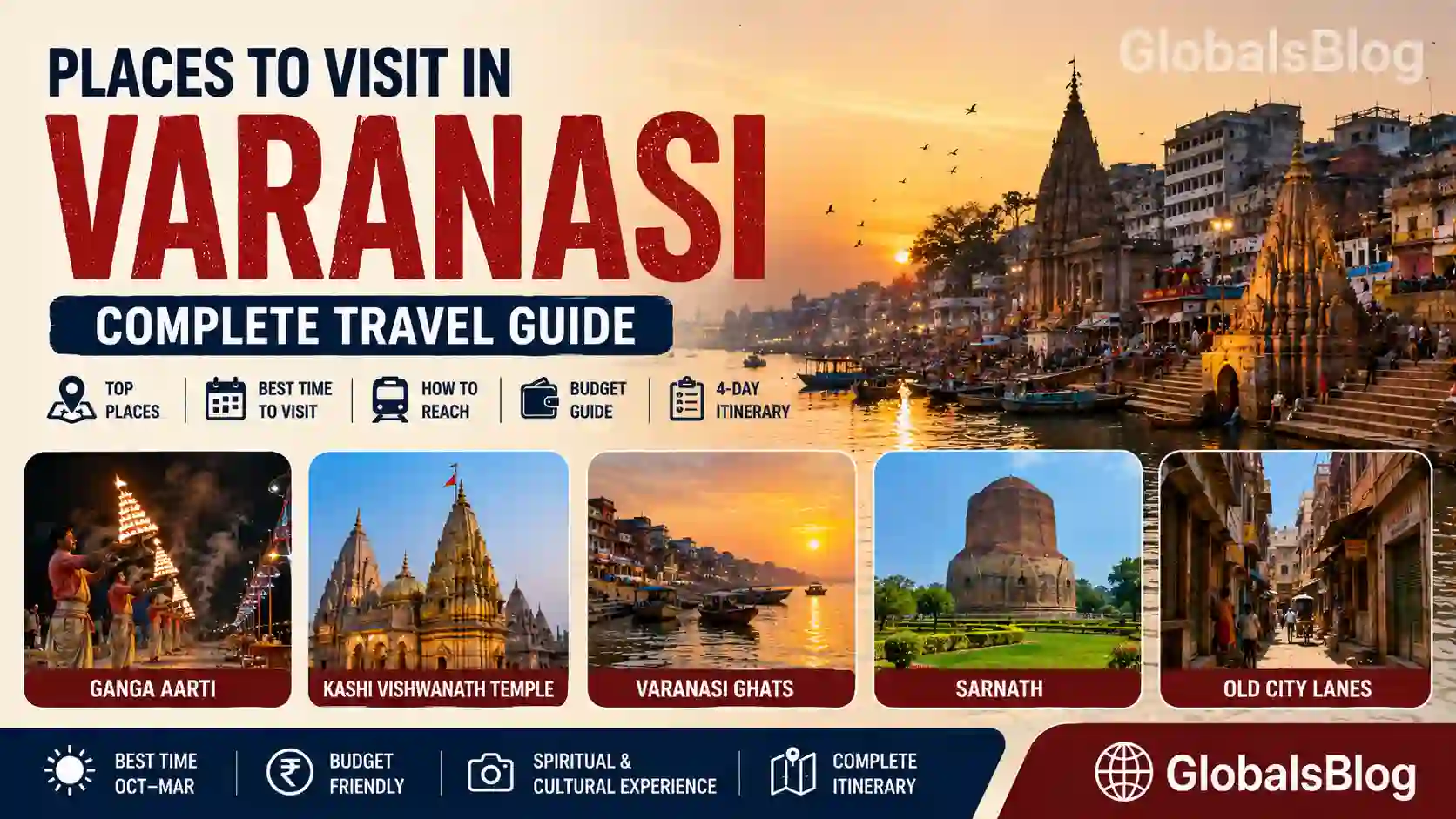
The Ganga Aarti at Dashashwamedh Ghat — 108 priests, fire lamps, Sanskrit chants, and the Ganges at dusk — is one of the most visually and spiritually powerful experiences in India. Varanasi is the world's oldest continuously inhabited city, a place where Hinduism, Buddhism, Jainism, and Sufism have coexisted for 3,500 years. And the narrow lanes of the old city hide silk weavers, chai stalls, and temples at every turn. This is everything you need to plan Varanasi right.
Varanasi — also known as Kashi and Benares — is one of the oldest continuously inhabited cities in the world, with a recorded history spanning at least 3,000 years and cultural traditions that may be 3,500 years old or older. Situated on the western bank of the Ganges in Uttar Pradesh, the city is the spiritual capital of Hinduism — it is believed that dying in Varanasi grants moksha (liberation from the cycle of rebirth) and that the Ganges here washes away all sin. Over 80 ghats (stepped stone embankments) line the river, each with its own history and ritual significance. The city's old quarter — the lanes behind the ghats, known as the Vishwanatha Gali and surrounding mohallas — is a medieval labyrinth of temples, silk weaving workshops, music schools, and tea stalls that functions essentially as it has for centuries. Beyond the ghats, Varanasi is also a centre of classical music (the Banaras Gharana of music), Banarasi silk weaving (GI-tagged, some of the most intricate silk in the world), Buddhist pilgrimage (Sarnath, where the Buddha gave his first sermon, is 10km away), and the philosophical traditions of the Kashi Vishwanath corridor. This guide covers every major Varanasi destination, ghat, experience, and practical detail you need.
Best places in Varanasi: Dashashwamedh Ghat (Ganga Aarti every evening — 7pm, 108 priests, fire ceremony), Kashi Vishwanath Temple (most sacred Shiva temple in India, Kashi Vishwanath Corridor, queue 2–5 hours), Manikarnika Ghat (ancient cremation ghat — always burning, solemn), Assi Ghat (morning aarti, cleaner area, popular with visitors), Sarnath (10km — where Buddha gave first sermon, Dhamek Stupa, museum with Lion Capital original), Banaras Hindu University (largest residential university in Asia, Vishwanath Temple inside), Ramnagar Fort (Maharaja's palace across the river, museum). Best time: October–March. How to reach: Fly to Varanasi (Lal Bahadur Shastri Airport), or train to Varanasi Junction. Budget: ₹800–2,000/night guesthouses near ghats.
Best Places to Visit in Varanasi
Dashashwamedh Ghat is Varanasi's most important ghat and the site of the nightly Ganga Aarti — one of the most visually spectacular religious ceremonies in India. Every evening at approximately 7pm (timings shift slightly by season), 11 priests dressed in saffron conduct a synchronised fire worship ceremony using large brass lamps (diyas), incense, conch shells, yak-tail whisks, and camphor — all offered to the Ganges river goddess Ganga. The ceremony lasts approximately 45–60 minutes and draws thousands of spectators — both pilgrims and tourists — who crowd the ghat steps, the surrounding balconies, and the dozens of boats that anchor in the river for a view. The boat view is the recommended option: a boat (₹100–200 per person shared, or ₹500–800 for a private boat) positions you in the river facing the entire ghat — giving an unobstructed, elevated view of all 11 priests simultaneously with the illuminated temple towers as backdrop. The ghat-side view is more immersive but significantly more crowded, and you may see only a portion of the ceremony from ground level. Arrive — by boat or by ghat — at least 30 minutes before the 7pm start time during peak season (October–March) as the best viewing positions are claimed early. The monsoon (July–August) aarti, conducted in heavy rain with the Ganges running high and fast, is reported by many visitors as the most dramatic version of the ceremony.
The Kashi Vishwanath Temple — the Golden Temple of Varanasi — is one of the twelve Jyotirlinga shrines of Shiva and is considered the most sacred Shiva temple in Hinduism. The current temple was built in 1780 by Maratha ruler Ahilyabai Holkar on the site of earlier temples that were repeatedly destroyed and rebuilt over centuries. The temple complex was dramatically expanded with the Kashi Vishwanath Corridor — a ₹800 crore redevelopment completed in 2022 that cleared the dense lanes surrounding the temple and created a wide walkway from Lalita Ghat directly to the temple complex, incorporating 24 buildings with restaurants, dharamshalas, and viewing platforms with Ganges views. Non-Hindus are not permitted inside the main sanctum sanctorum — but the corridor and outer complex are accessible to all visitors. The main shivling (Shiva's symbolic representation) is covered in gold donated by Maharaja Ranjit Singh. The queue for darshan can extend 2–5 hours during peak season (Shravan month, Shivratri, October–March peak tourism); the 4am–5am early morning slot typically has the shortest wait. Mobile phones are not permitted inside — leave them at the official bag-check counter at the entrance.
Manikarnika Ghat is Varanasi's principal cremation ghat — the place where Hindus believe the deceased who are brought here for cremation achieve moksha (liberation). The ghat has reportedly been burning continuously for centuries — wood pyres smoulder and blaze at all hours, tended by the Dom community (hereditary cremation workers). Between 100 and 200 cremations take place here daily. Visiting Manikarnika is a profound, sobering experience — the sight of families processing with their dead through the narrow lanes, the wood smoke rising across the river, and the philosophical matter-of-factness with which Varanasi treats death is unlike anything else in India. Protocol for visitors: approach quietly, photograph with extreme restraint (many families ask that no photographs be taken of the pyres or the deceased — respect this absolutely), do not enter the main burning area, do not wear leather (prohibited near the cremation site), and interact with the self-appointed guides at the ghat with caution — many are skilled at creating emotional narratives that conclude with requests for wood donations (a common Manikarnika ghat scam). The experience is approached most respectfully by watching from the river on a boat at a distance, or by sitting quietly at the ghat's edges without intruding on the families present.
A sunrise boat ride on the Ganges is arguably the single most important Varanasi experience — more evocative than the Ganga Aarti because it is quieter, more personal, and shows the ghats at their most genuinely Varanasi rather than their most theatrical. The boat moves slowly from Assi Ghat in the south to Manikarnika in the north (or further to Panchganga Ghat), passing all 84 ghats as the morning light turns the river gold and the city slowly awakens. On the ghats: sadhus performing morning puja, residents bathing and washing clothes, flower sellers arranging marigolds, yoga practitioners on stone platforms, and the smoke from Manikarnika visible in the distance. This view — from a wooden rowboat in the middle of the Ganges, watching a city that has lived this same morning ritual for 3,000 years — is the defining Varanasi photograph and the defining Varanasi feeling. Boats are available from any ghat — shared boats cost ₹50–150 per person, private rowboats cost ₹300–500 for the full sunrise circuit. Motorised boats are faster but noisier — a traditional rowboat is strongly recommended for the atmosphere. Book through your hotel or directly with ghat boatmen the previous evening.
Sarnath is one of the four most sacred Buddhist pilgrimage sites in the world — it is where Siddhartha Gautama (the Buddha), after attaining enlightenment at Bodh Gaya, came to deliver his first teaching (the Dhammacakkappavattana Sutta, or "Setting the Wheel of Dharma in Motion") to five disciples in the Deer Park in approximately 528 BCE. The Dhamek Stupa — a massive 28-metre-diameter cylindrical stone stupa built in 500 CE on the spot of the Buddha's first sermon — dominates the Sarnath Archaeological Park. The Sarnath Museum (within the same complex) houses the finest Buddhist art collection in India, including the original Ashoka Lion Capital — the four-lion sandstone sculpture that became the national emblem of India — carved in the 3rd century BCE by Emperor Ashoka. The museum also contains the earliest dated carved Buddha image in existence. Beyond the archaeological park: the Mulagandhakuti Vihara (a modern Japanese-built monastery with murals by Kosetsu Nosu depicting the Buddha's life), and several Tibetan, Japanese, and Sri Lankan monasteries in the Sarnath township. Sarnath is a half-day trip from Varanasi and is the essential Buddhist counterpoint to Varanasi's Hindu spiritual weight — visiting both in one Varanasi trip is the recommended approach.
Assi Ghat is the southernmost major ghat in Varanasi and the most comfortable base for first-time visitors — it is cleaner than the central ghats, has a concentration of cafés and guesthouses along the river, and is less overwhelmingly crowded than Dashashwamedh. The ghat has its own morning aarti (5:30am, smaller and more intimate than Dashashwamedh's evening ceremony) and a large Shiva lingam under a peepal tree at the ghat's top step that is an important worship site. The tree-lined boulevard behind Assi Ghat has several cafés with rooftop Ganges views — Brown Bread Bakery, Aum Café, and others that have become Varanasi institutions for the backpacker and long-stay traveller community. The Tulsi Ghat (next ghat north of Assi) is where the 16th-century saint-poet Tulsidas wrote the Ramcharitmanas — one of the most important texts in the Hindi literary tradition. The southern ghat area (Assi to Kedar Ghat) is where most independent travellers and yoga/meditation visitors base themselves — the energy is more contemplative and less touristic than the central ghats around Dashashwamedh. The morning boat ride from Assi Ghat covers the entire ghat promenade in a single northward sweep.
The narrow lanes (galis) behind the Varanasi ghats — too narrow for vehicles, navigable only on foot — are where the city's 3,500 years of continuous habitation are most viscerally present. Every gali contains temples (over 2,000 temples exist within the old city), silk weaving workshops (Banarasi silk is woven on handlooms in workshops that open directly onto the lanes), chai stalls where the same families have been serving the same style of tea for generations, and shrines to every god in the Hindu pantheon occupying every available corner. The most famous lane: Vishwanatha Gali, the primary route to the Kashi Vishwanath Temple, lined with flowers, milk offerings, and religious paraphernalia shops. Getting lost in the old city galis is a deliberate and recommended activity — but first-time visitors who find the density and disorientation overwhelming benefit significantly from 2 hours with a knowledgeable local guide (available through most Varanasi hotels, ₹500–800 for a 2-hour walk). Specific experiences to seek in the lanes: a functioning handloom silk workshop (ask to see the weaving process), a leaf-plate maker (pattal) working by hand, the tiny shrines of the Doon and Dom communities, and the Bhairav (Varanasi's city guardian deity) temples that appear at major gali intersections.
Banaras Hindu University (BHU) is one of India's most important educational institutions — founded in 1916 by Pandit Madan Mohan Malaviya, it is the largest residential university in Asia with over 30,000 students and a campus of 1,350 acres. The campus is a city within a city — tree-lined avenues, colonial-era buildings, the Bharat Kala Bhavan museum (exceptional collection of Indian art, miniature paintings, and archaeological artifacts), and at the centre of the campus, the New Vishwanath Temple (built by the Birla family, taller than the original Kashi Vishwanath and open to all visitors regardless of religion). The New Vishwanath Temple is notable because it accepts visitors of all faiths — unlike the original Kashi Vishwanath Temple — and its architecture is an impressive example of modern Hindu temple construction at scale. The BHU campus is a calm, green contrast to the dense old city — many Varanasi visitors spend an afternoon here walking the campus, visiting the Bharat Kala Bhavan, and attending the late afternoon aarti at the New Vishwanath Temple. Auto from Assi Ghat: ₹80–100 (3km, 15 minutes).
Ramnagar Fort is the 17th-century sandstone residence of the Maharaja of Varanasi (Kashi Naresh), located on the eastern bank of the Ganges — accessible by a short boat crossing from Tulsi Ghat or by road via the Ramnagar bridge. The fort is still the official residence of the current Maharaja (a ceremonial title) and contains a museum with a remarkable collection of vintage cars (1920s–1940s European automobiles), vintage weapons (including palanquins, sedan chairs, and armour), ivory carvings, ancient astronomical clocks, and royal clothing. The fort's architecture shows a mix of Mughal and Indian styles with riverfront towers and a Durga temple inside the complex. The Ramnagar Ram Lila — a month-long dramatic enactment of the Ramayana held during Navratri (September–October) in the village grounds adjacent to the fort — is considered the most authentic and elaborate Ram Lila performance in India, traditionally patronised by the Kashi Naresh family. If your visit coincides with Navratri, witnessing the Ramnagar Ram Lila is as significant as the Ganga Aarti. The fort itself is worth 1–1.5 hours for the vintage car collection and river views back toward the Varanasi ghats.
Banarasi silk sarees are among the finest handwoven textiles in the world — a GI (Geographical Indication) tagged product that can only be labelled "Banarasi" if woven in the Varanasi region by traditional handloom weavers. The characteristic features: real gold (zari) or silver thread weavings, intricate floral, bird, and geometric motifs drawn from Mughal design traditions, and the weight and drape that comes from pure mulberry silk. Prices range from ₹3,000 (katan silk, simpler designs) to ₹5,00,000 or more for the finest "tanchoi" and "jamdani" varieties with real gold zari work. The Varanasi weaving community is primarily concentrated in the Madanpura, Lallapura, and Peeli Kothi areas of the old city. Several weavers open their workshops to visitors — watching the handloom process (a single complex saree takes 15–30 days to weave) is an extraordinary craft experience. For purchasing: the government-run UP Handloom Corporation showroom (near Godowlia) provides fixed-price, certified Banarasi silk without the bargaining stress of private shops. Private shops in the Chowk area offer more variety but require knowledge of quality markers — ask your hotel to recommend trusted sellers or go with a knowledgeable guide.
How to Reach Varanasi
| Route | Mode | Duration | Cost (approx) | Notes |
|---|---|---|---|---|
| Delhi → Varanasi | Flight | 1.5 hrs | ₹3,000–8,000 | Multiple daily flights, IndiGo/Air India/SpiceJet |
| Delhi → Varanasi | Train (Vande Bharat) | 8 hrs | ₹1,200–2,200 | Vande Bharat Express — fastest train option |
| Mumbai → Varanasi | Flight | 2 hrs | ₹4,000–10,000 | Direct flights from Mumbai |
| Kolkata → Varanasi | Train | 12–14 hrs | ₹500–1,800 | Multiple overnight trains |
| Prayagraj → Varanasi | Train or road | 2 hrs | ₹100–400 | Easy day-trip or extension |
| Sarnath → Varanasi | Auto | 30 mins | ₹150–200 | Day trip from Varanasi — 10km |
Varanasi's Lal Bahadur Shastri International Airport (VNS) is 26km from the city centre — taxi approximately ₹600–800, auto ₹300–400. The Varanasi Junction (BSB) railway station is better connected than the airport with major Indian cities and is the recommended arrival mode from Delhi (Vande Bharat Express, 8 hours) and Prayagraj (Kumbh Mela circuit connection). The ghats are accessible from Varanasi Junction by auto in 20–30 minutes (₹100–150).
Varanasi 4-Day Itinerary
| Day | Morning | Evening |
|---|---|---|
| Day 1 | Arrive, check in near Assi Ghat — rest and explore Assi Ghat area | Ganga Aarti at Dashashwamedh — by boat (pre-book), dinner in old city |
| Day 2 | Sunrise boat ride (depart 5am) — full ghat circuit. Kashi Vishwanath Temple (early morning, shorter queue) | Old city lane walk — Vishwanatha Gali, silk workshops, chai stalls |
| Day 3 | Sarnath — Dhamek Stupa + museum (9am–noon) | BHU campus — Bharat Kala Bhavan + New Vishwanath Temple aarti |
| Day 4 | Manikarnika Ghat (respectful visit, early morning), Banarasi silk shopping | Ramnagar Fort (boat crossing), return for final evening at Dashashwamedh |
Varanasi Budget Guide
| Category | Budget | Mid-Range | Premium |
|---|---|---|---|
| Accommodation/night | ₹500–1,200 (guesthouse near ghats) | ₹2,000–5,000 (heritage hotel) | ₹8,000–20,000 (luxury) |
| Food/day | ₹300–500 (thali, chaat, lassi) | ₹700–1,200 | ₹1,500–3,000 |
| Transport/day | ₹200–400 (auto, cycle rickshaw) | ₹500–1,000 | ₹1,500–3,000 (private cab) |
| Activities/entry | ₹100–300 | ₹300–700 | ₹700–2,000 |
| Total/day (excl. travel) | ₹1,100–2,400 | ₹3,500–7,900 | ₹11,700–28,000 |
Realistic 4-day Varanasi trip from Delhi: Budget ₹10,000–15,000 total (train ₹2,400–4,400 return + local ₹7,600–10,600). Mid-range ₹25,000–40,000. Varanasi is one of India's most affordable major pilgrimage cities — thalis at Kashi Chat Bhandar, malaiyyo (winter seasonal sweet), thandai, and paan are local food experiences that cost ₹50–150 each. See our Golden Triangle Tour India guide for combining Varanasi with Delhi, Agra, and Jaipur in a single North India circuit.
Varanasi Travel Tips
- The Ganga Aarti by boat, not by ghat: The single best decision for experiencing the Ganga Aarti at Dashashwamedh is to pre-book a boat (through your hotel, ideally a traditional rowboat) rather than watching from the ghat steps. The ghat view is obscured and crowded — the boat view gives you all 11 priests in a single frame with the illuminated ghat behind them. Book the boat the morning of your aarti day, not at the last minute when boatmen charge peak rates
- Early morning is Varanasi's golden hour: The ghats between 5am and 8am are the most authentically atmospheric version of Varanasi — pilgrims bathing, priests conducting private pujas, flower sellers, and the morning light on the river. By 10am the commercial tourist circuit has begun and the magic dissipates. Set your alarm and be on a boat or at Assi Ghat before sunrise — this is the Varanasi that the photographs in every travel magazine are taken from
- Dress conservatively in the old city: Varanasi's old city is a genuinely active religious space, not a heritage tourism zone. Covered shoulders and knees are expected near temples and ghats — shorts and sleeveless tops draw unwanted attention and are considered disrespectful in the sacred areas. A light shawl or dupatta (available for ₹50–100 from any street vendor) solves the problem
- Be aware of common Varanasi scams: The city has well-documented tourist scams — the most common: the "free boat ride" that ends with aggressive demands for large payment; the silk shop commission system where auto drivers receive commission to take you to specific shops (ask auto to drop you at UP Handloom for fixed-price government silk); the Manikarnika wood donation scam (see ghat entry above); and fake student/guide approaches at Sarnath. None of these should deter the visit — just be informed and decline politely but firmly
- Varanasi food — what to eat: The city's food is its own pilgrimage: Kashi Chat Bhandar (tamatar chaat, samosa) at Godowlia; Blue Lassi Shop (near Kashi Vishwanath, open since 1925, fruit lassi in clay pots); malaiyyo (winter only, October–February — a cloud-like whipped milk sweet that exists only in Varanasi and Lucknow); thandai (spiced cold milk with bhang option); paan from the Chowk area after a meal. These are not tourist adaptations — they are 200-year-old food traditions
- For combining Varanasi with Prayagraj and Ayodhya on a North India pilgrimage circuit, see our Golden Triangle tour guide and our upcoming Uttar Pradesh pilgrimage circuit guide
Disclaimer: Entry fees, ghat timings, temple access rules, and aarti schedules in Varanasi are subject to change due to religious calendars, seasonal variations, and local authority decisions. Ferry and boat fares are negotiable and not fixed — always agree on price before boarding. Kashi Vishwanath Temple access rules for non-Hindus may change — verify current rules at the temple entrance or through the official website before visiting.
Ganga Aarti for the Spectacle. Sunrise Boat for the Soul. Kashi Vishwanath for the Faith. Sarnath for the History. Old City Lanes for the Real Varanasi.
Varanasi is unlike any other destination in India — a city that has been practising the same rituals, cooking the same food, weaving the same silk, and processing its dead at the same ghats for 3,500 years without interruption. The standard 4-day itinerary covers the essential experiences: a sunrise boat ride, the Ganga Aarti by boat, the Kashi Vishwanath Temple, Sarnath, and wandering the old city lanes. The city is overwhelming, occasionally confronting with its openness about death, always loud, always fragrant, and utterly unlike anywhere else on earth. Go in October–March for the best weather. Stay near Assi Ghat. Set your alarm for 4:30am on at least one morning. Eat the malaiyyo if you go in winter. Drink the lassi from the Blue Lassi Shop. And let the city show you what 3,500 years of continuous civilisation looks like from the inside.
The best places to visit in Varanasi are: Dashashwamedh Ghat (nightly Ganga Aarti at 7pm — 11 priests, fire ceremony, best viewed from a boat), Kashi Vishwanath Temple (most sacred Shiva temple in India, Jyotirlinga, queue 2–5 hours in peak season), Manikarnika Ghat (ancient cremation ghat, burning 24 hours — visit respectfully), morning boat ride on the Ganges (sunrise circuit from Assi to Manikarnika, private rowboat ₹300–500), Sarnath (10km — Dhamek Stupa, Sarnath Museum with original Ashoka Lion Capital, where Buddha gave first sermon), Assi Ghat (morning aarti 5:30am, cafés, base area for visitors), old city lane walk (Vishwanatha Gali, silk workshops, 2,000+ temples in narrow medieval lanes), Banaras Hindu University (largest residential university in Asia, Bharat Kala Bhavan, New Vishwanath Temple open to all), Ramnagar Fort (vintage car museum, river crossing, Maharaja's palace), and Banarasi silk shopping (GI-tagged handloom silk, UP Handloom Corporation for fixed prices).
The best time to visit Varanasi is October to March. October–November: post-monsoon, pleasant temperatures 20–30°C, festivals including Dev Deepawali (November — thousands of lamps lit on all 84 ghats, the most spectacular single night in Varanasi's annual calendar), Navratri Ram Lila at Ramnagar. December–February: peak season, cool and comfortable (10–22°C), malaiyyo sweet available (winter only), clearest morning light on the river, highest tourist volume. March: warming up but still pleasant (18–28°C), Holi festival (extremely vibrant in Varanasi). Avoid April–June: intense heat (38–46°C), unpleasant for ghat walking. July–September: monsoon — the Ganges rises dramatically (sometimes flooding lower ghats), Ganga Aarti continues through rain, the monsoon atmosphere is unique but infrastructure challenges increase. Dev Deepawali (full moon of Kartik month, October–November) is the single most spectacular time to be in Varanasi.
How to reach Varanasi from Delhi: By train (recommended) — Vande Bharat Express (train number 22436) departs Delhi Cantt at approximately 6am and arrives Varanasi at 2pm — 8 hours, ₹1,200–2,200 depending on class. Multiple overnight trains also available (Poorva Express, Mahanagari Express, Kashi Express) taking 12–14 hours. By flight — Delhi IGI to Varanasi Lal Bahadur Shastri Airport (VNS), 1.5 hours, IndiGo/Air India/SpiceJet, ₹3,000–8,000 one-way depending on booking lead time. Airport is 26km from city — taxi ₹600–800 to ghats. Train is generally preferred over flight for the Varanasi route — the price difference is significant and the arrival at Varanasi Junction (20–30 minutes by auto from the ghats) is more convenient than the airport (45–60 minutes by taxi). Book train tickets on irctc.co.in at least 2–3 weeks ahead for peak season travel.
The Ganga Aarti is a daily fire worship ceremony at Dashashwamedh Ghat in Varanasi conducted every evening at approximately 7pm (timings vary slightly by season — 6:30pm in winter, 7:30pm in summer). Eleven priests dressed in saffron conduct a synchronised puja (worship ceremony) using large brass lamps (diyas), incense sticks, conch shells, yak-tail whisks, and camphor — all offered to the Ganges river goddess Ganga in a precisely choreographed sequence lasting 45–60 minutes. The ceremony draws thousands of spectators daily — both Hindu pilgrims and tourists. The best way to watch is from a boat positioned in the river (₹100–200 per person shared boat, or ₹500–800 for a private boat) which gives an unobstructed view of all priests simultaneously. The ghat-side view is free but crowded. The aarti is held 365 days a year without exception — in rain, fog, or extreme heat. A smaller but equally authentic aarti is held at Assi Ghat every morning at 5:30am and is significantly less crowded than the Dashashwamedh evening ceremony.
Yes — Sarnath is absolutely worth visiting from Varanasi and should be considered an essential part of any Varanasi itinerary rather than an optional day trip. Sarnath is 10km from Varanasi (30 minutes by auto, ₹150–200 return) and is one of Buddhism's four most sacred pilgrimage sites — the spot where Siddhartha Gautama gave his first teaching after attaining enlightenment. The Dhamek Stupa (500 CE, 43-metre diameter cylindrical stone stupa) marks the exact spot of the first sermon. The Sarnath Museum contains the original Ashoka Lion Capital — the four-lion sandstone sculpture (3rd century BCE) that became India's national emblem, displayed here in the museum where it was excavated. The museum also has the earliest known carved Buddha image and exceptional Gupta-period Buddhist art. Allow 2–3 hours for the Archaeological Park and museum combined. Even for non-Buddhist visitors, Sarnath's combination of historical weight (528 BCE first sermon), the physical presence of Emperor Ashoka's original monument, and the peaceful archaeological park makes it one of the finest historical sites in North India and a completely distinct experience from Varanasi's Hindu sacred landscape.
Budget for a 4-day Varanasi trip from Delhi: Budget traveller — ₹10,000–15,000 total (Vande Bharat train return ₹2,400–4,400 + local expenses ₹7,600–10,600 covering guesthouse near ghats ₹500–1,200/night, local food ₹300–500/day, autos, boat rides, and Sarnath entry). Mid-range — ₹25,000–40,000 total (train or flight + heritage hotel ₹2,000–5,000/night + restaurant meals + private boat for aarti + guided city walk). Premium — ₹55,000–1,00,000+ with flights, luxury heritage hotels (₹8,000–20,000/night), private car throughout, curated silk shopping. Varanasi is one of India's most affordable major pilgrimage destinations — the main sights (ghats, Ganga Aarti from ghat, temple darshan, Sarnath) are free or very low cost. The discretionary expense is accommodation quality — heritage hotels with Ganges views represent the category's best value premium experience.
Reader Experiences