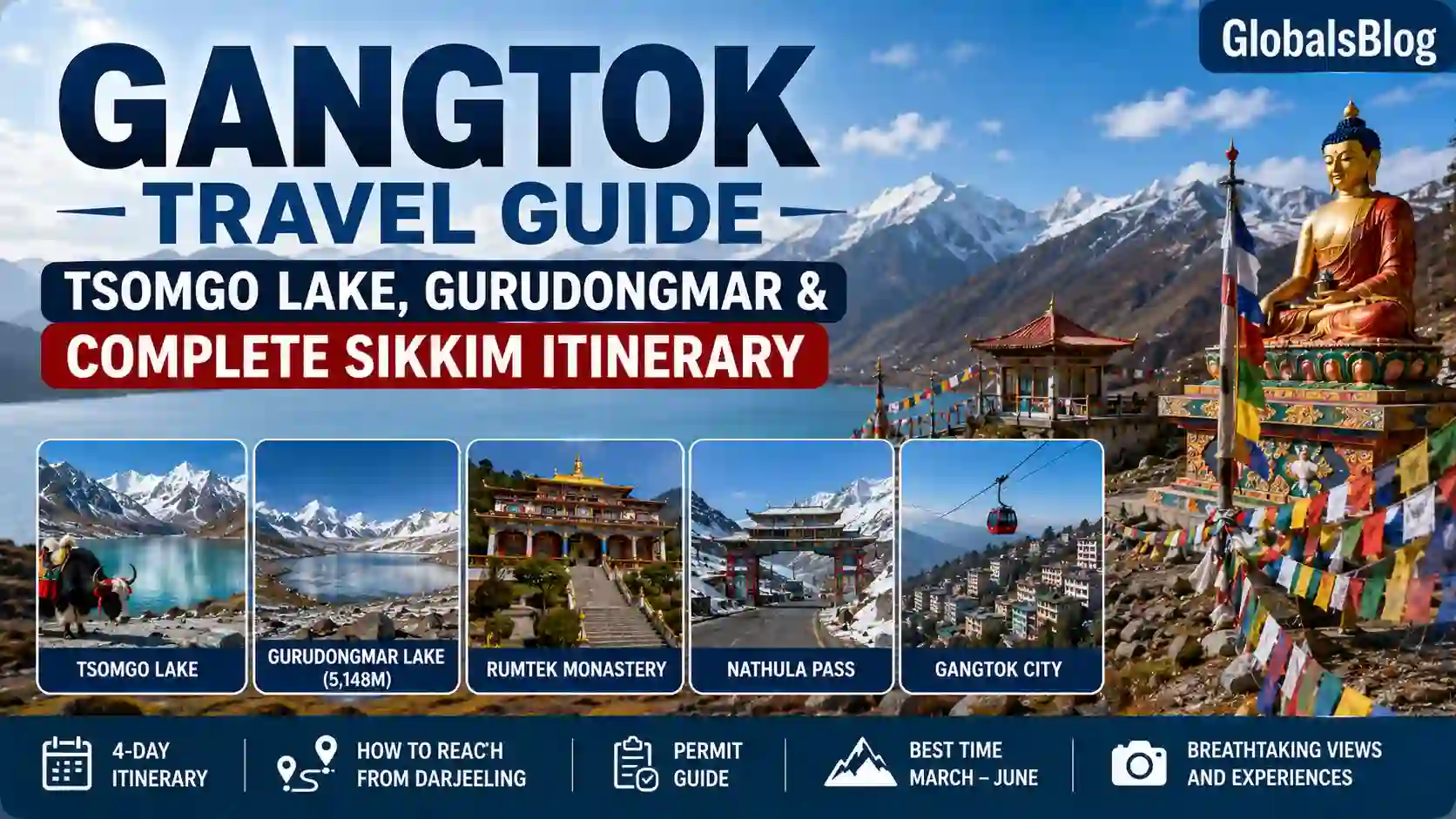
Gangtok sits at 1,650m in the Eastern Himalayas, the capital of Sikkim and the gateway to some of the most dramatic high-altitude landscapes in India — Tsomgo Lake at 3,753m, Gurudongmar Lake at 5,148m (the highest lake in India open to civilians), the Rumtek Monastery, and Kangchenjunga visible from MG Marg on clear winter mornings. Sikkim is the smallest state in India and the one that requires the least effort to feel far from ordinary life.
A reader from Kolkata had been to Darjeeling three times and assumed Gangtok would be similar — another hill station with mountain views and café culture, differentiated primarily by permit requirements and slightly higher altitude. What she found was categorically different: Sikkim is a Buddhist kingdom-turned-Indian-state where the monastic culture is not a tourist layer over a commercial town but the underlying reality of everyday life. The prayer flags on every building are not decoration — Sikkim's population is approximately 27% Buddhist, and the monasteries (Rumtek, Pemayangtse, Enchey) are functioning centres of a living religious tradition. The road to Tsomgo Lake at 3,753m, where a frozen lake sits surrounded by snow peaks, passes through 60km of landscape that changes from subtropical forest to alpine grassland to bare high-altitude terrain in a single drive. The Gurudongmar Lake at 5,148m — requiring a special permit and accessible only for a few months annually — is one of the highest lake visits available to non-mountaineers in the world. Gangtok is not Darjeeling's equivalent; it is Darjeeling's more dramatic, more Buddhist, more remote sibling. This guide covers both the accessible and the extraordinary.
Gangtok key facts: Capital of Sikkim, 1,650m altitude, 114km from Darjeeling, 124km from Bagdogra Airport (3 hours). Permit required: Restricted Area Permit (RAP) for Sikkim — Indian nationals get this free at the border or at Sikkim House in major cities; Foreigners need PAP. Key attractions: Tsomgo (Changu) Lake (3,753m, 40km, day trip), Rumtek Monastery (24km, Sikkim's most important monastery), MG Marg (pedestrian mall, Kangchenjunga views), Nathula Pass (4,310m, China border, 56km — requires special permit, not always open), Hanuman Tok, Enchey Monastery. Best time: March–May (clear views, rhododendrons) and October–December (clearest Kangchenjunga views). Gurudongmar Lake (5,148m): requires protected area permit, North Sikkim permit, accessible May–December only.
Best Places to Visit in Gangtok and Sikkim
Tsomgo Lake (also spelled Tsomgo, Changgu, or Changu) is the most visited attraction from Gangtok — a glacial lake at 3,753m altitude set in a natural cirque surrounded by steep ridges and snow peaks. The lake is sacred to both Hindus and Buddhists — the Sikkim Enchey Lamas and local Hindu community both revere it, and the lake's colour change (deep blue in summer, frozen solid December to February) is considered an omen by local people. In October to November and March to April, the lake is partially or fully frozen, yaks and yak-drawn sleds are available for rides on the ice, and the surrounding ridges carry snow — the combination produces the most cinematic high-altitude lake experience accessible on a day trip from any Indian hill station. The road to Tsomgo passes through subtropical rhododendron forest that transitions to alpine pasture at approximately 3,000m — the landscape change within a single 1.5-hour drive is one of the finest botanical and ecological transitions visible from a vehicle anywhere in Sikkim. Nathula Pass (4,310m, the India-China border) is 16km beyond Tsomgo and reachable on the same day with additional permits — see the Nathula section below.
Rumtek Monastery is Sikkim's most significant Tibetan Buddhist institution — the seat of the Karma Kagyu school of Tibetan Buddhism in exile, established by the 16th Gyalwang Karmapa (the leader of the Karma Kagyu lineage) after he fled Tibet in 1959. The monastery was built in 1961 on a hilltop overlooking a deep valley 24km from Gangtok, modelled exactly on the original Tsurphu Monastery in Tibet. The inner courtyard's golden stupa houses the relics of the 16th Karmapa — a consecrated structure of considerable religious significance to Karma Kagyu practitioners globally. The monastery complex includes the main assembly hall (with 16th-century thangkas and Buddhist artwork), a Nalanda Institute for Higher Buddhist Studies, monks' quarters, and the four-storey main temple. The drive to Rumtek through winding mountain roads with deep valley views is itself scenic — the monastery's hilltop position, visible from the approach road as a cluster of red and gold buildings against the forested ridgeline, is one of the most striking institutional settings in Sikkim. Visit in the early morning (8–10am) when monks conduct morning prayers — the sound of the prayer horns and cymbals in the assembly hall is the most authentic monastic sound experience in Gangtok's vicinity.
MG Marg (Mahatma Gandhi Marg) is Gangtok's defining urban space — a 500-metre pedestrian-only paved promenade that is consistently rated one of the cleanest public spaces in Northeast India. The mall is lined with shops (Sikkimese handicrafts, prayer flags, thangka paintings, Lepcha textiles, bamboo products), cafés, restaurants, and government tourist offices. In the evening, MG Marg fills with local families, students from Sikkim's university, monks from the nearby monasteries, and the small but significant proportion of tourists who make Gangtok their Himalayan base. The food on and around MG Marg covers both Sikkimese local (momos, thukpa, sel roti, gundruk soup — a preserved vegetable broth traditional to Sikkim's Nepali community) and standard Indian/Chinese options. On clear mornings in October–February, Kangchenjunga's massif is visible from the northern end of MG Marg above the town — a 8,586m peak appearing at the horizon above the Sikkim hill ridgeline in the early morning before cloud builds. This daily Kangchenjunga appearance at 6–8am on clear days is one of the most accessible world-class mountain views available from any Indian town centre.
Nathula Pass is the mountain pass on the historic Silk Road that crosses the Himalayan ridge at 4,310m and forms part of the India-China border — it was the main trade route between India and Tibet before the 1962 war closed it for four decades. The pass was reopened for limited border trade in 2006. The approach to Nathula from Tsomgo Lake (16km beyond, also following the same road) passes through increasingly stark high-altitude terrain — bare rock, small mountain streams, occasional patches of snow even in summer, and the specific quality of light at 4,000m+ altitude. At the pass itself, Indian Army personnel are present and the border fence marks the China side — visitors can see the Chinese military post on the other side. The experience of standing at the actual India-China border at 4,310m is genuinely distinct. Important caveats: Nathula requires a special permit beyond the standard Tsomgo permit (limited daily quota — arrange through a registered tour operator in Gangtok at least 24–48 hours ahead); it is open to Indian nationals only; and it is frequently closed without notice due to military considerations, weather, or diplomatic events — verify access on the day of planned visit. Not guaranteed on any specific date.
Gurudongmar Lake at 5,148m is the highest altitude lake accessible to civilians in India (Pangong Tso in Ladakh is at 4,350m; Chandratal at 4,270m — Gurudongmar is significantly higher). The lake is sacred to both Sikhs (Guru Nanak is believed to have visited) and Buddhists and Hindus — a section of the lake shore remains unfrozen even in deepest winter, attributed locally to Guru Nanak's blessing. The landscape at 5,148m is completely above the treeline — bare rock, thin air (approximately 54% of sea-level oxygen), and an enormous high-altitude lake of deep blue-violet colour set in a bowl of brown peaks. The altitude is genuinely challenging — most visitors experience headache and breathlessness at the lake. The mandatory overnight at Lachen village (2,748m, the night before the lake visit) helps with acclimatisation, but the gain from Lachen to Gurudongmar in a single morning is still 2,400m in altitude — proceed slowly and turn back at any signs of serious AMS. The 2-day North Sikkim package (Gangtok → Lachen overnight → Gurudongmar Lake → Gangtok) is the minimum itinerary for this visit and must be arranged through a registered Sikkim tourism operator who handles the permits.
Enchey Monastery is a 200-year-old Nyingma school Tibetan Buddhist monastery on a ridge above Gangtok — at 1,900m it sits above the main town and provides the finest Kangchenjunga view available from within Gangtok's immediate vicinity. The monastery is smaller than Rumtek but architecturally elegant — the main prayer hall with its butter lamps, painted walls, and seated Buddha statues has a contemplative atmosphere particularly in the early morning when monks conduct the first prayer session. Enchey is the site of the Chaam mask dance festival (held in January on the Tibetan calendar's 18th–19th day) — monks in elaborate deity costumes perform ritual dance in the monastery courtyard. The Flower Exhibition Centre (adjacent to Enchey, open seasonally) showcases Sikkim's extraordinary native orchid collection — Sikkim has 532 species of orchid, the most per unit area of any Himalayan state. The ridge walk from Enchey to the Ganesh Tok viewpoint (1km further) continues the Kangchenjunga view along the ridgeline above the town.
Banjhakri Falls is a maintained natural and cultural park 10km from Gangtok — the centrepiece is a waterfall in a forested gorge (strongest during and after monsoon, July–October), with a cultural park explaining the Banjhakri (the forest shaman/healer figure central to Sikkim's indigenous Lepcha and Limbu traditions). The park has sculptures and installations depicting Sikkimese mythology and forest folklore, a native plant garden, and the State Flower Show area displaying Sikkim's famous orchid and rhododendron collections. The cultural content is more unusual than most waterfall parks — the Banjhakri figure (a hairy mountain deity who kidnaps children to teach them shamanic arts, in the mythology) appears throughout the park in sculpture form. It provides the most accessible introduction to Sikkim's non-Buddhist indigenous traditions available in Gangtok. The waterfall itself is impressive June–October and modest November–May. A half-day visit combined with Rumtek Monastery makes a good circuit from Gangtok.
Sikkim Permits — What You Need and How to Get Them
| Permit Type | For | Cost | Indian Nationals | Foreign Nationals |
|---|---|---|---|---|
| Restricted Area Permit (RAP/ILP) | Entering Sikkim | Free | Get at Sikkim borders or Sikkim House offices in Delhi/Kolkata/Chennai | Additional procedures — apply at Foreigners Registration Office |
| Tsomgo Lake Permit | Tsomgo Lake day visit | ₹200–500 (operator fee, permit itself is minimal) | Arranged by taxi/tour operator in Gangtok — 24 hours ahead | Foreigners may not be permitted — verify current rules |
| Nathula Pass Permit | India-China border crossing (viewing only) | ₹200–500 (operator fee) | Limited daily quota — arrange through Gangtok operator 48 hours ahead, not guaranteed | Not permitted — Indian nationals only |
| North Sikkim Protected Area Permit | North Sikkim including Gurudongmar Lake | ₹50–200 per person | Arranged through registered Sikkim tour operator — minimum 2 people required | Additional permits required — more complex process |
Practical permit advice for most visitors: Get the basic Restricted Area Permit (free for Indian nationals) before arriving in Sikkim — at Rangpo (the main Sikkim border checkpost, 67km from Gangtok), or in advance at Sikkim Houses in Delhi, Kolkata, Mumbai, or other major cities. This permit covers Gangtok and most standard tourist destinations. Tsomgo and Nathula permits: arrange through your Gangtok hotel or a local taxi driver — they handle the paperwork daily and charge a service fee. North Sikkim (Gurudongmar): must use a registered package tour operator — independent travel to Gurudongmar is not permitted.
Gangtok 4-Day Itinerary
Day 1 — Arrive and Explore Gangtok: Arrive Gangtok (from Bagdogra/NJP). Check in. MG Marg evening walk — momos at a Marg restaurant, Sikkimese sel roti at a street stall. Early bed — check weather forecast for Kangchenjunga visibility at dawn.
Day 2 — Tsomgo Lake + Nathula (if permit available): 7am departure with shared taxi (₹350–500/person for Tsomgo day trip). Reach Tsomgo by 9am. 2 hours at the lake — yak ride if available, the shoreline walk, the prayer flags on the ridge above. Return via Nathula if permit available (additional 1.5 hours, 16km each way from Tsomgo). Back in Gangtok by 5pm. Enchey Monastery sunset (3km from MG Marg).
Day 3 — Rumtek Monastery + Banjhakri Falls: 9am: Rumtek Monastery (24km, 45 minutes) — morning prayers may still be in progress, assembly hall, golden stupa, monastery gardens. Back to Gangtok by 1pm. Afternoon: Banjhakri Falls and cultural park (10km, 25 min, ₹60). Evening: MG Marg — Sikkimese tongba (millet beer) at a local establishment.
Day 4 — Morning Kangchenjunga View + Depart: Wake 5:30am for MG Marg north end Kangchenjunga view if morning is clear (ask hotel staff the night before about expected weather). Ganesh Tok viewpoint (6km from MG Marg, best views on clear days). Depart Gangtok by 10am to NJP/Bagdogra (3 hours).
How to Reach Gangtok
| Mode | From | Duration | Cost | Notes |
|---|---|---|---|---|
| Flight + taxi | Delhi/Kolkata → Bagdogra (IXB) | 2 hrs flight + 3 hrs taxi | ₹4,000–10,000 flight + ₹1,500 taxi | Bagdogra Airport (Siliguri), 124km from Gangtok — shared jeep ₹300, private ₹1,200–1,500 |
| Train + taxi | Kolkata → New Jalpaiguri (NJP) | 8–10 hrs train + 3 hrs taxi | ₹300–1,500 train + ₹300 shared jeep | NJP to Gangtok: shared jeep ₹300, private ₹1,200–1,500, 3 hours (114km) |
| From Darjeeling | Darjeeling | 4 hours (96km) | ₹300 shared / ₹2,000 private taxi | Scenic route via Teesta valley — most scenic approach to Gangtok |
| Helicopter (seasonal) | Bagdogra to Gangtok | 30 minutes | ₹2,500–4,000 per person | PawanHans helicopter service operates seasonally — check availability |
The most common approach for most Indian travellers: fly to Bagdogra (from Delhi, Kolkata, Guwahati), then take a shared jeep or private taxi to Gangtok (3 hours, 124km). The shared jeep from Siliguri (near Bagdogra) costs ₹300 per person and runs throughout the day. From Darjeeling (96km, 4 hours via Teesta valley): the Darjeeling–Gangtok route through the Teesta river gorge is one of the most scenic drives in Northeast India — the river is emerald-green in the valley, the road carved into cliff faces, and the vegetation transitions from Darjeeling's misty forested ridges to Sikkim's subtropical lower valleys and then to the broader Gangtok basin.
✓ Gangtok Travel Tips
- October to December for the best Kangchenjunga views and Tsomgo snow: October–November post-monsoon clarity delivers the sharpest Kangchenjunga views from MG Marg and Gangtok viewpoints, while Tsomgo Lake begins to partially freeze and snow covers the surrounding ridges. December is cold (0–8°C in Gangtok) but produces the most dramatic high-altitude lake scenery as Tsomgo freezes fully. March–May (spring) is the alternative best season — rhododendrons bloom at altitude, the lake thaws, and temperatures are pleasant at Gangtok level (12–20°C)
- Arrange permits through your hotel or a Gangtok operator — not yourself: The permit system for Tsomgo, Nathula, and North Sikkim is not complex but requires local handling — your hotel front desk or the taxi driver who takes you to Tsomgo arranges these routinely. Tell them which places you plan to visit on Day 1 of your stay; they will have permits ready for Day 2 and charge a small service fee. Do not try to arrange Nathula or North Sikkim permits independently — the process requires a registered operator
- Check Nathula availability on the morning of your planned visit: Nathula can be closed without notice on any day due to military considerations, diplomatic events, or weather. Even with a permit in hand, the pass may be inaccessible on the day. Plan your Tsomgo day trip around seeing Tsomgo Lake as the primary destination and Nathula as a bonus if open — not as a guaranteed itinerary item
- Gurudongmar Lake is genuinely extreme altitude — respect the acclimatisation requirement: At 5,148m, Gurudongmar is significantly higher than anything in the standard Ladakh or Manali itinerary. The mandatory overnight at Lachen (2,748m) before the lake visit is not optional — it gives the body 2,400m of altitude gain in a single day, which is the upper limit of safe practice. If you have any cardiac or respiratory conditions, consult a doctor before planning Gurudongmar. Carry Diamox if your trek operator recommends it
- See our Darjeeling guide for the natural circuit partner to Gangtok — Darjeeling to Gangtok via Teesta valley is one of India's finest 4-hour drives
✗ Gangtok Mistakes to Avoid
- Visiting Tsomgo in June–September monsoon and expecting clear alpine scenery: Tsomgo Lake in monsoon is under persistent cloud — the surrounding ridges are invisible, the water is grey-blue rather than the vivid blue of clear-weather visits, and the road is frequently slippery from rain. The lake remains accessible but the experience is fundamentally diminished from the October–December or March–May visits when snow, clear sky, and mountain views are all present
- Treating Gangtok as a standard Indian hill station: The pattern — arrive, see viewpoints, buy souvenirs, leave — misses what Gangtok is. The monastery culture (Rumtek, Enchey, Phodong), the Sikkimese food distinctiveness (gundruk, sel roti, tongba, kinema), the permit system that keeps crowds lower than comparably scenic Himachal Pradesh hill stations, and the political history (Sikkim was an independent kingdom until 1975 when it acceded to India) all make Gangtok a fundamentally different kind of Himalayan destination. One half-day at Rumtek with some reading about the Karma Kagyu lineage changes the entire experience
- Booking only 2 nights and expecting to do both Tsomgo and Gurudongmar: Tsomgo Lake is a day trip (1 day). Gurudongmar Lake is a 2-day minimum (overnight at Lachen + Gurudongmar day). Both require separate permit processes. Visitors who book 2 nights in Gangtok expecting to do both frequently end up doing neither well. Minimum 4 nights for both Tsomgo and Gurudongmar plus Rumtek and Gangtok town
- Assuming Kangchenjunga will be visible — check weather forecast: Kangchenjunga from Gangtok is most commonly visible on clear mornings (6–9am before cloud builds) in October–February. It is invisible during monsoon and frequently cloud-covered in spring and summer afternoons. Ask your hotel staff on arrival about recent morning visibility. Waking at 5:30am for a clear dawn view of the world's third-highest peak from an Indian town centre is worth the early alarm — but only if the probability is reasonable on that morning
⚠️ Disclaimer: Permit requirements, road access, and attraction availability in Sikkim change based on government regulations, military considerations, and seasonal conditions. Nathula Pass can be closed without notice. Gurudongmar Lake access depends on weather and permit availability. All permits should be arranged through registered Sikkim tourism operators. Prices and fees listed are indicative as of August 2026. Altitude sickness is a genuine risk at Tsomgo (3,753m) and especially Gurudongmar (5,148m) — consult a doctor if you have any health concerns before visiting high-altitude sites.
MG Marg for the Kangchenjunga Dawn. Rumtek for the Living Buddhism. Tsomgo for the Frozen Lake. Gurudongmar for 5,148m. Gangtok Is Not Darjeeling's Equivalent — It Is Its Completion.
The Kolkata reader who arrived expecting a hill station variation and found a Buddhist kingdom in exile understood Gangtok correctly on the third day — not as a scenic viewpoint town but as the administrative, cultural, and spiritual centre of a place that has been Buddhist longer than it has been Indian, and whose relationship to the Himalayan landscape (from the subtropical Teesta valley floor to the 5,148m Gurudongmar Lake) encompasses a vertical range of experience that no comparable Indian state can match. The permits are minimal; the distances are manageable; the altitude is genuinely achievable; and the food — gundruk soup, sel roti, momo variations from Sikkimese villages rather than Tibetan-style, tongba in a clay pot — is one of the most distinctive regional food cultures in any Indian Himalayan destination. Arrive in October, check the dawn sky for Kangchenjunga, arrange the Tsomgo permit, and if 4 nights are available, consider the North Sikkim package for Gurudongmar. The Eastern Himalayas are among the most extraordinary landscapes in India. Gangtok is the correct base for all of them.
Best places to visit in Gangtok (August 2026): Tsomgo (Changu) Lake (3,753m, 40km, day trip — glacial lake, yak rides in winter, special permit required, ₹100 entry); Rumtek Monastery (24km, free — Karma Kagyu school's main seat in exile, golden stupa, morning prayers); MG Marg pedestrian mall (town centre, Kangchenjunga views on clear October–December mornings, Sikkimese food); Nathula Pass (4,310m, India-China border, 56km — special permit, Indian nationals only, not always open); Gurudongmar Lake (5,148m, North Sikkim, 2-day trip — India's highest civilian-accessible lake, North Sikkim PAP permit required); Enchey Monastery (3km from MG Marg, free, Nyingma school, Kangchenjunga views, morning prayers 6–8am); Banjhakri Falls (10km, ₹60, waterfall, cultural park, Sikkimese indigenous mythology). Best time: October–December (Kangchenjunga views, Tsomgo snow) and March–May (rhododendrons, spring).
Permits for Gangtok and Sikkim (Indian nationals, 2026): Basic Restricted Area Permit (RAP/ILP) — required for entering Sikkim, free for Indian nationals, obtained at Rangpo border checkpost or at Sikkim House offices in Delhi/Kolkata/Mumbai (apply in advance). Covers Gangtok and standard tourist areas. Tsomgo Lake permit — additional permit for the Tsomgo/Nathula day trip, arranged by Gangtok tour operators or taxi drivers (₹200–500 service fee, minimal government fee). Nathula Pass permit — separate from Tsomgo permit, limited daily quota, Indian nationals only, arranged through a Gangtok operator 48 hours ahead. Not guaranteed — frequently closed. North Sikkim Protected Area Permit — for Gurudongmar Lake and other North Sikkim destinations, must be arranged through a registered Sikkim tour operator as part of a minimum 2-person package tour. Foreign nationals need additional documentation for all restricted areas — process is more complex; check with Foreigners Registration Office or a registered Sikkim travel agent.
Best time to visit Gangtok: October–December — post-monsoon clarity delivers the sharpest Kangchenjunga views from MG Marg and Gangtok ridgeline viewpoints; Tsomgo Lake begins to freeze and snow covers the surrounding ridges; clear cold days (0–15°C in December) with excellent visibility. October and November are the recommended months for most first-time visitors. March–May — spring season, rhododendrons bloom at altitude (Tsomgo and higher elevations turn red-pink in April), Tsomgo thaws, temperatures in Gangtok pleasant (12–22°C), clearer than monsoon but slightly less clear than October–November. Avoid June–September (monsoon) — persistent cloud and rain obscure all mountain views, Tsomgo Lake is under cloud most days, Gurudongmar road may be difficult. January–February — cold (0–8°C in Gangtok, -15°C at Tsomgo) but stunning winter scenery if you are prepared for cold; Tsomgo fully frozen, Nathula road may be closed. Not recommended without proper winter gear and experience.
How to reach Gangtok from Darjeeling: Distance — 96km, approximately 4 hours. Shared jeep — ₹300 per person from Darjeeling Taxi Stand (multiple departure times, usually morning departures). Private taxi — ₹1,800–2,500. The route goes via Teesta valley — from Darjeeling the road descends steeply through tea gardens to the Teesta river valley, follows the Teesta north (the river is emerald-green and the road is carved into cliff faces), then climbs to Gangtok. This route is among the most scenic drives in Northeast India — the vegetation transition from Darjeeling's mixed forest to the Teesta gorge's tropical vegetation to the broader Gangtok basin is visually extraordinary. The road passes Rangpo (the Sikkim border checkpost where Restricted Area Permits for Indian nationals are issued — carry ID). Note: the road can be affected by landslides during monsoon (June–September) and occasionally one lane is closed for short periods — allow extra time during monsoon season travel.
Gurudongmar Lake (5,148m) is accessible to reasonably healthy adults but carries real altitude risks that must be respected: At 5,148m, approximately 52% of sea-level oxygen is available — most visitors experience headache, breathlessness, and fatigue at the lake. The mandatory overnight at Lachen (2,748m) before the lake visit is the most important safety step — it gives the body 2,400m of altitude gain in a single day (from Lachen to Gurudongmar), which is aggressive but manageable for most healthy adults who spend the previous night at Lachen. Who should not visit: people with cardiac conditions, uncontrolled hypertension, COPD, or any significant pulmonary disease should consult a doctor before considering Gurudongmar. Pregnant women should not visit. Severe AMS symptoms — confusion, inability to walk straight, severe vomiting, extreme headache not relieved by rest — at any altitude above Lachen require immediate descent. Most visitors who go slowly, stay hydrated, and avoid alcohol the previous night have an adequate experience. Who should visit: healthy adults under 60 without cardiac or respiratory conditions who have acclimatised at least one night at altitude. The lake is accessible May–December; January–April road is usually impassable.
Minimum 3 nights for Gangtok's core experience: Day 1 — arrive and settle, MG Marg evening. Day 2 — Tsomgo Lake day trip (full day). Day 3 — Rumtek Monastery + Banjhakri Falls. Depart Day 4. This covers the essential Gangtok experience but does not include Gurudongmar Lake or North Sikkim. For Gurudongmar: add 2 more nights (total 5 nights): Day 4–5 is the North Sikkim package (Gangtok → Lachen overnight → Gurudongmar day → return Gangtok). 5 nights allows: Tsomgo + Rumtek + Gurudongmar + MG Marg culture. For a Darjeeling–Gangtok combined circuit: 3 nights Darjeeling + 4 nights Gangtok = 7-night circuit covering Toy Train, Tiger Hill, Tsomgo, Rumtek, and optionally Gurudongmar. This is one of the finest 7-night Northeast India circuits available.
Leave a comment
Share a quick thought about this story.
Thanks for sharing your view. It is ready for review.
Please try again in a moment.