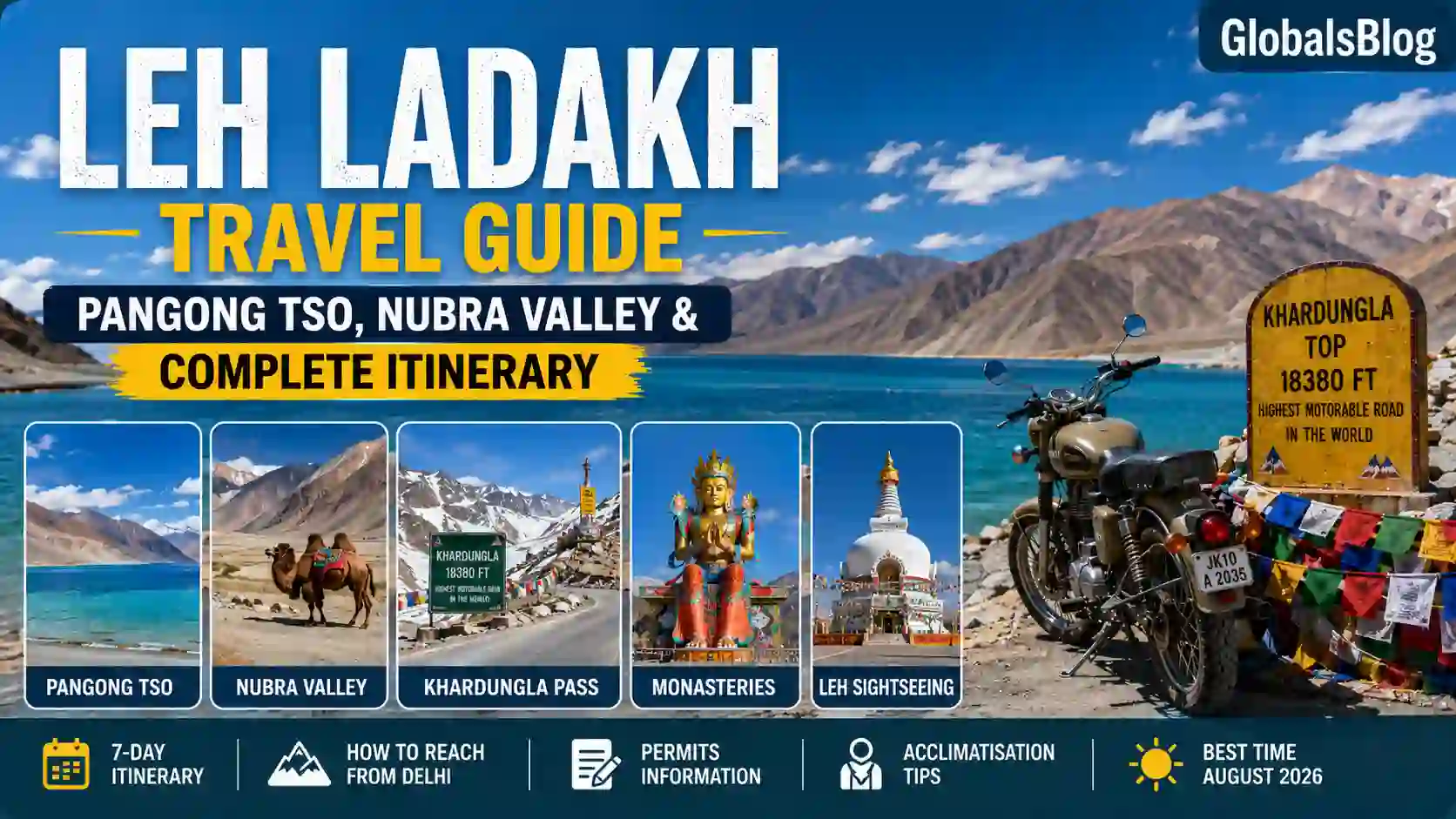
Ladakh is the world's highest motorable plateau — a cold desert at 3,500m where Buddhist monasteries cling to cliff faces, the Indus and Zanskar rivers meet in turquoise confluence, and a road over a 5,360m mountain pass is a standard morning drive. It is the most remote and the most extraordinary landscape accessible by road in India.
A reader from Chennai had saved Ladakh for "when I am ready" — the altitude, the remoteness, and the complexity seemed to require a special preparation. She went at 38 with her husband, neither of them particularly athletic, on a 10-day trip covering Leh town, Nubra Valley, and Pangong Lake. The acclimatisation headache on Day 1 was real. The Khardung La pass at 5,360m produced a brief breathlessness. Everything else — the Hemis Monastery gompa in morning mist, the Nubra Valley sand dunes with Bactrian camels against a backdrop of 6,000m peaks, the Pangong Lake turning from blue to green to turquoise as the light changed across the afternoon — was exactly the landscape she had seen in photographs but never believed was achievable at her fitness level. The answer Ladakh gives to its visitors is that the landscape is accessible — to almost anyone willing to acclimatise properly — and that no photograph fully captures the scale of the sky, the quality of the silence, or the specific blue of Pangong Tso at 4,350m. This guide covers how to reach it, how to acclimatise, and what to do when you get there.
Leh Ladakh key facts: Leh city altitude 3,500m. Best time: June to September (roads open, all passes accessible). How to reach: Fly to Leh (1 hour from Delhi) or drive Manali–Leh Highway (2 days, 479km, opens June) or Srinagar–Leh Highway (2 days, 434km, open May–October). Acclimatisation: First 2 days in Leh — no trekking, no Khardung La, drink water, rest. Key permits: Inner Line Permit (ILP) for Nubra Valley, Pangong Tso, and Tso Moriri (Indian nationals, ₹30/permit, available at DC office or online). Key destinations: Pangong Tso Lake (4,350m, 140km from Leh), Nubra Valley (3,048m, Bactrian camels, Diskit Monastery), Khardung La (5,360m — world's highest motorable pass), Hemis Monastery, Thiksey Monastery, Shanti Stupa, Magnetic Hill, Zanskar confluence.
Best Places to Visit in Leh Ladakh
Pangong Tso is the most photographed lake in India — a 134km glacial lake at 4,350m altitude that straddles the India-China border (approximately 60km of the lake is in India, 74km in China). The photographs of Pangong Tso's deep blue-to-turquoise colour against the barren brown Himalayan mountains have become the defining image of Ladakh for most Indian travellers, and the lake's real-world appearance matches — the colour shifts across the day from deep navy blue in morning to vivid turquoise in afternoon sun to deep grey-blue at dusk, depending on the angle of light and the sky above it. Overnight camping at Pangong (south bank, Spangmik area — the north bank road to Shyok is a different route) gives the pre-dawn setting when the lake is still and fog sometimes sits on the surface, and the first light turns the eastern peaks rose-gold before the water changes from black to blue. The overnight stay is strongly recommended over a day-trip: the Chang La road (5,360m pass on the way) adds 9–10 hours of driving to a single-day round trip, and the most spectacular Pangong light is in the early morning and late afternoon — neither available on a day trip from Leh. Altitude note: Pangong is 850m higher than Leh — acclimatise for minimum 2 full days in Leh before visiting Pangong.
The Nubra Valley is Ladakh's other essential destination — a wide, semi-arid valley between the Karakoram and Ladakh ranges at 3,048m, warmer and lower than Leh, famous for its sand dunes and the double-humped Bactrian camels that have lived in Nubra since the Silk Road era when they were used for trade over the Karakoram Pass. The combination — sand dunes at the edge of a high-altitude cold desert valley, with 6,000–7,000m snow peaks visible above the dune ridges, and Bactrian camels in the foreground — is one of the most surreal and visually extraordinary landscapes in India. The Hunder sand dunes (between Hunder and Diskit villages) are where the camel rides take place (₹200–400 per person, 20 minutes) and where the dune-to-mountain juxtaposition is most dramatic. Diskit Monastery — the largest and oldest monastery in Nubra Valley (14th century), perched on a cliff above Diskit village with a 32-metre seated Maitreya Buddha visible from the valley floor — is the cultural centrepiece of the valley. The monastery is reached by a short steep climb from the road; the view from the monastery terrace across the Nubra Valley is one of the finest in Ladakh. Nubra's lower altitude (3,048m vs Leh's 3,500m) means it is actually warmer than Leh — summer temperatures can reach 35°C in the valley floor, requiring sun protection and hydration even in the high-altitude context.
Hemis Monastery is the most important gompa in Ladakh — the largest, wealthiest, and most architecturally impressive monastery in the region, founded in the 11th century and rebuilt in the 17th century under Sengge Namgyal (the Ladakhi king who also built the Leh Palace). The monastery belongs to the Drukpa Kagyu sect of Tibetan Buddhism and houses a significant collection of thangka paintings, silver stupas, statues, and manuscripts. The annual Hemis Festival (Tsechu) — held in June or July on the 10th day of the fourth Tibetan lunar month — is the most famous festival in Ladakh: two days of Cham (mask) dance performances by monks in elaborate costumes representing the deities of the Drukpa pantheon, performed in the monastery courtyard to the sound of Tibetan horns and drums. The festival coincides with the anniversary of Guru Padmasambhava (who brought Buddhism to Tibet and Ladakh) and draws thousands of visitors. The monastery's setting — a red and white painted complex in a protected valley, invisible from the main road until you turn the final corner — is as striking as any single structure in Ladakh. Combine with Thiksey Monastery (12th-century gompa with 12-floor complex and a 15-metre Maitreya Buddha, 20km from Leh, closer and often combined in a single day circuit) and Rancho School (of the 3 Idiots film fame — now a real school accepting donations).
Khardung La (or Khardung Pass) is the gateway to Nubra Valley — the 5,360m mountain pass that the North Pullu–South Pullu road crosses before descending into the Nubra Valley. It became famous as "the world's highest motorable road" when signboards claiming this were erected in the 1980s — a claim that has been disputed by subsequent GPS surveys (which place it at approximately 5,359m, with other passes in the region also claiming the title). Regardless of the precise ranking, Khardung La is a high mountain pass accessible by any road vehicle, and the experience of being at 5,360m — where the air contains approximately 50% of the oxygen at sea level, where the sky is a deep blue-violet at altitude, and where snow frequently lies beside the road even in July — is real and physically distinct. Most Ladakh visitors stop at Khardung La on the way to Nubra Valley for photographs with the famous signboard and a cup of hot tea from the tea stalls that operate at the summit. Time at the summit should be brief for visitors without acclimatisation — 15–20 minutes maximum, then descend. AMS (Acute Mountain Sickness) symptoms can develop quickly at this altitude, particularly for visitors who are not well-acclimatised to Leh's 3,500m first.
Shanti Stupa is a white-domed Buddhist peace pagoda built on a hill above Leh in 1991 by the Japanese Buddhist organisation Nipponzan-Myohoji, containing relics of the Buddha in its two tiers. The stupa itself is architecturally elegant — white against the blue Ladakhi sky, with relief panels depicting scenes from the Buddha's life around its circumference. But the primary reason to visit is the view: the stupa sits on a ridge with a 270° panorama of the Leh valley — the town below, the Indus River silver in the distance, the Stok Kangri peak (6,153m) rising from the Zanskar Range to the south, and the brown-to-green agricultural terraces of the valley floor spreading east. The sunrise view from Shanti Stupa is among the finest single-hour experiences in Leh — when Stok Kangri catches the first light and the Leh palace glows amber before the valley wakes up. The stairs up to the stupa (480 steps from the main road, or a shorter approach from the vehicle road) make it a modest physical effort — appropriate for Day 2 or Day 3 after acclimatisation, not Day 1 arrival.
The confluence of the Indus and Zanskar rivers at Nimmu village (30km from Leh on the Srinagar highway) is one of the most visually striking natural phenomena in Ladakh — the grey-blue Indus meets the grey-green Zanskar in a visible two-colour meeting that runs for several hundred metres before the rivers fully mix. The colour difference comes from different mineral compositions in the rivers' catchment areas: the Indus carries grey glacial sediment from the Tibetan plateau, while the Zanskar carries different suspended mineral loads from the Zanskar Range. The confluence is visible from the road above (a common stopping point for Leh-Srinagar highway drivers) and more dramatically from the riverbank below — a 10-minute descent from the road. In winter (December–January), the Zanskar freezes while the Indus remains partially open, creating the famous Chadar Trek — a 105km walk on the frozen Zanskar river gorge that is one of the most demanding and spectacular treks in India (requires experienced guides and specialized winter gear). In summer, the Zanskar confluence is visited as a roadside stop on the way to Alchi Monastery (70km from Leh — 11th-century murals, some of the oldest Buddhist art in Ladakh) or Lamayuru Monastery (125km — one of Ladakh's oldest monasteries, in a dramatic moonscape setting).
Tso Moriri is the high-altitude lake most recommended for travellers who find Pangong too crowded and want the lake experience without the relative infrastructure that has developed around Pangong Tso. At 4,522m — 172m higher than Pangong — Tso Moriri is the highest lake of its size in India and a Ramsar-designated wetland of international significance. The lake is 28km long and up to 8km wide, set in the Changthang Plateau, surrounded by the Changpa nomad community who herd yaks and goats (including Pashmina goats — the source of Kashmiri Pashmina wool) on the lake's shore. Tso Moriri sees perhaps 10–15% of the visitor numbers of Pangong and has a more remote, undisturbed character — the camps on the shore are fewer and less commercial, the Changpa community is more visible in its daily life around the lake, and the Black-necked Crane (one of India's rarest birds, breeding at Tso Moriri) and bar-headed geese are a regular sight. The 240km distance from Leh (2 days via Chumathang hot springs, with an overnight at Korzok village on the lake shore) makes it less accessible for short itineraries — it works best as the Pangong alternative in a 7+ day Ladakh trip, or combined with Pangong via the Kibber-Khangkyen route for experienced high-altitude drivers.
The Leh Palace is a 9-storey, 17th-century royal palace built by Sengge Namgyal (the same king who rebuilt Hemis Monastery), modelled on the Potala Palace in Lhasa (Tibet) — it dominated the Leh valley as the Namgyal dynasty's seat of power until the Dogra invasion of 1834. The palace is now largely in ruins internally (the Namgyals fled to Stok village after the Dogra conquest and never returned) but the Archaeological Survey of India maintains the structure, and the interior's remaining wooden beams, painted walls, and high windows give an impression of its original grandeur. The rooftop view from the 9th floor is the finest single view of Leh town and the Leh valley available from within the town — looking down over the main bazaar, across the Indus valley, and up to Shanti Stupa on the opposite hill. The palace is the most appropriate Day 2 activity in Leh (after the mandatory first two resting days for acclimatisation) — the walk up from the bazaar is a gentle 15-minute climb, appropriate for partially acclimatised visitors. Leh's main bazaar below the palace is excellent for Ladakhi textiles (Pashmina scarves and shawls — verify quality, as mass-produced synthetic versions are widely sold), turquoise and coral jewellery, Tibetan singing bowls, and the local café culture (Tibetan butter tea and tsampa at any of the small restaurants off the main market street).
Leh Ladakh — Essential Information
| Place | Altitude | Distance from Leh | Permit | Best Months |
|---|---|---|---|---|
| Leh City | 3,500m | Base | None | June–September |
| Pangong Tso | 4,350m | 140km (5 hrs) | ILP required | June–September |
| Nubra Valley | 3,048m | 150km (5 hrs via KhardungLa) | ILP required | June–October |
| Khardung La | 5,360m | 39km (2 hrs) | None (on route to Nubra) | June–October |
| Tso Moriri | 4,522m | 240km (2 days) | ILP required | June–September |
| Hemis Monastery | 3,600m | 45km (1.5 hrs) | None | June–October |
| Thiksey Monastery | 3,600m | 19km (40 min) | None | Year-round |
| Shanti Stupa | 3,514m | 5km (15 min) | None | June–October |
| Zanskar Confluence | 3,380m | 30km (45 min) | None | June–September |
| Lamayuru | 3,510m | 125km (3 hrs) | None | June–October |
Leh Ladakh 7-Day Itinerary
Days 1–2 (Acclimatisation — mandatory): Arrive Leh by flight. Day 1: Rest completely — no physical exertion, no monastery climbs, no Shanti Stupa walk. Drink 3–4 litres of water. Eat light. Sleep early. Day 2: Short Leh town walk (Leh Palace and main bazaar — 2–3 hours maximum). Shanti Stupa sunrise is appropriate on Day 2 morning if you feel well. No high-altitude trips. Any AMS symptoms (persistent headache, nausea, dizziness) that continue after Day 2 should be treated seriously — consult a local doctor before proceeding to higher altitudes.
Day 3 (Leh environs): Thiksey Monastery morning (19km, 40 min) — the monks' morning prayer at 7am is worth the early departure. Hemis Monastery afternoon (45km). Shey Palace and Stok Palace en route. Return Leh evening.
Day 4–5 (Nubra Valley): Depart 7am — Khardung La (39km, 2 hrs), stop 15–20 minutes maximum. Descend to Nubra Valley via North Pullu. Diskit Monastery and Hunder sand dunes (camel ride) afternoon. Overnight at Hunder camp or guesthouse. Day 5: Nubra Valley local exploration (Turtuk village if time — 80km north of Diskit, former Pakistani territory, stunning valley) or return via Khardung La.
Day 6 (Pangong Tso): Depart Leh 7am — Zingchen, Thiksey (brief stop), Chang La (5,360m), descent to Pangong via Durbuk. Arrive Pangong Tso (Spangmik south bank) 12–1pm. Afternoon at the lake. Overnight camp on the lakeshore.
Day 7 (Pangong return + departure): Pre-dawn at the lake (most spectacular hour). Depart 8am. Leh by 2pm. Evening flight back to Delhi or begin Manali-Leh highway for road trip return.
How to Reach Leh Ladakh
| Route | Mode | Duration | Cost | Notes |
|---|---|---|---|---|
| Delhi → Leh | Flight | 1.25 hours | ₹4,000–12,000 | IndiGo, Air India, SpiceJet — book 3–4 weeks ahead, prices spike in season |
| Manali → Leh | Road (Manali-Leh Hwy) | 2 days / 479km | ₹2,000–3,000 shared taxi per leg | Open June–October (snow). Spectacular 2-day drive. Overnight at Jispa or Sarchu |
| Srinagar → Leh | Road (Srinagar-Leh Hwy) | 2 days / 434km | ₹1,800–2,800 shared taxi per leg | Open May–October. Passes Zoji La, Kargil, Magnetic Hill |
| Mumbai/Bengaluru → Leh | Flight via Delhi | 4–5 hours total | ₹7,000–18,000 | All Leh flights connect through Delhi — book Delhi-Leh leg separately |
Flying is the most common approach (1.25 hours from Delhi, no altitude adjustment time — hence the mandatory 2-day acclimatisation on arrival). The Manali–Leh Highway drive is the classic Ladakh road trip approach — 479km over 2 days crossing Rohtang La (3,978m), Baralacha La (4,890m), Lachulung La (5,065m), Tanglang La (5,328m), and past the high-altitude plains of Morey and Rumtse. Shared taxis from Manali to Sarchu (Day 1, ₹2,000–3,000 per seat) and Sarchu to Leh (Day 2, similar) are available or a private vehicle can be hired. The road is open June to October, subject to the Border Roads Organisation's maintenance schedule.
✓ Leh Ladakh Travel Tips
- The first two days in Leh are not optional — acclimatise properly: Acute Mountain Sickness (AMS) is a real risk at 3,500m for visitors arriving from sea level. The most common serious error in Ladakh planning is treating acclimatisation as a guideline rather than a requirement. Day 1 after flight arrival: rest completely, no climbing, no Shanti Stupa, no monastery visits. Drink 3–4 litres of water. Eat light. Symptoms that should prompt immediate descent or medical consultation: persistent severe headache after 12 hours of rest, vomiting, confusion, inability to walk straight (ataxia). Diamox (acetazolamide, 125mg twice daily) helps some people acclimatise faster — consult a doctor before taking. Most AMS resolves with rest and hydration at the same altitude without medication
- Get your Inner Line Permits before leaving Leh: ILPs for Nubra Valley, Pangong Tso, and Tso Moriri (Indian nationals) are issued at the DC office in Leh (₹30 per permit per area, open 10am–4pm weekdays) or through registered travel agents. The permits are now also available online via the official Ladakh portal. Carry photocopies — checkposts on the roads to Nubra and Pangong verify permits. Processing at the DC office typically takes 1–2 hours in non-peak time; budget accordingly
- Hire a local driver-guide for the entire trip — not a Delhi-based tour operator: The local Ladakhi taxi union runs fixed-rate taxis from Leh to all major destinations. A local Ladakhi driver knows the roads (which change condition after rain), the checkpost procedures, which campsites are honest, and can provide cultural context unavailable from a non-local guide. The Leh taxi union has fixed published rates — ask the union office for the current rate card before hiring. For Nubra + Pangong in 7 days, a full-package taxi hire (₹15,000–25,000 for the full itinerary in a shared vehicle for 4 passengers) is more efficient than booking each leg separately
- Pack for extreme temperature range: Leh in summer (June–August) reaches 25–30°C in the afternoon but drops to 5–10°C at night. At Pangong Tso (4,350m), nighttime temperatures drop to 0–5°C even in August. Thermal base layers, a fleece mid-layer, and a windproof outer layer are required even in peak summer. Sunscreen (SPF 50+) and UV-protection sunglasses are essential at altitude — UV radiation is approximately 50% more intense at 4,000m than at sea level, and sunburn and photokeratitis (snow blindness) are real risks
- Pangong overnight is the mandatory decision — do not day-trip it: The 5-hour drive each way makes a Pangong day trip physically brutal (10 hours of mountain road in a single day) and means you miss the dawn and dusk light that makes Pangong extraordinary. The lakeside camps on the south bank (Spangmik area, ₹2,000–6,000/night all-inclusive) are basic but adequate — solar-heated water, generator electricity evenings, adequate food. The pre-dawn setting when the lake is black and still is the finest hour at Pangong. You cannot see this on a day trip. Stay overnight
- See our Kasol guide for Parvati Valley comparison and our Manali guide for the start of the Manali–Leh highway trip
✗ Leh Ladakh Mistakes to Avoid
- Going to Khardung La on Day 1 or Day 2 after flying in: The most dangerous and most common Ladakh mistake. Flying from Delhi (sea level) to Leh (3,500m) in 1.25 hours gives the body no time to adjust. Going from 3,500m to 5,360m on Khardung La on Day 1 is medically reckless — the risk of HACE (High Altitude Cerebral Edema) increases significantly. Khardung La is a pass on the way to Nubra Valley, not a Day 1 destination. Visit it on Day 4 minimum, on the way to Nubra, after proper acclimatisation at Leh altitude
- Booking Ladakh trips in May or October without verifying road conditions: The Manali-Leh Highway opens in early June and the Srinagar-Leh highway in late April or early May depending on snowfall. October sees the first snowfall on passes — Khardung La can close for days at a time with no notice in October. Pangong road via Chang La can also become inaccessible. If travelling in shoulder season (May or October), verify current BRO road status before finalising tickets
- Underestimating distances and road times: Ladakh's mountain roads are slow — 140km to Pangong takes 5 hours (average 28 km/h). 150km to Nubra via Khardung La takes 4–5 hours. Planning to "quickly do" Pangong and Nubra in the same day is not feasible — they are in opposite directions from Leh. Build separate days for each major destination and do not try to rush the drives
- Skipping monasteries for "just" lakes and passes: Ladakh's Buddhist monastery heritage — Hemis, Thiksey, Diskit, Lamayuru, Alchi — is as extraordinary as its landscapes and is one of the few places in the world where Tibetan Buddhist culture and architecture exists in its most intact form outside Tibet. Visitors who focus exclusively on Pangong and Nubra and skip the monasteries miss the cultural depth that distinguishes Ladakh from any other high-altitude destination in the world
⚠️ Disclaimer: Ladakh road conditions, pass access, and permit requirements change frequently with weather, BRO maintenance, and government policy. The Manali-Leh and Srinagar-Leh highways open and close based on snow conditions — verify current status at bro.gov.in or through local travel agents before travel. Inner Line Permit requirements and fees for Indian nationals are subject to change. All prices listed are indicative as of August 2026. Acclimatisation requirements are non-negotiable medical realities — consult a physician if you have any cardiac or pulmonary conditions before planning high-altitude travel.
Two Days for Acclimatisation. One Day for Monasteries. Two Days for Nubra. One Night at Pangong. The Sky at 5,000 Metres Is a Different Colour. No Photograph Captures the Scale.
The Chennai reader who spent years waiting until she was "ready" for Ladakh arrived and found that readiness had nothing to do with fitness and everything to do with acclimatisation and pace. The Hemis Monastery in morning mist at 3,600m is accessible on Day 3 after two days of rest at Leh. The Bactrian camels in Nubra Valley are a 4-hour drive over Khardung La on Day 4. Pangong Tso at dawn is an overnight stay on Day 6. The 7-day itinerary above covers all of this — for two people who had never trekked, at a pace that respected altitude, in a landscape that no other Indian destination approaches for sheer geographic scale and visual intensity. The sky at 5,000 metres is a different blue from any sky below 3,000m. The silence at Pangong at 4am is not something that translates into language. The only way to understand it is to be there. Go in June, July, August, or September. Fly to Leh. Rest for two days. Then drive toward the sky.
Best places to visit in Leh Ladakh: Pangong Tso Lake (4,350m, 140km from Leh — 134km glacial lake changing from blue to turquoise across the day, ILP required, overnight camp recommended); Nubra Valley (3,048m, 150km via Khardung La — Bactrian camels, Hunder sand dunes, Diskit Monastery, ILP required); Khardung La (5,360m, 39km — world's highest motorable pass, on route to Nubra); Hemis Monastery (45km — largest gompa in Ladakh, 17th century, Hemis Festival June–July); Thiksey Monastery (19km — 12-floor complex with 15m Maitreya Buddha, morning prayer 7am); Shanti Stupa (5km from Leh — best sunrise view over Leh valley, free); Zanskar-Indus confluence (30km, Nimmu — two-colour river meeting); Tso Moriri (4,522m, 240km — quieter alternative to Pangong, Ramsar wetland); Leh Palace (₹15, central Leh — 9-storey 17th-century palace, best valley views); and Leh Market (Pashmina, turquoise jewellery, Tibetan food). Best time: June to September.
Minimum 7 days for Leh Ladakh (mandatory 2 acclimatisation days + 5 activity days). Day 1–2: Acclimatisation in Leh — rest, no high-altitude travel. Day 2 can include Leh Palace and main bazaar (short walks). Day 3: Monastery circuit (Thiksey + Hemis, 45km max). Day 4–5: Nubra Valley 2 days — Khardung La, Diskit Monastery, Hunder sand dunes, overnight in Nubra. Day 6: Pangong Tso (140km from Leh) — arrive afternoon, overnight camp. Day 7: Pre-dawn Pangong, return Leh, depart. For 10 days: add Tso Moriri (2 days each way from Leh), Lamayuru Monastery (125km, moonscape setting), Alchi Monastery (70km, 11th-century murals). For Manali–Leh road trip: add 2–3 days for the drive + acclimatisation at Keylong and Sarchu. 5 days is the absolute minimum (2 acclimatisation + Thiksey + Pangong overnight + Nubra) but is rushed — plan for 7 minimum.
Best time to visit Leh Ladakh: June to September, with July and August being peak season. June: Manali-Leh highway just opens (usually early June), roads clear, moderate crowds, Hemis Festival (June–July). July: all roads and passes open, maximum tourist activity, clear weather, temperatures 20–25°C in Leh. August: peak season continues, Pangong in full colour, Zanskar confluence at maximum flow. September: crowds reducing, weather still excellent, passes beginning to show early snow on highest sections. Avoid October to May: Manali-Leh highway closes October/November, Khardung La prone to snow closures, temperatures at Pangong drop to -15°C in winter. Winter Leh (December–February) is visited only by experienced cold-weather travellers — most hotels close, extreme cold (-20°C nights), but the Chadar Trek on frozen Zanskar runs February–March. First-time visitors: July to mid-August is the most reliable window for all roads open, all destinations accessible, and comfortable temperatures.
Permits required for Leh Ladakh (Indian nationals, 2026): Inner Line Permit (ILP) required for: Nubra Valley (Khardung La and beyond), Pangong Tso, Tso Moriri, Dha Hanu, and Hanle (emerging dark sky reserve). ILP fee: ₹30 per permit per area per person. Obtain at: Deputy Commissioner (DC) office, Leh (Fort Road, open 10am–4pm weekdays), or online at the official Ladakh Tourism portal. Process: bring Aadhaar card or passport (any Indian government ID). Most travel agents in Leh also arrange ILPs for a small service fee (₹100–200). Checkposts at South Pullu (Nubra Valley approach) and Durbok (Pangong approach) verify permits — carry original + photocopies. No permits required for: Hemis, Thiksey, Lamayuru, Alchi monasteries, Shanti Stupa, Zanskar confluence, or Leh city itself. Foreign nationals require Protected Area Permit (PAP) for the same restricted areas — available from DC office Leh with additional documentation. Indian nationals: no ILP needed within Leh district's unrestricted areas.
How to reach Leh from Delhi: By flight (recommended for first visit) — Delhi IGI to Leh Kushok Bakula Rimpochee Airport (IXL), 1.25 hours, IndiGo/Air India/SpiceJet, ₹4,000–12,000 one-way depending on booking lead time and season. Book 3–4 weeks in advance for July–August. Leh airport is at 3,256m — passengers experience altitude immediately on landing. By road — Manali–Leh Highway: Delhi → Manali (550km, 12 hours overnight bus ₹1,200–2,000 from ISBT Delhi) → Manali–Leh Highway (479km, 2 days, opens June). Overnight Day 1 at Jispa or Sarchu. Day 2 arrive Leh. Shared taxis on this route ₹2,000–3,000 per seat per day. By road — Srinagar–Leh Highway: Delhi → Srinagar by flight or road → Srinagar–Leh Highway (434km, 2 days via Kargil, opens May). Both road options provide acclimatisation benefits (gradual altitude gain over 2 days) versus the abrupt altitude gain of flying. For most first-time visitors: fly to Leh, rest 2 days, consider the Manali highway as the return route after the full itinerary.
Pangong Tso is a 134km glacial lake at 4,350m altitude — the most photographed lake in India and the defining image of Ladakh. 60km of the lake is in India (accessible); 74km is in China (no access). The lake's colour shifts from deep navy blue to vivid turquoise depending on the light angle and time of day. How to reach: 140km from Leh via Chang La pass (5,360m) — 4.5–5 hours one-way. ILP permit required (get from DC office Leh before departure). Day trip: technically possible but involves 9–10 hours of driving in a single day and misses the dawn and dusk light. Overnight stay: strongly recommended — camps on the south bank (Spangmik area) ₹2,000–6,000 per person including meals. What to expect: barren brown mountains, the lake changing colour across the day, extremely cold nights (0–5°C even in August), limited food options (camp food only at lakeside), no mobile network (BSNL has faint signal), and the specific quality of dawn light at 4,350m when the peaks across the lake catch the first light before the water turns from black to blue. Altitude note: Pangong is 850m higher than Leh — do not visit before completing 2 full acclimatisation days in Leh.
Leave a comment
Share a quick thought about this story.
Thanks for sharing your view. It is ready for review.
Please try again in a moment.