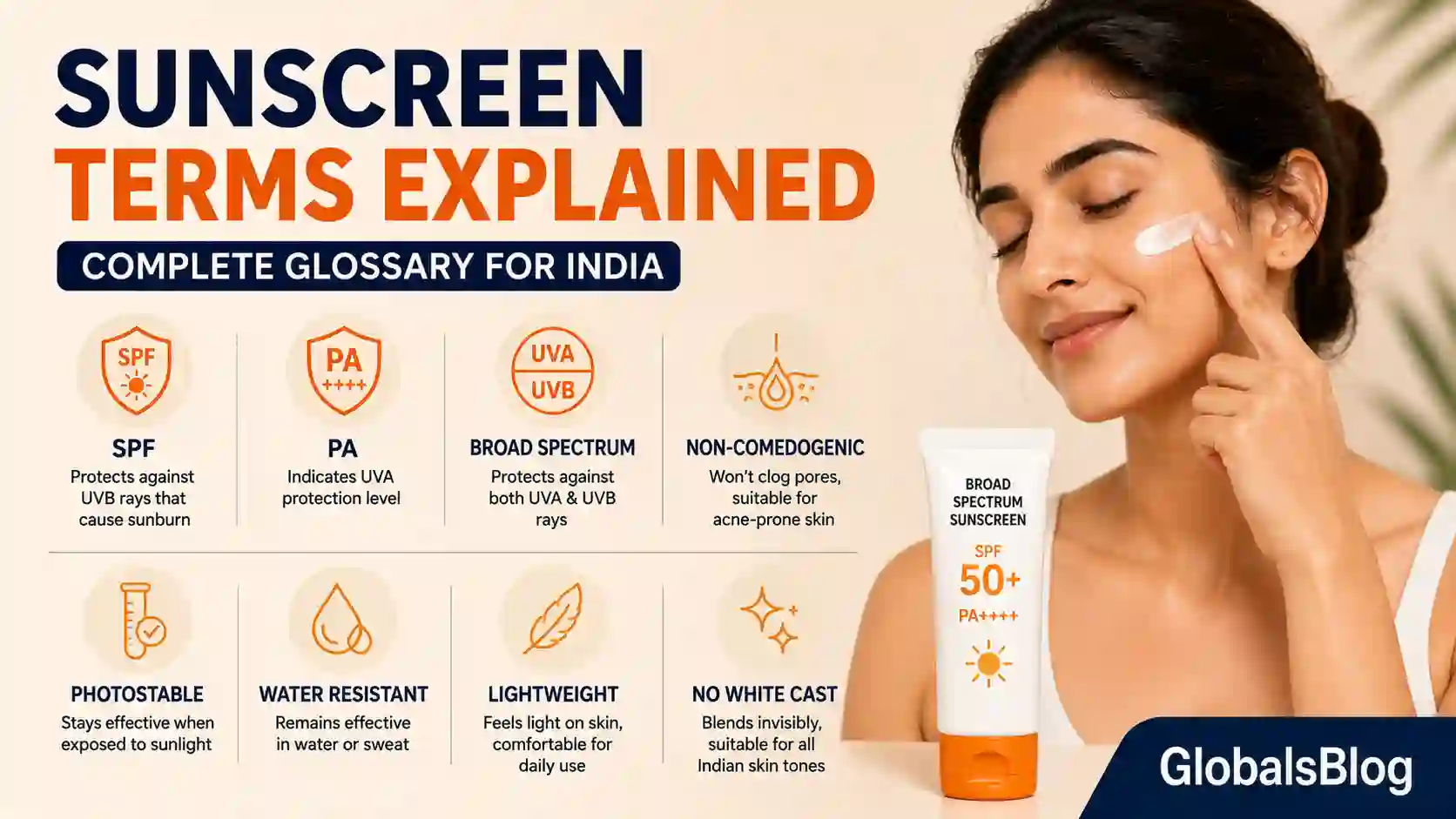
Every term on a sunscreen bottle, explained in plain language. No chemistry degree required.
A reader once photographed the back of her sunscreen bottle and sent it to us asking what any of it actually meant. PA++++, broad spectrum, photostable, non-comedogenic, PPD 16+, avobenzone — she had been buying sunscreen for years without understanding a single term beyond SPF. This guide exists to fix that, once and for all, for every Indian buyer who has ever wondered the same thing.
The most important sunscreen terms to understand are SPF (UVB protection level), PA rating (UVA protection level), broad spectrum (protects against both UVA and UVB), non-comedogenic (won't clog pores), photostable (filters don't break down in sunlight), and water-resistant (maintains protection during sweating or swimming for a stated time). For Indian conditions, SPF 50 PA++++ broad spectrum non-comedogenic is the complete specification to look for in a daily sunscreen.
Protection Rating Terms
SPF — Sun Protection Factor
Measures UVB protection only. SPF 30 blocks 97% of UVB, SPF 50 blocks 98%, SPF 100 blocks 99%. The relationship is not linear — doubling the SPF number does not double protection. For Indian conditions, SPF 50 is the recommended daily minimum. Full explanation in our SPF explained guide.
What it means for you: Always choose SPF 50 for Indian daily use. Anything below SPF 30 is insufficient for India's UV Index of 8-11.
PA Rating — Protection Grade of UVA
Measures UVA protection on a scale from PA+ (minimal) to PA++++ (maximum). Each additional plus sign represents roughly double the previous level's protection. PA++++ corresponds to a PPD value of 16 or above. Full explanation in our PA rating guide.
What it means for you: PA++++ is the minimum for Indian daily use. This is the number most relevant to pigmentation, dark spots, and ageing concerns — which SPF does not protect against at all.
Broad Spectrum
Means the sunscreen protects against both UVB and UVA radiation. However, "broad spectrum" does not specify how much UVA protection is provided — a sunscreen with PA++ can legally claim broad spectrum despite offering insufficient UVA coverage for Indian conditions.
What it means for you: Do not rely on "broad spectrum" labelling alone. Always check the actual PA rating printed on the bottle alongside the broad spectrum claim.
PPD — Persistent Pigment Darkening
The actual scientific measurement behind PA ratings. PPD measures how much UVA is needed to cause visible skin darkening. Higher PPD means stronger UVA protection. PA+ = PPD 2-4, PA++ = PPD 4-8, PA+++ = PPD 8-16, PA++++ = PPD 16+.
What it means for you: Mainly appears on imported European sunscreens. If you see PPD 16 or above, that corresponds to PA++++ — the Indian recommended standard.
UVA and UVB
Two different types of ultraviolet radiation. UVB causes sunburn and is primarily active between 10am-4pm. UVA causes pigmentation, premature ageing, and dark spots, penetrates clouds and glass, and is present at consistent intensity all day long. SPF measures UVB protection. PA measures UVA protection.
What it means for you: You need protection against both — which is why checking both SPF and PA rating on every sunscreen matters. See our full breakdown of SPF and PA rating.
UVC
A third type of UV radiation that is almost entirely absorbed by the Earth's ozone layer and never reaches the skin surface. Occasionally mentioned on packaging but completely irrelevant for skincare purposes.
What it means for you: Ignore any UVC claims on sunscreen packaging. No sunscreen needs to protect against UVC in real-world conditions.
| Term | What It Measures | Indian Standard | Priority |
|---|---|---|---|
| SPF | UVB protection % | SPF 50 minimum | Essential |
| PA Rating | UVA protection level | PA++++ minimum | Essential |
| Broad Spectrum | Both UVA + UVB coverage | Required — verify with PA | Important |
| PPD | Exact UVA protection value | PPD 16+ = PA++++ | Useful to know |
| UVC | Third UV type — irrelevant | Ignore entirely | Not relevant |
Formulation Terms
Non-Comedogenic
Means the formula is tested to not clog pores or trigger comedones (blackheads and whiteheads). Particularly important for oily, acne-prone, and combination skin types. The claim is not regulated in India with strict testing standards, so quality varies between brands, but it remains the most reliable label to look for if pore congestion is a concern.
What it means for you: Always check for non-comedogenic labelling if you have oily or acne-prone skin. See our best sunscreen for oily skin guide for the strongest non-comedogenic options.
Photostable
Means the UV filters in the formula do not break down when exposed to sunlight. Some older chemical filters, particularly avobenzone on its own, are photounstable — they degrade with sun exposure and lose effectiveness during the day. Photostable formulas maintain their full protection level throughout the stated application period.
What it means for you: Look for "photostable" on chemical sunscreens, or check whether avobenzone is paired with stabilisers like Helioplex or octisalate. Most modern well-formulated sunscreens are photostable by design.
Water-Resistant
Means the sunscreen maintains its SPF protection for a stated duration during water exposure or sweating — typically 40 or 80 minutes. Water-resistant does not mean waterproof — no sunscreen is fully waterproof. After the stated water-resistance time, reapplication is required for continued protection.
What it means for you: Important for swimming, outdoor sports, and heavy sweating. For office or daily use, standard water-resistant formulas are sufficient. Always reapply after the stated resistance time has elapsed.
Oil-Free
Means the formula contains no added plant or mineral oils in its base. Does not necessarily mean the formula is free of all silicones or heavier emollients — just the specifically oil category of ingredients. Genuinely oil-free formulas tend to feel lighter on oily skin types.
What it means for you: A useful filter for oily skin, but check the full ingredient list rather than trusting the label alone — some "oil-free" formulas still contain heavy silicones that can feel similarly occlusive for acne-prone skin.
Silicone-Free
Means the formula does not contain silicone-based ingredients like dimethicone, cyclomethicone, or cyclopentasiloxane. Some dermatologists specifically recommend silicone-free options for acne-prone skin as silicones can trap sebum and contribute to congestion in certain skin types.
What it means for you: Specifically relevant if your skin tends to break out even on non-comedogenic formulas. Re'equil Silicone-Free Sunscreen is the most notable Indian example of this category.
Hypoallergenic
Means the formula is designed to minimise the risk of allergic reactions. In India, there is no regulatory standard for this claim — brands self-certify. It generally indicates the formula avoids common allergens like heavy fragrance and certain preservatives, but does not guarantee a reaction-free experience for all sensitive skin types.
What it means for you: Useful as a guiding principle but not a guarantee. Fragrance-free is a more specific and reliable indicator for sensitive skin than hypoallergenic alone.
Fragrance-Free vs Unscented
These are different things. Fragrance-free means no fragrance ingredients have been added. Unscented means the product has no perceptible scent but may still contain masking fragrances that neutralise other ingredient smells — these can still irritate sensitive skin. For reactive or sensitive skin, fragrance-free is the more reliable choice.
What it means for you: If your skin is sensitive or prone to irritation, always choose fragrance-free over unscented. The distinction matters in practice.
Dermatologist Tested vs Dermatologist Recommended
Dermatologist tested means a dermatologist has reviewed or tested the formula — a very low bar that most brands can claim easily. Dermatologist recommended means dermatologists actively recommend the product in clinical practice — a meaningfully higher standard, though still unregulated. Neither claim requires independent verification in India.
What it means for you: Don't choose based on these labels alone. Our dermatologist-recommended sunscreen guide covers products with genuine clinical backing, not just marketing language.
Filter Type Terms
Mineral / Physical Sunscreen
Uses zinc oxide or titanium dioxide as UV filters. Sits on skin surface, works immediately, gentler for sensitive skin, can leave white cast on Indian skin tones. Full comparison in our mineral vs chemical guide.
Chemical Sunscreen
Uses organic UV-absorbing compounds. Absorbed into skin, needs 20-30 minutes to activate, better texture and finish, no white cast, occasionally causes irritation on very sensitive skin. See our mineral vs chemical guide for full comparison.
Hybrid Sunscreen
Combines mineral and chemical filters. Most modern well-formulated Indian sunscreens are hybrid by design — enough zinc oxide for mineral gentleness, enough chemical filter to prevent white cast and reduce formula weight.
Reef-Safe
Means the formula does not contain UV filters documented to cause coral bleaching — primarily oxybenzone and octinoxate. Genuinely reef-safe formulas use only zinc oxide or titanium dioxide as UV filters. The claim is not regulated and some brands use it loosely, so verifying the ingredient list is more reliable than the label claim.
What it means for you: Check the actual UV filter list rather than the front-label claim for Andaman or coral reef travel. Only zinc oxide and titanium dioxide as UV filters = genuinely reef-safe.
Application Terms
2mg/cm² — The Standard Application Amount
SPF ratings are measured in labs using 2 milligrams of product per square centimetre of skin. For face and neck coverage, this translates to approximately half a teaspoon. Most people apply a quarter to a third of this amount, receiving well below the labelled SPF protection.
What it means for you: Apply half a teaspoon for face and neck. This is more than you think — most people significantly under-apply.
Reapplication
Chemical sunscreens degrade with UV exposure over time; mineral sunscreens can physically rub or sweat off. The standard recommendation is reapplication every 2 hours during active sun exposure, or immediately after swimming or heavy sweating. A single morning application does not provide all-day protection during extended outdoor activity.
Layering Order
Sunscreen is always the last skincare step before makeup. Apply after cleanser, toner, serum, and moisturiser. Chemical sunscreen needs direct skin contact and should go on before moisturiser in some routines — but for most Indian buyers, applying it last over a thin moisturiser layer works adequately. Mineral sunscreen specifically works best as the absolute final skin-contact layer.
De-Tan vs Sunscreen
These are completely different products that Indian buyers frequently confuse. Sunscreen prevents UV damage during future sun exposure. De-tan products reduce existing tan and pigmentation from past exposure, typically through exfoliating or melanin-inhibiting ingredients. Using de-tan products without sunscreen means treating the symptom while continuing the cause.
What it means for you: A de-tan product without daily sunscreen is close to pointless for long-term skin health. Sunscreen prevents new pigmentation; de-tan products address what is already there.
The Five Terms That Matter Most for Indian Buyers
- SPF 50 — minimum for Indian daily use, blocks 98% of UVB
- PA++++ — minimum for Indian daily use, highest available UVA protection
- Broad spectrum — both UVA and UVB coverage, but verify with PA rating
- Non-comedogenic — won't clog pores, essential for oily and acne-prone skin
- Photostable — filters don't degrade in sunlight, maintains protection all day
💡 Quick Reference: The ideal Indian daily sunscreen specification is — SPF 50, PA++++, broad spectrum, non-comedogenic, fragrance-free (for sensitive skin), photostable. Every other term is secondary to getting these five right simultaneously.
Five Terms. One Specification. Every Day.
SPF 50. PA++++. Broad spectrum. Non-comedogenic. Photostable. Everything else on the bottle is secondary. Once you know what these five mean, every sunscreen purchase becomes a straightforward decision rather than a confusing label-reading exercise.
Non-comedogenic means the formula is tested or formulated to not clog pores or trigger comedones — the blocked pores that lead to blackheads and whiteheads. It is particularly important for oily, acne-prone, and combination skin types. In India the claim is not strictly regulated so quality varies, but it remains the most reliable label to prioritise when choosing sunscreen for breakout-prone skin.
Photostable means the UV filter ingredients do not break down when exposed to sunlight during normal use. Some older chemical filters, particularly avobenzone used alone, are photounstable and degrade with sun exposure, losing protection during the day. Photostable formulas maintain their full stated SPF and PA protection for the duration of the application window before reapplication is needed.
Water-resistant sunscreen maintains its SPF protection for a stated duration — typically 40 or 80 minutes — during water exposure or sweating. Waterproof sunscreen does not exist as a regulated claim in most markets including India, since no sunscreen maintains full protection indefinitely during water exposure. After the water-resistance period has elapsed, reapplication is always required.
Sunscreen prevents UV damage and new pigmentation during future sun exposure. De-tan products reduce existing tan and dark spots from past exposure using exfoliating or melanin-inhibiting ingredients. They address different problems at different points in time. Using de-tan products without daily sunscreen means treating existing pigmentation while simultaneously creating new damage — making the overall skin concern worse rather than better over time.
No — fragrance-free means no fragrance ingredients were added to the formula. Unscented means the product has no perceptible smell but may still contain masking fragrances that neutralise other ingredient odours. These masking fragrances can still irritate sensitive skin. For sensitive or reactive skin types, fragrance-free is the more reliable and safer choice compared to simply unscented products.
Reader Questions