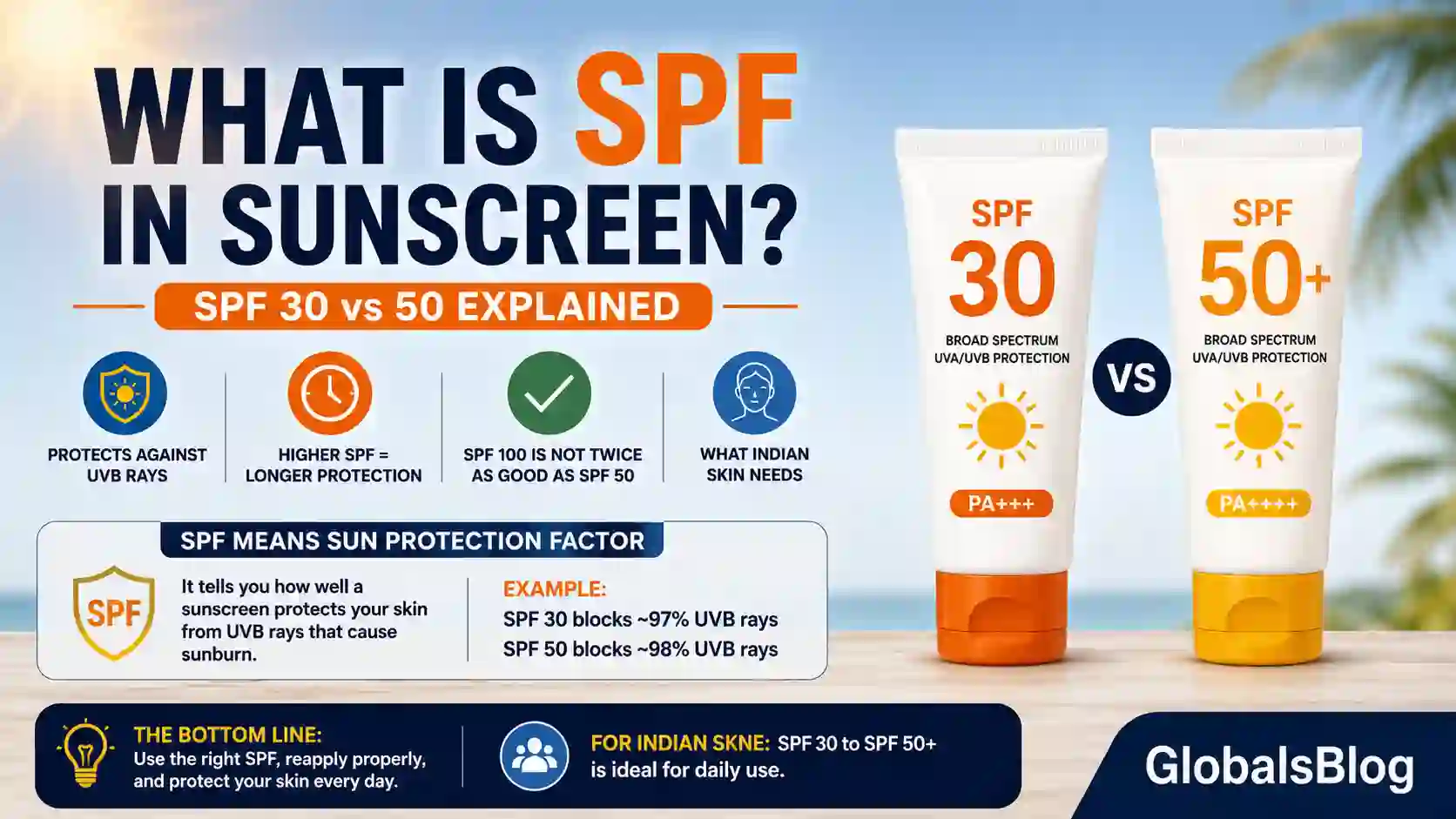
SPF is the most printed number in skincare — and one of the most misunderstood. Here is what it actually means.
A reader once asked us why she should use SPF 50 when SPF 30 already blocks 97% of UV rays. It was a genuinely smart question — and the answer changed how she thought about sunscreen entirely. Not because SPF 50 is dramatically better than SPF 30, but because understanding what the number actually measures revealed something more important about how sunscreen really works.
SPF stands for Sun Protection Factor and measures how much UVB radiation a sunscreen blocks compared to bare skin. SPF 30 blocks 97% of UVB rays, SPF 50 blocks 98%, and SPF 100 blocks 99% — the difference between SPF 30 and SPF 100 is just 2% additional protection, not triple or quadruple as the numbers imply. For Indian conditions with intense year-round UV, SPF 50 PA++++ is the recommended daily minimum — SPF 30 is adequate for brief outdoor exposure but insufficient for extended Indian sun.
What SPF Actually Measures — The Simple Version
SPF — Sun Protection Factor — is a measure of how long you can stay in the sun without burning compared to wearing no sunscreen at all. If your skin starts to burn after 10 minutes of unprotected sun exposure, SPF 30 theoretically means you can stay in the sun for 300 minutes (10 × 30) before getting the same amount of burning UV radiation.
That is the textbook definition. The real-world version is more nuanced — and more useful for Indian conditions specifically.
What SPF actually tells you in practice is the percentage of UVB rays the sunscreen blocks. SPF 30 blocks approximately 97% of UVB rays. SPF 50 blocks approximately 98%. SPF 100 blocks approximately 99%. The relationship is not linear — doubling the SPF number does not double the protection. This is the most important thing most people do not understand about SPF numbers.
What SPF Does NOT Measure
Here is what surprises most people: SPF only measures protection against UVB rays — the rays responsible for sunburn and a major cause of skin cancer. It tells you nothing about UVA protection. UVA rays penetrate deeper into skin, cause premature ageing, dark spots, and photoageing, and are present at nearly equal intensity throughout the day regardless of whether the sun feels "strong." This is precisely why the PA rating exists alongside SPF — and why checking both numbers on a sunscreen bottle matters, not just the SPF number alone. Our PA rating explained guide covers the UVA side of sun protection in full detail — essential reading alongside this SPF guide for complete understanding.
SPF 15 vs 30 vs 50 vs 50+ vs 100 — What the Numbers Actually Mean
| SPF Level | UVB Blocked | UVB That Gets Through | Best For | Indian Recommendation |
|---|---|---|---|---|
| SPF 15 | 93% | 7% | Brief outdoor exposure, cloudy days | Not Enough for India |
| SPF 30 | 97% | 3% | Daily use, moderate sun exposure | Minimum Acceptable |
| SPF 50 | 98% | 2% | Daily Indian conditions | Recommended Daily |
| SPF 50+ | 98%+ | Less than 2% | Extended outdoor exposure | Good for Outdoors |
| SPF 100 | 99% | 1% | Medical conditions, extreme exposure | Marginal Benefit |
The table makes it visually clear why jumping from SPF 30 to SPF 100 is not the dramatic upgrade the numbers suggest — you go from blocking 97% to blocking 99% of UVB. That extra 2% matters medically for very fair skin or people with sun-sensitive conditions, but for most Indian buyers the practical difference between SPF 50 and SPF 100 is minimal compared to simply applying SPF 50 correctly and consistently.
Why SPF 50 Is the Right Daily Number for Indian Skin
India's UV Index sits at 8-11 for most of the year across most of the country — classified as "Very High" to "Extreme" on the international UV scale. This is the context in which Indian skin operates daily, which is why the IADVL (Indian Association of Dermatologists) recommends SPF 50 PA++++ as the daily minimum rather than the SPF 30 that is still commonly recommended in lower-UV countries.
The argument for SPF 30 being "good enough" is based on lab conditions. In real Indian life — stepping outside for a two-wheeler commute, eating lunch near a window, walking between offices — reapplication rarely happens at the precise intervals the SPF time calculation assumes. When you are not reapplying every 2 hours as technically required, the extra 1% UVB filtration that SPF 50 provides over SPF 30 becomes genuinely meaningful accumulated over a full Indian workday.
What "SPF 50+" Actually Means
The "+" designation after SPF 50 indicates that the product was tested and confirmed to provide protection beyond SPF 50, but the exact figure was not measured further since most regulatory frameworks cap testing at SPF 50. In practice, SPF 50+ means somewhere between SPF 50 and SPF 60-70 in actual protection — a marginal improvement over SPF 50 that matters mainly as a regulatory label rather than a dramatic protection upgrade. Do not choose or reject a sunscreen based on whether it says "SPF 50" versus "SPF 50+" — the difference is negligible for everyday use.
The Application Problem — Why Your SPF Is Probably Not Working Properly
Here is the honest information that most sunscreen guides skip entirely: SPF ratings are measured in labs using 2mg of product per square centimetre of skin. The average person in real life applies roughly 0.5-1mg per cm² — a quarter to a half of the amount used in testing. This means if you are using SPF 50 but applying a thin layer, the actual protection you are getting may be closer to SPF 15-25 in practice.
This application gap is a more significant problem than the difference between SPF 30 and SPF 50 for most people. Before upgrading from SPF 30 to SPF 50, verify you are applying the correct amount of whatever you already have. The correct quantity for face and neck coverage is approximately half a teaspoon — more than most people apply in a single morning routine.
The Reapplication Rule Most People Ignore
SPF protection degrades with sun exposure, sweat, and time. The standard recommendation is reapplication every 2 hours during active sun exposure, or immediately after swimming or heavy sweating. In practice, most Indian office workers and commuters are not reapplying midday — which is fine for air-conditioned indoor environments but means the morning's protection is genuinely diminished by afternoon for anyone spending significant time outdoors.
SPF in Moisturisers and Makeup — Does It Count?
Many Indian buyers use a moisturiser with SPF 15 or 20 as their primary sun protection, assuming this is sufficient. It is not — for two reasons. First, the SPF level in most moisturisers (15-20) is below the recommended minimum for Indian conditions. Second, moisturisers are applied in much smaller quantities than dedicated sunscreens, meaning the actual delivered SPF is even lower than the labelled number. A dedicated SPF 50 sunscreen applied in the correct quantity provides significantly more real-world protection than a moisturiser with SPF 20 applied as a skincare product.
The same logic applies to makeup with SPF — foundation with SPF 15 is not your sun protection, it is a cosmetic product that happens to have some SPF. Treat it as a bonus, not a primary shield.
SPF Practical Tips for Indian Conditions
- Use minimum SPF 50 for daily Indian conditions — SPF 30 is adequate for countries with lower UV Index but India's UV levels justify the higher number
- Apply half a teaspoon for face and neck — most people apply significantly less, reducing actual protection well below the labelled SPF
- Reapply every 2 hours if spending extended time outdoors — a single morning application does not last all day regardless of SPF level
- Check both SPF and PA rating before buying — SPF only tells you UVB protection, PA tells you UVA protection which SPF says nothing about
- Do not rely on moisturiser or makeup SPF as your primary sun protection — use a dedicated sunscreen applied in the correct quantity
- Higher SPF beyond 50 gives marginally more protection — SPF 100 blocks 99% vs SPF 50's 98%, a difference that matters only in specific medical situations
Common SPF Mistakes Indian Buyers Make
- Assuming SPF 100 is twice as protective as SPF 50 — It is not. SPF 100 blocks 99% of UVB, SPF 50 blocks 98%. The marketing numbers suggest a far larger gap than the actual protection difference delivers.
- Using moisturiser with SPF 15-20 as the only sun protection — this provides inadequate protection for Indian UV conditions regardless of how premium the moisturiser is
- Applying too little sunscreen and not achieving the labelled SPF — applying half the correct amount gives roughly the square root of the SPF, not half
- Skipping reapplication outdoors after 2 hours assuming morning application is still active
- Choosing sunscreen based on SPF number alone without checking PA rating — SPF says nothing about UVA protection which causes ageing and pigmentation
💡 Key Takeaway: SPF 50 applied correctly and consistently is better protection than SPF 100 applied in too-small quantities. Application amount and reapplication frequency matter more than chasing a higher SPF number.
SPF 50, Applied Correctly, Every Day
SPF 30 blocks 97% of UVB. SPF 50 blocks 98%. SPF 100 blocks 99%. The number is not the whole story — applying enough product and reapplying during sun exposure matters more than chasing a higher number. For Indian conditions, SPF 50 PA++++ applied daily is the right standard.
SPF stands for Sun Protection Factor. It measures how much UVB radiation a sunscreen blocks compared to unprotected skin. SPF 30 blocks approximately 97% of UVB rays, SPF 50 blocks approximately 98%, and SPF 100 blocks approximately 99%. The number also indicates how much longer you can stay in the sun without burning — SPF 30 means 30 times longer than unprotected skin before equivalent UVB damage occurs.
SPF 30 is the minimum acceptable for Indian conditions but SPF 50 is the recommended daily standard. India's UV Index sits at 8-11 for most of the year — classified as Very High to Extreme — which is why IADVL recommends SPF 50 PA++++ as the daily minimum. SPF 30 blocks 97% of UVB which is reasonable, but given India's intense UV and the fact that most people under-apply sunscreen, SPF 50 provides a meaningful practical buffer.
No. SPF 100 blocks 99% of UVB rays while SPF 50 blocks 98% — a difference of just 1 percentage point, not double the protection. The SPF scale is not linear. Going from SPF 15 to SPF 30 is a meaningful improvement (from 93% to 97% UVB protection). Going from SPF 50 to SPF 100 is a marginal one (98% to 99%). For most Indian buyers, correct application of SPF 50 delivers significantly more real-world protection than under-applying SPF 100.
SPF ratings are tested at 2mg per square centimetre of skin. For face and neck coverage, this translates to approximately half a teaspoon of product. Most people apply significantly less than this in practice, meaning they receive well below the labelled SPF protection. Applying the correct amount is more important for real-world protection than choosing a higher SPF number while continuing to under-apply.
SPF in moisturiser provides some protection but should not be treated as a substitute for a dedicated sunscreen, for two reasons. First, most moisturiser SPF values are 15-20, below the recommended minimum for Indian conditions. Second, moisturisers are applied in much smaller quantities than the amount needed to achieve the labelled SPF, making the actual delivered protection significantly lower. Use a dedicated SPF 50 sunscreen as your primary protection and treat any SPF in moisturiser as a bonus.
SPF 50+ means the product was tested and confirmed to exceed SPF 50 protection, but the exact higher number was not further measured since most regulatory frameworks cap SPF testing at 50. In practice, SPF 50+ provides marginally more UVB protection than SPF 50 — somewhere between SPF 50 and SPF 60-70. For everyday use, the difference between SPF 50 and SPF 50+ is negligible and should not be the deciding factor when choosing a sunscreen.
Reader Questions