A hair straightener is one of the most consequential beauty tool purchases for Indian hair — get the temperature wrong and you cause damage that takes months to reverse. Indian hair, which is typically thicker, coarser, and more resistant to styling than fine European hair, requires higher effective temperatures to straighten but is simultaneously more prone to heat damage than its resistance suggests. The right straightener for Indian hair is not the cheapest or the most expensive — it is the one with precise temperature control and ceramic or titanium plates.
A reader from Bengaluru had burned through three hair straighteners in two years — not because the tools stopped working but because her hair did. The first was a ₹800 unbranded straightener that had no temperature control; she ran it as hot as it would go, achieved straight hair for the morning, and noticed her hair was snapping at the mid-length within two months. The second was a ₹2,500 ceramic-plated straightener that she used at maximum temperature (230°C) every morning because she read that Indian hair needs high heat; the result was identical but slower. The third was a Dyson Corrale at ₹45,000 that straightened beautifully and sustainably but required 20 minutes she didn't have on weekday mornings. What she actually needed was a mid-range ceramic or titanium plate straightener (₹4,000–8,000), used at 180–200°C (not 230°C) with a heat protectant spray, four times per week rather than daily. This guide covers exactly that — the correct tool, the correct temperature, and the correct technique for Indian hair.
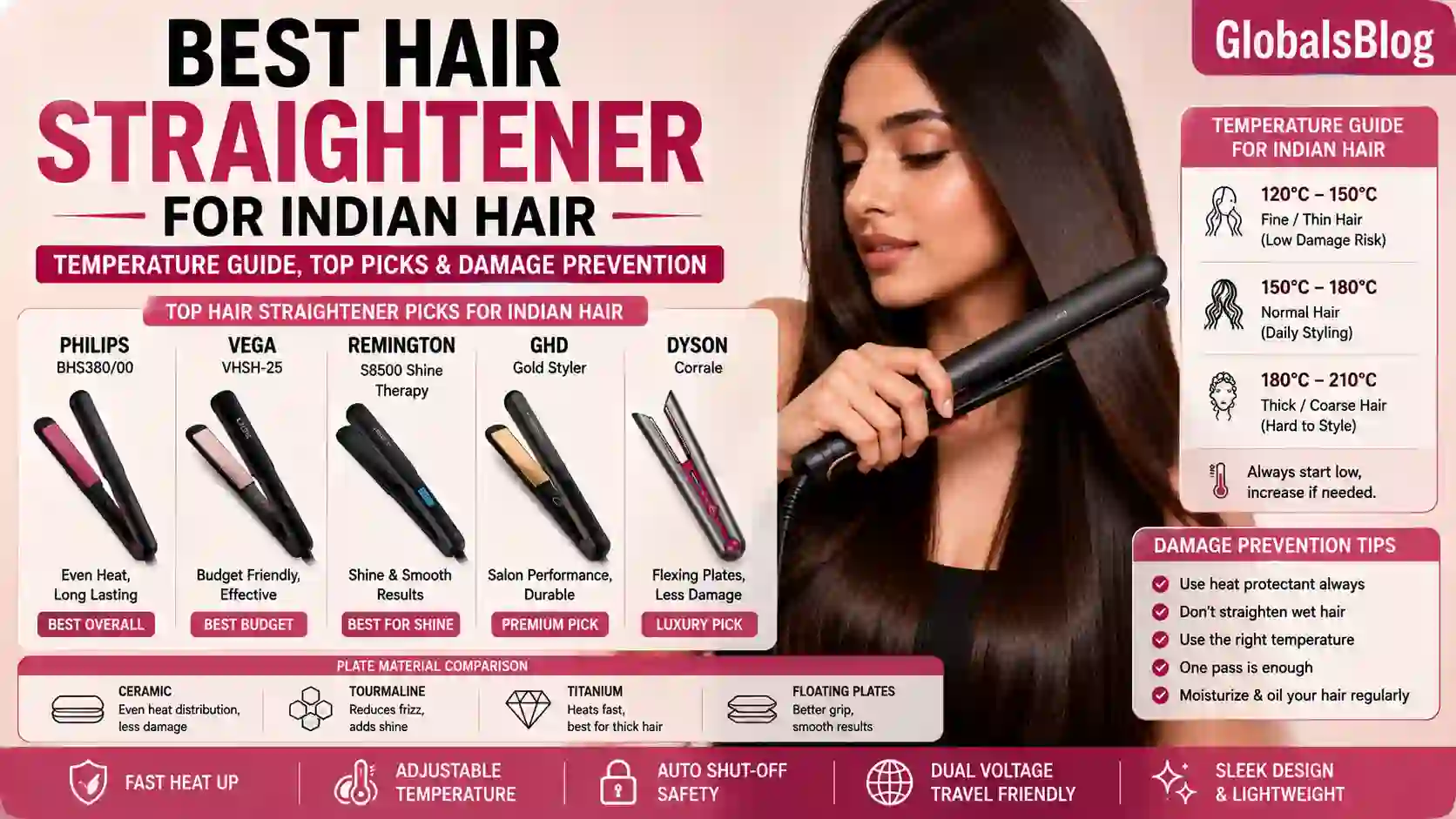
Best hair straightener for Indian hair (August 2026): Philips BHS375 (best overall Indian market, ₹2,499–3,499, ceramic plates, up to 230°C, keratin care plates); Vega Salon Straight Pro (best budget Indian brand, ₹1,299–1,799, ceramic, 130–230°C adjustable); Remington S5500 (best mid-range, ₹3,500–4,500, ceramic, wide plate, fast heat-up); GHD Original Glide (best premium under ₹15,000, ₹8,000–10,000, 185°C fixed optimal temperature — no guesswork); Dyson Corrale (best overall if budget allows, ₹44,900, flexing plates, 230°C precision, lowest heat damage). For Indian hair: 180–200°C is sufficient for most hair types — 230°C is reserved for the coarsest, most resistant Indian hair. Always use heat protectant spray before straightening.
Best Hair Straightener for Indian Hair — Ranked
The Philips BHS375 is the most consistently recommended hair straightener for Indian buyers across multiple price and quality considerations — a ceramic-plated straightener with keratin care ceramic coating (which the brand claims reduces friction on the hair strand during straightening), adjustable temperature from 130°C to 230°C in steps, a 60-second heat-up time, and Philips' established Indian service network. At ₹2,499–₹3,499, it is positioned at the sweet spot between genuinely cheap (unbranded or Syska at ₹600–800, where temperature control is absent or unreliable) and unnecessarily expensive (branded premium at ₹8,000+). The BHS375's temperature adjustment is the critical feature — the ability to set 180°C for fine Indian hair and 200°C for coarser textures, rather than running at a single fixed high temperature, is the most important practical capability in a hair straightener for Indian use. Available at Philips stores, Nykaa, Amazon, and Flipkart nationwide. Philips service centres in most tier-1 and tier-2 cities provide post-purchase support that unbranded alternatives cannot.
Vega is India's most widely distributed beauty appliance brand and the Salon Straight Pro is its best hair straightener — a ceramic-plated straightener with adjustable temperature (130°C–230°C) and a tourmaline ceramic coating that claims to reduce frizz through negative ion emission. At ₹1,299–₹1,799, it is the lowest price at which a straightener with genuine temperature control and ceramic plates is available in India from a brand with a service network. The temperature control distinguishes it from cheaper Vega models (the single-heat straighteners at ₹599–799 which should be avoided for the same reason as unbranded alternatives — no temperature adjustment). The Salon Straight Pro heats up in approximately 60–90 seconds and maintains temperature adequately for single-session styling. Long-term durability is lower than Philips or Remington — the heating element can degrade after 18–24 months of daily use, which is expected at this price point. For buyers who need an affordable entry-level straightener and will not use it daily: Vega Salon Straight Pro. For daily users: step up to Philips BHS375.
The Remington S5500 is the strongest mid-range recommendation for Indian buyers with thick, heavy hair — specifically because its wider 38mm ceramic plates (vs the standard 25–28mm on most straighteners in this price range) cover more hair per pass, reducing the number of sections needed and therefore reducing the total heat exposure time per styling session. For thick, voluminous Indian hair that requires multiple passes of a narrow plate, the wide plate straightener can reduce styling time by 30–40% while simultaneously reducing the cumulative heat exposure. Temperature control from 150°C–230°C in digital steps. Fast heat-up (approximately 60 seconds). Advanced ceramic coating with infrared heat. At ₹3,500–₹4,500, the Remington S5500 occupies the upper-mid range — more durable than the Philips BHS375 for daily use, significantly cheaper than the GHD or Dyson options. Available on Amazon, Nykaa, and Remington India's website.
GHD (Good Hair Day) is the global professional hair styling tool benchmark — used in salons worldwide and particularly recognised for its fixed 185°C operating temperature. The Original Glide's design philosophy is that 185°C is the scientifically optimal temperature for styling hair without damage — high enough to reshape the hair's hydrogen bonds (the mechanism by which straightening works) but below the threshold where protein degradation occurs rapidly. The fixed temperature eliminates the most common hair straightener misuse: selecting too-high temperatures because the user believes hotter equals better results. For Indian hair: 185°C is effective for straight-to-wavy Indian hair (the most common texture) and works adequately for moderately wavy textures. For the most tightly textured, coarsest Indian hair: 185°C may require more passes than a 200°C setting would. GHD's ceramic heating element is more precisely calibrated than most consumer straighteners — it maintains temperature throughout the plate rather than creating hot spots. At ₹8,000–₹10,000 (Nykaa, GHD India website), it is a premium investment for buyers who straighten regularly and want the lowest damage for the best result.
The Dyson Corrale is the most technologically advanced hair straightener currently available and justifies its ₹44,900 price for buyers who straighten 4+ times per week and are willing to invest in long-term hair health. The Corrale's unique feature is its flexing copper-manganese plates — the plates actively flex and mould to the hair's natural thickness variation, ensuring consistent plate contact (and consistent heat application) across the entire section being straightened. Standard flat plates create uneven pressure as sections vary in thickness — the hair receives less heat where the section is thinner, causing users to make additional passes and increasing cumulative heat exposure. The Corrale's flexing plates eliminate this by adapting to the hair. The result: fewer passes needed for the same straightness result, which Dyson claims produces 50% less heat damage than straighteners with fixed plates used to achieve the same outcome. Cordless (rechargeable) mode for up to 30 minutes of untethered use is a genuine convenience. At ₹44,900 it is a luxury investment — but for buyers who have damaged Indian hair from years of incorrect straightening and want to continue styling without worsening the damage, the Corrale's damage-reduction credentials are genuinely meaningful.
Hair Straightener Comparison — Best for Indian Hair
| Straightener | Price | Plates | Temperature | Best Indian Hair Type |
|---|---|---|---|---|
| Vega Salon Straight Pro | ₹1,299–₹1,799 | Tourmaline ceramic | 130–230°C | Fine to medium, 3–4x/week |
| Philips BHS375 | ₹2,499–₹3,499 | Keratin ceramic | 130–230°C | All types, daily use |
| Remington S5500 | ₹3,500–₹4,500 | Wide 38mm ceramic | 150–230°C | Thick, heavy Indian hair |
| GHD Original Glide | ₹8,000–₹10,000 | Professional ceramic | Fixed 185°C | Straight to wavy, regular use |
| Dyson Corrale | ₹44,900 | Flexing copper-manganese | Up to 230°C | Damaged hair, frequent use, all types |
Correct Temperature for Indian Hair — The Most Important Guide
The single most common hair straightening mistake for Indian women is using maximum temperature (230°C) because they believe Indian hair needs maximum heat. This is partially correct — Indian hair is often thicker and more resistant than fine European hair and requires higher temperatures than might be recommended in Western beauty content. But 230°C is not necessary for most Indian hair, and regular use at 230°C causes cumulative protein damage that manifests as brittleness, increased breakage, and dull colour within 3–6 months of daily use.
| Hair Type | Recommended Temperature | Notes |
|---|---|---|
| Fine Indian hair (thin strands, low density) | 130–160°C | Fine hair is most heat-sensitive — lowest effective temperature. One pass usually sufficient |
| Medium Indian hair (typical straight to wavy) | 170–185°C | Most common Indian hair type. GHD's fixed 185°C is designed for this category |
| Thick/coarse Indian hair (dense, resistant) | 190–210°C | Needs more heat but still not maximum. Two passes at 200°C better than one pass at 230°C |
| Very coarse/tightly textured Indian hair | 210–220°C maximum | Only this category benefits from temperatures approaching 230°C. One pass — never multiple passes at maximum |
| Chemically treated/coloured Indian hair | 150–175°C maximum | Chemical processes weaken hair protein. Treated hair needs lowest effective temperature |
| Damaged/brittle Indian hair | 130–160°C or avoid | Heat straightening on significantly damaged hair causes further damage. Consider air-drying and styling instead |
The correct protocol: Start at the lower end of the recommended range for your hair type. If one pass does not achieve the desired result, take a second pass at the same temperature rather than increasing temperature. Only increase temperature if two passes at the lower setting are insufficient. Increasing temperature is always a last resort — more passes at lower temperature produce better results with less cumulative damage than fewer passes at maximum temperature.
Plate Material — Ceramic vs Titanium vs Tourmaline
| Plate Material | Best For | Indian Hair Note | Price Range |
|---|---|---|---|
| Ceramic | Most Indian hair types, beginners, regular use | Even heat distribution, prevents hot spots, gentler on hair — best all-round choice for Indian hair | Budget to premium — all price ranges |
| Tourmaline ceramic | Frizz-prone Indian hair | Emits negative ions that reduce frizz and static — particularly useful in humidity-affected cities like Mumbai, Chennai | Budget to mid-range |
| Titanium | Very coarse, resistant Indian hair | Heats faster, reaches higher temperatures, better for thick resistant hair — but less forgiving on fine or damaged hair | Mid-range to premium |
| Nano-titanium | Professional use, very coarse hair | Ultra-smooth, extremely hot — professional salon plates; can cause significant damage if temperature not carefully controlled | Premium to professional |
For most Indian hair: ceramic or tourmaline ceramic plates are the correct choice. Titanium heats faster and to higher temperatures — useful for very resistant hair but less forgiving for beginners or those with fine/normal hair. Ceramic distributes heat more evenly, preventing the hot spots that cause uneven damage along the strand.
✓ Hair Straightener Tips for Indian Hair
- Always use heat protectant spray before straightening — without exception: A heat protectant spray applied to towel-dried or dry hair before straightening forms a barrier that reduces the heat transferred to the hair cortex by approximately 40–50%. This is the single most impactful damage-reduction practice available. Apply on damp hair (if straightening after washing) or dry hair (if straightening between washes), from roots to ends, and allow to dry before applying the straightener. Products: Tresemmé Heat Tamer Spray (₹299–350, widely available), L'Oréal Professionnel Thermo Protect (₹450–550), Schwarzkopf Bonacure Heat Protect (₹400–500)
- Section hair before straightening — small sections produce better results with less heat exposure: A common Indian hair straightening mistake is attempting to straighten large sections in one pass and compensating with higher temperature when the result is insufficient. Dividing hair into smaller sections (approximately 2–3cm wide) and straightening each section separately allows the plates to make complete contact with all strands — producing a better result at lower temperature with fewer passes. The time investment in sectioning is recovered by the reduced number of passes needed
- The 2-second glide rule for Indian hair: Move the straightener slowly and steadily through each section — approximately 2–3 seconds per 10cm of hair length. Moving too fast leaves hair inadequately straightened (requiring additional passes); moving too slowly concentrates heat on one spot and causes a burn mark or damage point. The consistent 2-second glide at the correct temperature is the most reliable technique for Indian hair straightening
- Do not straighten wet or even damp hair: Hair straightened when wet or damp (not completely dry) undergoes a process called hygral fatigue and internal steam damage — the water inside the hair strand turns to steam under the plate, expanding the hair cortex and causing micro-fractures in the protein structure. This is one of the fastest routes to severe hair damage. Hair must be completely dry (air-dried or blow-dried) before a straightener touches it. If using a straightener after washing: blow dry to 100% dry first
- See our best hair serum guide for post-straightening protection and our hair oil guide for overnight care to maintain hair health when straightening regularly
✗ Hair Straightening Mistakes Indian Buyers Make
- Using maximum temperature (230°C) because Indian hair "needs" maximum heat: The Bengaluru reader's three-straightener burnout was a temperature problem — running at 230°C daily on medium-texture Indian hair. Most Indian hair straightens effectively at 180–200°C. The perception that maximum heat produces better or longer-lasting results is incorrect: at 200°C, hydrogen bonds in the hair (the mechanism responsible for straightening) are fully reshaped. Temperatures above 200°C provide diminishing returns on straightening quality while producing progressively more damage to the hair's keratin protein structure. Start at 180°C, increase only if insufficient
- Buying unbranded straighteners at ₹600–800 from online marketplaces: The fundamental problem with unbranded heat styling tools is the absence of accurate temperature control. An unbranded straightener sold as "230°C ceramic" may run at 270°C or may fluctuate between 190°C and 260°C within a single session — neither temperature is displayed, neither is the user aware. The consequence is unpredictable heat delivery on Indian hair. At ₹1,299, the Vega Salon Straight Pro provides a genuinely calibrated temperature setting; the ₹500 savings from an unbranded alternative cannot be weighed against months of irreversible hair damage
- Straightening hair every day: Daily heat styling with a straightener — even at the correct temperature with heat protectant — produces cumulative keratin degradation that manifests as brittleness within 3–6 months of consistent daily use. The maximum recommended frequency for heat straightening on Indian hair is 4 times per week, with at least 3 days per week allowing the hair to air-dry without heat. On non-straightening days: air-dry with a light hair serum rather than heat-styling to maintain the straightened look
- Skipping heat protectant because the straightener has "protective" ceramic plates: Ceramic plates reduce heat damage compared to metal plates — but they do not eliminate it. "Ceramic coating" or "tourmaline ceramic" on a straightener means the heat is distributed more evenly and the plates are smoother, not that the heat is cooler. At 200°C, ceramic plates still deliver 200°C to the hair strand. A heat protectant spray is required regardless of plate material. The combination of ceramic plates AND heat protectant spray produces the best outcome; neither is a substitute for the other
⚠️ Disclaimer: Hair straightener prices vary by retailer and promotional periods. All prices listed are indicative as of August 2026. Hair type recommendations are general guidance — individual hair texture, porosity, and chemical treatment history vary. If you have significantly damaged hair, consult a professional stylist before continuing heat styling. Heat protectant sprays should always be used prior to heat tool use to minimise damage.
Vega for Budget. Philips BHS375 for Best All-Round. Remington for Thick Hair. GHD for Premium Precision. Dyson for Damaged Hair Investment. 180–200°C Not 230°C. Heat Protectant Every Time. Section the Hair.
The Bengaluru reader's journey through three straighteners to reach the right answer — mid-range ceramic plates, correct temperature (not maximum), heat protectant applied every session, four times per week not daily — is the exact journey this guide exists to shortcut. The right straightener for Indian hair is not about spending the most. It is about precise temperature control, ceramic or titanium plates, the correct operating temperature for your specific hair texture, and a heat protectant spray that absorbs 40–50% of the heat before it reaches the hair. The Philips BHS375 at ₹2,499–₹3,499 delivers all of this. The GHD delivers it more precisely at ₹8,000–₹10,000. The Dyson Corrale delivers it with the lowest damage technology available at ₹44,900. Between them: the best straightener is the one used at the right temperature on properly protected hair, four days a week, with hair oil treatment on the non-styling days.
Best hair straightener in India (August 2026): Best overall: Philips BHS375 (₹2,499–₹3,499, ceramic with keratin care coating, 130–230°C adjustable, 60-second heat-up, Philips service network). Best budget: Vega Salon Straight Pro (₹1,299–₹1,799, tourmaline ceramic, 130–230°C — the lowest price with genuine temperature control). Best for thick Indian hair: Remington S5500 (₹3,500–₹4,500, wide 38mm ceramic plates — reduces styling time for thick hair). Best premium: GHD Original Glide (₹8,000–₹10,000, fixed 185°C optimal temperature — no guesswork on settings). Best overall if budget allows: Dyson Corrale (₹44,900, flexing plates reduce heat damage by up to 50% vs standard flat plates). Key buying rule: always choose a straightener with adjustable temperature control — fixed-heat or uncontrolled cheap straighteners often run too hot and cause irreversible hair damage on Indian hair.
Correct temperature for straightening Indian hair: Fine Indian hair (thin, low density) — 130–160°C. Medium Indian hair (typical straight-to-wavy, most common) — 170–185°C. Thick/coarse Indian hair (dense, resistant) — 190–210°C. Very coarse/tightly textured — 210–220°C maximum. Chemically treated/coloured hair — 150–175°C maximum. Damaged/brittle hair — 130–160°C or avoid heat styling. Most Indian women should use 180–200°C — not 230°C. The common belief that Indian hair "needs" maximum temperature is incorrect. At 200°C, hair's hydrogen bonds are fully reshaped for straightening. Temperatures above 200°C cause protein degradation with diminishing returns on straightening quality. Always start at the lower end of the range for your hair type and increase only if two passes at the lower temperature are insufficient.
GHD Original Glide is worth buying for Indian buyers who straighten regularly (3+ times per week) and want the best result with least damage at a mid-premium price. The key advantage: GHD's fixed 185°C temperature is specifically calibrated to the scientifically optimal straightening temperature — high enough to fully reshape hair's hydrogen bonds without the protein degradation that occurs at 210–230°C. For Indian straight-to-wavy hair (the most common texture), 185°C is entirely effective with the GHD's precisely maintained temperature. For very coarse or tightly textured Indian hair, 185°C may require additional passes but is still preferable to multiple passes at 210–230°C damage-causing temperatures. The GHD's professional-grade ceramic heating element maintains temperature consistently across the plate (no hot spots) — better than consumer straighteners that can fluctuate ±20–30°C. At ₹8,000–₹10,000 (Nykaa, GHD India), the GHD is a 5–7 year investment for daily to frequent users. Compared to replacing a ₹2,500–3,500 straightener every 2–3 years, the total cost of ownership is comparable while delivering better results and lower hair damage.
Ceramic vs titanium for Indian hair: Ceramic is better for most Indian hair types — it distributes heat evenly across the plate (no hot spots), produces a gentler, more consistent heat delivery, and is more forgiving for beginners or those with normal to thick hair. Titanium is better specifically for very coarse, resistant Indian hair that requires higher temperatures and benefits from faster heat-up and higher maximum temperatures. Titanium plates heat faster and reach higher maximum temperatures than ceramic — useful for thick resistant hair but potentially damaging for normal or fine hair if temperature is not precisely controlled. Tourmaline ceramic (a ceramic plate coated with powdered tourmaline crystal) is the best choice for frizz-prone Indian hair — the tourmaline emits negative ions that neutralise the static electricity that causes frizz, particularly relevant in humid Indian cities. For the vast majority of Indian buyers: ceramic or tourmaline ceramic. Only choose titanium if your hair is significantly thick and resistant and you have experience controlling heat tool temperatures appropriately.
Best hair straightener under ₹3,000 in India (August 2026): Top pick: Philips BHS375 (₹2,499–₹3,499 — the best overall choice with keratin care ceramic plates, 130–230°C adjustable, Philips service network, widely available). Budget pick: Vega Salon Straight Pro (₹1,299–₹1,799 — tourmaline ceramic, 130–230°C adjustable, nation-wide availability). Both include the critical feature: adjustable temperature control. This is the minimum requirement for any hair straightener recommended for Indian hair — without temperature control, the tool cannot be used safely for different hair textures and types. Avoid: unbranded or no-name straighteners at ₹500–800 from online marketplaces. These typically have no temperature control or inaccurate temperature markings, often run at temperatures above what is stated, and cause hair damage that cannot be reversed. The ₹1,299 Vega is the absolute minimum acceptable entry price for a quality straightener for Indian hair.
Maximum recommended frequency for heat straightening Indian hair: 4 times per week — with at least 3 days per week free of direct heat styling. Daily heat straightening (7 days per week) causes cumulative keratin degradation that manifests as brittle, snapping hair within 3–6 months even with heat protectant use. The protein damage is cumulative and irreversible — once keratin is degraded from repeated high-heat exposure, it cannot be fully restored even with protein treatments. Practical approach: straighten on days when appearance for public or professional situations is a priority. On remaining days: air dry hair and apply a light hair serum for smoothness without heat. Deep condition with a protein treatment or hair mask once per week if straightening 3–4 times weekly — this helps partially replenish the protein bonds weakened by repeated heat exposure. Always apply heat protectant spray before every straightening session regardless of frequency — reducing damage per session extends the safe straightening frequency over time.
Leave a comment
Share a quick thought about this story.
Thanks for sharing your view. It is ready for review.
Please try again in a moment.