Most Indians check SPF and ignore PA rating. That is exactly the wrong priority for Indian skin concerns.
A reader spent two years wondering why she had increasing dark spots and pigmentation despite using SPF 50 sunscreen every single day. Her sunscreen was SPF 50 PA++. Her dermatologist pointed out the problem immediately — PA++ provides limited UVA protection, and UVA rays are the primary cause of pigmentation, dark spots, and photoageing. She switched to PA++++. The improvement over the next six months was visible. The SPF number had not been the issue at all.
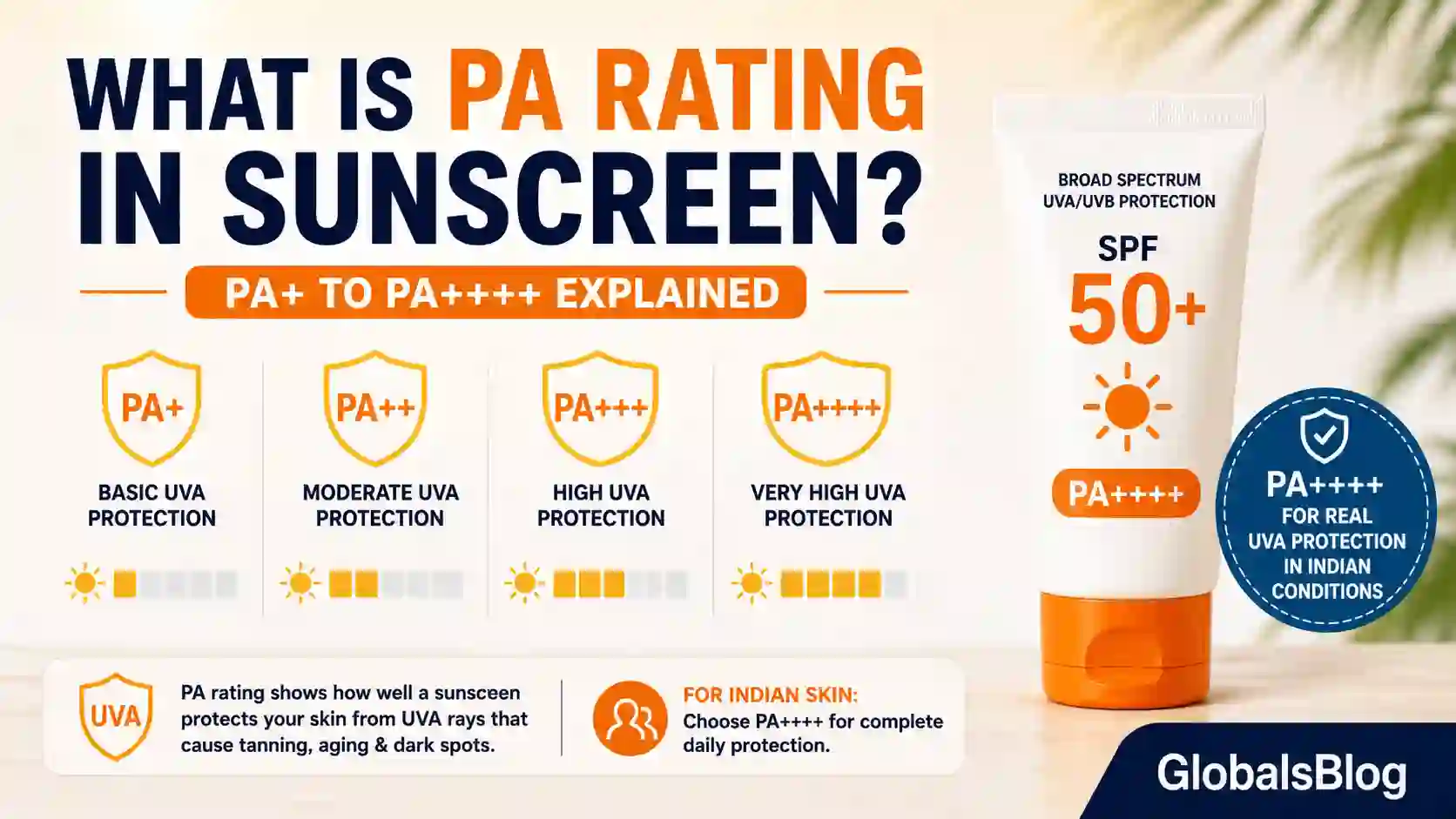
PA stands for Protection Grade of UVA rays — a Japanese rating system adopted widely in Asia including India that measures how well a sunscreen protects against UVA radiation. PA+ provides some UVA protection, PA++ provides moderate protection, PA+++ provides high protection, and PA++++ provides the highest available UVA protection. For Indian skin specifically, PA++++ is the minimum recommended rating since UVA rays are the primary cause of pigmentation, dark spots, and premature ageing that concern most Indian buyers.
What PA Rating Actually Measures
PA — Protection Grade of UVA — is a rating system developed in Japan that has become the standard UVA protection indicator across most Asian sunscreen markets including India. While SPF measures UVB protection, PA measures UVA protection. These are two completely different types of ultraviolet radiation that require separate measurement and separate labelling.
UVA and UVB affect skin in genuinely different ways. UVB rays are shorter wavelength, primarily responsible for sunburn, and are most intense between 10am-4pm. UVA rays are longer wavelength, penetrate much deeper into skin, cause pigmentation, premature ageing, collagen breakdown, and dark spots — and are present at nearly equal intensity throughout the entire day, through clouds, and even through glass windows. This is why sitting near a sunny office window all day causes cumulative skin damage even if you never feel the sun "burning" you.
The Science Behind PA — What PPD Means
The PA rating is based on the PPD value — Persistent Pigment Darkening — which measures how much UVA radiation causes skin to darken. A higher PPD value means stronger UVA protection. The PA system translates PPD values into a simple plus-sign scale for consumer labelling. PA+ corresponds to PPD 2-4, PA++ to PPD 4-8, PA+++ to PPD 8-16, and PA++++ to PPD 16 and above. For Indian buyers dealing with pigmentation and dark spot concerns, understanding this scale is more relevant to their actual skin concern than the SPF number alone.
PA+ vs PA++ vs PA+++ vs PA++++ — What Each Level Means
| PA Rating | PPD Value | UVA Protection Level | Best For | Indian Recommendation |
|---|---|---|---|---|
| PA+ | PPD 2–4 | Some UVA protection | Very brief outdoor exposure | Insufficient for India |
| PA++ | PPD 4–8 | Moderate UVA protection | Low UV index environments | Not Enough for India |
| PA+++ | PPD 8–16 | High UVA protection | Daily use in moderate UV | Minimum Acceptable |
| PA++++ | PPD 16+ | Highest UVA protection | Daily Indian conditions | Recommended for India |
The reader with pigmentation at the start of this article was using PA++ — PPD 4-8, moderate UVA protection — in a country where year-round UV Index reaches 10-11. That gap between her protection level and India's actual UV intensity was the direct cause of her continuing skin concerns despite using a high-SPF product. Switching to PA++++ addressed the actual problem her SPF 50 was never solving.
Why PA Rating Matters More Than SPF for Indian Skin Concerns
This is the opinion we will state directly: for the majority of Indian skin concerns — pigmentation, uneven skin tone, dark spots, premature wrinkles, and dullness — PA rating is a more important number to check than SPF.
Here is why. Sunburn is relatively rare for most Indian skin types, which tend to have enough natural melanin to resist burning under typical urban sun exposure conditions. But UVA-induced pigmentation, dark spots, and photoageing affect virtually every Indian skin tone regardless of how dark or fair — melanin does not protect against UVA damage the way it limits sunburn risk from UVB. This means the PA rating, which measures UVA protection, directly addresses the skin concern most Indian buyers actually have, while SPF addresses a concern that is less immediately relevant for most.
UVA Through Windows and Clouds — The Hidden Exposure
UVA rays penetrate standard window glass and cloud cover with minimal reduction in intensity. UVB rays are largely blocked by glass and significantly reduced by clouds. This means that sitting near a window in an air-conditioned office, or driving with the window up, exposes your skin to meaningful UVA radiation throughout the workday even if you never step outdoors. For Indian office workers who assume indoor environments mean no sun protection needed, this is genuinely important to understand. Your PA rating matters indoors as much as outdoors — your SPF matters primarily when you are actually in direct sun.
How to Check PA Rating When Buying Sunscreen in India
-
Look for PA rating on the packaging directly All reputable sunscreens sold in India now display the PA rating alongside SPF. If a sunscreen does not display a PA rating at all, this is a red flag — it may only provide UVB protection through the SPF and offer negligible UVA coverage.
-
Count the plus signs — minimum 4 for Indian conditions PA+ is one plus, PA++ is two, PA+++ is three, PA++++ is four. For daily use in India, you want four plus signs. Three plus signs (PA+++) is the absolute minimum, and even that is a compromise for high-sun-exposure situations.
-
Check that SPF and PA ratings are both on the bottle A sunscreen with SPF 50 but only PA++ is providing strong UVB protection and weak UVA protection — a mismatch that leaves you partially vulnerable. Both numbers should be appropriate for Indian conditions simultaneously.
-
Do not confuse "broad spectrum" with PA rating "Broad spectrum" is a general claim that a sunscreen protects against both UVA and UVB. It does not specify how much UVA protection is provided. A sunscreen can legally claim "broad spectrum" with only PA++ — technically true but insufficient for Indian conditions. Always check the actual PA rating rather than relying on "broad spectrum" labelling alone.
PA Rating and Indian Skin Concerns — The Direct Connection
For buyers specifically dealing with hyperpigmentation, melasma, dark spots, or uneven skin tone — which represent the most common skin concerns raised by Indian buyers in our reader questions — UVA protection is the primary line of defence. UVA rays stimulate melanin production, the same process that creates dark spots and uneven pigmentation, at a level that SPF provides no protection against.
This is why a complete anti-pigmentation skincare approach — vitamin C serum, niacinamide, sunscreen — only works if the sunscreen component includes strong UVA protection through a PA++++ rating. Our dermatologist-recommended sunscreen guide covers why Indian dermatologists specifically emphasise PA rating alongside SPF for patients with pigmentation concerns.
PA Rating Practical Tips
- Always choose PA++++ for daily use in Indian conditions — PA+++ is the minimum but PA++++ provides meaningfully stronger UVA coverage
- Check PA rating even when buying sunscreen for indoor use — UVA penetrates glass and clouds, making protection relevant even in air-conditioned environments
- Prioritise PA rating over SPF if your primary skin concern is pigmentation, dark spots, or uneven skin tone — these are UVA-driven concerns
- Do not trust "broad spectrum" labelling alone — always verify the actual PA rating printed on the bottle
- PA rating applies equally to tinted and mineral sunscreens — check it on every formula regardless of type
- Read our SPF explained guide alongside this one — both numbers together give the complete picture of a sunscreen's actual protection level
PA Rating Mistakes Indian Buyers Make
- Choosing sunscreen based on SPF alone and ignoring PA rating entirely — The reader at the start of this article used SPF 50 PA++ for two years and continued developing pigmentation because the UVA side of her protection was inadequate. SPF 50 PA++ is not the same as SPF 50 PA++++.
- Assuming "broad spectrum" means strong UVA protection — it only guarantees some UVA coverage, not necessarily PA++++ level
- Skipping sunscreen indoors because "there is no sun" — UVA rays penetrate glass and clouds at nearly full intensity regardless of whether direct sunlight is visible
- Using PA++ or PA+++ sunscreens for daily Indian use while dealing with active pigmentation concerns — the protection level is simply insufficient for the UV intensity India delivers year-round
- Not checking PA rating on tinted or moisturising sunscreens assuming these have equivalent protection — always verify the actual PA rating regardless of other product features
💡 Key Takeaway: For Indian skin — SPF 50 handles UVB (sunburn). PA++++ handles UVA (pigmentation, ageing, dark spots). You need both numbers to be right on the same bottle. One without the other is incomplete protection.
SPF Handles Sunburn. PA++++ Handles Pigmentation.
If your skin concern is dark spots, uneven tone, or premature ageing — PA rating is the number that matters most. SPF 50 PA++++ gives you complete protection for Indian conditions. SPF 50 PA++ leaves UVA exposure largely unaddressed regardless of how high the SPF number looks.
PA stands for Protection Grade of UVA rays — a Japanese rating system that measures how well a sunscreen protects against UVA radiation. The rating runs from PA+ (some protection) through PA++ (moderate), PA+++ (high), and PA++++ (highest available protection). Unlike SPF which measures UVB protection, PA specifically measures protection against UVA rays which cause pigmentation, dark spots, and premature ageing.
Yes — PA++++ is the recommended minimum for daily use in India. India's UV Index sits at 8-11 for most of the year, delivering intense UVA radiation year-round. For buyers dealing with pigmentation, dark spots, or uneven skin tone — the most common Indian skin concerns — PA++++ provides the strongest available UVA protection against the primary driver of these conditions. PA+++ is the minimum acceptable; PA++++ is the recommended standard.
PA++ corresponds to a PPD value of 4-8, providing moderate UVA protection. PA++++ corresponds to PPD 16 and above, providing the highest available UVA protection — at minimum double the protection of PA++ and potentially four times or more depending on the exact PPD value. For Indian conditions and skin concerns like pigmentation, the difference between PA++ and PA++++ is genuinely meaningful in real-world daily use.
Yes — UVA rays penetrate standard window glass and clouds at nearly full intensity. UVB rays, which SPF measures, are largely blocked by glass. This means indoor environments near windows expose skin to meaningful UVA radiation throughout the day even without direct sun exposure. PA rating is relevant for indoor use specifically because UVA penetration through glass is the form of UV that most affects indoor skin over time.
No — "broad spectrum" only guarantees that a sunscreen provides some UVA and UVB protection, not that the UVA protection meets the PA++++ standard recommended for Indian conditions. A sunscreen with PA++ can legally claim "broad spectrum" despite providing insufficient UVA coverage for Indian daily use. Always check the actual PA rating printed on the bottle rather than relying on broad spectrum claims alone.
Both matter but for different concerns. For sunburn prevention, SPF matters. For pigmentation, dark spots, uneven skin tone, and premature ageing — the concerns most Indian buyers actually have — PA rating matters more, since these are UVA-driven conditions that SPF provides no protection against. The ideal sunscreen addresses both with SPF 50 and PA++++. If your primary concern is pigmentation rather than sunburn, PA rating deserves equal or greater attention than SPF when choosing a sunscreen.
Reader Questions
Best retinol cream for Indian skin 2026 — Minimalist Granactive Retinoid, The Derma Co, RoC Retinol Correxion ranked. Beginner protocol, sandwich method and PIH prevention guide.
Leave a comment
Share a quick thought about this story.
Thanks for sharing your view. It is ready for review.
Please try again in a moment.
Newsletter
Get weekly travel, auto & beauty tips
Join 1,000+ readers. No spam. Unsubscribe anytime.
GlobalsBlog uses cookies for analytics (Google Analytics) and personalised advertising (Google AdSense). By clicking Accept All you consent to these cookies. You can decline non-essential cookies without losing access to any content. Read our Privacy Policy