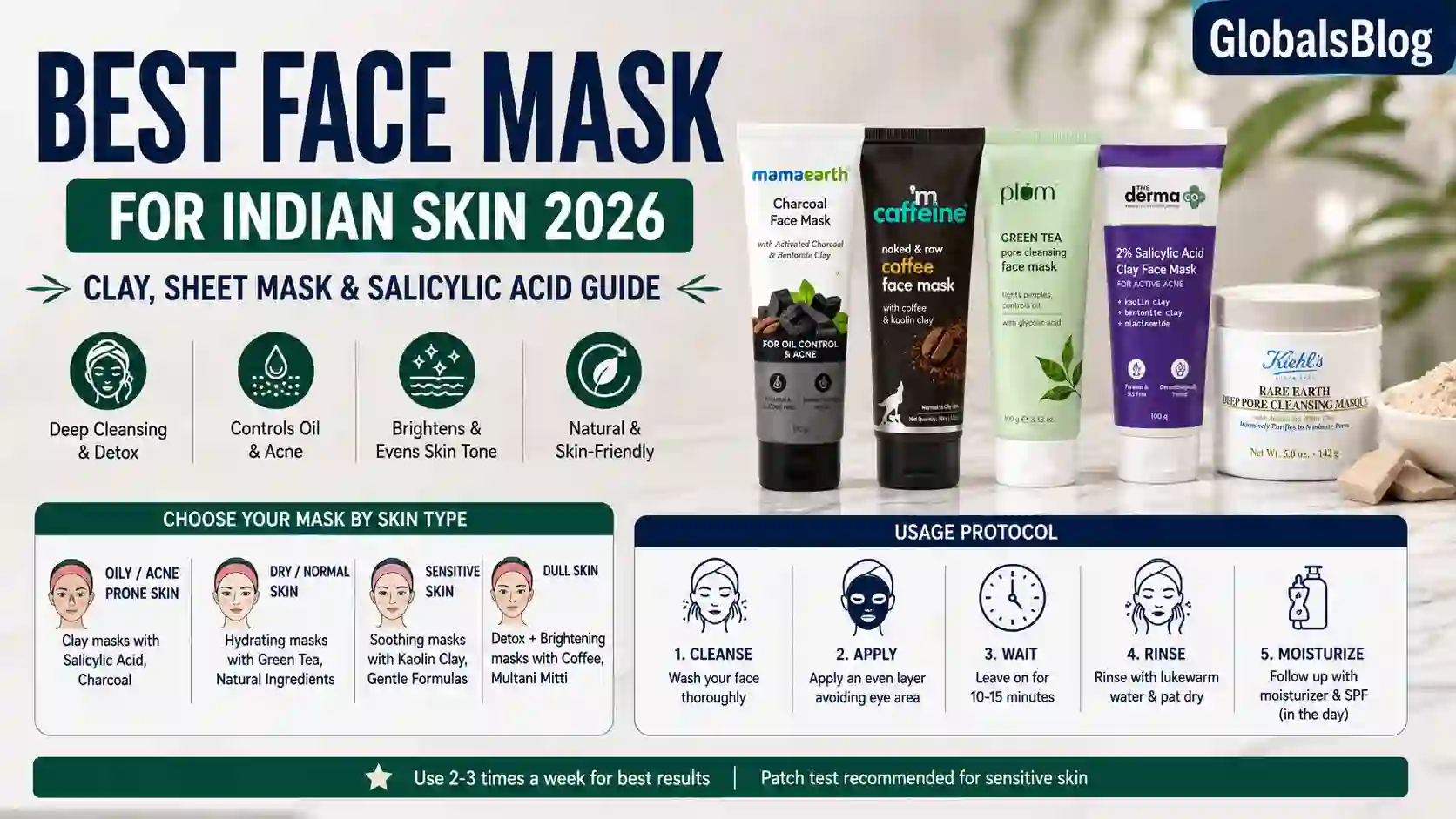
A face mask used correctly once or twice a week does more for Indian skin than adding a fifth daily skincare product. The right mask — clay for oily skin in Mumbai's monsoon, hydrating sheet masks for Delhi's dry winter, brightening vitamin C masks for UV-damaged South Indian skin — targets what your daily routine cannot address in its two-minute application window.
A reader from Mumbai had spent ₹4,800 on skincare products in six months — a niacinamide serum, a vitamin C serum, a gel moisturiser, a toner, and a sunscreen — and was reasonably happy with her skin. What she couldn't address was the congestion: the texture around her nose and forehead, the occasional closed comedones (whiteheads under the skin), and the dull look that persisted even with vitamin C. Her dermatologist's suggestion was simple: a kaolin clay mask once a week on the T-zone. Four weeks later she was back asking what else the dermatologist could recommend "because whatever that clay mask did in four weeks was more than everything else I bought in six months." The clay mask absorbed the sebum that was feeding the congestion and chemically occluding her pores. No serum applied for two minutes daily could have done that — it requires a 15-minute contact time that only a mask provides. This guide covers every face mask type for Indian skin, which Indian skin concerns each one addresses, and the correct once-or-twice-weekly protocol that makes them actually work.
Best face masks for Indian skin (August 2026): Mamaearth Charcoal Face Mask (best overall for oily/combination Indian skin, ₹299–349, kaolin + charcoal, congestion and sebum control); mCaffeine Coffee Face Mask (best for dull skin, ₹299–349, coffee + kaolin, brightening + oil control); Plum Green Tea Clear Face Mask (best for acne-prone Indian skin, ₹349–399, salicylic acid + green tea, BHA exfoliation); The Derma Co 2% Salicylic Acid Face Mask (best chemical exfoliant mask, ₹499–599, BHA deep pore); L'Oréal Paris Clay Mask Pure Clay Brighten (best international drugstore, ₹749–849, three clays + charcoal); Kiehl's Rare Earth Deep Pore Cleansing Masque (best premium clay, ₹1,800–2,000, Amazonian white clay); Korean sheet masks — Innisfree My Real Squeeze or Nature Republic (best hydrating, ₹99–249/sheet). Use 1–2x weekly, not daily. Oily Indian skin: clay. Dry/dehydrated Indian skin: sheet mask or overnight mask.
Best Face Masks for Indian Skin — Ranked by Type
The Mamaearth Charcoal Face Mask is the most consistently recommended affordable face mask for Indian oily and combination skin — a kaolin clay and activated charcoal formula that addresses sebum excess, enlarged pores, and congestion in a 10–15 minute weekly application. Kaolin (white clay) is the gentler of the common clay types in Indian skincare — it absorbs sebum and impurities without the excessive drying effect of bentonite or fuller's earth, making it appropriate for combination skin where the T-zone is oily but the cheeks are normal or slightly dry. The activated charcoal acts as an adsorbent — binding to oxidised sebum, dead skin cells, and surface impurities within the pores through a surface charge interaction. At ₹299–₹349 for 100g (approximately 10–12 mask applications), it is excellent value for the ingredient combination. Free from SLS, parabens, and artificial fragrance — a relevant claim for Indian skin prone to fragrance sensitivity. Available at Mamaearth's website, Nykaa, and Amazon. The mask is also PETA-certified cruelty-free — a relevant differentiator for buyers who prioritise this.
The mCaffeine Coffee Face Mask is the strongest recommendation for dull, fatigued, or congested Indian skin — a coffee-infused kaolin clay mask where the coffee grounds provide mild physical exfoliation and the caffeine acts as a vasoconstrictor (temporarily tightening blood vessels and reducing puffiness), while the kaolin addresses the underlying sebum-driven congestion. Caffeine is also a strong antioxidant — neutralising free radical damage from India's high UV environment. The combined effect of physical coffee exfoliation + chemical clay absorption + antioxidant caffeine produces a visible brightening and smoothing effect within the first 1–2 uses that is more immediately apparent than most vitamin C serums at longer contact times. At ₹299–₹349 for 100g, it is the same price as the Mamaearth charcoal mask with a different primary action — brightening over deep-pore cleansing. For buyers whose primary concern is dullness and uneven texture: mCaffeine. For buyers whose primary concern is congestion and enlarged pores: Mamaearth Charcoal.
The Plum Green Tea Clear Face Mask is the most recommended face mask for acne-prone Indian skin — a kaolin clay base combined with salicylic acid (BHA, a beta-hydroxy acid that is oil-soluble and penetrates the pore lining to exfoliate from inside the pore) and green tea extract (anti-inflammatory antioxidant that reduces redness and oxidative stress associated with acne). The salicylic acid is the key differentiator: it chemically exfoliates inside the pore (unlike physical scrubs which only address the surface), dissolving the oxidised sebum and dead cell material that causes closed comedones and acne. The 15-minute contact time of a mask application allows the salicylic acid to work more effectively than a 60-second face wash with the same ingredient. At ₹349–₹399 for 125g, it is slightly more expensive than the two products above but delivers a medically recognised acne-fighting ingredient (salicylic acid) alongside the clay base. Best used as a spot treatment on active breakout areas or as a full-face weekly treatment for consistently acne-prone Indian skin. Do not use on the same day as AHA toning or high-strength vitamin C — combine with gentle hydrating skincare on mask days.
The Derma Co's 2% Salicylic Acid Face Mask is the strongest salicylic acid mask available from an Indian brand — a 2% BHA concentration (the maximum widely used in Indian consumer skincare) combined with a clay base and centella asiatica (anti-inflammatory) for pore-deep exfoliation. The 2% salicylic acid concentration is clinically validated for acne and comedone treatment — the same concentration used in dermatologist-prescribed formulations. As a mask (15-minute contact time) rather than a cleanser or toner (60-second contact), it delivers the salicylic acid to the pore lining for longer, producing more comprehensive pore exfoliation than a 2% salicylic acid face wash would. At ₹499–₹599 for 50g (approximately 6–8 applications), it is more expensive per gram than the Plum mask — justified for skin with persistent comedone issues or where Plum's lower concentration is insufficient. Not recommended for dry or sensitive Indian skin — 2% BHA at mask contact time on already-dry skin can cause irritation and over-drying. Best reserved for specifically oily, acne-prone, or comedone-heavy skin types. Available on The Derma Co website and Nykaa.
L'Oréal Paris Pure Clay Brightening Mask uses a combination of three clays (kaolin, montmorillonite, and ghassoul) with yuzu lemon extract — the three-clay combination addresses different aspects of pore function (kaolin absorbs surface sebum, montmorillonite draws deeper impurities, ghassoul exfoliates gently), while the yuzu lemon provides vitamin C-type brightening. At ₹749–₹849 for 50ml, it is positioned above the Indian brand alternatives at a price that reflects L'Oréal's international formulation heritage. The mask is available at most pharmacies, supermarkets, and Nykaa — the widest physical retail distribution of any mask on this list. For buyers who want an international brand with proven clay mask formulation available at a local pharmacy without ordering online: L'Oréal Pure Clay is the most practical choice. The brightening variant (Yuzu Lemon) is the most universally appropriate for Indian skin concerns — addressing both pore congestion and UV-related dullness simultaneously. Also available in an exfoliating variant (red algae) and a detox variant (charcoal).
Kiehl's Rare Earth Deep Pore Cleansing Masque uses Amazonian white clay — one of the highest-grade clays available in premium skincare, with exceptional absorption capacity for sebum and impurities. At ₹1,800–₹2,000 for 125ml (approximately 20–25 applications), it is the most expensive mask on this list — justified for buyers with specifically persistent enlarged pores or chronic sebum overproduction who have not achieved results with lower-grade clay masks. The Amazonian clay provides more intensive pore-clearing in a single application than kaolin-only masks, with less post-application tightness (the formula includes glycerin as a humectant buffer). Dermatologists who recommend the Kiehl's Rare Earth note that it is particularly effective for Indian skin in high-humidity cities (Mumbai, Chennai, Kolkata) where sebum production is elevated by climate conditions and standard clay masks may be insufficient. Available at Kiehl's stores and Nykaa.
Sheet masks are the most appropriate mask type for dry, dehydrated, or normal Indian skin — particularly for Delhi and North India winter (November–February) when ambient humidity drops below 30% and skin feels tight, dull, and dry despite regular moisturiser use. A sheet mask (a serum-saturated fabric or bio-cellulose sheet applied to the face for 15–20 minutes) delivers a significantly higher concentration of hydrating actives — hyaluronic acid, ceramides, niacinamide, vitamin C — directly to the skin surface under occlusion, producing a plumping and brightening effect visible within 20 minutes. Recommended sheet masks available in India: Innisfree My Real Squeeze Mask (₹149–₹199, multiple variants — green tea for oil balance, aloe for soothing, honey for dry skin); Nature Republic Real Nature Sheet Masks (₹99–₹149, widely available, multiple actives); Garnier Moisture Bomb Sheet Mask (₹99–₹149, hyaluronic acid + pomegranate, widely available in Indian pharmacies). Korean sheet masks are not for oily or acne-prone skin as a standalone — the essence can feel heavy on congested skin. For combination skin: use a clay mask on the T-zone and a sheet mask on the cheeks simultaneously for targeted treatment.
Multani mitti (Fuller's Earth) is the traditional Indian clay used for face masking for centuries — a magnesium aluminium silicate clay with extremely high sebum absorption capacity (higher than kaolin or bentonite by weight). It is the original face mask ingredient of Indian skincare and remains the most effective and affordable option for very oily Indian skin. At ₹50–₹150 for 250g at any pharmacy or general store, it is the lowest-cost face mask ingredient available — requiring only mixing with rose water, aloe vera gel, or plain water to use. The absorption capacity of multani mitti is why it works for heavy sebum production that kaolin-only masks may not adequately address. The limitation: it is more drying than commercial clay masks — it must never be left until completely dry on the face (which causes it to pull moisture from the skin, not just sebum). Remove at the tacky-but-not-dry stage (approximately 12–15 minutes for most Indian climates). Not recommended for dry, sensitive, or combination skin as a full-face mask — T-zone spot use only for combination skin types.
Which Face Mask for Your Indian Skin Type?
| Skin Type | Best Mask Type | Recommended Product | Frequency | Key Concern Addressed |
|---|---|---|---|---|
| Oily (Mumbai, Chennai climate) | Clay — kaolin or multani mitti | Mamaearth Charcoal or multani mitti | 1–2x weekly | Sebum, congestion, enlarged pores |
| Combination (oily T-zone, normal cheeks) | Clay on T-zone only | Mamaearth Charcoal (T-zone) + sheet mask (cheeks) | Once weekly | T-zone congestion without over-drying cheeks |
| Acne-prone | BHA clay mask | Plum Green Tea Clear or Derma Co 2% SA | Once weekly | Closed comedones, active acne, pore exfoliation |
| Dull / pigmented (UV damage) | Brightening clay or vitamin C mask | mCaffeine Coffee or L'Oréal Yuzu Clay | 1–2x weekly | Dullness, uneven texture, antioxidant protection |
| Dry (Delhi winter) | Sheet mask or overnight hydrating mask | Innisfree My Real Squeeze or Garnier Moisture Bomb | 2–3x weekly | Dehydration, tightness, dull dry skin |
| Sensitive | Gentle hydrating mask — no clay | Aloe vera-based sheet mask or Garnier Moisture Bomb | Once weekly | Hydration without potential clay irritation |
| Very oily (strong sebum) | Multani mitti or premium clay | Multani mitti + rosewater or Kiehl's Rare Earth | Once weekly | Maximum sebum absorption, deep pore cleansing |
Face Mask Routine for Indian Skin — Step by Step
When to apply: After cleansing (clean skin ensures the mask contacts skin directly, not surface oil or sunscreen). Before toning and serum — the mask is a step after cleansing, before the rest of skincare. Evening recommended for clay masks — the skin repair cycle peaks at night and the temporary tightness from a clay mask is less disruptive in the evening.
Clay mask protocol (oily Indian skin): Cleanse → apply clay mask to T-zone or full face (if oily throughout) → 12–15 minutes → rinse with lukewarm water → pat dry → apply toner → apply serum → apply moisturiser. The moisturiser after the mask is not optional — the clay will have removed some surface moisture along with the sebum, and sealing in fresh hydration immediately after prevents the rebound oiliness that comes from dry skin signalling for more sebum.
Sheet mask protocol (dehydrated Indian skin): Cleanse → apply sheet mask → 15–20 minutes → remove sheet mask → pat in remaining essence (do not wash off) → apply moisturiser to seal. Sheet mask essence is active ingredient concentrate — patting it in rather than washing off preserves the beneficial actives. No need for toner or serum on sheet mask evenings — the essence contains both.
Multi-masking for combination Indian skin: Apply clay mask to T-zone (forehead, nose, chin) and a hydrating sheet mask piece or aloe vera gel to the cheeks simultaneously. Remove clay after 12–15 min; remove sheet mask remnant after 20 min. This addresses the combination skin problem that most single masks cannot — different zones with different needs treated in one session.
✓ Face Mask Tips for Indian Skin
- Never leave a clay mask until completely dry on Indian skin: The most common clay mask mistake — leaving the mask on until it cracks and flakes. When a clay mask dries completely, it transitions from absorbing pore sebum (the intended function) to absorbing skin moisture (the unintended and damaging function). In Indian summer heat, a clay mask dries in 8–10 minutes — remove at the slightly tacky stage (not wet, not cracked). Set a 12-minute timer and rinse before the mask fully sets. This applies to multani mitti in particular, which dries faster than commercial masks and is more aggressively drying when fully set
- Moisturise immediately after every clay mask — not optional: Clay masks remove surface sebum and leave the skin temporarily less protected than before. Without immediate moisturiser application after rinsing the mask, the skin interprets the dryness as a signal to produce more sebum — the opposite of what the mask was meant to achieve. Apply toner and then a light gel moisturiser (for oily skin) or a medium moisturiser (for combination skin) within 5 minutes of rinsing the clay mask. This completes the mask's effect by hydrating the now-clean pores
- The pre-event glow from sheet masks is real and repeatable: A sheet mask applied 30 minutes before a significant event (interview, wedding function, photoshoot) produces a visible plumping and brightness from the concentrated hyaluronic acid and serum essence — the equivalent of a professional hydration facial in 20 minutes at ₹100–200. This effect is temporary (3–6 hours) but reliable and cumulative when used consistently weekly
- Spot-masking on active acne is more effective than full-face masking: For specific active pimples, applying a small amount of the Plum Green Tea or Derma Co SA mask directly to the breakout area (a thick 2–3mm layer) and leaving for 20 minutes produces a more targeted effect than thinly applying the same mask full-face. The concentrated BHA contact on the active spot reduces redness and accelerates the resolution cycle. This spot technique can be used more frequently (3–4x weekly on active spots) without the over-exfoliation risk of full-face BHA masking
- See our face wash guide for oily skin for the cleansing step that should precede every clay mask, and our moisturiser guide for oily skin for the post-mask sealing step
✗ Face Mask Mistakes Indian Buyers Make
- Using clay masks daily: The most common Indian face mask mistake — using a clay mask every day or every other day because the visible pore-clearing effect feels like it should be done as often as possible. Daily clay masking strips the skin barrier, leads to rebound sebum production (the skin overcompensates for the excessive oil removal), and over-exfoliates the skin surface. Once weekly is the recommended maximum for oily Indian skin; twice weekly only if sebum production is consistently high and skin shows no signs of over-drying. If skin feels tight, flaky, or sensitive after masking: reduce frequency immediately
- Choosing the wrong mask type for skin type: A clay mask on dry Indian skin (like Delhi winter skin that is already dehydrated from heating systems and low ambient humidity) is the wrong tool — it removes what little surface oil the dry skin has and leaves it more dehydrated. Similarly, a hydrating sheet mask on very oily, congested skin provides temporary surface comfort without addressing the underlying pore congestion that a clay mask would treat. Match the mask to the skin concern: clay for oily/congested, sheet mask or overnight mask for dry/dehydrated
- Skipping the moisturiser after clay masking because skin "feels clean": The "tight, clean" feeling after a clay mask is the feeling of the skin surface having been stripped of its protective lipid layer along with the excess sebum. This tightness is not desirable — it is a signal that the skin barrier is temporarily weakened. Without immediate moisturisation, the bare skin attracts environmental pollutants (particularly relevant in Delhi and Mumbai), loses water through TEWL (Transepidermal Water Loss), and signals sebaceous glands to overproduce sebum to compensate. The moisturiser within 5 minutes of rinsing is not optional
- Expecting one mask application to produce lasting change: A face mask produces immediate effect (cleaned pores, temporarily reduced oiliness, visible brightening) and cumulative benefit (consistently smaller-looking pores, less congestion, more even texture over 4–6 weeks of regular once-weekly use). Buyers who use a mask once, notice some immediate effect, and then do not continue consistently miss the cumulative benefit. The Mumbai reader's 4-week clay mask improvement was from consistent once-weekly use — not from one application
⚠️ Disclaimer: Face mask prices change periodically. All prices listed are indicative as of August 2026. Salicylic acid (BHA) masks are not recommended during pregnancy — consult your doctor. For severe acne, cystic breakouts, or persistent skin concerns that do not respond to regular masking within 4–6 weeks, consult a dermatologist. Patch test any new face mask on the inner arm 24 hours before first full-face application.
Mamaearth Charcoal for Indian Oily Skin. mCaffeine for Dullness. Plum Green Tea for Acne. Derma Co 2% SA for Persistent Comedones. Kiehl's for Premium Deep Pore. Korean Sheet Mask for Dehydration. Multani Mitti for Very Oily Budget Buyers. Once Weekly. Moisturise After Every Clay Mask.
The Mumbai reader's four-week clay mask transformation was not a product discovery — it was a protocol discovery. Weekly clay masking provides a 15-minute contact time that daily serums cannot match. It absorbs the sebum that feeds congestion, temporarily reduces pore visibility, and — done consistently with immediate post-mask moisturisation — interrupts the sebum overproduction cycle that drives oily Indian skin's most persistent complaints. The mask does not replace the daily routine. It addresses what the daily routine, applied for two minutes at a time, cannot. At ₹299–₹349 for 10–12 applications of the Mamaearth or mCaffeine masks — approximately ₹28–30 per mask session — weekly clay masking is among the most cost-effective skincare interventions available for Indian oily and combination skin.
Best face masks in India (August 2026): Best overall for oily/combination skin: Mamaearth Charcoal Face Mask (₹299–349, kaolin + activated charcoal, pore cleansing, 10–12 applications). Best for dull skin: mCaffeine Coffee Face Mask (₹299–349, coffee + kaolin, brightening + oil control). Best for acne-prone skin: Plum Green Tea Clear Mask (₹349–399, salicylic acid BHA + green tea). Best chemical exfoliant mask: The Derma Co 2% Salicylic Acid Mask (₹499–599, strongest BHA available in Indian market). Best international drugstore: L'Oréal Paris Pure Clay Brighten Mask (₹749–849, three clays + vitamin C). Best premium: Kiehl's Rare Earth Deep Pore Cleansing Masque (₹1,800–2,000, Amazonian white clay). Best sheet mask (hydration): Innisfree My Real Squeeze or Garnier Moisture Bomb (₹99–249/sheet). Best traditional Indian: Multani mitti (₹50–150/250g, highest sebum absorption). Use 1–2x weekly maximum — not daily.
Yes — multani mitti (Fuller's Earth) is effective for very oily Indian skin as a face mask ingredient. It has the highest sebum absorption capacity among common Indian clay mask ingredients — higher than kaolin or bentonite by weight. Correct use: mix with rosewater, aloe vera gel, or plain water to a spreadable paste. Apply to face (T-zone only for combination skin, full face for very oily skin). Remove when the mask is tacky but NOT fully dry — approximately 12–15 minutes in Indian climates. Do not leave until cracked or flaking — a fully dried multani mitti mask pulls moisture from the skin along with sebum, causing over-drying. Immediately apply a light gel moisturiser after rinsing. Use once weekly. Not recommended for dry or sensitive skin — the absorption capacity that makes it effective for oily skin also makes it too drying for skin that is already dry. At ₹50–₹150 for 250g at any Indian pharmacy, it is the lowest-cost effective face mask ingredient available in India.
Face mask frequency by type: Clay masks (kaolin, bentonite, multani mitti) — maximum once weekly for most Indian skin types, twice weekly only for very oily skin that shows no signs of over-drying. Daily clay masking strips the skin barrier and triggers rebound sebum production — the opposite of the intended effect. Sheet masks (Korean, hydrating) — 2–3x weekly is appropriate as they are hydrating rather than stripping. Overnight masks — 1–2x weekly. BHA/salicylic acid masks — once weekly for acne-prone skin; spot application on active breakouts can be 2–3x weekly on the specific area only. The overuse signal for clay masks: skin feels tight, flaky, or sensitive after masking. When this occurs: reduce frequency to once every 10 days and increase post-mask moisturisation. Face masks work cumulatively — consistent once-weekly use for 4–6 weeks produces better results than intensive daily use for 1 week.
Best face masks for oily skin in India (August 2026): Budget (DIY): Multani mitti + rosewater (₹50–150/250g) — highest sebum absorption, traditional Indian clay, remove before fully dry. Best Indian brand: Mamaearth Charcoal Face Mask (₹299–349) — kaolin + activated charcoal, 10–12 applications per pack, widely available. For dullness + oiliness: mCaffeine Coffee Face Mask (₹299–349) — brightening + oil control combination. For acne-prone oily skin: Plum Green Tea Clear Mask (₹349–399) — salicylic acid BHA dissolves pore-clogging material. For severe congestion: The Derma Co 2% Salicylic Acid Mask (₹499–599) or Kiehl's Rare Earth (₹1,800–2,000) for maximum intensity. International drugstore: L'Oréal Pure Clay Brighten (₹749–849). Protocol for oily skin: clay mask on T-zone and full face, 12–15 minutes, once weekly. Always apply light gel moisturiser immediately after rinsing — without it, rebound oiliness occurs within hours as the skin compensates for excessive oil removal.
Yes — Korean sheet masks are effective for Indian skin with specific application: they are best for dry, normal, or combination skin types (particularly the dry cheek zone of combination skin), and are particularly useful in dry Indian conditions (Delhi winter, air-conditioned environments, dehydrated travel skin). The concentrated serum essence in Korean sheet masks delivers hyaluronic acid, niacinamide, vitamin C, ceramides, or other actives directly to the skin surface under mild occlusion for 15–20 minutes — producing a hydration and brightening effect visible immediately after use. Not recommended as a primary mask for very oily or acne-prone skin — the concentrated essence can feel heavy on congested skin. Recommended Korean sheet masks in India: Innisfree My Real Squeeze Mask (₹149–199 on Nykaa, multiple variants including green tea, aloe, honey); Nature Republic Real Nature Sheet Masks (₹99–149); Garnier Moisture Bomb (₹99–149, available in pharmacies). Use 2–3x weekly for dehydrated skin, or once weekly for maintenance. Pat in the remaining essence after removing — do not rinse off.
Clay mask vs sheet mask — key differences for Indian skin: Clay mask: a paste applied to the face, absorbs excess sebum and pore impurities, then washed off. Best for oily, combination, and acne-prone Indian skin. Works by drawing sebum and impurities to the surface through adsorption. After rinsing, pores appear temporarily cleaner and smaller. Requires immediate post-rinse moisturisation. Use 1–2x weekly. Sheet mask: a fabric or biocellulose sheet saturated in concentrated serum essence, pressed onto the face for 15–20 minutes, then removed. The essence is patted in — not washed off. Best for dry, dehydrated, or normal Indian skin — particularly in dry weather conditions. Works by delivering high-concentration hydrating and brightening actives under mild occlusion. After removing, skin appears plumper and more luminous. No rinse required. Can be used 2–3x weekly. Which to choose: If your skin concern is excess oil, congestion, enlarged pores, or acne — choose clay mask. If your skin concern is dryness, dehydration, dullness, or you want a pre-event glow — choose sheet mask. For combination Indian skin: use both simultaneously (multi-masking) — clay on T-zone, sheet mask piece or aloe on cheeks.
Leave a comment
Share a quick thought about this story.
Thanks for sharing your view. It is ready for review.
Please try again in a moment.