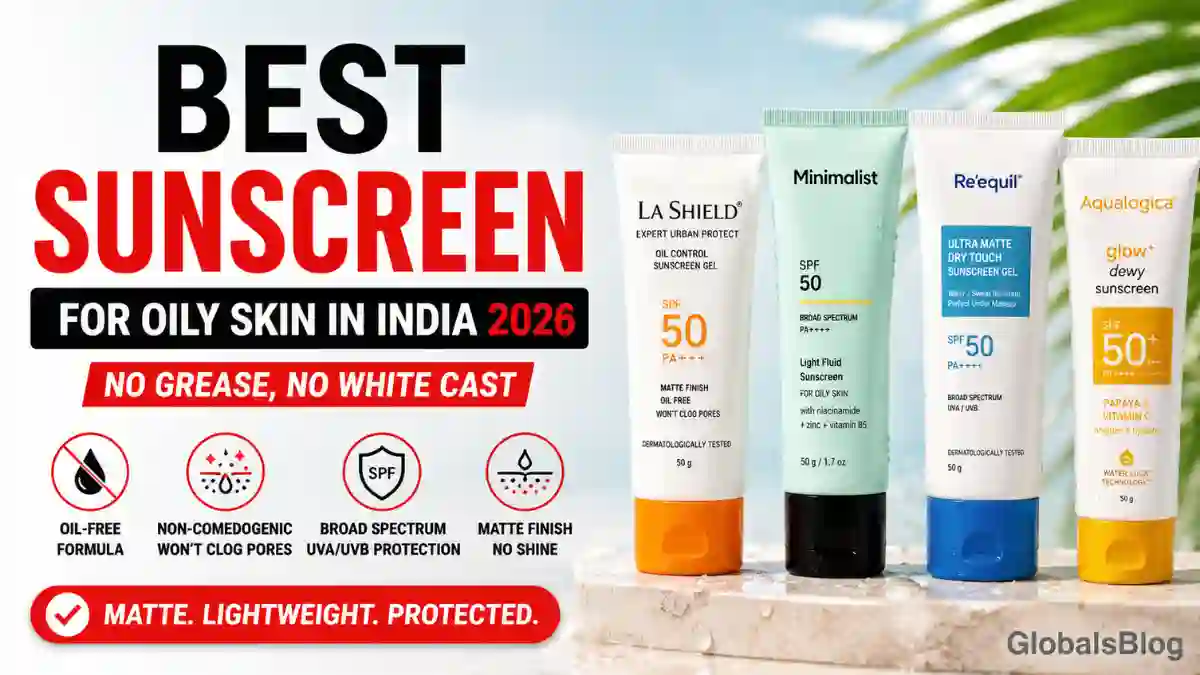
The right sunscreen for oily skin in India feels like nothing — absorbs in 30 seconds, leaves no white cast, adds no grease to a face that already produces enough oil, and provides SPF 50+ PA++++ broad-spectrum protection against the UV index that Indian summers routinely hit. Finding that product in a market where most sunscreens are formulated for dry European skin is the challenge this guide solves.
A reader from Chennai had given up on sunscreen twice. The first time: a thick, white, SPF 50 cream that sat on her oily T-zone like a second skin for 20 minutes before migrating into every crease and pore. The second time: a "matte" sunscreen that turned grey-white on her medium-deep Indian skin tone and required blending for five minutes to disappear. She concluded that sunscreen and oily dark skin were fundamentally incompatible and stopped using any. The UV index in Chennai averages 9–11 from March to October — at that level, unprotected exposure accelerates hyperpigmentation, increases open pore visibility over time, and contributes to the post-acne dark marks that oily acne-prone skin is already prone to. The incompatibility was not with sunscreen as a category — it was with formulations designed for a different skin type and climate. This guide identifies the sunscreens that work correctly for oily Indian skin.
Best sunscreens for oily skin in India: Re'equil Oxybenzone and OMC Free Sunscreen SPF 50+ PA++++ (best overall — matte, no white cast, ₹425–₹595); Minimalist SPF 50 PA++++ Sunscreen (best budget — lightweight gel, ₹399); Dot & Key Watermelon Cooling SPF 50 PA++++ (best texture — serum-finish, ₹499–₹649); Lotus Herbals Safe Sun UV Screen Matte Gel SPF 50 PA+++ (best drugstore — matte gel, ₹270–₹395); Neutrogena Ultra Sheer Dry Touch SPF 50+ PA++++ (best no-white-cast for medium-deep skin, ₹430–₹599); La Roche-Posay Anthelios XL Anti-Shine SPF 50+ (best premium — Tinosorb filters, ₹1,200–₹1,800). Apply 2ml (half a teaspoon) for the face. SPF 50+ PA++++ minimum for Indian summer UV. Reapply every 2 hours in outdoor exposure.
Best Sunscreens for Oily Skin in India — Ranked
Re'equil's Oxybenzone and OMC Free Sunscreen is the most consistently recommended sunscreen for oily Indian skin in dermatologist circles — a hybrid UV filter formulation that uses newer-generation chemical filters (avoiding the potentially irritating oxybenzone and octyl methoxycinnamate that are present in older chemical sunscreens) in a lightweight gel base designed specifically for oily and acne-prone skin. The matte finish is genuine — not the "matte" that many sunscreens advertise but provide for 30 minutes before the oil breaks through, but a drier, more controlled surface that lasts 3–4 hours in moderate Indian humidity before requiring touch-up. The formulation is fragrance-free, non-comedogenic, and leaves no white cast on medium to dark Indian skin tones — tested across a range of skin tones from NC30 to NC50 in independent reviews. At ₹425–₹595 for 50–80ml, it is mid-priced for its quality. The thin gel texture applies in small quantities and absorbs in 30–45 seconds. Dermatologist-tested and widely available at Nykaa, Apollo Pharmacy, and Amazon.
Minimalist's SPF 50 PA++++ Sunscreen is the most accessible high-specification sunscreen for oily Indian skin — a water-based gel formulation with hybrid UV filters (both chemical and mineral at low mineral concentration) that provides broad-spectrum SPF 50 protection without the white cast typical of mineral-only sunscreens. The formulation is stripped to the essential UV filters and the lightest possible vehicle for oily skin application. The gel texture absorbs in 20–30 seconds and leaves a natural-to-slightly-matte finish — appropriate for normal-to-oily skin and for Indian skin tones that want a more natural rather than matte-flat finish. Fragrance-free is particularly important for oily acne-prone skin where fragrance is a documented comedogenic irritant. At ₹399 for 50ml, it is the most affordable premium sunscreen in this list.
Dot & Key's Watermelon Cooling SPF 50 PA++++ is the best-textured sunscreen for oily skin in the Indian mid-premium market — a serum-gel formulation that applies like a skincare serum (very thin, fast-absorbing, no drag) rather than a conventional sunscreen. The watermelon extract serves as an antioxidant and skin-soothing ingredient while the gel vehicle provides the lightest possible application experience. The cooling sensation on application is particularly pleasant in Indian summer heat, making reapplication more motivating than with heavier formulations. The finish is natural rather than matte — appropriate for oily skin that doesn't want the flat-matte look but needs a non-greasy sunscreen. The most frequently recommended sunscreen for oily skin in Indian skincare community reviews for its texture and ease of use.
Lotus Herbals Safe Sun Matte Gel is the most widely available matte sunscreen for oily skin in India — stocked at pharmacies, chemists, and general stores across tier-2 and tier-3 cities where Nykaa delivery may not be reliable. The matte gel formula provides SPF 50 with PA+++ in a lightweight, non-sticky gel that absorbs quickly on oily skin. The Lotus Safe Sun range has been one of the most trusted Indian sunscreen products for over a decade. At ₹270–₹395 for 50–80ml, it is the most affordable option in this list and the go-to recommendation for buyers in cities where newer D2C brands are not easily available. For daily indoor-to-outdoor office use, PA+++ provides adequate UVA coverage; for outdoor workers or prolonged sun exposure, step up to PA++++ alternatives.
Neutrogena Ultra Sheer Dry-Touch is the most established international sunscreen for oily Indian skin — a chemical filter formulation with Helioplex technology that has been used by dermatologists in India for over 15 years. The "dry touch" finish creates a non-tacky surface after application that is particularly effective on oily skin. No white cast on medium to dark Indian skin tones. SPF 50+ PA++++ provides maximum UV protection. At ₹430–₹599 for 50–88ml, the 88ml pack offers the best value. The safest recommendation for first-time sunscreen buyers on oily skin — the brand familiarity and 15-year India market track record reduce the uncertainty of trying a newer product. Note: contains oxybenzone — patch test recommended for sensitive acne-prone skin.
La Roche-Posay Anthelios XL Anti-Shine is the premium benchmark sunscreen for oily and acne-prone skin — using Tinosorb M and Tinosorb S (next-generation UV filters with better photostability than standard chemical filters) combined with Thermal Spring Water as a skin-calming base. The Anti-Shine variant is specifically formulated for oily skin: a dry, almost powdery finish after application, and Mexoryl SX + Mexoryl XL that provides comprehensive UVA protection. At ₹1,200–₹1,800 for 50ml, it is positioned for buyers who want the most advanced filter system and French dermatological brand assurance. The product dermatologists recommend when conventional sunscreens have caused reactions on sensitive oily skin.
Best Sunscreen for Oily Skin — Comparison Table
| Product | Price | SPF/PA | Finish | White Cast | Best For |
|---|---|---|---|---|---|
| Re'equil SPF 50+ PA++++ | ₹425–₹595 | SPF 50+ PA++++ | Matte | None | Daily matte, oily skin |
| Minimalist SPF 50 PA++++ | ₹399 | SPF 50 PA++++ | Natural-matte | Minimal | Budget, fragrance-free |
| Dot & Key Watermelon SPF 50 | ₹499–₹649 | SPF 50 PA++++ | Natural | None | Lightweight texture, summer |
| Lotus Safe Sun SPF 50 | ₹270–₹395 | SPF 50 PA+++ | Matte gel | Minimal | Budget, wide availability |
| Neutrogena Ultra Sheer SPF 50+ | ₹430–₹599 | SPF 50+ PA++++ | Dry-touch | None | No white cast, established brand |
| La Roche-Posay Anthelios XL | ₹1,200–₹1,800 | SPF 50+ PA++++ | Dry-powdery | None | Sensitive skin, premium |
Sunscreen Application for Oily Skin — The Correct Protocol
The dose that most people miss: SPF ratings are tested at 2mg/cm² — approximately 2ml (half a teaspoon) for the face alone. Most people apply 25–50% of this amount, receiving approximately SPF 12–18 in practice when applying an SPF 50+ product. For oily skin in particular, the temptation to apply less (to avoid greasiness) results in inadequate protection. The correct application: use a product that absorbs cleanly (all of the above qualify), apply the full 2ml dose, and allow 30–60 seconds of absorption before applying makeup or going outdoors.
Morning routine sequence for oily skin with sunscreen: Cleanser → toner (optional) → niacinamide serum (optional) → lightweight moisturizer (see our moisturizer for oily skin guide) on damp skin → sunscreen (2ml, full face and neck) → wait 2–3 minutes → foundation or makeup if required. The sunscreen goes after moisturizer and before makeup — never underneath moisturizer, where it is diluted and displaced.
Reapplication is mandatory for outdoor exposure: Sunscreen degrades under UV radiation, sweat, and sebum — particularly chemical filter sunscreens which require reapplication every 2 hours during outdoor exposure. For indoor office use, a single morning application is typically adequate. For outdoor exposure, reapplication every 2 hours is necessary. Setting powder sunscreens and SPF mists allow reapplication over makeup.
Year-round application, not just summer: India's UV index never drops below 5 in most cities — even in December and January in north India, the UV index reaches 5–7, well above the protection-recommended threshold of 3. South Indian cities maintain UV index 9–11 nearly year-round. Sunscreen is a daily year-round step for Indian skin, not a summer-only application.
Understanding SPF and PA for Indian Skin
SPF measures UVB protection: SPF 15 blocks 93% of UVB; SPF 30 blocks 97%; SPF 50 blocks 98%. The difference between SPF 30 and SPF 50 is 1% — but because most people apply at 50% of the tested dose, SPF 50 delivers approximately SPF 25 in real-world use (adequate), while SPF 30 delivers approximately SPF 15 (insufficient). The buffer provided by SPF 50+ makes real-world protection adequate even with imperfect application.
PA matters more than SPF for Indian skin: UVA radiation penetrates deeper than UVB, is responsible for photoaging, and most importantly for Indian skin — stimulates the melanin production that causes hyperpigmentation, dark spots, and post-acne marks. PA++++ (the maximum grade) indicates at least 16× UVA protection. For oily acne-prone Indian skin where post-inflammatory hyperpigmentation is the primary cosmetic concern, PA++++ is the minimum recommended grade.
Chemical vs mineral filters for oily skin: Chemical filters absorb UV radiation and convert it to heat — they are invisible on the skin (no white cast), lightweight, and the correct choice for oily Indian skin. Mineral filters (zinc oxide, titanium dioxide) reflect UV physically — they provide excellent protection but leave white cast on medium to dark Indian skin tones and have a heavier texture that feels greasy on oily skin. Hybrid formulations (low-concentration mineral + chemical) are a good compromise, as used in the Minimalist SPF 50.
✓ Sunscreen Tips for Oily Indian Skin
- Apply 2ml — not "a thin layer": "Apply a thin layer" is the most common and most damaging sunscreen instruction on Indian packaging. SPF ratings are tested at 2mg/cm² — approximately 2ml for the face. A thin layer applied by feel is typically 0.5–0.8ml, delivering SPF 10–18 in practice from an SPF 50 product. The instinct to apply less on oily skin is understandable — but choose a product that absorbs cleanly and apply the correct quantity. The difference between adequate and inadequate UV protection is application quantity, not SPF number
- PA++++ for hyperpigmentation-prone Indian skin: Oily acne-prone Indian skin is particularly vulnerable to post-inflammatory hyperpigmentation — the dark marks that remain after breakouts heal. UVA radiation darkens PIH significantly and prolongs its duration. PA++++ sunscreen reduces UVA exposure and measurably shortens PIH recovery time. Dermatologists who treat post-acne hyperpigmentation consistently prescribe SPF 50+ PA++++ as a foundational step
- Patch test before committing to a full-face sunscreen: Some chemical UV filters (particularly oxybenzone, found in Neutrogena Ultra Sheer) can cause reactions on sensitive or acne-prone oily skin. Patch test on the inner jaw for 3 days before full-face application. The Re'equil and La Roche-Posay formulations specifically avoid the more reactive filters for this reason
- Use a separate sunscreen — not just SPF in moisturizer: Moisturizers with SPF require the same 2ml dose for adequate protection. Most people apply 0.5–0.8ml of moisturizer — far less than needed. A dedicated sunscreen after a lightweight moisturizer provides more reliable protection
- See our best sunscreen for women in India for a broader overview including dry and normal skin picks, and our toner for oily skin guide for the pre-moisturizer step
✗ Sunscreen Mistakes Oily Skin Buyers Make
- Not using sunscreen because "it makes my skin oilier": The greasy sunscreen experience is specifically a problem with sunscreens formulated for dry skin — mineral sunscreens with heavy emollient bases, thick cream formulations, products designed for European skin. All six sunscreens in this list absorb in 20–60 seconds without adding perceptible surface oil. The correct response to "sunscreen makes my skin oily" is switching products, not eliminating sunscreen. Unprotected Indian UV exposure causes hyperpigmentation, widened pores over time, and accelerated photoaging — all of which make oily skin look and behave worse
- Choosing SPF 30 to feel lighter on oily skin: The weight difference between SPF 30 and SPF 50 from the same brand is typically zero — the SPF number reflects the filter concentration, not product weight. Texture comes from the formulation type (gel vs cream, chemical vs mineral) rather than the SPF number. Always choose SPF 50+ PA++++ and address texture concerns through formulation choice
- Skipping sunscreen under makeup because "foundation has SPF": Foundation is applied in 0.1–0.3ml quantities, compared to the 2ml required for SPF testing. A foundation with SPF 30 applied at 0.2ml delivers approximately SPF 3 protection in practice. Sunscreen is always a dedicated step under foundation — not replaced by foundation with SPF
- Using body sunscreen on the face: Body sunscreens use heavier emollient bases and higher physical filter concentrations that produce white cast and greasiness on oily facial skin — the most common cause of the "sunscreen makes my skin greasy" complaint. Always use a face-specific formulation on the face
⚠️ Disclaimer: Sunscreen prices and formulations are subject to change. All prices are indicative as of August 2026. Sunscreen efficacy varies by application quantity — the SPF rating is achieved only at the 2mg/cm² tested dose. For persistent skin concerns including hyperpigmentation, acne, or sun damage, consult a dermatologist for personalised treatment alongside over-the-counter sunscreen use.
Re'equil for Daily Matte. Minimalist for Budget. Dot & Key for Lightest Feel. Lotus for Drugstore Availability. Neutrogena for No White Cast. La Roche-Posay for Sensitive Skin. Apply 2ml. Every Day. Year-Round.
The Chennai reader who gave up on sunscreen twice — because of white cast and grease — had tried products formulated for the wrong skin type. Every sunscreen in this list is formulated specifically for oily skin, absorbs in 20–60 seconds, and leaves no white cast on medium to dark Indian skin tones. The Re'equil at ₹425 is the correct starting point for most oily skin buyers — the matte finish, no-oxybenzone formulation, and SPF 50+ PA++++ coverage make it the most complete package at the most reasonable price. Apply the full 2ml dose. Apply it every morning, including December. Reapply every 2 hours if outdoors. The UV index in India is high enough, and the cost of post-inflammatory hyperpigmentation from unprotected acne-prone oily skin in Indian sun is significant enough, that sunscreen is not optional self-care — it is the foundational step that everything else in an oily skin routine builds on.
Best sunscreens for oily skin in India: Re'equil Oxybenzone and OMC Free Sunscreen SPF 50+ PA++++ (₹425–₹595, best overall — matte, no white cast, newer-generation chemical filters, dermatologist recommended); Minimalist SPF 50 PA++++ (₹399, best budget — lightweight gel, fragrance-free); Dot & Key Watermelon Cooling SPF 50 PA++++ (₹499–₹649, best texture — serum-gel, lightest application feel); Lotus Herbals Safe Sun Matte Gel SPF 50 PA+++ (₹270–₹395, best drugstore — wide availability, affordable); Neutrogena Ultra Sheer Dry-Touch SPF 50+ PA++++ (₹430–₹599, best no-white-cast on dark skin tones); La Roche-Posay Anthelios XL Anti-Shine SPF 50+ (₹1,200–₹1,800, best premium — Tinosorb filters, sensitive skin). Apply 2ml (half teaspoon) per application. SPF 50+ PA++++ minimum for Indian UV levels.
Sunscreens with no white cast on medium to dark Indian skin tones (NC30–NC50): Re'equil Oxybenzone and OMC Free SPF 50+ (chemical filters only — no white cast), Neutrogena Ultra Sheer Dry-Touch SPF 50+ (chemical filters, Helioplex — no white cast), Dot & Key Watermelon SPF 50 PA++++ (chemical filters, serum-gel — no white cast), La Roche-Posay Anthelios XL Anti-Shine (Tinosorb/Mexoryl chemical filters — no white cast). White cast is caused by mineral UV filters (zinc oxide, titanium dioxide) which reflect visible light and appear white on dark skin. Pure chemical filter sunscreens leave no white cast. Hybrid formulations with low mineral concentrations (like Minimalist SPF 50) leave minimal white cast.
Yes — Re'equil Oxybenzone and OMC Free Sunscreen SPF 50+ PA++++ is the most recommended sunscreen for oily skin in India in dermatology practice. The formulation avoids oxybenzone and octyl methoxycinnamate and uses newer-generation UV filters in a gel base designed for oily skin. The matte finish lasts 3–4 hours in Indian conditions. No white cast on medium to dark skin tones. Fragrance-free and non-comedogenic. Price: ₹425 (50ml) / ₹595 (80ml). Available at Nykaa, Apollo Pharmacy, and Amazon. Patch test before full-face use, as with any new sunscreen.
SPF 50+ PA++++ is the recommended minimum for Indian skin. India's UV index averages 9–11 in most cities from March to October — classified as very high to extreme UV. SPF 50 blocks 98% of UVB and is the standard dermatology recommendation for Indian sun exposure. PA++++ is the maximum UVA protection rating — essential for Indian skin because UVA causes the hyperpigmentation and post-inflammatory dark marks that are the primary cosmetic concern of oily acne-prone Indian skin. Because most people apply sunscreen at 25–50% of the tested dose, SPF 50 applied at half-dose delivers approximately SPF 25 in practice (adequate), while SPF 30 at half-dose delivers approximately SPF 15 (insufficient).
How to apply sunscreen on oily skin: Use 2ml (half a teaspoon) for the face — more than most people apply. Apply after moisturizer and before makeup in the morning routine. Distribute with fingertips in dotting or gentle pressing motions rather than rubbing. Allow 30–60 seconds for the sunscreen to absorb before applying makeup. For outdoor exposure, reapply every 2 hours. For indoor office use, one morning application is typically adequate. Apply to face, neck, and ears at minimum — the neck receives the same UV exposure as the face and shows photoaging equally.
Yes — Neutrogena Ultra Sheer Dry-Touch SPF 50+ PA++++ is suitable for oily skin. The dry-touch formulation creates a non-tacky surface after application. No white cast on medium to dark Indian skin tones. Absorbs in 30–45 seconds. However, the formula contains oxybenzone — some people with sensitive or acne-prone skin may find this causes reactions. Patch test for 3 days before full-face use. Alternative: Re'equil Oxybenzone and OMC Free SPF 50+ avoids oxybenzone, making it better for reactive skin. For non-reactive oily skin, Neutrogena Ultra Sheer is a reliable option with 15+ years of India market use. Price: ₹430 (50ml) / ₹599 (88ml).
Leave a comment
Share a quick thought about this story.
Thanks for sharing your view. It is ready for review.
Please try again in a moment.