Dandruff affects an estimated 50% of adults in India — and the Indian climate makes it both more common and harder to treat than in temperate countries. The combination of heat-driven scalp oil production, monsoon humidity (which feeds the Malassezia fungus responsible for dandruff), and hard water in most Indian cities creates ideal conditions for chronic dandruff. The right shampoo has a medically effective antifungal active — not just zinc pyrithione marketing.
A reader from Chennai had spent three years alternating between Head and Shoulders, Clinic Plus Anti-Dandruff, and Dove Dandruff Care — cycling through them because each worked for 4–6 weeks before the dandruff returned. A dermatologist's explanation was direct: the dandruff was returning not because the shampoos had stopped working, but because she was using them as regular shampoos (every day, then reducing to every other day as dandruff improved, then stopping completely) rather than as treatment shampoos with a maintenance protocol. The protocol change — ketoconazole 2% shampoo twice weekly for four weeks (treatment), then zinc pyrithione shampoo once weekly indefinitely (maintenance) — resolved the cycling pattern within six weeks. The shampoo she had been using (Head and Shoulders Classic) was adequate for maintenance; she had simply never established what maintenance meant. This guide covers the active ingredients, the correct protocol, and the specific products that work for Indian scalp conditions.
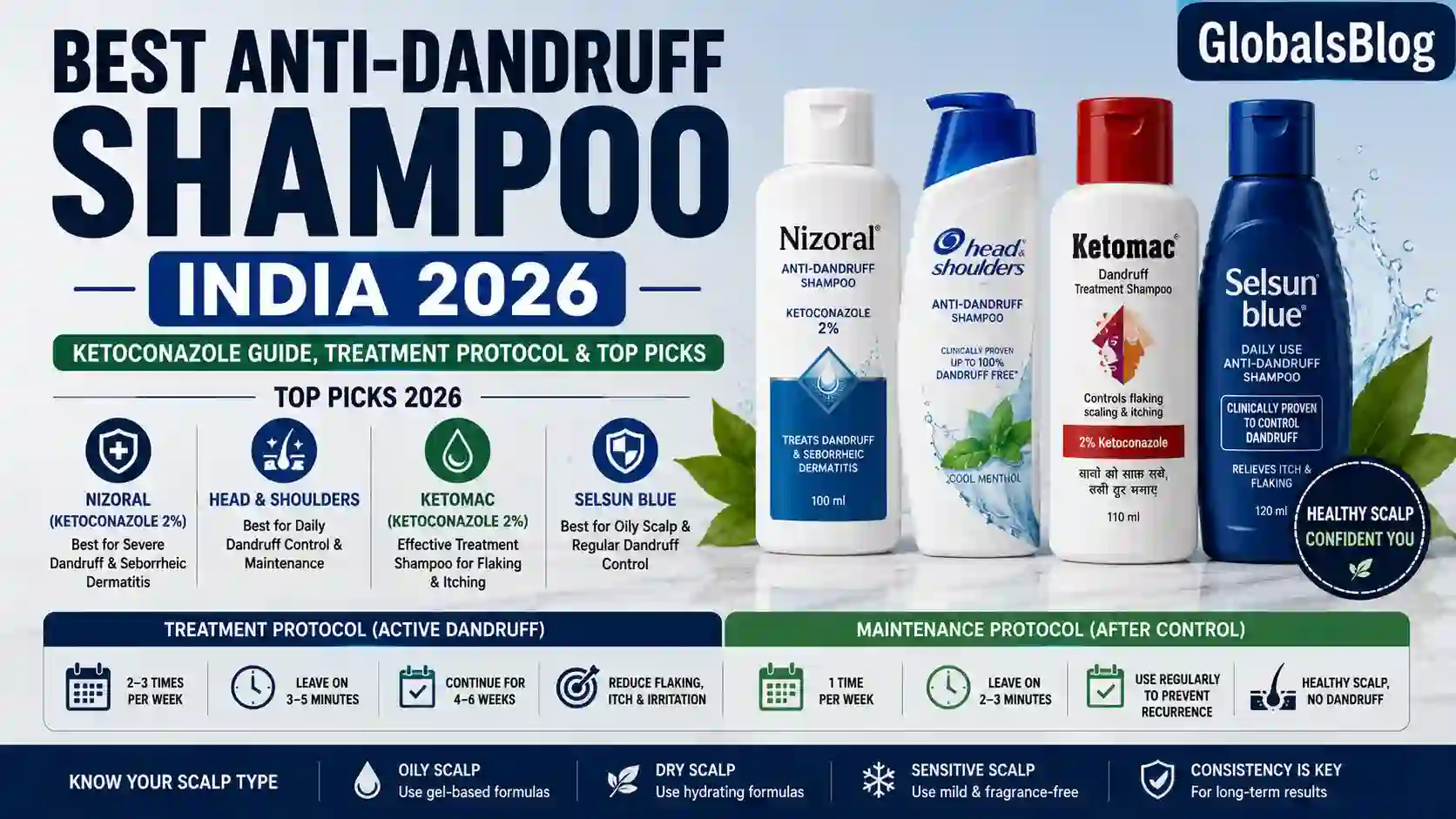
Best anti-dandruff shampoo India (August 2026): Head and Shoulders Classic Clean (best overall zinc pyrithione maintenance, ₹199–279, most widely available); Nizoral Anti-Dandruff Shampoo (best ketoconazole treatment shampoo, ₹299–399, 2% ketoconazole — use twice weekly for 4 weeks then once weekly maintenance); Selsun Blue (best selenium sulphide shampoo, ₹349–449, strong for resistant dandruff); Ketomac Shampoo (best Indian ketoconazole, ₹199–249, widely available at pharmacies); Dove Dandruff Care (best for dry scalp dandruff, ₹249–299, zinc pyrithione + moisture); Himalaya Anti-Dandruff Shampoo (best herbal/budget option, ₹149–199). Key rule: zinc pyrithione for maintenance; ketoconazole 2% for active treatment and resistant dandruff. Use twice weekly — not daily — for treatment shampoos.
Active Ingredients — What Actually Treats Dandruff
Most anti-dandruff shampoo marketing focuses on fragrance, appearance, or "moisturising" claims — the only thing that actually treats dandruff is the antifungal active ingredient. There are four medically validated actives used in anti-dandruff shampoos:
| Active | How It Works | Best For | Use Frequency | Indian Products |
|---|---|---|---|---|
| Ketoconazole 2% | Antifungal — kills Malassezia directly by disrupting its cell membrane | Active dandruff, resistant dandruff, seborrhoeic dermatitis | 2x weekly for 4 weeks (treatment), then 1x monthly (maintenance) | Nizoral, Ketomac, Nizral |
| Zinc pyrithione (ZPT) | Antimicrobial — inhibits Malassezia growth, reduces scalp inflammation | Mild to moderate dandruff, long-term maintenance | 2–3x weekly (maintenance shampoo) | Head and Shoulders, Dove Dandruff Care, Pantene Anti-Dandruff |
| Selenium sulphide 1–2.5% | Antifungal — disrupts Malassezia's cell cycle, reduces scalp cell turnover | Moderate to severe dandruff, oily scalp dandruff | 2x weekly (treatment), 1–2x weekly (maintenance) | Selsun Blue, Selsun Gold |
| Piroctone olamine (salicylate) | Antifungal — similar to ZPT but gentler, better for sensitive scalps | Sensitive scalp dandruff, colour-treated hair with dandruff | 2–3x weekly | Some premium formulations |
The Indian climate context: India's climate is particularly favourable for Malassezia growth — the fungus thrives in warm, humid conditions and feeds on sebum (scalp oil). Indian summers (35–45°C) dramatically increase scalp sebum production; Indian monsoons (80–95% humidity) create the moisture conditions Malassezia requires. This is why Indian dandruff tends to be more persistent than European dandruff and why the maintenance protocol is essential rather than optional. Treating dandruff with ketoconazole and then stopping treatment entirely is guaranteed to result in recurrence within 6–8 weeks in Indian conditions.
Best Anti-Dandruff Shampoo India — Ranked
Head and Shoulders Classic Clean is India's most widely used anti-dandruff shampoo and the benchmark zinc pyrithione (ZPT) maintenance product — a 1% zinc pyrithione formula in a gentle cleansing base that can be used 2–3 times per week as the maintenance phase of dandruff treatment. It is the correct product for mild dandruff maintenance and post-treatment maintenance after a ketoconazole treatment course. What it does not do: it is not a strong enough antifungal for acute or resistant dandruff — for established dandruff with significant flaking, a ketoconazole 2% treatment course is required before H&S Classic becomes effective as maintenance. The product's width of availability (every pharmacy, supermarket, and general store in India) is its most practical advantage — no subscription or pharmacy requirement. At ₹199–₹279 for 180–340ml, it is excellent value for a proven ZPT formula. H&S also makes a range of variants (Lemon Fresh, Smooth and Silky, Anti-Hairfall) — the Classic Clean is the original ZPT formula; other variants add conditioners and actives but the anti-dandruff active is the same.
Nizoral (ketoconazole 2%) is the gold standard anti-dandruff treatment shampoo — the most effective single product for active dandruff, seborrhoeic dermatitis, and dandruff that has not responded to zinc pyrithione shampoos. The 2% ketoconazole concentration directly kills Malassezia by disrupting the fungal cell membrane — this is antifungal treatment, not just maintenance. The Nizoral protocol for Indian conditions: use twice weekly for 4 consecutive weeks (treatment phase), then reduce to once per week for an additional 4 weeks (consolidation), then maintain with a zinc pyrithione shampoo (H&S Classic or equivalent) 2–3x weekly, and return to Nizoral once per month as a maintenance boost. This protocol produces the most durable dandruff control available without prescription medication. At ₹299–₹399 for 60–100ml, Nizoral is expensive per ml — but the monthly maintenance use after the initial treatment makes it cost-effective. Available at pharmacies (OTC in India — no prescription required for the 2% OTC formulation); less commonly at supermarkets. Also available online (Nykaa, Amazon, 1mg).
Ketomac is the most widely available Indian-brand ketoconazole 2% shampoo — identical active ingredient and concentration to Nizoral but manufactured domestically at a lower price point. At ₹199–₹249 for 110ml, Ketomac is approximately 30–40% cheaper than Nizoral for the same active concentration. The formulation is slightly thicker and more conditioning than Nizoral's lean formula — some users prefer the lather and rinse feel of Ketomac. The active ingredient (ketoconazole 2%) is identical in both products — the price difference reflects brand premium and formulation base differences only. For buyers who need ketoconazole 2% treatment and want to minimise cost: Ketomac is the recommended alternative. Available at pharmacies nationwide — easier to find at independent pharmacies than at supermarket chains. Also available at 1mg and Netmeds online.
Selsun Blue contains selenium sulphide 1% — an antifungal active that works differently from both ketoconazole and zinc pyrithione. Selenium sulphide disrupts the Malassezia cell cycle and reduces the rate of scalp skin cell turnover (the rapid cell turnover that produces visible flakes). It is particularly effective for oily scalp dandruff — the type where the scalp is visibly greasy and the dandruff flakes are yellowish and sticky (as opposed to dry, white flakes). In Indian conditions where heat drives high sebum production, this oily-scalp dandruff type is common. Selsun Blue is the recommended choice for buyers who have tried zinc pyrithione shampoos (H&S) without adequate control and whose dandruff presents with greasy, yellowish flakes rather than dry white ones. At ₹349–₹449 for 120–200ml, it is the most expensive of the three antifungal types. Use 2x weekly for 2–4 weeks treatment, then once weekly maintenance. Important: Selenium sulphide can discolour colour-treated, bleached, or grey hair — do not use on chemically treated hair without consulting a stylist or dermatologist first.
Dove Dandruff Care is the most recommended anti-dandruff shampoo for dry scalp dandruff — a zinc pyrithione formula combined with Dove's moisture complex, specifically designed to address the combination of dandruff and dry scalp that affects a significant proportion of Indian buyers in winter (Delhi, North India, high-altitude cities) or those who use hard well water or very hot water for hair washing. Standard anti-dandruff shampoos (H&S Classic, Nizoral) can strip moisture from an already-dry scalp, worsening the dryness-driven flaking alongside the Malassezia-driven flaking. Dove Dandruff Care's moisture complex counteracts this. The zinc pyrithione in Dove Dandruff Care is the same active as H&S Classic — the differentiation is the conditioning base that makes it more suitable for dry or sensitive scalps. At ₹249–₹299 for 180ml, it is available at all standard retail formats. For oily scalp: H&S Classic or Nizoral is more appropriate; for dry scalp: Dove Dandruff Care is the correct choice.
Himalaya Anti-Dandruff Shampoo uses tea tree oil (natural antifungal at 5% concentration in some formulations) and rosemary extract in a gentle herbal base — an alternative for buyers who want a herbal formula or who have mild dandruff that has responded to natural actives. Tea tree oil has documented antifungal activity against Malassezia at sufficient concentration — at 5%, it is a clinically relevant antifungal. However, herbal formulations in general have lower active concentration and less predictable efficacy than pharmaceutical-grade ketoconazole or ZPT. For mild dandruff (light occasional flaking, no itching, non-oily scalp): Himalaya Anti-Dandruff is effective and gentle. For moderate to severe dandruff: pharmaceutical actives (ketoconazole or ZPT) are clinically more appropriate. At ₹149–₹199 for 200ml, it is the most affordable option on this list and available at every pharmacy and general store in India. It can be used daily (gentler formula) rather than the 2–3x weekly of pharmaceutical actives.
The Correct Anti-Dandruff Protocol for India
The most common dandruff mistake in India is treating it as a shampoo-switching problem rather than a treatment-and-maintenance protocol problem. The Chennai reader's three-year cycle of different shampoos was not a product failure — it was a protocol failure. The correct two-phase protocol:
Phase 1 — Treatment (4–6 weeks): Ketoconazole 2% shampoo (Nizoral or Ketomac) twice per week. Lather, leave on scalp for 3–5 minutes before rinsing. Do not use a regular conditioner on the same wash — the medicated shampoo needs contact time with the scalp. On other wash days, use a gentle, sulphate-reduced regular shampoo. After 4–6 weeks of this protocol, dandruff should be significantly reduced (80–90% reduction in most cases).
Phase 2 — Maintenance (ongoing): Switch to a zinc pyrithione shampoo (H&S Classic or Dove Dandruff Care) used 2–3x weekly as your regular shampoo. Use Nizoral or Ketomac once per month as a booster. Do not stop the maintenance phase when dandruff disappears — Malassezia is always present on the scalp and will return without ongoing maintenance in Indian conditions. The maintenance phase is indefinite for most Indian adults — the climate conditions that favour Malassezia growth do not change.
Hard water adjustment (relevant for most Indian cities): Hard water (high mineral content) reduces the effectiveness of medicated shampoos by interfering with lather formation and active ingredient contact time. If you live in a hard water area (Delhi, Bengaluru, most North Indian cities), rinse hair with filtered or softened water if possible, or ensure the anti-dandruff shampoo has sufficient contact time (3–5 minutes) before rinsing despite reduced lather.
Dandruff vs Dry Scalp vs Seborrhoeic Dermatitis — Which Do You Have?
| Condition | Flake Type | Scalp Type | Itching | Correct Treatment |
|---|---|---|---|---|
| Dandruff (mild) | Small, white, dry flakes | Normal to mildly oily | Mild | ZPT shampoo 2–3x weekly |
| Dandruff (moderate-severe) | Larger flakes, more profuse | Oily | Moderate | Ketoconazole 2x weekly × 4 weeks, then ZPT maintenance |
| Dry scalp | Very fine, white, dry flakes (like powder) | Dry, tight, sometimes red | Itching from dryness, not fungal | Moisturising anti-dandruff (Dove) + oil treatment before wash |
| Seborrhoeic dermatitis | Yellowish, greasy, large flakes; may extend to eyebrows, nose fold | Very oily | Significant | Ketoconazole 2% or selenium sulphide; consult dermatologist if persistent |
| Psoriasis (scalp) | Thick, silvery, adherent scales | Variable | Significant | Consult dermatologist — requires prescription treatment |
The distinction between dandruff and dry scalp is important because the treatment differs: dandruff is caused by Malassezia fungus (treated by antifungals) while dry scalp is caused by insufficient scalp moisture (treated by moisturising). Applying a strong antifungal shampoo to a dry scalp that is not Malassezia-driven will worsen the dryness and flaking without resolving the underlying cause. If you are uncertain: a dermatologist can confirm the diagnosis by scalp examination. Seborrhoeic dermatitis (which extends to eyebrows, nasolabial folds, and ears in addition to the scalp) requires a higher level of medical management — see a dermatologist if dandruff is accompanied by facial flaking.
✓ Anti-Dandruff Shampoo Tips for Indian Conditions
- Leave the shampoo on for 3–5 minutes — this is the most important technique change: Anti-dandruff shampoos are treatment products — the active ingredient (ketoconazole or ZPT) requires contact time with the scalp to be effective. Most people apply shampoo, lather, and rinse within 60 seconds — this is adequate for cleansing but insufficient for antifungal action. Apply the anti-dandruff shampoo to a wet scalp, massage into a lather, then leave for 3–5 minutes (set a timer) before rinsing. This single protocol change improves the effectiveness of any anti-dandruff shampoo significantly. During the wait time: apply the shampoo to other scalp areas while the first section sits
- Don't use anti-dandruff shampoo daily — 2–3 times per week is the correct treatment frequency: Daily use of anti-dandruff shampoo strips the scalp's natural oils more aggressively than necessary, can cause rebound oiliness, and does not provide better anti-dandruff control than 2–3x weekly use. On non-treatment days, use a gentle regular shampoo or skip washing. The 2x weekly frequency for ketoconazole and 2–3x weekly for ZPT are based on the scalp skin cell cycle (approximately 3–4 days) — this frequency matches the treatment to the cell turnover rate
- Switch to a more aggressive treatment during Indian monsoon (July–September): The July–September monsoon in India dramatically increases humidity — the perfect environment for Malassezia. Buyers who have mild dandruff controlled by ZPT maintenance in winter often find their dandruff worsening in monsoon. For most Indian adults: switching from ZPT maintenance shampoo to ketoconazole 2% twice weekly during July–September is the most effective seasonal adjustment. Return to ZPT maintenance in October when humidity drops
- Apply coconut oil or tea tree oil treatment before the anti-dandruff shampoo — not instead of it: Pre-wash oil treatments (particularly coconut oil with tea tree oil) can reduce scalp inflammation and provide some antifungal benefit when left on the scalp for 30–60 minutes before shampooing. However, they are a supplement to — not a replacement for — ketoconazole or ZPT shampoo treatment. Coconut oil alone does not provide sufficient antifungal action for moderate to severe dandruff. The correct sequence: oil treatment (optional, 30–60 min) → anti-dandruff shampoo with 3–5 min contact → rinse → gentle conditioner on hair ends (not scalp)
- See our shampoo for hair fall guide for the relationship between dandruff and hair fall (inflammation from dandruff is a hair fall trigger), and our hair oil guide for pre-wash oil treatments
✗ Anti-Dandruff Shampoo Mistakes Indian Buyers Make
- Stopping treatment when dandruff disappears: The most universally made dandruff mistake — stopping the anti-dandruff shampoo when flakes are no longer visible and assuming the problem is resolved. Dandruff is not a one-time infection that is cured and then gone; it is a chronic condition driven by Malassezia's permanent presence on the scalp. When treatment stops in Indian conditions, Malassezia populations recover within 6–8 weeks and dandruff returns. The correct response to dandruff disappearing is to shift from treatment frequency (2x weekly ketoconazole) to maintenance frequency (ZPT 2–3x weekly + monthly ketoconazole) — not to stop treatment entirely
- Using anti-dandruff shampoo as a daily shampoo: Anti-dandruff shampoos are medicated treatment products, not regular cleansing shampoos. Daily use of ketoconazole or selenium sulphide can cause scalp dryness, hair colour fading (selenium sulphide specifically), and over-stripping of scalp oils that can actually worsen dandruff through rebound oiliness. Use medicated anti-dandruff shampoos at their prescribed frequencies (2–3x weekly) and use a regular gentle shampoo on other wash days
- Cycling through different shampoos without completing a treatment course: The Chennai reader's three-year cycle of H&S → Clinic Plus → Dove was this mistake. Each shampoo worked while she used it consistently, then the dandruff returned when she reduced use. Completing the full treatment course — ketoconazole twice weekly for 4 consecutive weeks, then maintaining with ZPT indefinitely — produces durable control. Switching products before the treatment course is complete prevents the therapeutic effect from accumulating
- Applying conditioner to the scalp after anti-dandruff shampoo: Conditioner applied to the scalp coats the scalp skin surface with silicones and emollients — reducing the scalp skin's exposure to air and creating the oily, occluded environment that Malassezia prefers. Always apply conditioner only to the hair length and ends, not to the scalp or roots. On anti-dandruff treatment days, the conditioner wait time also dilutes the antifungal contact time if applied before full rinsing of the shampoo
⚠️ Disclaimer: Anti-dandruff shampoo prices change periodically. All prices listed are indicative as of August 2026. Ketoconazole 2% shampoos (Nizoral, Ketomac) are OTC in India but are medicated products — follow the usage instructions on the package. If dandruff is accompanied by significant scalp inflammation, skin lesions, hair loss, or facial skin involvement, consult a dermatologist. Seborrhoeic dermatitis and scalp psoriasis require diagnosis and prescription treatment. Patch test any new shampoo on the inner arm if you have scalp or skin sensitivities.
Nizoral/Ketomac 2x Weekly for 4 Weeks to Treat. Head and Shoulders 2–3x Weekly to Maintain. Never Stop Maintenance. 3–5 Minutes Contact Time. Dandruff Is a Chronic Condition in India — Not a One-Time Fix.
The Chennai reader's three-year cycle ended with a protocol change, not a product change. The shampoos she had been using (including Head and Shoulders Classic, which is an effective maintenance product) were adequate — the treatment and maintenance framework was missing. Ketoconazole 2% twice weekly for four weeks — then zinc pyrithione twice weekly indefinitely — with monthly ketoconazole as a booster is the protocol that produces durable dandruff control in Indian conditions. The Indian climate (heat, humidity, hard water) makes Malassezia persistently active for most of the year; the maintenance protocol is as necessary in October as in June. The product recommendation is secondary to the protocol: Nizoral or Ketomac to treat, Head and Shoulders or Dove Dandruff Care to maintain. The discipline to continue maintenance when flakes are gone is what resolves the cycling pattern.
Best anti-dandruff shampoo in India (August 2026): Best treatment (active dandruff): Nizoral Anti-Dandruff (₹299–399, ketoconazole 2%, strongest OTC antifungal) or Ketomac Shampoo (₹199–249, ketoconazole 2%, budget equivalent). Protocol: use 2x weekly for 4 weeks. Best maintenance (after treatment): Head and Shoulders Classic Clean (₹199–279, zinc pyrithione 1%, use 2–3x weekly). Best for dry scalp dandruff: Dove Dandruff Care (₹249–299, zinc pyrithione + moisture). Best for oily scalp dandruff: Selsun Blue (₹349–449, selenium sulphide 1%). Best budget herbal: Himalaya Anti-Dandruff (₹149–199, tea tree oil, for mild dandruff). Key rule: for active dandruff — start with ketoconazole 2% (Nizoral/Ketomac), not just H&S. H&S Classic is a maintenance product, not a treatment product for established dandruff.
Yes — Nizoral (ketoconazole 2%) is the most clinically effective OTC anti-dandruff shampoo available in India. Ketoconazole 2% is an antifungal that directly kills Malassezia (the yeast responsible for dandruff) by disrupting its cell membrane. Clinical studies consistently show ketoconazole 2% produces the highest rates of dandruff clearance of any OTC anti-dandruff active. Correct Nizoral protocol for India: use twice per week for 4 consecutive weeks (treatment phase), applying and leaving on scalp for 3–5 minutes before rinsing. Then reduce to once per week for 4 more weeks (consolidation). Then maintain with zinc pyrithione shampoo (H&S Classic) 2–3x weekly and Nizoral once monthly as a booster. Available OTC at pharmacies in India (no prescription needed for the 2% OTC formulation). Price: ₹299–399 for 60–100ml. The Indian equivalent Ketomac (₹199–249, same ketoconazole 2%) is a budget alternative with identical active ingredient.
Anti-dandruff shampoo frequency by type: Ketoconazole 2% (Nizoral, Ketomac) — treatment phase: 2x per week for 4 weeks; maintenance: once monthly. Zinc pyrithione (Head and Shoulders, Dove Dandruff Care) — 2–3x per week as ongoing maintenance. Selenium sulphide (Selsun Blue) — 2x per week for treatment, once weekly maintenance. Herbal (Himalaya Anti-Dandruff) — can be used daily as a gentle formula. Key rule: never use ketoconazole or selenium sulphide daily — daily use strips the scalp excessively and can cause rebound oiliness. Daily use of anti-dandruff shampoo (especially stronger actives) does not improve dandruff control and worsens scalp condition. On days you are not using anti-dandruff shampoo: use a gentle regular shampoo or skip washing. The 3–5 minute contact time is more important than wash frequency — leaving the active on the scalp for 3–5 minutes twice weekly is far more effective than rinsing immediately daily.
Dandruff recurs after anti-dandruff shampoo because the treatment is stopped when dandruff disappears — not because the shampoo stopped working. Dandruff is a chronic condition caused by Malassezia, a yeast that is permanently present on the human scalp. Anti-dandruff shampoos suppress Malassezia activity; they do not permanently eliminate it. In Indian conditions (heat and humidity maintain ideal Malassezia growth conditions most of the year), Malassezia populations recover within 6–8 weeks of stopping treatment and dandruff returns. The solution is a maintenance protocol — not switching products: after the initial treatment course (ketoconazole 2x weekly for 4 weeks), switch to zinc pyrithione shampoo (Head and Shoulders) 2–3x weekly indefinitely, and use ketoconazole once monthly as a booster. Continue this maintenance even when dandruff is invisible — the maintenance prevents recurrence. Additionally: the Indian monsoon (July–September) reliably worsens dandruff due to increased humidity — return to ketoconazole 2x weekly during this period even if dandruff has been controlled.
Head and Shoulders Classic (zinc pyrithione 1%) is effective for mild to moderate dandruff maintenance — it is one of the most studied anti-dandruff formulas in the world with decades of clinical validation. However, it is a maintenance product, not a treatment product for established or moderate-severe dandruff. For active dandruff with significant flaking: ketoconazole 2% (Nizoral or Ketomac, used 2x weekly for 4 weeks) is more effective than H&S as an initial treatment. After ketoconazole treatment clears the active dandruff: H&S Classic 2–3x weekly is the correct maintenance shampoo. Why H&S fails for some people: they use it as a daily shampoo (correct is 2–3x weekly with 3–5 minutes contact time), or they use it without a prior ketoconazole treatment course for established dandruff, or they stop using it when dandruff clears (maintenance should continue indefinitely). H&S is highly effective when used correctly as a maintenance shampoo following a ketoconazole treatment course.
Dandruff vs dry scalp — key differences: Dandruff is caused by Malassezia fungus overgrowth on the scalp — produces visible flakes (white to yellowish depending on oiliness), itching, and sometimes redness. Treated with antifungal actives (ketoconazole, zinc pyrithione, selenium sulphide). Flakes are typically larger and adhere slightly to hair roots. Dry scalp is caused by insufficient scalp moisture — produces very fine, powder-like white flakes that fall off hair easily, with itching from dryness rather than inflammation. Treated with moisturising shampoos and scalp hydration — not antifungals. Using a strong antifungal shampoo on a dry scalp will worsen the dryness and flaking. How to tell which you have: If your scalp feels tight or dry after washing and flakes are fine and powdery: likely dry scalp. If your scalp feels oily and flakes are larger, more yellowish, or adherent: likely dandruff. If itching is severe and flaking extends to eyebrows and nose fold: consult a dermatologist — may be seborrhoeic dermatitis. Correct treatment for dry scalp: Dove Dandruff Care (ZPT + moisture) or a moisturising scalp treatment, plus pre-wash oil treatment.
Leave a comment
Share a quick thought about this story.
Thanks for sharing your view. It is ready for review.
Please try again in a moment.