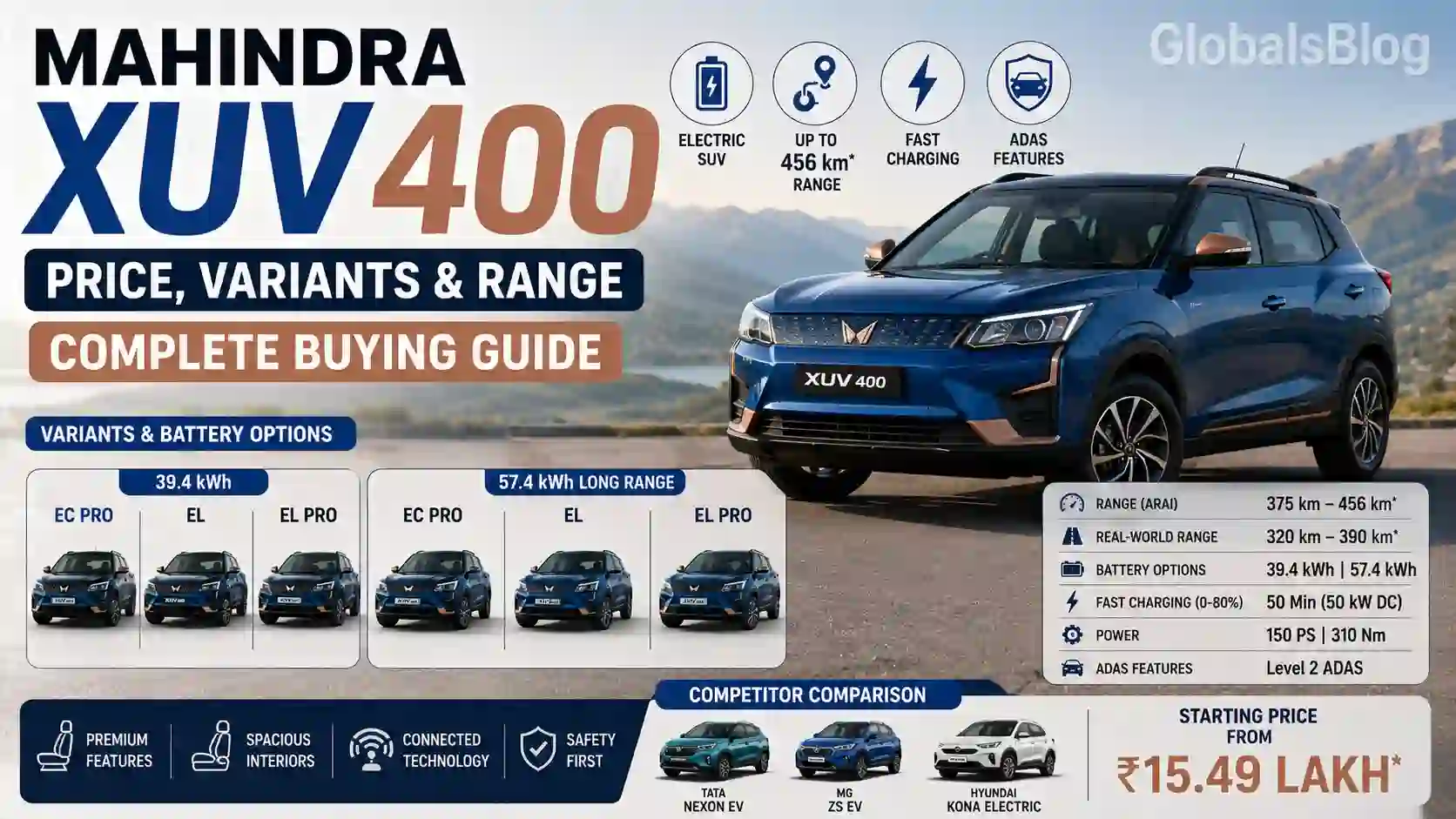
The Mahindra XUV400 EV is India's most feature-rich electric SUV under ₹20 lakh — offering up to 456 km of ARAI-certified range, a 10.25-inch infotainment screen, Level 2 ADAS, and Mahindra's trusted SUV build quality. It outsells many premium EVs twice its price. Here is the complete buying guide for every variant, real-world range, and who should buy it.
The Mahindra XUV400 EV — launched in January 2023 — is Mahindra's first purpose-built electric vehicle and positions itself as the most value-for-money electric SUV in India above the Tata Punch EV segment. Built on a modified version of the XUV300 platform (which itself is based on the SsangYong Tivoli architecture), the XUV400 brings Mahindra's trusted SUV build quality, a larger body than the Tata Nexon EV, and a competitive price starting at ₹15.99 lakh ex-showroom. The XUV400 offers two battery options — a 39.4 kWh standard range and a 57.4 kWh long range (the EC Pro and EL Pro variants) — with ARAI-certified ranges of 375 km and 456 km respectively. The XUV400 competes directly with the Tata Nexon EV in the sub-₹20 lakh electric SUV space and additionally against the MG ZS EV in the ₹20–25 lakh bracket. This guide covers the complete Mahindra XUV400 price list, all variants, battery and range details, real-world performance, charging specifications, and a clear buying verdict for every buyer profile.
Mahindra XUV400 price: ₹15.99 lakh (EC Pro 39.4 kWh) to ₹19.19 lakh (EL Pro 57.4 kWh) ex-showroom. Two battery options: 39.4 kWh (ARAI range 375 km, real-world 270–300 km) and 57.4 kWh (ARAI range 456 km, real-world 330–360 km). Key variants: EC Pro, EL, EL Pro. Motor: 150 PS / 310 Nm (39.4 kWh) and 170 PS / 380 Nm (57.4 kWh). DC fast charging: 50 kW CCS2. Best variant: EL Pro (57.4 kWh) for maximum range and features. Competitors: Tata Nexon EV, MG ZS EV, Tata Curvv EV.
Mahindra XUV400 Variants and Price List
The EC Pro is the entry variant of the XUV400 — the starting point into Mahindra's electric SUV lineup at ₹15.99 lakh ex-showroom. It uses the 39.4 kWh battery pack with a ARAI-certified range of 375 km and a single electric motor producing 150 PS and 310 Nm of torque. Standard equipment includes a 10.25-inch touchscreen infotainment system with wireless Android Auto and Apple CarPlay, a 7-inch digital instrument cluster, LED headlights, automatic climate control, 6 airbags, and a 50 kW DC fast charger port (CCS2) — a key advantage over base Tata Punch EV variants that lack DC fast charging at the entry level. The EC Pro does not get the larger 57.4 kWh battery, Level 2 ADAS, panoramic sunroof, or ventilated seats of higher variants. Real-world range on the 39.4 kWh pack: approximately 270–300 km under mixed driving conditions with AC on. For buyers whose primary need is urban commuting under 100 km per day with occasional weekend intercity use, the EC Pro's range is adequate. The ₹15.99 lakh entry price makes it the most affordable way into a full-size electric SUV in India — meaningfully larger than the Tata Punch EV with a more truck-like SUV stance.
The EL adds meaningful comfort and safety features over the EC Pro at a ₹1.70 lakh premium for the 39.4 kWh version. Key additions: a sunroof (standard size), a 360-degree surround-view camera (critical for parking the XUV400's larger body in urban Indian conditions), connected car features (Mahindra's AdrenoX connected car suite with remote start, pre-cooling, geofencing, and over-the-air updates), ventilated front seats (a genuine comfort upgrade for Indian summers), and a rear parking camera with guidelines upgrade. The EL is also the first variant where the 57.4 kWh long range battery becomes available (₹18.34 lakh) — a significant jump to 456 km ARAI range and 170 PS motor output from 375 km and 150 PS on the 39.4 kWh. The EL 57.4 kWh is a compelling proposition: at ₹18.34 lakh, it delivers the XUV400's largest battery, ventilated seats, sunroof, 360-degree camera, and connected car — all features that make the XUV400 a genuinely complete electric SUV. The pre-cooling via AdrenoX app (cooling the cabin before you reach the car — critical in Indian summers where cabin temperatures exceed 60°C in a parked car) is a quality-of-life feature that significantly improves real-world EV ownership satisfaction.
The EL Pro is the fully-loaded XUV400 — available exclusively with the 57.4 kWh battery at ₹19.19 lakh ex-showroom. The key addition over EL is Level 2 ADAS (Advanced Driver Assistance Systems) — a comprehensive suite including adaptive cruise control, lane keep assist, lane departure warning, forward collision warning, automatic emergency braking, and high-beam assist. At ₹19.19 lakh, this is Level 2 ADAS at a price point previously unavailable in Indian EVs under ₹20 lakh. Additional features over EL: a larger 10.25-inch dual-screen setup (infotainment + digital instrument cluster in a connected display arrangement), a wireless charging pad upgrade, a JBL premium audio system (7 speakers), and a panoramic sunroof (replacing the standard sunroof of the EL). The EL Pro at ₹19.19 lakh is the most complete electric SUV package available in India under ₹20 lakh — competing effectively with the Tata Nexon EV Long Range top variant and the base MG ZS EV. For buyers who cover regular highway distances (Mumbai–Pune, Delhi–Jaipur, Bengaluru–Mysore), the ADAS + 456 km ARAI range combination makes the EL Pro a genuinely capable long-distance electric SUV.
Mahindra XUV400 — Complete Specifications
| Specification | 39.4 kWh Pack | 57.4 kWh Pack |
|---|---|---|
| Battery capacity | 39.4 kWh | 57.4 kWh |
| ARAI certified range | 375 km | 456 km |
| Real-world range (mixed) | ~270–300 km | ~330–360 km |
| Motor output | 150 PS / 310 Nm | 170 PS / 380 Nm |
| 0–100 km/h | ~10.5 sec | ~8.3 sec |
| Top speed | 150 km/h | 160 km/h |
| AC charging | 7.2 kW onboard | 7.2 kW onboard |
| DC fast charging | 50 kW CCS2 | 50 kW CCS2 |
| DC charge time (0–80%) | ~60 minutes | ~50 minutes |
| AC charge time (7.2 kW, 20–100%) | ~5 hours | ~7 hours |
| Length | 4,200 mm | 4,200 mm |
| Width | 1,821 mm | 1,821 mm |
| Height | 1,634 mm | 1,634 mm |
| Wheelbase | 2,600 mm | 2,600 mm |
| Boot space | 378 litres | 378 litres |
| Ground clearance | 200 mm | 200 mm |
| Seating | 5 | 5 |
Mahindra XUV400 vs Competitors
| Model | Price Range | Battery | ARAI Range | DC Fast Charge | Key Point |
|---|---|---|---|---|---|
| Mahindra XUV400 EL Pro | ₹19.19L | 57.4 kWh | 456 km | 50 kW | Best range under ₹20L, Level 2 ADAS |
| Tata Nexon EV Long Range | ₹17.49–19.49L | 40.5 kWh | 465 km | 50 kW | Slightly more range, established model |
| Tata Punch EV (35 kWh) | ₹13.49–15.49L | 35 kWh | 421 km | 50 kW | More affordable, smaller cabin |
| MG ZS EV | ₹18.98–23.98L | 50.3 kWh | 461 km | 76 kW | Faster DC charging, better interior quality |
| Tata Curvv EV | ₹17.49–21.99L | 45 / 55 kWh | 502 / 585 km | 50–100 kW | Better range options, coupe-SUV design |
| BYD Atto 3 | ₹24.99–26.99L | 49.9 / 60.5 kWh | 420 / 521 km | 60 kW | Premium segment, better build |
Mahindra XUV400 Features by Variant
| Feature | EC Pro | EL (39.4 kWh) | EL (57.4 kWh) | EL Pro (57.4 kWh) |
|---|---|---|---|---|
| 57.4 kWh battery | ❌ | ❌ | ✅ | ✅ |
| Sunroof | ❌ | Standard | Standard | Panoramic |
| Ventilated front seats | ❌ | ✅ | ✅ | ✅ |
| 360-degree camera | ❌ | ✅ | ✅ | ✅ |
| AdrenoX connected car | ❌ | ✅ | ✅ | ✅ |
| Level 2 ADAS | ❌ | ❌ | ❌ | ✅ |
| JBL premium audio | ❌ | ❌ | ❌ | ✅ |
| Panoramic sunroof | ❌ | ❌ | ❌ | ✅ |
| Wireless charging | ❌ | ❌ | ❌ | ✅ |
| 50 kW DC fast charging | ✅ | ✅ | ✅ | ✅ |
| 7.2 kW AC charging | ✅ | ✅ | ✅ | ✅ |
| Airbags | 6 | 6 | 6 | 6 |
Mahindra XUV400 Buying Guide — Who Should Buy Which Variant
- Buy EC Pro (₹15.99L) if: budget is the primary constraint, your daily commute is under 80 km round trip, you have home charging, and you want the most affordable entry into a full-size electric SUV. The 39.4 kWh/375 km ARAI battery is sufficient for most city-centric use. However, the missing sunroof, ventilated seats, and connected car features make daily ownership less comfortable than the EL. The ₹1.70 lakh step to EL 39.4 kWh buys meaningful daily-use improvements
- Buy EL 57.4 kWh (₹18.34L) if: you want the best XUV400 value — the 57.4 kWh battery (456 km ARAI, ~340 km real-world), ventilated seats, sunroof, 360-degree camera, and AdrenoX connected car at ₹18.34 lakh is the recommended sweet spot. This variant removes all practical EV range anxiety, adds the features that genuinely matter for daily comfort, and costs ₹0.85 lakh less than the EL Pro. For most XUV400 buyers, the EL 57.4 kWh is the right choice
- Buy EL Pro (₹19.19L) if: you drive highways regularly and value ADAS safety features. The Level 2 ADAS package (adaptive cruise, lane keep assist, AEB) on the EL Pro is genuinely useful on Indian highways where lane discipline is inconsistent. The panoramic sunroof and JBL audio are also welcome additions. The ₹0.85 lakh premium over EL 57.4 kWh is justified if highway safety features matter for your use case
- XUV400 vs Tata Nexon EV — key comparison: The Nexon EV Long Range (40.5 kWh, ₹17.49–19.49L) has a marginally longer ARAI range (465 km vs 456 km) and the established Tata EV service network advantage. The XUV400 EL Pro (57.4 kWh, ₹19.19L) has Level 2 ADAS (Nexon EV has ADAS only in some variants at higher prices), a larger 200mm ground clearance (vs Nexon EV's 190mm), and a more SUV-like stance. Both are excellent — the Nexon EV wins on brand loyalty and service network; the XUV400 wins on ground clearance and ADAS value
- Home charging is essential — install a 7.2 kW wallbox: All XUV400 variants support 7.2 kW AC charging (much better than base Tata Punch EV's 3.3 kW). Mahindra offers an eCharge home charger installation service through Mahindra dealers — ₹15,000–20,000 installed. This reduces full charge time from ~7 hours (standard 15A socket, 3.3 kW equivalent draw) to ~5–7 hours on the 57.4 kWh pack via the 7.2 kW wallbox
- For a broader EV comparison see our best electric cars under 20 lakhs guide and our Tata Nexon EV vs Mahindra BE 6 comparison for the next segment up
Disclaimer: Mahindra XUV400 prices, variant availability, range figures, and specifications are subject to change. ARAI-certified range figures are test-cycle results — real-world range varies based on driving style, AC usage, temperature, road conditions, and speed. Always verify current ex-showroom and on-road prices with your nearest authorised Mahindra dealership. FAME subsidy applicability (if any) at time of purchase may reduce effective price.
EC Pro for Budget Entry. EL 57.4 kWh for Best Value. EL Pro for ADAS and Premium Features.
The Mahindra XUV400 EV delivers India's best ARAI range (456 km on EL Pro) in a sub-₹20 lakh electric SUV with Mahindra's trusted build quality, 200mm ground clearance, and Level 2 ADAS — at a price that makes it genuinely competitive with the Tata Nexon EV and significantly more capable than the Tata Punch EV for buyers who need a larger vehicle. The EL 57.4 kWh at ₹18.34 lakh is the recommended variant for most buyers — removing range anxiety while delivering all the daily comfort features. The EL Pro at ₹19.19 lakh adds Level 2 ADAS and panoramic sunroof for the discerning buyer who also covers highway distance regularly. Set up home charging, choose your variant, and the XUV400 EV's ₹1.50–2 per km running cost versus ₹7–9 per km for a comparable petrol SUV delivers real savings from month one.
Mahindra XUV400 price ranges from ₹15.99 lakh to ₹19.19 lakh ex-showroom. Variant-wise: EC Pro (39.4 kWh) ₹15.99 lakh, EL (39.4 kWh) ₹17.69 lakh, EL (57.4 kWh) ₹18.34 lakh, EL Pro (57.4 kWh) ₹19.19 lakh. On-road prices add registration, insurance, and applicable state taxes — typically adding ₹1.5–2.5 lakh to the ex-showroom price depending on the state. Always verify current pricing with your nearest authorised Mahindra dealership as prices may be revised. FAME subsidy applicability (if any) at time of purchase reduces the effective purchase price — confirm current subsidy eligibility with the dealership.
Mahindra XUV400 real-world range: the 39.4 kWh battery (EC Pro and EL variants) has an ARAI-certified range of 375 km but delivers approximately 270–300 km in real-world mixed city and highway driving with AC on. The 57.4 kWh battery (EL and EL Pro variants) has an ARAI range of 456 km and delivers approximately 330–360 km real-world. Factors that reduce real-world range below ARAI figures: AC usage at full blast reduces range by 15–20%, sustained highway speeds above 90 km/h reduce range by 20–25%, cold weather below 15°C reduces range by 10–15%, and aggressive acceleration reduces range further. For practical planning: use 280 km as the conservative usable range for the 39.4 kWh pack and 330 km for the 57.4 kWh pack with a 20% buffer. The Eco drive mode and regenerative braking setting (Regen1 to Regen3) can extend range by 8–15% in city stop-start driving.
Mahindra XUV400 vs Tata Nexon EV: both are India's most popular electric SUVs in the ₹15–20 lakh bracket and the comparison is genuinely close. XUV400 advantages: higher ground clearance (200mm vs 190mm — meaningful for Indian roads and occasional unpaved surfaces), Level 2 ADAS available from ₹19.19 lakh (Nexon EV ADAS availability varies by variant), slightly larger exterior footprint giving a more SUV-like presence. Nexon EV advantages: Tata's larger and more established EV service network (more Tata service centres than Mahindra with EV expertise), the Tata EV ecosystem (Tata Power home charger, Tata ZConnect app), slightly better resale value as the longer-established model. For buyers in cities with good Mahindra EV service centres — XUV400 EL Pro (₹19.19L, 456 km ARAI, Level 2 ADAS, 200mm clearance) is the better value. For buyers prioritising service network and brand confidence — Nexon EV Long Range (₹17.49–19.49L, 465 km ARAI) is the safer choice. Both are excellent EVs.
Mahindra XUV400 charging times: All variants support DC fast charging via 50 kW CCS2 — 0% to 80% takes approximately 60 minutes on the 39.4 kWh pack and 50 minutes on the 57.4 kWh pack at a 50 kW DC charger (available at Statiq, Tata Power EZ, ChargeZone, EESL, and major highway plazas). AC home charging via the 7.2 kW onboard charger: full charge from 20% takes approximately 5 hours on the 39.4 kWh pack and 7 hours on the 57.4 kWh pack using a 7.2 kW home wallbox. On a standard 15A domestic socket (approximately 2.5–3 kW effective draw), the 57.4 kWh pack takes 14–16 hours for a full charge from 20% — overnight charging is possible but the wallbox significantly improves convenience. Mahindra offers an eCharge home wallbox installation service through dealers for approximately ₹15,000–20,000 including installation — strongly recommended for the 57.4 kWh pack owners.
The best Mahindra XUV400 variant depends on your priorities. For most buyers — EL 57.4 kWh (₹18.34 lakh) is the recommended choice: 456 km ARAI range (real-world ~340 km), 170 PS motor, ventilated front seats, sunroof, 360-degree surround camera, AdrenoX connected car with pre-cooling app, and 50 kW DC fast charging — all the features that make EV ownership genuinely convenient at the best value price point in the lineup. For highway-heavy buyers who value ADAS safety — EL Pro (₹19.19 lakh) adds Level 2 ADAS (adaptive cruise, lane keep assist, AEB), panoramic sunroof, and JBL premium audio at a ₹0.85 lakh premium over EL 57.4 kWh. For budget-constrained buyers — EC Pro (₹15.99 lakh) is the entry point but misses ventilated seats, sunroof, and connected car. The missing comfort features make daily ownership less satisfying — the ₹1.70 lakh step to EL 39.4 kWh is worth considering before settling on EC Pro.
Mahindra XUV400 running cost per km: with home charging at the Indian domestic electricity rate of approximately ₹8–10 per kWh, the 57.4 kWh battery costs ₹460–570 for a full charge delivering approximately 340 km real-world range — equating to approximately ₹1.35–1.68 per km. At commercial DC fast charger rates (₹18–25 per kWh), the cost rises to ₹2.90–4.20 per km — still significantly lower than petrol. A comparable 1.5L petrol SUV at 13 kmpl and ₹105/litre petrol costs approximately ₹8 per km in fuel alone. Over 5 years at 15,000 km per year (75,000 km total), the XUV400 saves approximately ₹4.75–5.00 lakh in fuel costs compared to a petrol SUV equivalent — partially offsetting the higher purchase price of the EV. Annual maintenance costs are also lower (no engine oil, no gearbox oil, reduced brake wear from regenerative braking) — estimated ₹3,000–6,000 per year vs ₹10,000–15,000 for a comparable petrol SUV.
Reader Experiences