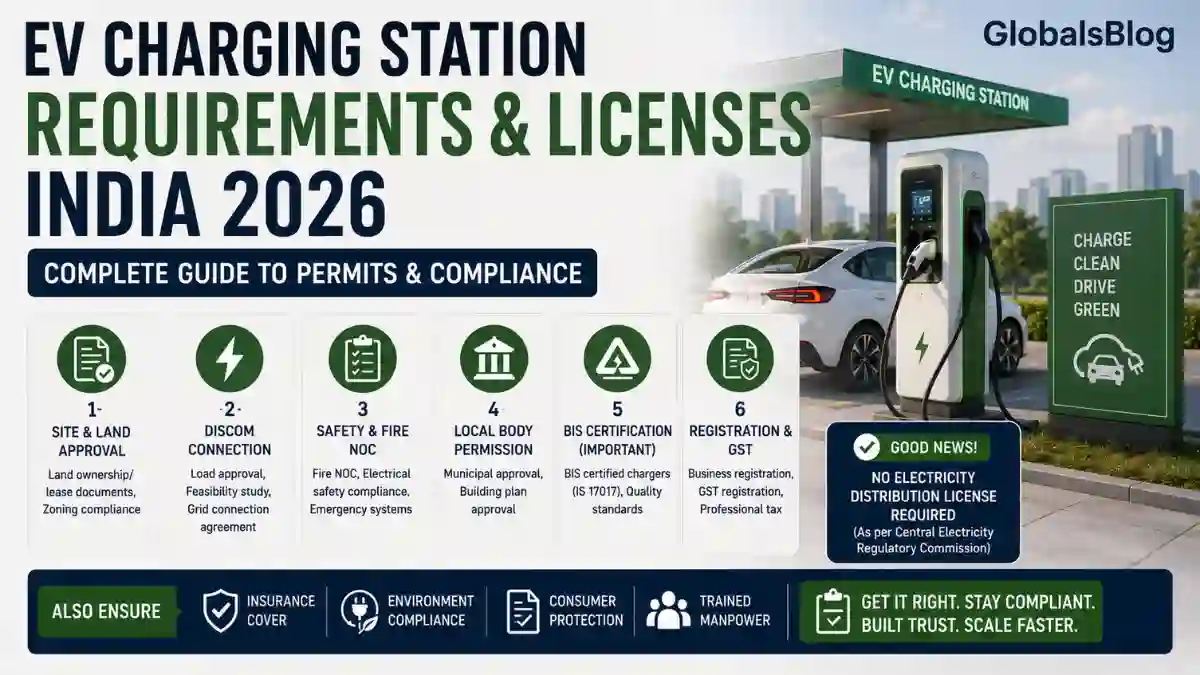
No electricity distribution licence required — but 6 other regulatory steps must be completed correctly. Here's every one of them with timelines, agencies, and costs.
🔥 Trending in this cluster
- No Licence Required for EV Charging in India — But the 6 Things You Still Need to Get Right
- OCPP 2.0.1 Is Now Mandatory. Here's What It Means for Your Charging Station Business
- DISCOM Connection for EV Charging: Why the Grid Approval Takes Longer Than the Charger Installation
The single most important thing to know about EV charging station licensing in India: you do not need an electricity distribution licence to operate a public charging station. The Ministry of Power explicitly clarified this in its Revised Consolidated Guidelines of January 2022, and it remains the legal position in 2026. Setting up a charging station is a de-licensed activity under the Electricity Act, 2003.
What you do need is a structured set of six approvals and certifications that are less intimidating than they sound — but must be completed in the right sequence to avoid costly delays. Miss the DISCOM load sanction step and you'll install chargers that have no power. Miss the BIS certification check and you'll install chargers that are not legally permitted for public use. This guide maps every EV charging station requirement and license step in India for 2026, with timelines, responsible agencies, and the sequence that minimises delay.
The De-Licensing Confirmation — In Plain Language
Under the Ministry of Power's Revised Consolidated Guidelines (January 2022), any individual or entity can set up and operate an EV charging station in India without obtaining a licence under the Electricity Act, 2003. This applies to public charging stations for cars, two-wheelers, and commercial vehicles. The government has specifically structured this to encourage private participation in EV infrastructure. You are not operating as an electricity distributor — you are a consumer who resells charging services.
The 6 Regulatory Steps — In Sequence
Business Entity Registration
Proprietorship, LLP, or Private Limited — the legal vehicle that holds the charging business
Before any application to any agency, the charging station must be owned by a registered legal entity. A sole proprietorship (simplest, cheapest) is adequate for single-station operators. A Private Limited Company or LLP is preferable for multi-station operators or franchise arrangements, as it enables cleaner capital structuring, easier bank financing, and professional credibility with franchise partners like Tata Power and Statiq.
GST registration is required once annual turnover crosses ₹20 lakh (₹10 lakh for special category states) — but should be obtained from the start if you intend to raise invoices for commercial fleet charging contracts or B2B services.
DISCOM Electricity Connection & Load Sanction
The approval that determines your charger capacity — and the longest-lead item in the entire process
This is the step that most new operators underestimate. While installing chargers physically takes days, getting the electricity connection and load sanction from your local DISCOM (Distribution Company) takes significantly longer in practice — 30–90 days in most cities, despite the Ministry of Power's mandate that DISCOMs provide connections within 7 days in metros and 15 days elsewhere.
The load sanction determines how much electrical power your site can draw — and therefore the maximum charger capacity you can install. For a 4-unit AC setup, you need approximately 40–80 kVA sanctioned load. For a DC fast charging hub, 100–300 kVA. The DISCOM will assess your existing connection, site infrastructure, and local grid capacity before approving. If the local grid requires upgradation for your load requirement, add 60–120 days and ₹2–8 lakh to your cost estimate.
Apply to the DISCOM first — before ordering charger equipment. The load sanction letter determines what you can install, and ordering equipment before approval risks buying hardware the grid cannot support at your site.
BIS Certification for Charging Equipment
Only BIS IS 17017-certified chargers are legally permitted at public charging stations in India
The Bureau of Indian Standards (BIS) mandates that all EV charging equipment installed at public stations must comply with IS 17017 (Parts 1–4) for AC chargers and IS 17017 (Part 5) for DC chargers. This certification covers safety standards including shock protection, thermal management, ingress protection (minimum IP54 for public outdoor installations), and connector compatibility with India's mandated standards.
As a station operator, you do not obtain the BIS certification yourself — it is the responsibility of the charger manufacturer. What you must do is verify that every charger you purchase carries a valid BIS certification mark and IS 17017 compliance declaration before purchase. Installing non-certified chargers at a public station exposes you to regulatory action and voids insurance coverage. All major charger brands operating in India — Delta, Exicom, Servotech, Lectrix, and international brands — carry this certification for their India-market products.
OCPP 2.0.1 Compliance & Network Registration
All public charging stations must use OCPP 2.0.1 protocol — and register on the government's e-Amrit portal
The Ministry of Power mandates that all public EV charging stations must use the Open Charge Point Protocol (OCPP) version 2.0.1 for communication between charging points and the central management system. This ensures interoperability — meaning any OCPP-compliant app can connect with and initiate charging at your station regardless of the brand.
Additionally, all public charging stations must register on the government's e-Amrit portal (https://e-amrit.niti.gov.in) — NITI Aayog's EV information and charging network discovery platform. Registration makes your station discoverable to EV users through government platforms and feeds into national charging network databases used by Google Maps, PlugShare, and OEM navigation systems. Non-registered stations miss substantial organic discovery traffic.
OCPP 2.0.1 compliance is handled by your Charge Point Operator (CPO) software provider. Annual software fees for a OCPP-compliant management system range from ₹24,000–₹1,20,000 per year depending on charger count and feature set.
Fire NOC & Local Body Approvals
Fire NOC from State Fire Department — required for DC fast charger stations and commercial locations
A No Objection Certificate (NOC) from the State Fire Department is required for EV charging stations with DC fast chargers, stations above a certain power capacity threshold (typically 50 kW+), and stations in commercial buildings or malls. The fire NOC ensures that fire suppression equipment, emergency shutoffs, and safety signage meet the fire safety code requirements for high-voltage electrical installations.
Additionally, depending on your location type, you may need: a trade licence from the Municipal Corporation, a building plan approval if constructing a charging canopy or structure, and an environmental clearance if the station falls above certain power thresholds or is located near ecologically sensitive areas. State-specific requirements vary — Rajasthan, for instance, requires a dedicated EV charging station registration with the state transport department for highway stations.
Listing on EV Charging Discovery Platforms
Google Maps, PlugShare, Tata EZ, Statiq, Bolt.Earth — listing drives utilisation, utilisation drives revenue
This step is not a government requirement — but it is a commercial requirement that determines whether your station achieves the utilisation rate needed for profitability. EV users find charging stations primarily through Google Maps, the EV apps on their phones, and OEM in-car navigation systems. A station that is not listed on these platforms is functionally invisible to the majority of potential customers.
List on: Google Maps Business (free, highest discovery volume), PlugShare (free, community-verified reviews), e-Amrit portal (mandatory, as above), Tata Power EZ Charge aggregator, Statiq's open network, Bolt.Earth, and your state's EV portal if applicable. Each listing takes 15–30 minutes. Combined, they ensure your station appears across 90%+ of the channels EV users consult when planning a charging stop.
The Approval Timeline — What Happens When
Requirements by Station Size — Quick Reference
| Requirement | Small AC (2–4 units) | DC Fast Hub (4–6 units) | Ultra-Fast Highway |
|---|---|---|---|
| Electricity Distribution Licence | Not required | Not required | Not required |
| Business Registration | Required | Required | Required |
| DISCOM Load Sanction | Required | Required | Required |
| BIS IS 17017 Certification | Required (manufacturer) | Required (manufacturer) | Required (manufacturer) |
| OCPP 2.0.1 Compliance | Required | Required | Required |
| e-Amrit Registration | Required | Required | Required |
| Fire NOC | May be required | Required | Required |
| Municipal Trade Licence | Location-dependent | Location-dependent | Required |
| Environmental Clearance | Not required | Threshold-dependent | May be required |
"Setting up a charging station is a de-licensed activity under the Electricity Act 2003. Anyone — individual or company — can set up and operate EV charging stations without obtaining a licence from an Electricity Regulatory Commission."— Ministry of Power, Revised Consolidated Guidelines for EV Charging Infrastructure, January 2022
✓ Regulatory Tips for Faster Approvals
- Apply to the DISCOM before ordering any equipment — the load sanction determines what you can install and is your longest-lead approval item
- Run Fire NOC and municipal trade licence applications in parallel with the DISCOM wait — both typically take 15–45 days and there is no dependency between them
- Verify BIS IS 17017 certification for every charger before purchase, not after — ask the supplier for the certificate number and validate it on the BIS website
- Register on e-Amrit on launch day, not after — the portal feeds directly into national EV discovery platforms and new registrations appear within 48–72 hours
- For the franchise route, see our EV Franchise Guide — most CPO franchises handle the OCPP compliance, e-Amrit registration, and platform listing on your behalf as part of the franchise package
- For government subsidy eligibility, regulatory compliance is typically a prerequisite — see our EV Subsidy Guide for the specific documentation required per scheme
The Regulatory Path Is Clearer Than You Think.
India's EV charging station requirements and licence framework is genuinely accessible. No electricity distribution licence. A DISCOM connection that is mandated within 7–15 days. BIS certification handled by equipment manufacturers. OCPP compliance managed by software providers. The real work is sequencing these steps correctly and starting the DISCOM application before everything else.
Leave a comment
Share a quick thought about this story.
Thanks for sharing your view. It is ready for review.
Please try again in a moment.