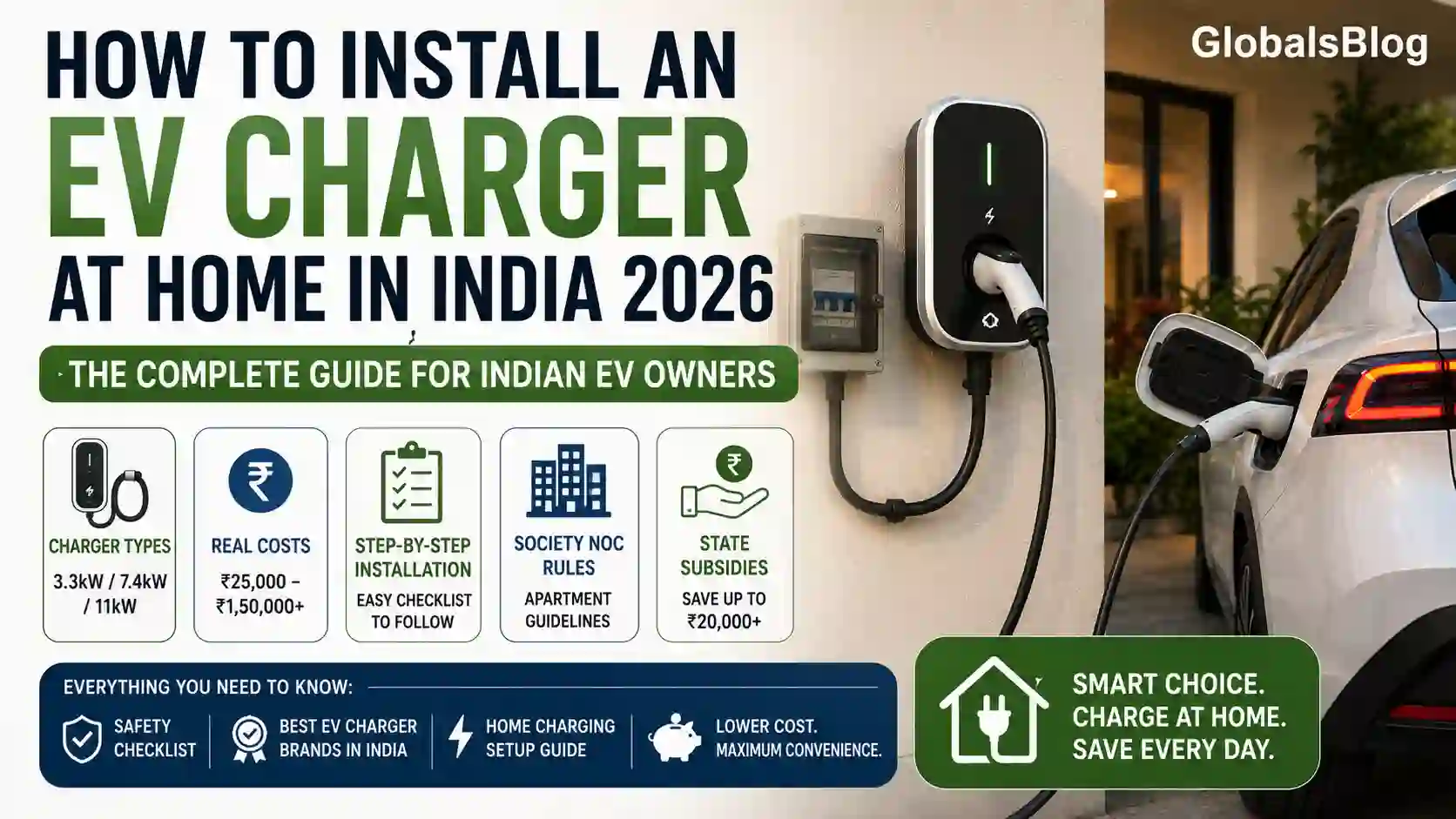
Real costs, step-by-step process, society NOC rules, state subsidies, and the safety checklist every Indian EV owner needs before calling an electrician.
- "My Housing Society Refused My EV Charger NOC — Here's Exactly What I Did Next"
- "Why Installing a 7.4 kW Charger Changed My Entire EV Ownership Experience"
- "The Home EV Charger Mistake That Costs Indian Owners ₹20,000 More Than It Should"
More than 80% of EV charging in India happens at home — not at public stations, not at malls, not on highways. It happens at night, while you sleep, from a socket in your parking spot. This single fact changes everything about how you should think about EV ownership: the public charging network matters for long trips, but your home charger is the infrastructure that makes the whole system work every single day.
And yet, the process of actually getting a home EV charger installed in India — choosing the right type, understanding the real costs, navigating housing society rules, claiming subsidies, and ensuring it's done safely — is genuinely confusing for first-time buyers. This guide gives you every piece of that puzzle, verified against 2026 regulations, real installation cost data, and current state subsidy schemes.
For most Indian EV owners, the right choice is a 7.4 kW AC wallbox charger installed by a certified electrician. Total installed cost ranges from ₹35,000 to ₹75,000 depending on your state, wiring distance, and whether a load upgrade is needed. If you live in Delhi, you can claim a ₹6,000 subsidy and access the ₹4.50/kWh EV tariff. In Maharashtra, housing societies must issue a NOC within 7 days of application. Home charging costs just ₹5–10 per kWh versus ₹15–25 at public DC fast chargers — making it the single biggest factor in EV running cost savings.
01 Why Home Charging Beats Public Charging Every Time
The economics are not close. Home AC charging costs ₹5–10 per kWh, while public DC fast charging typically costs ₹15–25 per kWh. For a typical EV owner driving 1,200 km per month with a 20 kWh/100km consumption, that translates to roughly 240 kWh monthly. At home, that's ₹1,440–₹2,400. At a public DC charger, the same energy costs ₹3,600–₹6,000. The annual saving from home charging alone runs to ₹25,000–₹43,000 — more than the cost of the charger installation itself.
"Upgrading to a dedicated 7.2kW AC wall-box charger cuts the charging window to under 6 hours, letting you plug in after dinner and wake up to a full battery. That is not a minor convenience — it changes how you live with your car." — EngineeringMix, Home EV Charger Cost Guide 2026
02 Types of Home EV Chargers: Which One Do You Actually Need?
There are three levels of EV charging — but for home installation in India, the choice almost always comes down to Level 1 (slow) versus Level 2 (fast AC). Level 3 (DC fast charging) is commercial infrastructure, not a home option.
Adds ~15–20 km of range per hour
Often bundled free with your EV. Plugs into any standard 15A socket. No installation required — but also genuinely inadequate for daily use on any EV with a battery above 30 kWh. A 45 kWh Nexon EV takes over 14 hours to fully charge from empty. Practical only for two-wheelers or as an emergency backup.
Adds ~35–50 km of range per hour (7.4 kW)
The gold standard for home charging in India. A 7.4 kW charger can add about 35–40 km of range per hour, fully charging a typical 40 kWh EV battery in 5–6 hours. Requires professional installation and a dedicated circuit. Single-phase works for 7.4 kW; 11 kW requires a three-phase connection. This is what most EV owners should install.
Adds 200–400 km of range per hour
DC fast chargers are public infrastructure — petrol station replacements, not home appliances. The equipment alone costs ₹5–20 lakh, requires a dedicated transformer, a commercial grid connection, and extensive civil work. AC slow charging at home is generally gentler on your EV's battery compared to frequent DC fast charging. Not a home option for Indian residential users.
7.4 kW vs 11 kW: Which to Choose?
For most Indian homes, 7.4 kW is sufficient and easier to install from an electrical load perspective. It works on a standard single-phase 32A circuit. The 11 kW option requires a three-phase connection — which adds cost and complexity, particularly in apartments or older buildings with single-phase supply. Unless your EV has an onboard charger rated above 7.4 kW (most do not), spending extra on 11 kW yields minimal real-world benefit.
03 Real Installation Costs in India 2026
The most common mistake buyers make is budgeting only for the charger unit. The total installed cost includes the hardware, wiring, safety devices, load upgrade (if needed), and electrician fees — and these vary significantly by state and building type.
| Component | Cost Range | Notes |
|---|---|---|
| Bundled portable charger (3.3 kW) | ₹0 (included) | Most EVs include this at purchase. Not a home wallbox. |
| 7.4 kW AC wallbox charger unit | ₹25,000–₹50,000 | Brands like Tata Power EZ Charge, ChargeGrid, Exicom offer good options. Smart features and brand reputation influence pricing. |
| 11 kW AC wallbox (3-phase) | ₹40,000–₹70,000 | Requires verified 3-phase connection at your parking location. |
| Standard installation (up to 15m wiring) | ₹5,000–₹15,000 | Includes professional electrician fees, wiring, conduit, safety devices (MCB, RCD/RCCB), and consultation. |
| Extended wiring (15m+) or complex routing | ₹15,000–₹35,000 | Conduit through walls, podium parking, or multi-level routes add significantly. |
| DISCOM load upgrade (if required) | ₹5,000–₹25,000 | Varies by state. Tamil Nadu (TANGEDCO) and UP (UPPCL) are among the higher-cost states for load sanction upgrades. |
| Licensed C-Certificate electrician | ₹3,000–₹8,000/day | Required to provide the mandatory Form-4 Test Report for TANGEDCO or equivalent state DISCOM load upgrade. |
| Total — Independent house | ₹35,000–₹65,000 | Lower end assumes minimal wiring distance and no load upgrade required. |
| Total — Apartment/society | ₹55,000–₹1,20,000 | Total installation costs vary between ₹67,420 and ₹1,68,677 depending on wiring distance and distance from the existing power circuit. |
Always insist on ISI-marked 6 sq.mm copper cable. Reject any aluminium cable substitution — aluminium has lower conductivity, expands and contracts differently at joints under thermal load, and carries a significantly higher fault risk at sustained high amperages. Also: using non-certified chargers may lead to insurance claim rejections in the event of an electrical fire. Certified equipment and a licensed installer are non-negotiable — not optional cost savings.
04 Step-by-Step Installation Process
Whether you live in an independent house or an apartment, the installation follows the same logical sequence. The primary variable is whether you need society approval first — which we cover in detail in the next section.
05 The Housing Society NOC: Your Rights in 2026
This is the section most apartment-dwelling EV owners need most urgently. The situation has shifted dramatically in favour of residents through a combination of central government guidelines, Bombay High Court rulings, and state regulations — but many housing societies still resist or delay NOC issuance. Here is exactly where you stand legally.
Your Legal Position — Key Rules by State
What to Include in Your NOC Application
A well-prepared application reduces the likelihood of delay or rejection. Include: a written request specifying the charger model and kW rating; a site plan showing the proposed cable route; the electrician's credentials and BIS certification of the charger; a commitment to follow CEI safety guidelines; and a copy of the Ministry of Power EV Guidelines (September 2024) as a legal reference. Most societies approve properly documented applications without issue — resistance typically comes when the application arrives incomplete.
06 State Subsidies and EV Tariffs You Can Claim
Central government direct subsidies for home chargers are limited in 2026 — PM E-DRIVE's charging infrastructure budget is primarily directed at public charging infrastructure. However, state-level subsidies and concessional EV tariffs can significantly reduce both your installation cost and your ongoing electricity bill.
07 Safety Non-Negotiables: What Every Installation Must Have
An EV charger draws sustained high current for 4–8 hours nightly — a fundamentally different electrical load profile than any other home appliance. The safety requirements are not bureaucratic formalities; they exist because the failure modes of an improperly installed EV circuit are genuinely serious.
08 Quick Tips: Getting the Most From Your Home EV Charger
Featured Snippet — Home EV Charger Tips India 2026
- Install a smart charger with a scheduling app — set it to charge between 11 PM and 5 AM to access off-peak tariff rates and reduce your monthly electricity bill by 20–40%
- If your EV brand (Tata, Mahindra, MG) offers a bundled home charger installation package at purchase, accept it — these include brand-warranted equipment, certified installers, and often a dedicated helpline
- Apply for a dedicated EV meter connection from your DISCOM separately from your home meter — this qualifies you for concessional EV tariffs in Delhi, Maharashtra, and several other states
- Never charge NMC battery EVs (Mahindra BE6, Kia EV6, most Korean EVs) to 100% routinely — set the daily charge limit to 80–90% to extend battery life; LFP battery EVs (BYD Seal, some MG models) can safely charge to 100% daily
- Take a photo of your charger installation before the electrician leaves — date-stamped documentation protects you if the society later challenges the installation
- Future-proof your wiring: even if you install a 7.4 kW charger now, ask the electrician to run conduit sized for 10 sq.mm cable and a 3-phase ready distribution board — upgrading later will cost a fraction of re-running new cable
- If you're in a rented apartment, get written landlord consent before installation — you need this for subsidy claims and to protect your deposit
09 Frequently Asked Questions
The Charger Is the Investment. The Savings Pay for It.
Installing a home EV charger in India is not an optional upgrade — it is the foundational infrastructure that makes EV ownership financially rational. The gap between home charging costs (₹5–10/kWh) and public DC charging (₹15–25/kWh) is wide enough that the entire installation cost pays for itself within 12–18 months for most owners. After that, every kilometre you drive costs a fraction of what it cost on petrol.
The process is more straightforward than most buyers expect. Choose a 7.4 kW wallbox. Hire a licensed electrician. Use BIS-certified equipment. In an apartment, submit a proper NOC application — societies can no longer legally refuse. Claim your state subsidy and apply for the EV tariff meter. Set your charger to run overnight.
That's it. You wake up every morning to a full battery, without a fuel station in your week, for the cost of running a few large appliances overnight. That is the actual promise of home EV charging in India — and in 2026, it is entirely within reach.
Leave a comment
Share a quick thought about this story.
Thanks for sharing your view. It is ready for review.
Please try again in a moment.