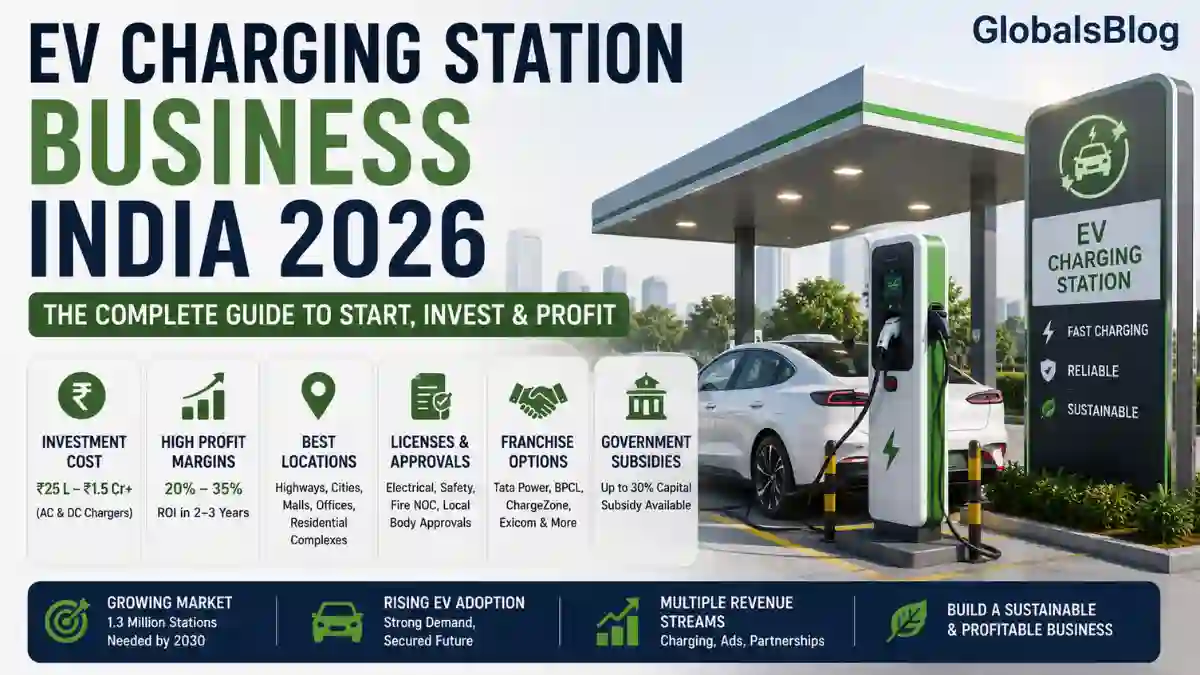
India has 29,000 public chargers. It needs 1.3 million by 2030. That gap is the business opportunity — and 2026 is the best window to enter it.
🔥 Also in this cluster
- India Will Need 1.3 Million EV Chargers by 2030 — Here's How to Own One of Them
- The EV Charging Business Has No License Requirement — But 5 Other Things You Must Get Right
- Government Is Paying Up to 80% of Infrastructure Cost for New Charging Stations. Here's How to Claim It.
The numbers are almost impossible to believe until you check them. India has approximately 29,000 public EV charging stations today. To support the government's target of 30% EV penetration by 2030, the country needs an estimated 1.3 million. That is not a typo. The demand-supply gap in Indian EV charging infrastructure is one of the largest infrastructure opportunities in the country's modern economic history — and it is open to any individual or entity willing to enter.
Setting up an EV charging station in India is a de-licensed activity under the Electricity Act, 2003. You do not need a special permit from the government to open one. The Ministry of Power has specifically made this point to encourage private participation. Combined with central government subsidies of up to ₹2,000 crore under the PM E-DRIVE scheme for charging infrastructure, concessional electricity tariffs in most states, and a rapidly expanding EV fleet creating real daily demand, 2026 is — as Zevpoint's industry analysis put it — "arguably the best window" to enter this space.
This pillar guide maps the complete commercial EV charging business landscape in India: the market opportunity, the five models for entering it, and links to the five deep-dive guides in this cluster covering costs, profit margins, licensing, franchises, and government subsidies in full detail.
⚡ Quick Answer: The 5 Ways to Enter India's EV Charging Business in 2026
Why 2026 Is the Critical Entry Window
Four market conditions that make this the optimal year — not two years from now.
The EV Charging Business Model — How the Economics Work
The core revenue mechanism is straightforward: you buy electricity from your DISCOM at a concessional EV tariff (₹5–6.50 per kWh in most states) and sell charging services to EV owners at ₹12–18 per kWh at public stations. The spread between your cost and your charge rate — after rent, maintenance, and DISCOM charges — is your margin. At 15–30% net profit margins and 25–50% margins at premium high-traffic locations, the economics are compelling for well-chosen sites.
Revenue isn't limited to charging fees. A well-placed station can layer in advertising revenue from the digital screens that modern chargers include, partnerships with nearby retail or food businesses whose customers benefit from the waiting dwell time, and corporate fleet subscription contracts that guarantee a base load of revenue regardless of walk-in traffic.
The Two Critical Variables: Location and Utilisation
Every EV charging business analysis leads to the same conclusion: utilisation rate is the master variable. A station at 25% utilisation is a marginal business. The same station at 40–50% utilisation is highly profitable. Location determines utilisation — and location decisions made in 2026 will define the business outcome for the next decade. The deep-dive on profit margins, utilisation modelling, and revenue stack is in our EV Charging Station Profit Margin Guide.
Investment Range by Station Type
| Station Type | Investment Range | Charger Power | Best Location | ROI Timeline |
|---|---|---|---|---|
| Small AC Setup | ₹1.5–3 lakh | 7–22 kW | Apartments, offices | 2.5–4 years |
| Mid AC Station | ₹4–10 lakh | 22 kW × 4–6 units | Malls, corporate parks | 2–3.5 years |
| DC Fast Charger | ₹15–25 lakh | 30–60 kW | High-traffic commercial | 2–3 years |
| Highway DC Hub | ₹25–50 lakh | 60–150 kW | Highway corridors | 18–30 months |
| Ultra-Fast Hub | ₹50L–1 crore+ | 150–400 kW | Expressways, premium urban | 18–24 months |
For the complete cost breakdown — equipment, civil works, electrical infrastructure, software, and grid connection — see our dedicated guide: How Much Does It Cost to Open an EV Charging Station in India?
The Full Cluster — Every Guide You Need
This pillar links to five deep-dive guides. Each covers one dimension of the EV charging business in full detail. Together, they give you everything needed to evaluate, plan, and launch a charging station in India.
How Much Does It Cost to Open an EV Charging Station in India?
Full cost breakdown: equipment, electrical, civil, software & grid connection
AC charger to 400 kW ultra-fast hub — every rupee itemised with 2026 market pricing, DISCOM connection costs, and the hidden expenses most guides skip.
Read the Cost Guide →EV Charging Station Business Profit Margin Explained
Revenue stacks, utilisation modelling, and what separates 15% from 50% margins
The honest profit story — buy rate vs. sell rate, utilisation sensitivity, ancillary revenue streams, and the fleet subscription model that stabilises early-stage income.
Read the Profit Guide →EV Charging Station Requirements & Licenses in India
What you need (and don't need) — DISCOM, BIS, fire NOC, OCPP 2.0.1
No electricity distribution licence required. But five other regulatory steps must be completed correctly. This guide walks each one with timelines and responsible agencies.
Read the License Guide →EV Charging Station Franchise in India 2026
Tata Power, Statiq, ChargeZone, Jio-bp — franchises ranked by investment, support & ROI
The franchise vs. independent debate settled with real numbers. Eight franchise options compared across investment size, earning potential, territory rights, and brand strength.
Read the Franchise Guide →Government Subsidy for EV Charging Stations in India 2026
PM E-DRIVE, FAME II legacy, state subsidies — what to claim and how
₹2,000 crore earmarked for charging infrastructure under PM E-DRIVE. State capital subsidies of 20–25%. Concessional tariffs. Electricity duty exemptions. This guide maps every one.
Read the Subsidy Guide →"EV charging is one of the most accessible infrastructure businesses in India right now — no licence required, concessional electricity tariffs, financing options available, and a massive demand-supply gap. The investment starts from ₹1.5 lakh for a small AC-only setup. The ROI is typically 18–36 months at well-located stations."— Zevpoint Industry Analysis, May 2026
⚡ Quick Tips: Before You Start an EV Charging Station Business
- Run a site feasibility study before spending anything — local EV fleet density, competition proximity, available sanctioned load, and DISCOM connection timeline are the four inputs that determine whether a location is viable
- Check PM E-DRIVE and your state's EV policy subsidy status before finalising charger procurement — the subsidy can cover 20–80% of infrastructure cost if applied before installation
- For your first station, start with AC chargers not DC — lower capital risk, faster installation, and a learning curve you can manage before scaling to high-power hardware
- List on every major EV charging discovery app from day one: Google Maps, PlugShare, Tata EZ Charge, Statiq, Bolt.Earth — discovery drives utilisation and utilisation is the entire business
- Also read our Home EV Charging Station Cost Guide — many commercial operators start with residential society installations before moving to public locations
- Consider solar integration from the planning phase, not as an afterthought — in states like Rajasthan, Gujarat and Telangana, solar + storage can reduce electricity cost by 40–60%, fundamentally improving margins
The Gap Is the Opportunity. 2026 Is the Window.
India's EV charging infrastructure gap is one of the most clearly defined business opportunities in the country's current economy. The government has removed the licence barrier. Subsidies are live. The EV fleet is growing at 75% per year. And the locations that will generate the best returns for the next decade are being claimed right now.
Use this pillar to navigate the full picture — then follow each linked guide for the detail you need on your specific question: cost, profit, licensing, franchise, or government subsidy. The EV charging business in India has never been more accessible to enter.
Leave a comment
Share a quick thought about this story.
Thanks for sharing your view. It is ready for review.
Please try again in a moment.