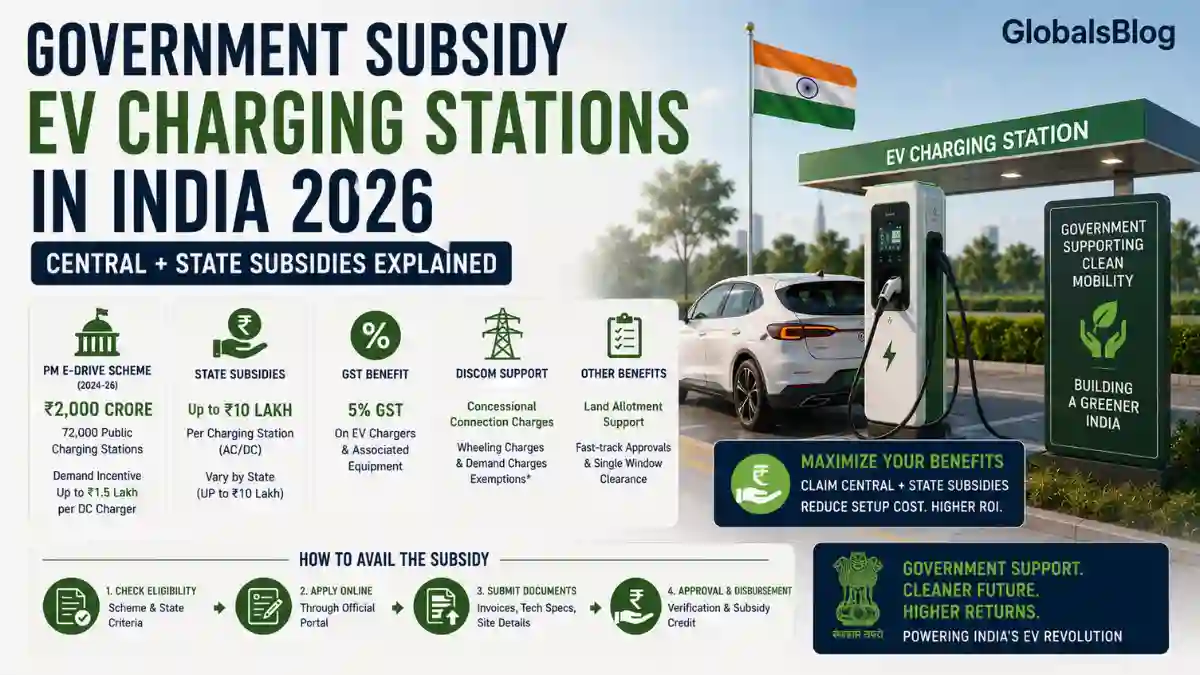
₹2,000 crore is set aside. 72,000 chargers are in the pipeline. Central schemes, state capital subsidies, electricity duty exemptions, and concessional land — here's every benefit available and exactly how to claim it.
Also Searched As
- How Much Government Subsidy Can I Get for Setting Up an EV Charging Station in India?
- PM E-DRIVE Scheme for EV Charging Infrastructure — What's Changed in 2026
- State-Wise EV Charging Station Subsidy India: Delhi, Maharashtra, Karnataka, Gujarat — Compared
Here is a number that puts the opportunity in perspective: under FAME II, which ran for five years from 2019 to 2024, the Indian government supported approximately 9,300 public EV chargers. Under PM E-DRIVE — the successor scheme that launched in October 2024 — the target is over 72,000 chargers in just two years. The scale shift is intentional, and the funding is real: ₹2,000 crore earmarked exclusively for charging infrastructure, sitting alongside ₹10,900 crore in total scheme outlay.
For anyone considering setting up an EV charging station in India — whether as a commercial venture, a highway corridor operator, a housing society, or a fleet operator — 2026 represents the most well-funded policy window the sector has seen. This guide maps every layer of government subsidy for EV charging stations in India: central schemes, state-level capital subsidies, electricity tariff benefits, land support, and the practical steps to apply before deadlines close.
Quick Answer
Central subsidy (PM E-DRIVE): ₹2,000 crore allocated for 72,000 public chargers. Coverage ranges from 70–100% of charger cost depending on location type (highways, cities, transit hubs). Infrastructure support extended to March 2028.
State capital subsidies: ₹1–10 lakh per station depending on state and charger type. Maharashtra offers up to ₹10 lakh per DC fast charger via VGF; Delhi offers 100% subsidy up to ₹6,000 per slow charger; Karnataka offers 25% capital subsidy; Gujarat offers 25% + 100% electricity duty exemption.
GST benefit: EV chargers and charging services are taxed at 5% GST — down from the 18% that previously applied — significantly reducing input costs for CPO businesses.
From FAME II to PM E-DRIVE: Understanding the Policy Timeline
India's EV charging subsidy framework has gone through three distinct phases since 2019. Each transition has expanded both funding and ambition. Understanding where the current scheme fits helps you plan your application timeline accurately.
FAME II — Faster Adoption & Manufacturing of EVs (Phase 2)
₹10,000 crore outlay. Supported ~9,300 public chargers over five years across highways and metro cities. Set the template for concessional rates and OEM-linked deployment. Replaced by EMPS as a transitional bridge in April 2024.
EMPS — Electric Mobility Promotion Scheme (Bridge Scheme)
Short bridging programme to maintain demand incentives during the FAME→PM E-DRIVE transition. Vehicle subsidies continued; infrastructure funding deferred to PM E-DRIVE.
PM E-DRIVE — Electric Drive Revolution in Innovative Vehicle Enhancement
India's current flagship EV scheme. ₹10,900 crore total outlay. ₹2,000 crore specifically for 72,000+ public chargers — a 7× jump over FAME II's charger output in less than half the time. Charging infrastructure support runs until March 2028, giving operators a meaningful planning horizon.
State EV Policies — Capital Subsidies & Tariff Benefits
25+ states have notified independent EV policies offering capital subsidies (₹1–10 lakh per station), electricity duty exemptions, concessional tariffs, and land support. These stack with PM E-DRIVE benefits and are often the more immediately accessible subsidy layer for operators.
Thinking of Starting an EV Charging Station Business in India?
Before applying for subsidies, understand the full business model — location strategy, operator types, revenue streams, and what the 2026 EV charging station landscape looks like for new entrants.
PM E-DRIVE: What the Central Scheme Covers for Charging Infrastructure
The PM E-DRIVE scheme's ₹2,000 crore charging infrastructure allocation is designed around strategic density rather than uniform distribution. This means the highest subsidies go to locations where coverage gaps create range anxiety — national highway corridors, metro transit hubs, airports, and city clusters with high EV density.
Subsidy Coverage Rate: 70–100% Depending on Location
PM E-DRIVE's tiered subsidy structure recognises that commercial viability varies by geography. The scheme's tiered subsidy structure — covering 70–100% depending on location type — can cover a significant portion of setup costs. Highway corridor chargers in underserved regions attract the highest coverage rates, while urban chargers in high-footfall commercial areas receive lower but still meaningful support. The Ministry of Heavy Industries published detailed PM E-DRIVE guidelines for public charging infrastructure in early 2026 — businesses entering the space now are accessing a largely untapped subsidy pool.
The Contrarian Opportunity: Infrastructure Subsidies Are Still Underutilised
PM E-DRIVE guidelines for public charging infrastructure were only published in early 2026. With 72,000+ chargers in the pipeline, this is the next major subsidy category — and largely untapped for businesses entering the space now. Most attention has focused on vehicle subsidies. The infrastructure side is where the policy window remains wide open.
State-Wise EV Charging Station Subsidy: Where You Stand in 2026
State EV policies in Delhi, Maharashtra, Karnataka, Tamil Nadu, Telangana, Gujarat, Kerala, and Uttar Pradesh all offer capital subsidies — typically ₹1–10 lakh per station — tariff concessions, and property-tax waivers for public charging infrastructure. Here's the complete reference for major states:
| State | Capital Subsidy | Electricity Benefit | Land / Other | Strength |
|---|---|---|---|---|
| Delhi | 100% up to ₹6,000 per slow/medium charger (first 30,000 points) Land allotment at public parking lots for large stations |
EV tariff ₹4.50/kWh — one of India's lowest | Single-window empaneled vendor system; municipal parking lot access | ★★★★★ |
| Maharashtra | VGF: 15% reimbursement, up to ₹10 lakh per DC fast charger on highways; 50–60% infra reimbursement in some categories | EV tariff ₹5.00–₹5.50/kWh; electricity duty waived for initial years; demand charges waived | Priority cities: Mumbai, Pune, Nagpur, Nashik, Aurangabad; 1 charger per 5 parking spots mandated in new builds | ★★★★★ |
| Karnataka | 25% capital subsidy on EV charging equipment; 15% capital incentive for investors | EV tariff ₹5.00–₹6.00/kWh; BESCOM dedicated EV cell for connection | ₹1,500 crore PPP with Tata Power, Statiq for highway corridors; mandated 3 km charger density in Bengaluru | ★★★★☆ |
| Gujarat | 25% capital subsidy on equipment and machinery; 250+ stations planned across towns and villages | 100% electricity duty exemption for EV charging services (~15% cost reduction); Road tax 1% (till March 2026) | EV manufacturing hub incentives indirectly reduce hardware cost | ★★★★☆ |
| Tamil Nadu | Subsidies for public charging; focus on manufacturing-linked infrastructure | Concessional EV tariff; electricity duty holiday in EV policy | 50% land cost subsidy in EV supplier parks for charging equipment plants; Chennai/Coimbatore priority | ★★★★☆ |
| Telangana | Capital subsidy for public chargers; 100% road tax/registration exemption through Dec 2026 | EV tariff ₹5.50–₹6.00/kWh; land in EV parks at concessional long-term lease rates | Hyderabad designated priority EV deployment city; battery swapping operators also covered | ★★★☆☆ |
| Uttar Pradesh | 20% subsidy on fixed capital investment up to ₹10 lakh per station; subsidised upstream electrical infrastructure (transformers, grid connections) — first state to do this | Dedicated EV tariff in progress; EV policy 2022 (amended June 2025) | June 2025 amendment added grid connection subsidies — unique nationally | ★★★☆☆ |
| Rajasthan | Capital subsidy under state EV policy; 100% road tax exemption for EV buyers | EV tariff benefit; electricity duty concessions | Part of PM E-DRIVE highway corridor target states | ★★★☆☆ |
| Punjab | Capital subsidy available; electricity duty exemption for charging operations | Higher domestic tariff (₹8–10/kWh) — electricity duty exemption more valuable here | Charging station density targets in Chandigarh and Ludhiana | ★★☆☆☆ |
"Maharashtra, Delhi, Gujarat, and Karnataka offer the strongest combined incentives for EV charging infrastructure operators. Stack PM E-DRIVE with state capital subsidies and electricity duty exemptions — in the right state, combined incentives can cover 30–50% of total project cost." — Bolt.Earth Policy Analysis, January 2026
EV Charging Station Setup Cost in India — Full Breakdown
Know what you're subsidising before you apply. This guide covers AC vs DC charger costs, civil work, grid connection, and total capex for different station types — so you can calculate your actual subsidy benefit accurately.
Beyond Capital Subsidies: Tariff, GST, and Land Benefits That Change the Economics
Most first-time EV charging station operators focus entirely on capital subsidies — the upfront equipment cost reimbursements. But the ongoing operational benefits are often more valuable over a 5–7 year operating period. Here are the four categories of non-capital benefits that serious CPO businesses should factor into their financial models.
⚡ Concessional EV Electricity Tariff
₹4.5–₹6/kWhMost states offer dedicated EV tariffs 20–40% below standard commercial rates. Delhi's EV tariff at ₹4.5/kWh vs commercial rates of ₹9–12/kWh saves a busy charging station ₹3–5 lakh per year in electricity costs alone. Apply through your DISCOM's EV tariff category.
🏭 GST at 5%
5% (down from 18%)EV chargers, charging equipment, and the electricity sold through charging stations are all taxed at 5% GST. This significantly reduces both the hardware acquisition cost and the ongoing service charge, improving margin for CPO operators and making the service more competitively priced for end users.
🏭 Electricity Duty Exemption
Up to 15% cost savedGujarat offers 100% electricity duty exemption for EV charging services. Maharashtra, Odisha, Bihar, Tamil Nadu, and Punjab include similar duty holidays — often for 5–10 years. In high-tariff states like Punjab, this exemption is especially valuable and can make otherwise marginal sites commercially viable.
🏛 Concessional / Free Land
Major cost reductionDelhi's single-window system offers government parking lots at subsidised rates for CPOs. Maharashtra targets bus depots, rest areas, and municipal parking. Tamil Nadu offers 50% discounted land in EV parks for charging-related facilities. Telangana provides long-term concessional leases in upcoming EV parks. Land typically represents 15–25% of total project cost.
Demand Charges: The Hidden Cost Subsidy That Most Guides Miss
Maharashtra's EV tariff framework from MERC waives demand charges for charging station operators in the initial operating years. Demand charges — fixed monthly fees based on peak power draw — can add ₹50,000–₹2,00,000/month to a large DC fast charging station's electricity bill. Getting this waiver significantly improves early-stage cash flow before a station reaches full utilisation.
EV Charging Station Cost & Profit Margin — Detailed Financial Model
Subsidies change the capex equation. This guide models the actual revenue, electricity cost, maintenance, and profit margin for EV charging stations in India — including what happens when you stack central and state benefits.
Who Is Eligible for EV Charging Station Subsidies in India?
Eligibility varies between central and state schemes, but the broad framework is consistent across PM E-DRIVE and most state policies. Understanding the eligibility matrix before you invest in site acquisition or equipment prevents wasted applications.
✅ Typically Eligible
- Registered companies / LLPs / partnerships as CPOs (Charge Point Operators)
- DISCOM-empaneled operators with approved charger hardware
- Housing societies / RWAs installing shared infrastructure
- Hotels, malls, fuel stations on highway corridors
- Fleet operators installing captive charging for commercial EVs
- State transport undertakings and public agencies (buses)
- Individual home owners — for state-level home charger subsidies (Delhi ₹6,000)
- Startups registered under DPIIT with MSME or startup certificate
❌ Typically Ineligible or Limited
- Non-BIS / AIS certified charger hardware — certification is mandatory
- Installations without proper DISCOM load sanction
- Sites without separate EV energy metering (required for commercial stations)
- Operators without OCPP-compliant systems (required for interoperability mandates)
- Projects that don't allow public access (purely captive private sites may not qualify for PM E-DRIVE)
- Applications filed after scheme deadlines or budget exhaustion
The No Licence Required Rule — And What It Actually Means
Under MoP (Ministry of Power) guidelines, selling electricity through an EV charging station does not require a distribution licence — you are classified as a service provider, not a utility. This de-licensing significantly lowers the barrier to entry. You do, however, need DISCOM connection approval, BIS-certified hardware, separate metering, and OCPP registration where mandated by your state. These are compliance requirements, not licences.
How to Apply for EV Charging Station Subsidies in India: Step-by-Step
The application process has two distinct tracks — the central PM E-DRIVE route for highway and transit hub installations, and state-level applications for capital subsidies and tariff benefits. Both are increasingly digital, but the documentation requirements are specific and rejections for incomplete filings are common.
Register on the PM E-DRIVE Portal (Ministry of Heavy Industries)
Visit the MHI portal and register your entity as a CPO. You'll need GST registration, PAN, company incorporation documents, and technical specifications of the charger hardware you plan to deploy. BIS certification documents for the charger model are mandatory at this stage.
Identify Your Target Location Category
PM E-DRIVE's subsidy rates are location-tiered. Apply for highway corridor sites through NHAI/MoRTH's charging station tender process. For city locations, apply through the relevant DISCOM or Smart City mission portal depending on your state. This step determines your subsidy percentage (70–100%).
Apply for State Capital Subsidy — Simultaneously
State applications are independent of PM E-DRIVE. Visit your state's designated nodal agency — DISCOM, Energy Development Agency, or EV Mission cell. Delhi uses a single-window system. Maharashtra has a VGF portal for highway stations. Karnataka routes through BESCOM's EV department. File both applications in parallel, not sequentially.
Apply for EV Tariff Category from Your DISCOM
Submit a separate application for the EV-specific electricity tariff category. This requires your charger's technical specifications, the dedicated separate metering plan, and proof of public access (if applicable). Processing time is 2–6 weeks in most states. This is the step most new operators delay — prioritise it early.
Complete Installation with BIS-Certified Hardware
Only use charger models with valid BIS IS 17017-series certification. The installation must be carried out by a licensed C-Certificate electrician. Request a Form-4 Electrical Test Report upon completion — this is required for subsidy disbursement in most states and for DISCOM permanent connection.
Submit Disbursement Claim with Installation Proof
Upload final installation photographs, DISCOM connection certificate, Form-4 test report, metering data, and invoices. Many state portals require bank account details that match the registered entity name exactly — mismatches are the most common cause of disbursement delays. Save all acknowledgement numbers.
EV Charging Station Requirements & Licences in India — Complete Checklist
BIS certification, DISCOM approval, OCPP compliance, Form-4 test reports — here's every mandatory requirement and licence for setting up a legal EV charging station in India, so your subsidy application doesn't get rejected on a technicality.
⚡ Government EV Charging Station Subsidy India — Quick Reference (Featured Snippet)
- Central scheme: PM E-DRIVE — ₹2,000 crore for 72,000 chargers; 70–100% subsidy by location; infrastructure support until March 2028.
- Best state for capital subsidy: Maharashtra (up to ₹10 lakh per DC fast charger via VGF); Delhi (100% up to ₹6,000 for slow chargers at homes/shops); Karnataka (25% equipment cost).
- Best state for electricity benefits: Gujarat (100% electricity duty exemption); Delhi (₹4.50/kWh EV tariff — lowest nationally); Maharashtra (demand charge waiver in initial years).
- GST on EV chargers and charging services: 5% — down from 18%. Applies to both hardware purchase and electricity revenue from charging.
- Key eligibility requirement: BIS IS 17017-certified charger hardware is non-negotiable for both PM E-DRIVE and all state subsidy schemes. Non-certified equipment disqualifies the entire application.
- No distribution licence required to sell electricity via EV chargers — MoP guidelines classify CPOs as service providers. DISCOM connection + metering is required, not a utility licence.
- Apply state and central subsidies simultaneously — they don't conflict, they stack. Combined benefits can cover 30–50% of total project cost in the strongest states.
- Deadline risk: Subsidy budgets are finite. PM E-DRIVE vehicle demand incentives already reduced from ₹10,000 to ₹5,000 per 2W. Infrastructure subsidies are still robust but apply early in the window.
Mistakes That Get EV Charging Station Subsidy Applications Rejected
Using Non-BIS Certified Hardware
The single most common rejection reason across both PM E-DRIVE and state applications. Several imported charger brands available in India — particularly lower-cost units from unverified distributors — do not carry BIS IS 17017-series certification. Always request the BIS certification document from your charger vendor and verify it on the BIS portal before purchase. No certification, no subsidy — regardless of how good the hardware is otherwise.
Applying for Only One Subsidy Layer
A significant number of operators apply only for the state capital subsidy and miss the PM E-DRIVE central scheme entirely, or vice versa. Companies setting up EV charging infrastructure routinely qualify for three or four overlapping schemes but apply for one. Central PLI, state EV policy, charging infra incentives — they stack. Hire a scheme-aware consultant or CA for any project above ₹10 lakh investment to ensure complete capture.
Missing the EV Tariff Application
The concessional EV electricity tariff application is treated as a separate process from subsidy applications — and many operators don't file it until months after installation. In high-tariff states like Maharashtra (₹7.50–₹11.85/kWh domestic commercial), every month of delayed EV tariff approval costs ₹30,000–₹1,50,000 in excess electricity charges for a busy station. File this on the same day you receive DISCOM connection approval.
Not Maintaining OCPP Compliance Records
PM E-DRIVE and multiple state policies require charging stations to be registered on the national EV payment interoperability platform and to maintain OCPP 1.6 or higher compliance. This generates data records — session logs, energy delivered, uptime — that subsidy authorities use for disbursement verification. Without compliant OCPP-connected hardware and records, claiming infra subsidies becomes difficult post-installation.
EV Charging Station Franchise in India 2026 — Operators, Costs & How to Join
Want the subsidy benefits without building from scratch? Franchising with established CPOs like Tata Power, Statiq, or ChargeZone lets you access their subsidy applications, networks, and operational systems. Here's how it works and what it costs.
What's Changing: The Direction of Subsidies in 2026 and Beyond
India's EV subsidy policy is deliberately shifting. Government thinking has shifted toward fleet electrification as a better use of subsidy money than individual consumer incentives. Commercial vehicles get a longer runway — e-buses, e-trucks, and e-ambulances have support running through 2028. For charging infrastructure investors, this trajectory matters because it signals sustained demand from the most predictable charging users: bus depots, last-mile delivery fleets, and commercial EV operators.
The other significant shift is from equipment subsidies toward viability gap funding — rather than paying for hardware, the newer Maharashtra VGF model pays against utilisation milestones. This rewards well-located, well-operated stations rather than simply deployed ones. Operators who focus on site quality, uptime, and utilisation rates — not just installation count — are better positioned for the next generation of subsidy structure.
The 2027–28 Outlook: What Comes After PM E-DRIVE
PM E-DRIVE's infrastructure support runs until March 2028. Industry discussions suggest the successor scheme will pivot further toward performance-linked incentives — rewarding kWh delivered, station uptime, and geographic coverage gaps rather than simple installation volume. Operators who invest in quality OCPP-connected infrastructure, accurate metering, and high-utilisation sites today will be best positioned to qualify for performance-linked funding in the next cycle.
The Window Is Open — But It Won't Stay This Wide Forever
The government subsidy for EV charging stations in India has never been better funded, better structured, or more accessible than in 2026. PM E-DRIVE's ₹2,000 crore infrastructure allocation, extended to March 2028, is the largest single central commitment to EV charging infrastructure India has seen. Layered on top of it, Maharashtra's VGF scheme, Delhi's single-window system, Karnataka's 25% capital subsidy, and Gujarat's 100% electricity duty exemption create a policy environment where serious operators can realistically recover 30–50% of project costs through combined incentives.
The steps are clear: register on the PM E-DRIVE portal, file your state capital subsidy application simultaneously, apply for the EV tariff category on the same day as your DISCOM connection, and use only BIS-certified hardware. Read the full requirements and licences guide before you purchase equipment, understand your total setup costs and profit margins with subsidies factored in, study the current business landscape, and consider whether a franchise model might give you faster access to established subsidy relationships and CPO networks.
The chargers India needs are still largely unbuilt. The money to help build them is allocated and waiting. The question is which operators move quickly enough to claim their share of it.
Leave a comment
Share a quick thought about this story.
Thanks for sharing your view. It is ready for review.
Please try again in a moment.